
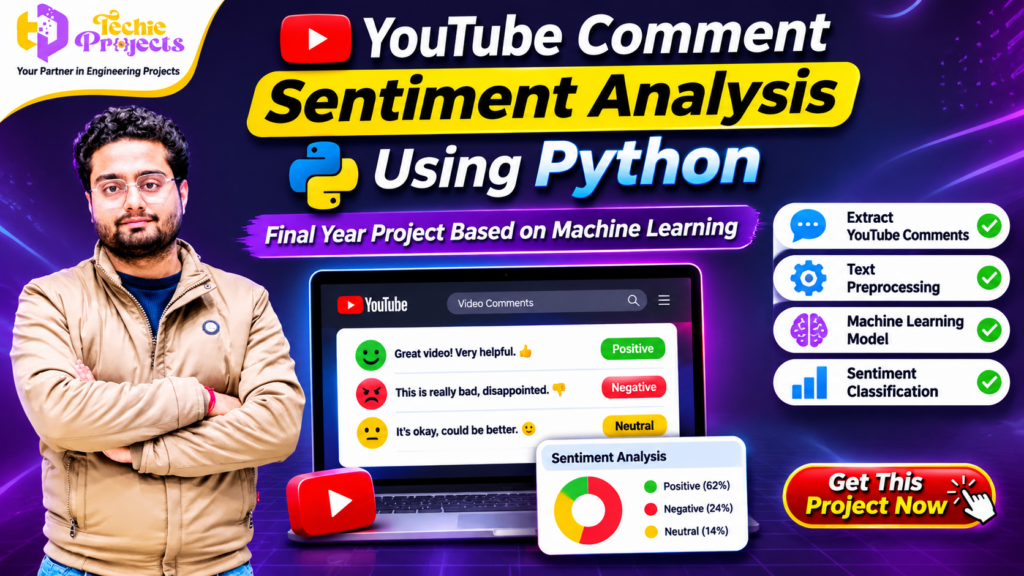
🚀 Looking for a practical Machine Learning project for your final-year engineering submission? Get the YouTube Comment Sentiment Analysis Using Python project from Techie Projects! This project demonstrates how Python, Natural Language Processing (NLP), and Machine Learning can be used to analyze YouTube comments and identify their sentiment.
Instead of manually reading hundreds of comments, this application demonstrates how text data can be processed and classified into sentiment categories such as positive, negative, and neutral. It is an interesting project for students who want practical experience with Python programming, text processing, and machine learning techniques.
If you are searching for a ready-to-explore academic project with implementation guidance, source code availability, and project support, YouTube Comment Sentiment Analysis Using Python is worth considering. Contact Techie Projects to enquire about the project package and available deliverables.
📞 Project Enquiries – Get Your Project from Techie Projects
Planning to purchase this project for your college assignment, mini project, or final-year submission? Contact Techie Projects to discuss the available project package.
- 📞 Call/WhatsApp: +91-9460060699
- 🌎 Website: www.techieprojects.com
- 📺 Instagram: @pythonprojects_
Ask about source code, documentation, installation instructions, project demonstrations, and technical support before placing your order.
🎬 Watch the YouTube Comment Sentiment Analysis Project Demo
Explore the project demonstration to understand its concept, interface, and working approach. The demonstration can help students understand how comments are processed and how sentiment categories are presented.
📌 What Is YouTube Comment Sentiment Analysis Using Python?
YouTube Comment Sentiment Analysis Using Python is a Natural Language Processing and Machine Learning project designed to analyze textual comments and identify the opinions or emotions expressed in them.
YouTube videos receive comments from viewers with different opinions, reactions, and feedback. Manually reviewing a large collection of comments can take considerable time. Sentiment analysis provides a way to process text and identify its general emotional orientation.
The project demonstrates how Python can be used to prepare text data, extract useful information, and classify comments into sentiment categories.
Depending on the implemented model and dataset, the application may classify comments into:
- Positive Sentiment: Comments expressing appreciation, satisfaction, or support.
- Negative Sentiment: Comments expressing dissatisfaction, criticism, or disagreement.
- Neutral Sentiment: Comments that provide information or express no clearly positive or negative opinion.
The main objective of this project is to demonstrate how machine learning and NLP techniques can support automated text analysis.
🎯 Main Objectives of the Project
The project focuses on applying machine learning concepts to real-world text data.
Its major objectives include:
- To understand the fundamentals of sentiment analysis.
- To process and prepare textual comments for analysis.
- To demonstrate Natural Language Processing using Python.
- To apply machine learning techniques for text classification.
- To categorize comments into sentiment groups.
- To present the classification results in an understandable format.
- To provide students with practical experience in an AI-based application.
By working on this project, students can understand how raw text is transformed into structured information that can be analyzed by a machine learning model.
⚙️ How Does YouTube Comment Sentiment Analysis Using Python Work?
The general workflow of YouTube Comment Sentiment Analysis Using Python involves several stages. Each stage contributes to preparing comments and generating sentiment predictions.
1. 📥 Comment Data Collection
The first stage involves collecting YouTube comments for analysis. Depending on the project implementation, comments may be provided through a dataset or retrieved using an available YouTube API integration.
The collected comments become the input for the sentiment analysis process.
2. 🧹 Text Preprocessing
Raw comments often contain unnecessary characters, punctuation, URLs, and inconsistent text formatting. Preprocessing helps prepare the data for analysis.
Common preprocessing operations include:
- Converting text into lowercase.
- Removing unnecessary punctuation.
- Cleaning unwanted characters.
- Removing extra spaces.
- Tokenizing sentences into individual words.
- Removing selected stop words where appropriate.
These operations help create a cleaner text dataset for the next stage.
3. 🧠 Feature Extraction
Machine learning algorithms generally require numerical representations of text. Feature extraction converts processed comments into numerical features that can be used by a classification model.
Depending on the implementation, techniques such as Bag of Words or TF-IDF may be used.
TF-IDF helps represent the importance of words within a collection of documents and is commonly used in text classification applications.
4. 🤖 Machine Learning Model
The processed text features are supplied to a machine learning classifier. The classifier learns patterns from labeled training data and uses those patterns to predict the sentiment of new comments.
The algorithm used depends on the actual implementation and may include a suitable classification technique such as Naive Bayes, Logistic Regression, or Support Vector Machine.
5. 📊 Sentiment Classification
After processing the input, the model generates a predicted sentiment category.
The output may be displayed as:
- Positive
- Negative
- Neutral
The result helps users understand the general sentiment expressed in the analyzed comments.
6. 📈 Result Presentation
The final stage presents the classification results through the application interface. Depending on the available implementation, results may be displayed using text labels, tables, or visual charts.
This makes the output easier to understand and helps demonstrate the working of a machine learning application.
🌟 Key Features of the YouTube Comment Sentiment Analysis Project
The following features describe the common functionality and possible scope of a YouTube comment sentiment analysis application. Confirm the exact features included in the selected project package before purchase.
💬 Comment Analysis
The application processes textual comments and analyzes their sentiment using an implemented machine learning approach.
😊 Positive, Negative, and Neutral Classification
The project demonstrates how comments can be assigned to sentiment categories according to the model’s predictions.
🧹 Text Cleaning and Preprocessing
Text preprocessing helps remove unnecessary information and prepares comments for machine learning analysis.
🤖 Machine Learning Integration
The project demonstrates the use of a trained classification model to predict sentiment from text.
📊 Result Visualization
Where supported by the implementation, sentiment results can be represented through charts, graphs, or summary information.
🐍 Python-Based Implementation
Python provides the programming environment for developing the application and integrating text-processing and machine-learning libraries.
🛠️ Technologies Used in the Project
YouTube Comment Sentiment Analysis Using Python can demonstrate several technologies used in modern AI and data science applications.
| Technology | Purpose |
|---|---|
| Python | Main programming language |
| Machine Learning | Sentiment classification |
| Natural Language Processing | Text understanding and preprocessing |
| Pandas | Dataset handling |
| NumPy | Numerical operations |
| Scikit-learn | Machine learning and text feature extraction |
| NLTK | Natural language processing tasks |
| Matplotlib | Data visualization, if implemented |
The exact libraries and versions depend on the supplied project implementation.
💻 Software and Hardware Requirements
Software Requirements
- Programming Language: Python
- Operating System: Windows or another supported platform
- Development Environment: VS Code, PyCharm, or Jupyter Notebook
- Machine Learning Library: Scikit-learn, if used
- Data Processing Library: Pandas and NumPy, if used
- NLP Library: NLTK or another supported NLP package
Hardware Requirements
- Processor: Intel or AMD processor
- RAM: 4 GB minimum recommended for basic experimentation
- Storage: Sufficient space for Python, dependencies, datasets, and project files
- Display: Standard monitor or laptop display
- Input Devices: Keyboard and mouse
Actual requirements depend on the dataset size and implementation.
🎓 Why Choose This Project for Your Final-Year Submission?
Students often need a project that demonstrates practical programming skills and connects academic concepts with real-world applications.
YouTube Comment Sentiment Analysis Using Python combines several important areas of computer science, including Python programming, machine learning, NLP, and data analysis.
Some reasons to consider this project include:
1. Practical Machine Learning Experience
Students can explore how a trained model processes textual information and generates predictions.
2. Understanding Natural Language Processing
The project introduces important NLP concepts such as tokenization, text cleaning, feature extraction, and classification.
3. Real-World Application
Online comments are a common form of user feedback. Analyzing them provides a practical example of how businesses and researchers can study public opinions.
4. Suitable for Academic Demonstrations
The project provides an opportunity to explain the complete workflow, from input text to sentiment prediction, during a project presentation or viva.
5. Scope for Further Development
Students can explore additional functionality and experiment with different machine learning models.
🏢 Real-World Applications of Sentiment Analysis
Sentiment analysis is useful in several industries where understanding customer opinions and feedback is important.
📱 Social Media Monitoring
Organizations can analyze public comments and discussions to understand audience reactions to products, campaigns, or announcements.
🛍️ Product Review Analysis
E-commerce businesses can use sentiment analysis techniques to study customer reviews and identify common positive or negative opinions.
📺 YouTube Channel Feedback
Content creators may analyze viewer comments to understand audience reactions to videos, topics, and content styles.
🏨 Customer Service
Businesses can examine customer feedback to identify recurring concerns and improve service quality.
📊 Market Research
Researchers can use text analysis to study opinions about products, services, or brands.
These are broader applications of sentiment analysis. This academic project demonstrates the underlying concepts and should not be considered a complete enterprise monitoring platform unless those integrations are specifically implemented.
🚀 Advanced Features You Can Explore
Students interested in extending YouTube Comment Sentiment Analysis Using Python can explore additional development opportunities.
1. Real-Time Comment Retrieval
Integrate an appropriate YouTube API workflow to retrieve comments from supported videos.
2. Sentiment Statistics Dashboard
Create a dashboard that summarizes the number or percentage of comments classified into different sentiment categories.
3. Word Cloud Generation
Generate word clouds to visualize frequently occurring words in positive and negative comments.
4. Multiple Video Analysis
Extend the application to analyze comments from multiple videos and compare their sentiment distributions.
5. Improved Text Classification
Experiment with different machine learning algorithms and compare their performance using suitable evaluation metrics.
6. Deep Learning Integration
Explore deep learning models and advanced language-processing approaches for more complex text classification tasks.
These features are possible enhancement ideas. Their availability should be confirmed separately from the standard project package.
📚 What Students Can Learn from This Project
Working with this project can help students develop practical knowledge in multiple technical areas.
- Python programming and application development.
- Natural Language Processing fundamentals.
- Text preprocessing and tokenization.
- Feature extraction techniques.
- Machine learning model training.
- Text classification and prediction.
- Dataset preparation and analysis.
- Result interpretation and visualization.
Students can also learn how to explain the project workflow, discuss the selected algorithm, and understand the limitations of a trained sentiment classifier.
🛒 Purchase YouTube Comment Sentiment Analysis Using Python from Techie Projects
Are you searching for a YouTube Comment Sentiment Analysis Using Python project for your B.Tech, BCA, MCA, diploma, or final-year engineering submission?
Techie Projects offers academic project solutions across Python, Artificial Intelligence, Machine Learning, Computer Vision, Web Development, Android Applications, and Data Analytics.
Get in touch with our team to enquire about the available project package and choose the solution that matches your academic requirements.
📦 Enquire About Project Deliverables
Before purchasing, you can ask about the availability of:
- Python project source code.
- Project documentation.
- Installation and execution instructions.
- Software and library requirements.
- Project demonstration.
- Technical guidance and support.
- Customization options, where available.
The exact deliverables and support depend on the selected package. Please confirm the inclusions before ordering.
📞 Contact Techie Projects Today
Ready to explore this machine learning project? Contact us for pricing, availability, and project details.
📞 Call/WhatsApp: +91-9460060699
🌎 Website: www.techieprojects.com
📺 Instagram: @pythonprojects_
Techie Projects – Your Partner in Engineering Projects.
🔗 Explore Related Python and Machine Learning Projects
Students interested in this project can also explore other academic project topics available through Techie Projects.
- Sentiment Analysis Using Python
- Twitter Sentiment Analysis Using Machine Learning
- Fake News Detection Using Machine Learning
- News Classification Using Natural Language Processing
- Traffic Sign Classification using Computer Vision
- Chatbot Development Using Python
- Movie Review Sentiment Analysis
- Emotion Detection Using Machine Learning
- Social Media Data Analysis Using Python
Explore more project ideas at Techie Projects.
❓ Frequently Asked Questions (FAQs)
1. What is YouTube Comment Sentiment Analysis Using Python?
It is a Python-based machine learning project that analyzes textual YouTube comments and predicts their sentiment, such as positive, negative, or neutral.
2. Which programming language is used in this project?
Python is used as the primary programming language. Libraries for text processing, data handling, and machine learning may also be included.
3. What is the role of NLP in this project?
Natural Language Processing helps clean, process, and transform textual comments into a format suitable for machine learning algorithms.
4. Can this project classify positive and negative comments?
Yes. Sentiment classification can identify positive and negative comments. A neutral category may also be included depending on the dataset and model implementation.
5. Is this project suitable for final-year engineering students?
It can be suitable for students studying computer science, information technology, artificial intelligence, and related fields, subject to their institution’s project requirements.
6. Can the project analyze comments from YouTube videos?
Comment analysis can be performed on available datasets. Retrieving comments directly from YouTube requires an appropriate data collection method and, where applicable, API integration.
7. Can I customize the project?
Customization may be possible depending on the selected package. Students can enquire about additional features, interface changes, or model improvements.
8. Where can I purchase this project?
You can contact Techie Projects through WhatsApp at +91-9460060699 or visit https://techieprojects.com/ to enquire about the project package.
🏁 Conclusion
YouTube Comment Sentiment Analysis Using Python is an interesting academic project that demonstrates how machine learning and Natural Language Processing can be applied to understand opinions expressed in online comments.
By combining Python programming, text preprocessing, feature extraction, and sentiment classification, the project provides students with practical exposure to important concepts in artificial intelligence and data science.
Whether you are exploring machine learning for the first time or preparing a final-year engineering project, this topic offers opportunities to understand real-world text analysis and develop your technical skills.
Choose a project that helps you learn, experiment, and demonstrate your knowledge with confidence. 🚀