
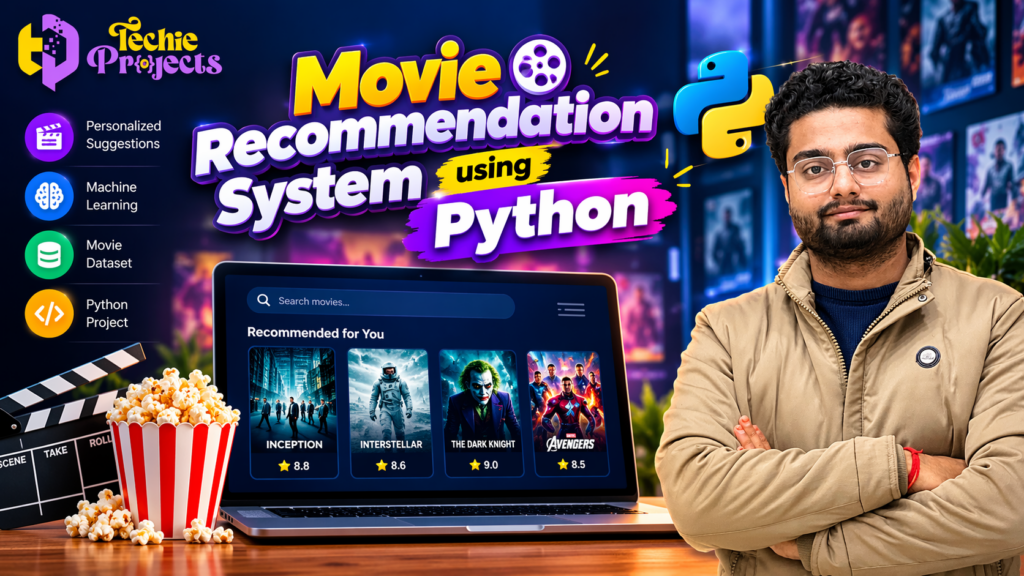
Want to develop an impressive machine learning project for your final-year submission? 🎓 The Movie Recommendation System Using Python is an excellent choice for computer science students who want to explore artificial intelligence, data science, and personalized recommendations through a practical application.
If you need a ready-to-study project instead of spending weeks building every component from scratch, Techie Projects can help you explore project source code, documentation, implementation details, and technical guidance options. Contact us to check the available package, features, pricing, and delivery details before purchasing. Make your academic project more manageable with a solution you can study, understand, customize, and demonstrate.
📞 Get Your Movie Recommendation Project
Looking for a Python machine learning project for your college submission? Contact Techie Projects to enquire about availability, source code, documentation, installation support, and customization options.
- 📲 WhatsApp: Chat with Techie Projects
- 🌐 Website: https://techieprojects.com/
- 📸 Instagram: Techie Projects
- ☎️ Contact: +91 94600 60699
🎬 Movie Recommendation System Using Python – Project Demo
Explore how a movie recommendation using machine learning, content-based filtering, and collaborative filtering application can display relevant movie suggestions through a user-friendly interface. A typical implementation allows users to select a movie and receive recommendations based on similarities between movie features, genres, descriptions, or rating patterns.
Watch the project demonstration to understand the application’s workflow, interface, and recommendation output.
🎯 What Is a Movie Recommendation System?
A movie recommendation system is an application that suggests films to users based on their preferences, interests, or interactions. Instead of searching through thousands of movies manually, users can discover relevant titles through automated recommendations.
Popular streaming platforms use recommendation techniques to personalize the content presented to viewers. These systems can consider factors such as genres, movie descriptions, user ratings, viewing history, and similarities between users or films.
The Movie Recommendation System Using Python project demonstrates how programming and machine learning techniques can be applied to this real-world problem. It helps students understand data preprocessing, feature extraction, similarity measurement, and recommendation generation.
Depending on the implementation, the system may use content-based filtering, collaborative filtering, or a hybrid approach.
💡 Why Choose This Python Machine Learning Project?
Students often need a project that demonstrates practical programming skills and provides enough technical depth for a presentation or viva. This project connects several important concepts in one application.
Key benefits include:
- 🧠 Understanding machine learning and recommendation algorithms.
- 🐍 Practicing Python programming and data analysis.
- 📊 Learning how to process and analyze movie datasets.
- 🎬 Exploring personalized movie suggestions.
- 💻 Developing an application that can be demonstrated.
- 🎓 Building knowledge for academic presentations and technical interviews.
If you are short on development time, enquire about the available project package from Techie Projects. Review the included files and support options so you know exactly what you will receive before placing an order.
⚙️ Technologies Used in the Project
The technology stack depends on the selected implementation. A typical Python-based movie recommendation application may use the following tools.
🐍 Python
Python is the primary programming language used to process data, implement recommendation logic, and connect the application’s components. Its readable syntax and extensive machine learning ecosystem make it suitable for academic projects.
📊 Pandas and NumPy
Pandas helps load, organize, filter, and clean movie datasets. NumPy supports numerical operations used during data processing and similarity calculations.
🧠 Scikit-learn
Scikit-learn provides tools for feature extraction, vectorization, and similarity calculations. For example, a content-based model can use TF-IDF vectorization and cosine similarity to compare movie descriptions.
🗂️ Movie Dataset
A dataset may contain movie titles, genres, descriptions, keywords, ratings, or user interactions. The dataset determines which recommendation techniques are appropriate.
🖥️ User Interface
Depending on the project design, a simple interface can be created with Streamlit, Flask, Tkinter, or another suitable framework. The interface lets users select a movie and view the recommendations.
🔍 How Does the Movie Recommendation System Work?
A recommendation application generally follows a sequence of data-processing and prediction steps.
1. 📥 Dataset Collection
The first step is to obtain a movie dataset containing the information required by the chosen algorithm. This may include titles, genres, descriptions, or user ratings.
2. 🧹 Data Preprocessing
The dataset is checked for missing values, duplicate records, inconsistent text, and other quality issues. Clean data helps the recommendation algorithm produce more meaningful results.
3. 🧩 Feature Extraction
The system converts useful movie information into a representation that an algorithm can compare. For example, text descriptions can be transformed into numerical vectors using TF-IDF.
4. 📐 Similarity Calculation
In a content-based implementation, cosine similarity can measure how closely two movie feature vectors match. Movies with higher similarity scores can be considered more relevant to the selected title.
5. 🎬 Recommendation Generation
After a user selects a movie, the system identifies other movies with similar features and ranks the candidates according to the chosen method.
6. 🖥️ Displaying Results
The application presents the recommended titles through its interface. Additional details, such as genres, descriptions, and ratings, may be shown if they are available in the dataset.
This workflow makes the Movie Recommendation System Using Python a useful project for understanding the complete process from raw data to user-facing results.
🧠 Types of Movie Recommendation Algorithms
Different recommendation methods solve the same problem using different types of information.
🎭 Content-Based Filtering
Content-based filtering recommends movies with features similar to those of a movie the user already likes.
For example, if someone selects a science-fiction movie, the system may recommend other science-fiction titles with similar descriptions, keywords, or genres.
Common techniques: TF-IDF, cosine similarity, and feature-based ranking.
👥 Collaborative Filtering
Collaborative filtering uses user-item interactions, such as ratings or viewing preferences, to identify patterns. It can recommend films liked by users with similar preferences.
This method requires suitable interaction data and can be affected by sparse ratings or new users.
🔗 Hybrid Recommendation
A hybrid system combines content-based and collaborative methods to use multiple sources of information. It can be more flexible, although it requires additional implementation and evaluation.
For a student project, the best approach depends on the available dataset, implementation time, and project requirements.
🎯 Key Benefits of a Movie Recommendation System Using Python
A Movie Recommendation System Using Python helps users discover films that match their interests without manually browsing a large movie collection. By applying machine learning techniques, the application can compare movie features and generate relevant suggestions.
🎬 Personalized Movie Suggestions
The system can recommend movies based on genres, descriptions, keywords, or rating patterns, depending on the implemented algorithm.
🧠 Practical Machine Learning Experience
Developing a Movie Recommendation System Using Python helps students understand data preprocessing, feature extraction, similarity calculations, and recommendation generation.
📊 Efficient Movie Data Analysis
Python libraries such as Pandas, NumPy, and Scikit-learn can help process movie datasets and build recommendation workflows.
🎓 Useful for Academic Projects
This project connects theoretical machine learning concepts with a practical application that students can demonstrate and explain during a presentation or viva.
🚀 Flexible Project Development
Students can extend the application with movie posters, search functionality, user ratings, improved recommendation algorithms, or a web interface.
⭐ Important Features of the Project
The exact features depend on the version you select. Common features of a movie recommendation application include:
- 🔎 Movie selection: Choose a movie from the available dataset.
- 🎬 Similar movie suggestions: Display titles related to the selected movie.
- 📊 Dataset processing: Organize and process movie information.
- 🧠 Recommendation logic: Generate suggestions using the implemented algorithm.
- 🖥️ Interactive interface: Present recommendations in an understandable format.
- ⚡ Automated results: Produce suggestions without manually comparing every movie.
- 🛠️ Extendable design: Allow further development with additional features.
Before purchasing, ask Techie Projects which of these features are included in the available version and whether the project supports your required operating system and Python environment.
💻 Applications of Movie Recommendation Systems
Recommendation systems are used in several digital products and services.
📺 Streaming Platforms
Streaming applications can use recommendation models to help viewers discover content that matches their interests.
🎥 Online Movie Catalogues
Movie websites can organize titles by genre, similarity, and user preferences to improve content discovery.
🛍️ E-Commerce Platforms
Related recommendation techniques can suggest products based on browsing activity, purchase history, or similarities between products.
🎵 Music and Entertainment
Recommendation methods can also be adapted to music playlists, artists, podcasts, and other entertainment categories.
📚 Academic Research
Students and researchers can use recommendation systems to study ranking algorithms, data quality, personalization, and model evaluation.
📈 Advantages and Limitations
Understanding both strengths and limitations makes your project explanation more credible.
✅ Advantages
- Helps users discover relevant content.
- Demonstrates practical Python and machine learning concepts.
- Supports experimentation with different recommendation techniques.
- Can be extended with additional datasets and interface features.
- Provides a useful foundation for learning data-driven applications.
⚠️ Limitations
- Poor-quality data can lead to irrelevant recommendations.
- Content-based methods may recommend overly similar movies.
- Collaborative filtering can struggle with new users or movies that have little interaction data.
- Large datasets can increase processing and storage requirements.
- Recommendations should be evaluated rather than assumed to be accurate.
These limitations create opportunities for future improvements, including hybrid models, better ranking strategies, improved user feedback, and more comprehensive evaluation.
🧪 How to Test and Evaluate the Project
Testing helps confirm that the application behaves as expected.
- Verify that the dataset loads correctly.
- Check how the system handles missing or invalid movie selections.
- Confirm that recommended titles exist in the dataset.
- Test multiple input movies to examine recommendation quality.
- Check whether the interface displays results clearly.
- Measure recommendation quality using suitable evaluation methods when relevant data is available.
For rating-based systems, metrics such as RMSE or MAE may be appropriate for rating prediction. For ranked recommendations, precision at K, recall at K, or NDCG may be more useful, depending on the evaluation setup.
🎓 Who Can Choose This Project?
The project may be suitable for:
- B.Tech and M.Tech Computer Science students.
- BCA and MCA students.
- Students learning Python and machine learning.
- Data science beginners seeking practical experience.
- Students interested in recommendation algorithms and artificial intelligence.
Your college’s requirements may differ, so confirm the required programming language, report format, demonstration expectations, and submission guidelines before selecting a project.
💻 How to Build a Movie Recommendation System Using Python
Building a Movie Recommendation System Using Python involves several stages, from preparing the dataset to displaying movie suggestions.
- Prepare the dataset: Collect movie titles, genres, descriptions, or ratings.
- Clean the data: Handle missing values and remove unnecessary duplicate records.
- Extract features: Convert selected movie information into numerical features.
- Apply an algorithm: Use content-based filtering, collaborative filtering, or a suitable hybrid approach.
- Generate recommendations: Identify and rank movies according to the selected method.
- Create the interface: Display movie suggestions through a simple application.
- Test the results: Verify that recommendations are relevant and the application runs correctly.
If you prefer to study an existing implementation, contact Techie Projects to enquire about the Movie Recommendation System Using Python package, available source code, documentation, pricing, and technical support options before purchasing.
📦 What Should You Check Before Purchasing?
Choosing a project package should involve more than checking the title. Ask for a clear list of deliverables before making payment.
Depending on the package, you may want to confirm whether it includes:
- Python source code and required files.
- Dataset or instructions for obtaining it.
- Installation and execution instructions.
- Project documentation or report.
- Explanation of the algorithm and workflow.
- Demonstration video, if available.
- Technical support or customization options.
Want to purchase this project? Contact Techie Projects to check the current package, pricing, delivery format, and included services.
🚀 Future Enhancements
A basic recommendation application can be extended in several ways:
- Add user registration and personalized profiles.
- Include movie posters, genres, and descriptions.
- Integrate a larger or more frequently updated dataset.
- Experiment with hybrid recommendation methods.
- Add a rating or feedback mechanism.
- Improve the interface for desktop or web use.
- Compare recommendation algorithms using suitable evaluation metrics.
These enhancements can help students develop a deeper understanding of how recommendation systems are designed and improved.
❓ Frequently Asked Questions (FAQs)
1. What is a Movie Recommendation System Using Python?
It is a Python application that suggests movies using information such as genres, descriptions, similarities, ratings, or user interactions. The specific approach depends on the implemented algorithm.
2. Is this project suitable for final-year students?
Yes. It can be suitable for computer science, information technology, and related courses, provided the implementation meets the institution’s requirements.
3. Which algorithm is used in the project?
Common choices include content-based filtering, collaborative filtering, and hybrid recommendation. A content-based implementation may use TF-IDF and cosine similarity.
4. Do I need machine learning experience?
Basic Python knowledge is helpful. Students can learn the underlying concepts while studying the dataset, preprocessing steps, recommendation logic, and evaluation methods.
5. Can I purchase the source code from Techie Projects?
You can contact Techie Projects to enquire about the current source-code package, availability, documentation, pricing, and technical support. Confirm the deliverables before ordering.
6. Can I customize the project?
Customization depends on the implementation and the services available in the selected package. Possible extensions include a new interface, additional movie metadata, or alternative recommendation algorithms.
7. What information should I request before buying?
Ask about source code, dataset access, installation requirements, documentation, demonstration availability, supported software versions, and after-sales support.
🎓 Explore Related Python Projects
If you are exploring more academic project ideas, browse related topics on Techie Projects:
- Artificial Intelligence Projects — applications that use intelligent algorithms.
- Machine Learning Projects — projects focused on data-driven prediction and analysis.
- Data Science Projects — data cleaning, visualization, and analytical applications.
- Deep Learning Projects — neural network-based solutions.
- Python Projects for Students — practical applications for learning and demonstration.
Visit Techie Projects to explore available projects and identify a solution that matches your interests and academic requirements.
📲 Purchase Enquiry – Contact Techie Projects
Ready to explore the Movie Recommendation System Using Python project for your academic work?
Contact Techie Projects to discuss the available package, source code, documentation, installation requirements, and technical assistance. Review the project details before purchasing so you can choose an option that fits your requirements and budget.
- 📲 Call/WhatsApp: +91-9460060699
- 🌎 Website: www.techieprojects.com
- 📺 Instagram: @pythonprojects_
🏁 Conclusion
The Movie Recommendation System Using Python is a practical way to explore machine learning, data processing, similarity calculations, and personalized content discovery. It combines programming concepts with a familiar real-world application and offers opportunities for further experimentation.
Whether you plan to develop the application independently or explore an available project package, focus on understanding the algorithm, verifying the implementation, and preparing to explain your work confidently.
Contact Techie Projects today to enquire about the project package and take the next step toward your academic project goals.