
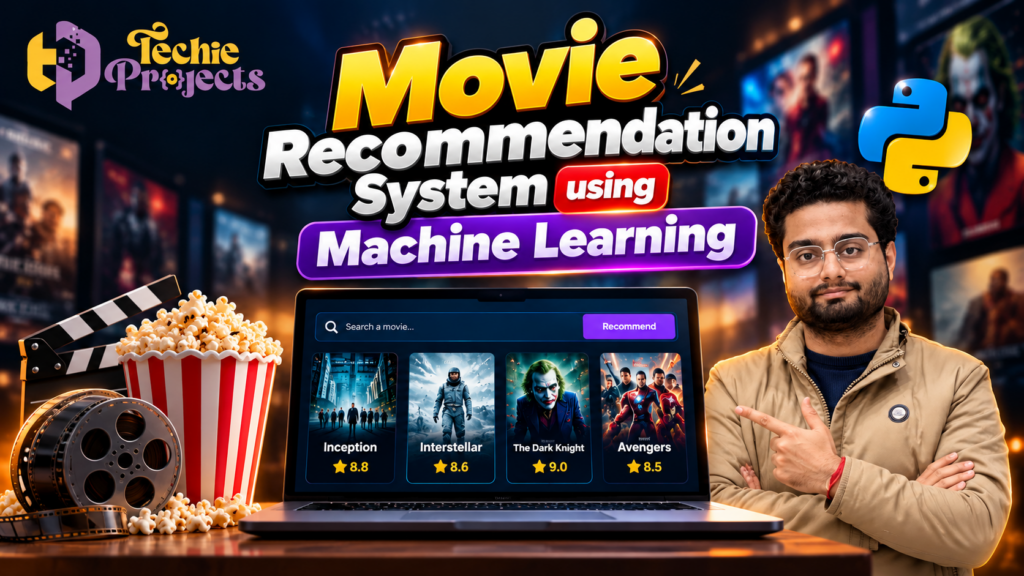
🎬 Want to build an AI project that recommends movies based on user preferences? The Movie Recommendation System Using Machine Learning project from Techie Projects is an excellent choice for students who want to explore artificial intelligence, recommendation algorithms, Python programming, and data analysis through a practical application.
Movie recommendation systems power many modern entertainment platforms by helping users discover films that match their interests. This project demonstrates how machine learning techniques can analyze movie ratings, user preferences, or movie similarities to generate personalized recommendations.
🎓 If you are a B.Tech, M.Tech, MCA, BCA, or computer science student searching for a practical AI or final-year project, this application can help you understand how recommendation engines work. Instead of spending weeks building the complete workflow from scratch, you can contact Techie Projects to enquire about the available project package.
Depending on the package, you may be able to obtain project source code, installation instructions, documentation, and technical guidance. Before purchasing, confirm the included features, dataset, pricing, supported software versions, and delivery details.
📲 Contact Techie Projects for Project Details
Ready to explore or purchase this project? Contact Techie Projects to discuss your requirements and confirm the available package.
- 📱 WhatsApp: Enquire About the Movie Recommendation Project
- 🌐 Website: Techie Projects
- 📸 Instagram: Follow Techie Projects
- ☎️ Contact Number: +91 94600 60699
🎬 Movie Recommendation System – Project Demo
Explore the project demonstration to understand how a movie recommendation application presents movie suggestions through a user-friendly interface.
The demonstration can help you see how a user selects a movie or interacts with the system to receive recommendations. Depending on the implementation, recommendations may be generated using movie similarity, user ratings, or a collaborative filtering approach.
Watch the embedded video on this page to explore the actual project output and evaluate whether its features match your academic requirements.
🔍 What Is a Movie Recommendation System Using Machine Learning?
A Movie Recommendation System Using Machine Learning is an application that suggests movies to users based on available data, preferences, ratings, or similarities between films and users.
Recommendation systems help solve the problem of choice overload. With thousands of movies available, users may struggle to find films that match their interests. A recommendation engine analyzes relevant information and generates a shortlist of potentially suitable options.
For example, if a user enjoys science-fiction movies, the system may recommend other films with similar genres, descriptions, ratings, or viewing preferences. More advanced systems can use patterns across multiple users to identify films that a particular user may enjoy.
The recommendation quality depends on the dataset, algorithm, feature selection, and evaluation method. A student project provides a practical way to study these concepts and understand their limitations.
🎯 Objectives of the Project
The primary objective is to build an application that recommends movies using machine learning techniques and available movie data.
The main objectives include:
- Understanding the fundamentals of recommendation systems.
- Collecting and preparing movie-related data.
- Exploring movie metadata and user ratings.
- Implementing a suitable recommendation algorithm.
- Generating recommendations based on similarity or user behavior.
- Presenting recommended movies through an application interface.
- Evaluating recommendation relevance using suitable methods.
- Understanding challenges such as sparse data and new users.
These objectives connect machine learning theory with a practical application that students can demonstrate and explain.
💻 How to Develop a Movie Recommendation System Using Machine Learning
Developing a Movie Recommendation System Using Machine Learning involves several important stages.
- Dataset preparation: Collect movie information, descriptions, genres, or user ratings.
- Data preprocessing: Clean the dataset and handle missing or duplicate values.
- Feature engineering: Convert movie descriptions or metadata into features suitable for recommendation.
- Algorithm implementation: Apply content-based filtering, collaborative filtering, or another suitable recommendation method.
- Recommendation generation: Rank relevant movies and display the results.
- Testing and evaluation: Check recommendation quality and verify that the application works as expected.
- Interface development: Present movie suggestions through a clear and user-friendly interface.
If you want to study a working implementation instead of building every component from scratch, contact Techie Projects to enquire about the available Movie Recommendation System Using Machine Learning project package, source code, documentation, and technical guidance.
⚙️ Key Features of the Movie Recommendation System
🎥 1. Personalized Movie Suggestions
Depending on the implementation, the system can suggest movies based on user preferences, ratings, selected titles, or similar movie characteristics.
Personalization helps users discover films that may align with their interests.
🧠 2. Content-Based Filtering
Content-based filtering recommends movies by comparing their characteristics. These characteristics may include genre, overview, keywords, cast, director, or other available metadata.
For example, if a user selects an action movie, the system may recommend other movies with similar genres or descriptions.
👥 3. Collaborative Filtering
Collaborative filtering uses patterns in user preferences or ratings to identify potentially relevant recommendations.
For example, if users with similar rating patterns enjoy a particular film, the system may recommend it to another user with related preferences. This approach requires appropriate user-item interaction data.
🔎 4. Movie Similarity Analysis
The system may calculate similarity between movie records using text features, metadata, or other numerical representations.
Techniques such as cosine similarity can compare feature vectors and help identify movies with similar characteristics.
⭐ 5. Rating-Based Recommendations
If the dataset contains ratings, the application can use them to analyze movie popularity or user preferences. The exact behavior depends on whether the system uses average ratings, user-specific ratings, or a collaborative filtering algorithm.
🖥️ 6. User-Friendly Interface
A graphical interface can make the system easier to demonstrate. Users may select a movie, request recommendations, and view the returned titles.
The actual interface and available controls depend on the supplied project implementation.
📊 7. Data Analysis and Visualization
The project can support exploration of movie genres, rating distributions, popular titles, and other dataset characteristics. These analyses help students understand the data behind recommendation results.
🔄 8. Expandable Recommendation Logic
The project can provide a foundation for experimenting with additional metadata, alternative algorithms, or improved recommendation strategies. More advanced changes may require additional data preparation and development.
Confirm which features are included in the project package before purchasing.
🧰 Technologies Used in the Project
The exact tools depend on the implementation. Common technologies used in a Python-based movie recommendation system include the following.
🐍 Python
Python is used to process data, implement recommendation algorithms, and connect the model to the application interface.
🧮 Pandas
Pandas helps load, clean, filter, and organize movie datasets. It is useful for working with movie metadata, user ratings, and structured records.
🔢 NumPy
NumPy supports numerical operations and array processing used in data analysis and machine learning workflows.
🤖 Scikit-learn
Scikit-learn provides tools for text vectorization, similarity calculations, preprocessing, and selected machine learning algorithms.
📚 Natural Language Processing
If movie descriptions or keywords are used, NLP techniques can transform text into features. For example, TF-IDF can represent the importance of terms across movie descriptions.
📊 Data Visualization
Libraries such as Matplotlib or Seaborn may be used to visualize rating distributions, genres, and other dataset patterns.
🌐 Application Interface
A web framework or GUI toolkit can display movie recommendations. The specific interface depends on the project package.
🔄 How Does a Movie Recommendation System Work?
Understanding the workflow helps students explain the application during project demonstrations and viva examinations.
Step 1: Collect Movie Data
The system uses a dataset containing information such as movie titles, genres, descriptions, ratings, or user interactions. The available fields depend on the dataset.
Step 2: Clean and Prepare the Data
Missing values, duplicate records, inconsistent text, and unsuitable fields are handled before analysis. Data preparation helps make the recommendation process more reliable.
Step 3: Select Relevant Features
The system selects information that can support recommendations. Content-based approaches may use movie descriptions, genres, or keywords, while collaborative filtering relies on user-item interactions.
Step 4: Convert Data Into a Usable Representation
Textual features may be transformed using techniques such as TF-IDF. Numerical ratings can be organized into a user-item matrix for suitable collaborative filtering approaches.
Step 5: Calculate Similarity or Learn Preference Patterns
A content-based system may calculate similarity between movie feature vectors. A collaborative filtering system may identify patterns in ratings or user interactions.
Step 6: Generate Recommendations
The algorithm ranks candidate movies and selects suitable results based on the chosen method and available information.
Step 7: Display Results
The application presents recommended movie titles and, where supported, posters, genres, ratings, or descriptions.
Step 8: Evaluate the Results
The system can be evaluated using suitable methods. Depending on the approach, evaluation may involve precision, recall, ranking metrics, rating prediction errors, or qualitative inspection.
🎯 Benefits of a Movie Recommendation System Using Machine Learning
A Movie Recommendation System Using Machine Learning helps users discover movies based on their interests, preferences, and viewing patterns. It demonstrates how machine learning can turn movie data into useful and personalized suggestions.
⭐ Personalized Movie Discovery
A Movie Recommendation System Using Machine Learning can recommend films based on movie genres, descriptions, ratings, or user interactions, depending on the algorithm used.
🧠 Intelligent Recommendation Algorithms
The system can use content-based filtering, collaborative filtering, or a combination of both approaches to identify potentially relevant movies.
📊 Better Movie Data Analysis
A Movie Recommendation System Using Machine Learning allows students to explore movie datasets, analyze ratings, compare genres, and understand how data influences recommendations.
🎓 Practical Academic Learning
This project provides hands-on experience with Python, Pandas, Scikit-learn, data preprocessing, similarity calculations, and recommendation algorithms.
🚀 Opportunities for Further Development
Students can extend a Movie Recommendation System Using Machine Learning with additional movie metadata, improved ranking methods, or a more interactive user interface.
🎓 Why Choose This Project for Your Engineering Course?
📚 Practical Machine Learning Experience
The project introduces students to data preprocessing, feature engineering, similarity measures, and recommendation algorithms.
💻 Source Code Learning
If source code is included in the package, students can examine how the dataset is processed, how recommendations are calculated, and how the interface presents results.
📄 Project Documentation
Academic reports commonly cover the problem statement, objectives, literature review, methodology, system architecture, implementation, results, and limitations. Ask whether documentation is included in the selected package.
🎤 Viva and Presentation Preparation
The project offers several useful discussion topics, including content-based filtering, collaborative filtering, cosine similarity, TF-IDF, cold-start problems, and evaluation metrics.
🧪 Experimentation Opportunities
Students can compare recommendation results using different features, similarity measures, or datasets. This experimentation helps illustrate the effect of algorithm choices on the final output.
💼 Portfolio Development
A recommendation system can demonstrate practical experience with Python, data analysis, and machine learning. Understanding the implementation and being able to explain its limitations is important when presenting the project.
🌍 Real-World Applications of Recommendation Systems
📺 Entertainment Platforms
Movie and television platforms can use recommendation algorithms to help users discover content relevant to their interests.
🎵 Music Recommendations
Music applications can suggest songs, artists, or playlists based on listening patterns, similarity, and user preferences.
🛒 E-Commerce
Online stores use recommendation systems to suggest products based on browsing behavior, purchases, product attributes, or similar customers.
📚 Learning Platforms
Educational systems can recommend courses, tutorials, or learning materials based on user interests and previous activity.
📰 News and Content Discovery
Recommendation algorithms can help organize articles and other content according to relevance, preferences, or reading behavior.
🎓 Academic Research
Students can use recommendation systems to experiment with ranking methods, user-item data, similarity measures, and evaluation techniques.
These are potential application areas. A basic student implementation may not include all the functionality or scale of commercial recommendation platforms.
🛠️ Software and Hardware Requirements
Actual requirements depend on the dataset, algorithms, and interface.
Software Requirements
- Operating system: Windows 10/11 or another supported platform
- Programming language: Python
- Data processing: Pandas and NumPy, where used
- Machine learning: Scikit-learn or another compatible framework
- Dataset: Movie metadata, ratings, or user interactions
- Additional packages: As specified in the project requirements
Hardware Requirements
- Computer or laptop with sufficient RAM
- Adequate storage for the dataset, source code, and dependencies
- Internet access if required to download datasets or external resources
A basic recommendation system generally does not require a dedicated GPU, although requirements may vary for larger datasets or more advanced models.
📦 What Should You Confirm Before Purchasing?
Before purchasing the Movie Recommendation System Using Machine Learning project from Techie Projects, ask for a clear list of the deliverables.
Depending on the available package, enquire about:
- Project source code
- Dataset and dataset description
- Installation instructions
- Python dependency or requirements file
- Recommendation algorithm details
- Project report and technical documentation
- Presentation slides, if available
- Project demonstration video
- Code explanation or technical guidance
- Supported Python and library versions
- Customization options
- Troubleshooting support
Confirm the package contents, pricing, delivery timeline, and support terms before making payment.
💰 Purchase the Movie Recommendation System Project
Looking for a practical machine learning project for your engineering coursework? The Movie Recommendation System Using Machine Learning project is worth considering if you want to explore personalized recommendations, data analysis, and Python development.
Techie Projects can help you enquire about the available package and understand which deliverables match your academic requirements. Before ordering, confirm source code availability, dataset access, documentation, installation instructions, algorithm details, and support options.
📲 Enquire Today
Discuss your requirements before choosing the project package.
❓ Frequently Asked Questions (FAQs)
1. What is a Movie Recommendation System Using Machine Learning?
It is an application that suggests movies using available information such as movie metadata, user preferences, ratings, or patterns in user interactions.
2. Which algorithms are used in movie recommendation systems?
Common approaches include content-based filtering, collaborative filtering, and hybrid recommendation methods. The appropriate method depends on the dataset and project goals.
3. What is content-based filtering?
Content-based filtering recommends items with characteristics similar to items a user already likes or selects.
4. What is collaborative filtering?
Collaborative filtering identifies patterns in user preferences or ratings and uses those patterns to generate recommendations.
5. Which programming language is commonly used?
Python is commonly used because it offers libraries for data processing, machine learning, and application development.
6. Does the project require a GPU?
Most basic recommendation systems can run on a standard computer without a dedicated GPU. Larger or more advanced implementations may have different requirements.
7. Can the system recommend new movies?
It can recommend movies present in its dataset, but handling newly added movies may require updating the data and rebuilding relevant features or models.
8. Is the project suitable for B.Tech and MCA students?
It may be suitable for students studying computer science, artificial intelligence, data science, or related disciplines, subject to their institution’s requirements.
9. Does the project package include a report?
Documentation availability depends on the selected package. Confirm whether the project report, presentation slides, and installation guide are included.
10. How can I purchase the project?
Contact Techie Projects through WhatsApp to enquire about pricing, source code, dataset, documentation, installation, and technical support.
🔗 Explore Related Projects
Explore related AI and machine learning project options through Techie Projects.
- 🤖 AI Chatbot Using Python – Explore conversational AI and natural language processing.
- 📰 Fake News Detection Using Machine Learning – Study text classification techniques.
- 🎯 Object Detection Using YOLO – Explore deep learning-based computer vision.
- 📊 Sentiment Analysis Using NLP – Analyze opinions and emotions in text.
- 📈 Movie Data Analysis Using Python – Explore movie datasets and rating patterns.
- 🧠 Personalized Product Recommendation System – Learn how recommendation techniques apply to e-commerce.
Visit Techie Projects to explore available AI, Python, and machine learning projects.
🏁 Conclusion
The Movie Recommendation System Using Machine Learning project provides a practical introduction to recommendation algorithms, data preprocessing, feature engineering, and personalized content discovery. It demonstrates how movie metadata or user preferences can be used to generate relevant suggestions.
For students looking for an AI or machine learning project, it offers opportunities to study both the underlying algorithms and their integration into a working application.
🎓 Ready to explore this project? Contact Techie Projects to confirm source code availability, dataset access, documentation, installation requirements, package pricing, and technical support options.
📱 Enquire on WhatsApp: +91 94600 60699
📺 Instagram: @pythonprojects_