
🎓 Introduction
Fashion is constantly changing, and understanding emerging trends can help businesses, designers, retailers, and customers make better decisions. With the growth of Artificial Intelligence and Machine Learning, fashion data can be analyzed to identify popular styles, colors, clothing categories, and changing customer preferences.
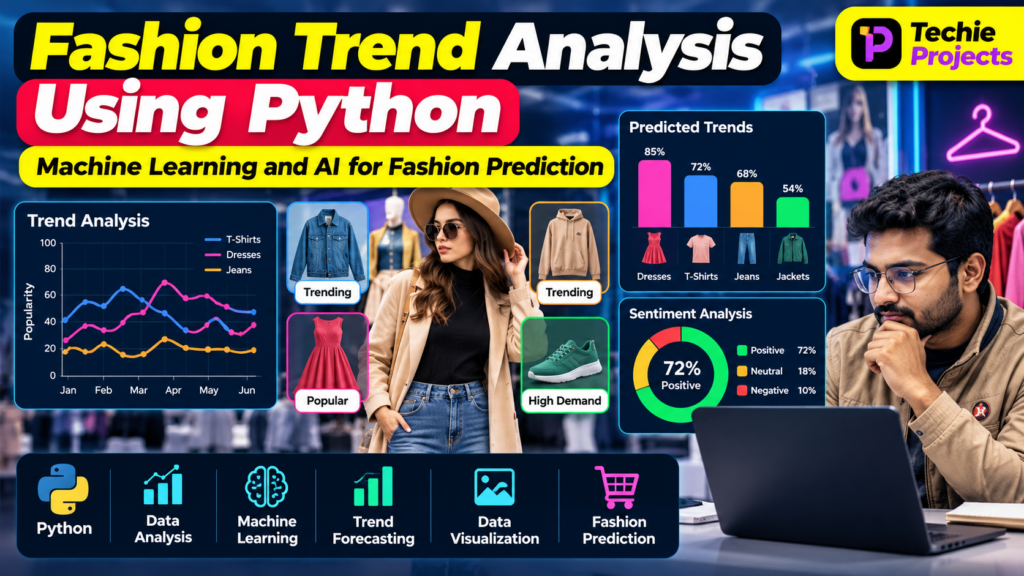
Fashion Trend Analysis Using Python is a practical project that demonstrates how Python, data analysis, visualization, and machine learning can be used to analyze fashion-related data and identify potential trends.
This project is suitable for B.Tech, BCA, MCA, Computer Science, IT, Data Science, Artificial Intelligence, and final-year engineering students who want to work on a practical machine learning and data analytics project.
🎥 Watch the Fashion Trend Analysis Project Working Demo
Before selecting the project, students can watch the Fashion Trend Analysis Using Python working demo to understand the project’s interface, analysis workflow, visualizations, and AI-based fashion prediction concept.
The demonstration provides a practical overview of how fashion data can be analyzed to identify popular trends and generate useful insights.
👉 Watch the complete project working demo to understand how the Fashion Trend Analysis project works.
👗 What Is Fashion Trend Analysis?
Fashion trend analysis is the process of studying fashion-related data to identify patterns, preferences, and emerging trends.
A fashion trend analysis system can analyze information such as:
- Clothing categories
- Colors
- Brands
- Product popularity
- Customer preferences
- Seasonal trends
- Product ratings
- Search trends
- Social media trends
- Sales-related information
Python provides a wide range of libraries that make it useful for collecting, processing, analyzing, and visualizing this type of data.
🎯 Objectives of the Project
The main objectives of the Fashion Trend Analysis Using Python project are:
- To analyze fashion-related datasets using Python.
- To identify popular fashion categories and products.
- To understand changes in fashion preferences.
- To visualize fashion trends using graphs and charts.
- To analyze customer or product data.
- To identify patterns that may indicate emerging trends.
- To explore machine learning techniques for fashion trend prediction.
- To demonstrate the practical application of Python in the fashion industry.
🧠 Why Use Python for Fashion Trend Analysis?
Python is widely used for data science and machine learning because it provides powerful libraries for data processing and visualization.
Some advantages of using Python include:
- Easy-to-understand programming syntax
- Large collection of data science libraries
- Powerful data visualization tools
- Machine learning support
- Easy dataset processing
- Support for artificial intelligence applications
- Ability to build prediction models
Python can therefore be used to create an end-to-end fashion trend analysis system.
📊 Benefits of Fashion Trend Analysis
Fashion trend analysis can provide several useful benefits:
1. Trend Identification
The system can analyze historical data to identify products, colors, or styles that are becoming popular.
2. Customer Preference Analysis
Fashion-related datasets can be analyzed to understand what customers prefer.
3. Better Product Planning
Trend information can help businesses understand which products may receive higher demand.
4. Data-Driven Decisions
Instead of relying only on assumptions, businesses can use analyzed data to support decision-making.
5. Fashion Forecasting
Machine learning techniques can be explored to estimate future trends based on historical patterns.
🐍 Python Libraries Used
The project can use several Python libraries depending on the implementation and dataset.
Pandas
Pandas can be used for loading, cleaning, filtering, and analyzing fashion datasets.
NumPy
NumPy can support numerical calculations and data processing.
Matplotlib
Matplotlib can be used to create charts and graphs for fashion trend visualization.
Seaborn
Seaborn can create statistical visualizations that make trends easier to understand.
Scikit-learn
Scikit-learn can be used for machine learning tasks such as preprocessing, model training, and evaluation.
OpenCV
OpenCV can be included when the project involves image-based fashion analysis.
🔄 Steps Involved in Fashion Trend Analysis
Step 1: Data Collection
The first step is to collect a suitable fashion dataset.
Possible sources can include:
- Product datasets
- Fashion catalog data
- Customer reviews
- Sales information
- Fashion images
- Public datasets
- Social media trend information
The quality of the dataset has an important impact on the analysis.
Step 2: Data Cleaning
Collected data may contain missing values, duplicate records, incorrect values, or inconsistent formats.
Python can be used to clean and prepare the dataset before analysis.
Common operations include:
- Removing duplicate records
- Handling missing values
- Converting data types
- Standardizing categories
- Removing unnecessary columns
Step 3: Exploratory Data Analysis
Exploratory Data Analysis (EDA) helps identify patterns within the fashion dataset.
For example, the system can analyze:
- Most popular clothing categories
- Most common colors
- Product ratings
- Brand popularity
- Seasonal patterns
- Product demand
Charts and graphs can make these patterns easier to understand.
Step 4: Data Visualization
Visualization is an important part of fashion trend analysis.
The project can generate:
- Bar charts
- Line charts
- Pie charts
- Heatmaps
- Distribution plots
- Trend graphs
These visualizations can help users quickly understand changes in fashion data.
🤖 Machine Learning for Fashion Trend Prediction
Fashion Trend Analysis Using Python can be used to create an end-to-end system for analyzing fashion data, visualizing trends, and exploring future predictions.
Machine Learning can be used to identify patterns from historical fashion data.
Depending on the dataset and project objective, different machine learning techniques can be explored.
For example:
- Regression
- Classification
- Clustering
- Time-series analysis
- Recommendation techniques
The selected algorithm should depend on the type and quality of data available.
🔮 Fashion Trend Forecasting
Fashion trend forecasting attempts to estimate future trends using historical information.
For example, a forecasting system could analyze previous data to identify whether interest in a particular category has increased or decreased over time.
A simple workflow can be:
Historical Data → Data Cleaning → Feature Engineering → Model Training → Prediction → Trend Visualization
The prediction should be treated as an analytical estimate rather than a guarantee of future fashion demand.
🛍️ Applications of Fashion Trend Analysis
Fashion trend analysis can be useful in several areas.
1. Fashion Retail
Retailers can analyze customer and product data to understand changing preferences.
2. E-Commerce
Online fashion platforms can use data analysis to understand popular products and categories.
3. Fashion Designing
Designers can study historical and current trends when developing new collections.
4. Marketing
Fashion brands can analyze customer preferences to support targeted marketing strategies.
5. Inventory Planning
Trend analysis can help businesses make better-informed inventory decisions.
6. Recommendation Systems
Fashion data can also be used as a foundation for personalized product recommendation systems.
📈 Example Features of the Project
A complete Fashion Trend Analysis project can include:
- Dataset upload
- Data preprocessing
- Fashion category analysis
- Product popularity analysis
- Color trend analysis
- Customer preference analysis
- Interactive charts
- Trend visualization
- Machine learning model
- Fashion trend prediction
- Results dashboard
The exact features depend on the dataset and implementation.
💻 Software Requirements
- Python 3.x
- Jupyter Notebook or VS Code
- Pandas
- NumPy
- Matplotlib
- Seaborn
- Scikit-learn
- Required dataset
Additional libraries can be installed depending on the machine learning or visualization requirements.
🖥️ Hardware Requirements
A basic system is generally sufficient for a student-level implementation.
- Processor: Intel Core i3 or above
- RAM: 4 GB minimum, 8 GB recommended
- Storage: 10 GB or more free space
- Operating System: Windows, Linux, or macOS
- Internet connection for downloading datasets and required packages
Larger datasets and advanced machine learning models may require higher hardware specifications.
⚠️ Challenges in Fashion Trend Analysis
Developing a fashion trend analysis system can involve several challenges:
- Fashion trends change quickly.
- Datasets may contain incomplete information.
- Social media trends can change rapidly.
- Fashion preferences vary between regions and demographics.
- Historical trends do not always predict future trends accurately.
- Large datasets may require additional processing.
- Image-based fashion analysis can require more computational resources.
🚀 Future Scope
The project can be enhanced in several ways.
Future improvements may include:
- Real-time fashion trend monitoring
- Social media trend analysis
- Deep learning-based fashion image analysis
- Personalized fashion recommendations
- Computer vision-based clothing recognition
- Sentiment analysis of customer reviews
- Real-time fashion dashboards
- E-commerce integration
- Advanced trend forecasting
- AI-powered virtual shopping assistants
Combining fashion data with computer vision, natural language processing, and deep learning can create more advanced fashion intelligence systems.
🎓 Why This Is a Good Final-Year Project
Fashion Trend Analysis Using Python is a useful final-year project because it combines multiple areas of computer science, including:
- Python programming
- Data Science
- Data Analytics
- Machine Learning
- Data Visualization
- Artificial Intelligence
Students can also customize the project according to their academic requirements by adding additional datasets, algorithms, dashboards, or prediction features.
🔗 Explore Related Python & Machine Learning Projects
- Machine Learning Projects Using Python
- Data Analytics Projects Using Python
- Artificial Intelligence Projects
- Computer Vision Projects Using Python
- Deep Learning Projects
- Python Final-Year Projects
🎓 Need Help With Your Final-Year Project?
Looking for a Python, Machine Learning, Artificial Intelligence, Data Science, or final-year engineering project?
Techie Projects can help you discuss your project idea, features, source-code requirements, documentation, and project scope.
📲 Call/WhatsApp: +91-9460060699
🌎 Website: www.techieprojects.com
📺 Instagram: @pythonprojects_
Conclusion
Fashion Trend Analysis Using Python demonstrates how data analytics and machine learning can be applied to understand fashion trends and customer preferences.
By collecting fashion data, cleaning and analyzing it, creating visualizations, and exploring machine learning techniques, students can develop a practical project that combines Python, Data Science, Machine Learning, and Artificial Intelligence.
The project can also be expanded into an advanced fashion prediction or recommendation system by integrating larger datasets, real-time data, computer vision, and deep learning techniques.
This Fashion Trend Analysis Using Python project can also be extended with machine learning and recommendation techniques.