
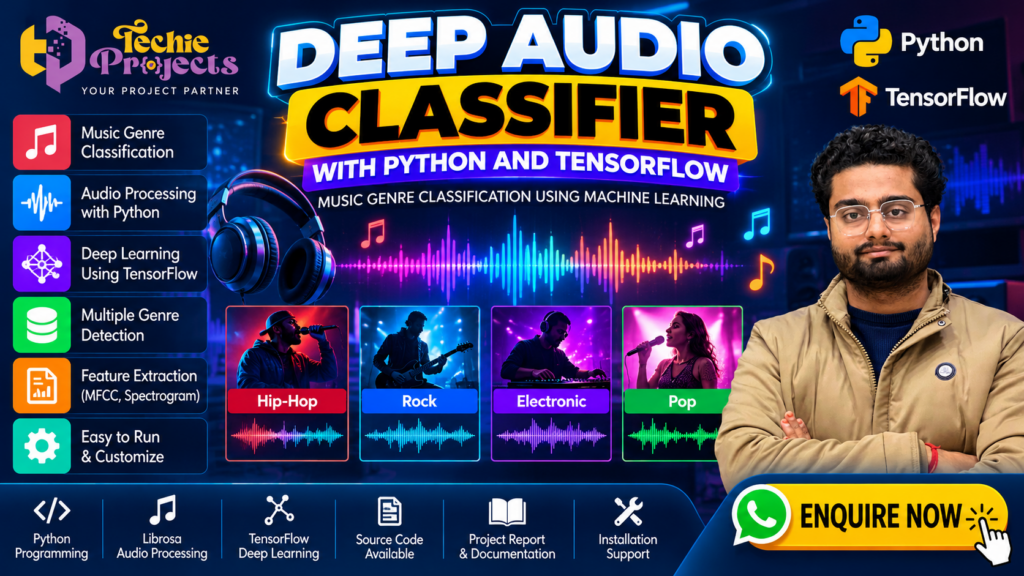
Are you looking for a practical deep learning project that combines audio processing, artificial intelligence, and music genre classification? 🎵 The Deep Audio Classifier Using Python and TensorFlow is an interesting project for engineering students who want to explore how machine learning can analyse audio signals and classify music into different genres.
Instead of spending weeks searching for suitable datasets, understanding audio features, selecting a model, and integrating different Python libraries, you can contact Techie Projects to enquire about the availability of this project package. Discuss your requirements, source code availability, project documentation, installation guidance, demonstration, and technical support options before purchasing.
Whether you are preparing a B.Tech, M.Tech, MCA, BCA, or computer science project, this topic offers an opportunity to learn practical concepts related to deep learning, audio feature extraction, neural networks, and predictive modelling. You can use the project to understand how a computer system processes audio information and predicts a music category based on the trained model.
📞 Contact Techie Projects for Project Enquiries
Interested in purchasing the Deep Audio Classifier Using Python and TensorFlow? Contact us to enquire about package availability, pricing, source code, documentation, installation guidance, and technical support options.
💬 WhatsApp Enquiry: Chat with Techie Projects
📱 Contact Number: +91 94600 60699
🌐 Official Website: https://techieprojects.com/
📸 Instagram: Follow Techie Projects
🎓 Project Categories: Artificial Intelligence, Deep Learning, Machine Learning, Python, TensorFlow, and Audio Processing.
✅ Request Project Details: Share your engineering branch, preferred features, academic requirements, and technical expectations so the team can discuss a suitable available package.
🚀 Ready to get started? Click here to enquire on WhatsApp and mention Deep Audio Classifier Using Python and TensorFlow.
🎬 Deep Audio Classifier Project Demo
Explore the project demonstration to understand the intended workflow, interface, and music genre classification concept. The demonstration can help you evaluate whether this project matches your academic requirements.
The project can be designed to accept an audio file, process the audio signal, extract useful features, and display a predicted genre. The precise functionality depends on the implementation, trained model, and supported audio dataset.
🎵 What Is a Deep Audio Classifier?
A deep audio classifier is a machine learning application that analyses audio signals and assigns them to predefined categories. Rather than relying only on manually written rules, the model learns patterns from labelled training examples.
In a music genre classification application, these categories may include:
- 🎤 Hip-hop
- 🎸 Rock
- 🎹 Electronic
- 🎶 Pop
- 🎻 Classical
- 🥁 Jazz
The available categories depend on the dataset used to train the model. A model trained on a limited selection of genres should not be expected to recognise every music style accurately.
The Deep Audio Classifier Using Python and TensorFlow combines audio processing with deep learning techniques to demonstrate how a computer can learn patterns from sound. Students can study the relationship between input audio, extracted features, model training, and classification output.
🎯 Objectives of the Project
The main objective is to develop an application that demonstrates how audio data can be processed and classified using machine learning.
The key objectives include:
- 🧠 Understanding the fundamentals of audio classification.
- 🎵 Learning how music genre prediction works.
- 🐍 Using Python for audio data processing and application development.
- ⚙️ Exploring TensorFlow and neural network concepts.
- 📊 Extracting meaningful features from audio signals.
- 🔍 Evaluating model predictions using suitable performance metrics.
- 💻 Building a demonstration that students can explain during an academic presentation.
This project can also help students understand the practical challenges of working with unstructured data. Unlike a conventional spreadsheet, an audio recording contains a time-varying signal that must be transformed into a representation suitable for machine learning.
⚙️ Technologies Used in the Project
The exact technology stack depends on the implementation selected for the project.
🐍 Python
Python is the primary programming language for data preparation, audio processing, model integration, and application logic. Its ecosystem includes libraries for numerical computation, signal analysis, visualisation, and machine learning.
🧠 TensorFlow
TensorFlow provides tools for building, training, and evaluating neural network models. Depending on the selected architecture, it can process numerical audio features or spectrogram representations to learn patterns associated with different music genres.
🎧 Librosa
Librosa is a Python library commonly used for music and audio analysis. It supports operations such as loading audio files, calculating spectral features, generating mel spectrograms, and extracting Mel-frequency cepstral coefficients (MFCCs).
📊 NumPy
NumPy supports numerical calculations and array operations. It can be used when preparing audio features, transforming data, and organising inputs for a machine learning model.
📈 Matplotlib
Matplotlib can visualise audio waveforms, spectrograms, training curves, and other analytical results. Visualisations make it easier to understand the data and explain the project during a demonstration.
🖥️ Application Interface
A graphical or web-based interface may be added to make the system easier to demonstrate. The interface could allow users to select an audio file and view the predicted genre, depending on the features included in the selected package.
🔬 How Does Music Genre Classification Work?
A music genre classifier follows a sequence of data-processing and prediction steps.
1. 🎼 Audio Dataset Collection
The system begins with a collection of audio recordings labelled according to their genres. The dataset should contain suitable examples for each category the model is expected to recognise.
Students should check the dataset’s licence and usage conditions before using it in an academic project.
2. 🧹 Audio Preprocessing
Audio files may have different durations, sampling rates, and channel configurations. Preprocessing helps standardise the inputs so that the model can process them consistently.
Typical operations may include resampling, converting stereo audio to mono, normalising signal levels, and dividing longer recordings into segments.
3. 📉 Feature Extraction
Raw audio contains a large amount of information. Feature extraction converts the signal into a representation that can help the model learn meaningful patterns.
Common audio features include:
- MFCCs: Represent characteristics of the audio spectrum using a perceptually motivated frequency scale.
- Mel spectrograms: Show how energy across frequency bands changes over time.
- Spectral centroid: Describes the centre of mass of the frequency spectrum.
- Zero-crossing rate: Measures how often a signal changes sign.
- Chroma features: Represent energy associated with musical pitch classes.
Not every implementation needs all these features. The selection depends on the dataset and model architecture.
4. 🧠 Model Training
The extracted features are paired with their corresponding genre labels and used to train a suitable model.
Depending on the implementation, the architecture might use a dense neural network or a convolutional neural network trained on spectrogram-like inputs.
The dataset should be separated into training, validation, and test sets to help measure performance on examples that were not used to fit the model.
5. 🎯 Music Genre Prediction
After training, the model receives an audio sample prepared using the same preprocessing steps as the training data. It produces scores or probabilities for the supported genre categories.
The application can display the category with the highest predicted score. These scores should not automatically be interpreted as perfectly calibrated probabilities.
6. 📊 Performance Evaluation
Accuracy alone may not fully describe a classifier’s performance, particularly when some genres have more training examples than others.
Useful evaluation methods include precision, recall, F1-score, and a confusion matrix. These measurements help students identify which genres the model recognises well and which categories it tends to confuse.
⚙️ Implementation of Deep Audio Classifier Using Python and TensorFlow
The implementation generally begins with preparing a labelled audio dataset. Audio samples are processed into suitable features, and the resulting data is used to train and evaluate a classification model.
TensorFlow can support the neural network, while Python libraries such as Librosa and NumPy can assist with audio processing and numerical operations. The trained model can then predict a genre for a supported audio sample.
The exact model architecture, dataset, and supported genres depend on the project package. Students should review these details and understand the workflow before presenting their results.
🎵 Features of Deep Audio Classifier Using Python and TensorFlow
The Deep Audio Classifier Using Python and TensorFlow demonstrates how machine learning can analyse audio recordings and predict music genres. Depending on the implementation, the system may include audio file input, feature extraction, neural network prediction, and a results display.
Students can explore how audio features such as MFCCs and mel spectrograms represent sound in a form suitable for model training. These concepts make the project useful for understanding audio processing, deep learning, and classification workflows.
✨ Key Features of the Deep Audio Classifier
The following features are suitable for a music classification project, depending on the selected implementation.
🎧 Audio File Input
Users may be able to select a supported audio recording for processing. The accepted formats should be documented clearly, and the system should handle invalid or unsupported files appropriately.
🎵 Automatic Genre Prediction
The trained model predicts one of the supported music categories. This feature demonstrates how learned patterns can be used to classify new audio samples.
📈 Audio Feature Analysis
The project can include visualisations of waveforms, MFCCs, or spectrograms to show how sound is transformed into numerical information.
🧠 Deep Learning Integration
TensorFlow can be used to implement and evaluate the neural network. Students can explore model structure, training parameters, loss functions, and validation results.
🖥️ User-Friendly Results
A simple interface can display the selected file, predicted category, and relevant output information. Additional visualisations may be included if they are part of the actual implementation.
📊 Model Evaluation
Evaluation reports can help explain how well the model performs across different categories. Include only measurements obtained from actual experiments rather than estimated or invented accuracy figures.
🎓 Benefits for Engineering Students
The Deep Audio Classifier Using Python and TensorFlow provides a practical topic for students interested in artificial intelligence and audio analytics.
Practical machine learning experience: Students can explore the complete workflow, from dataset preparation to model evaluation.
Understanding audio data: The project introduces students to signal representations and the challenges of processing sound.
Python programming skills: Working with data arrays, audio libraries, and neural networks strengthens practical programming knowledge.
Technical presentation: Waveforms, spectrograms, and prediction results can help students explain the implementation visually.
Scope for improvement: Students may experiment with different feature extraction methods, model architectures, dataset sizes, or interface designs.
For the best learning experience, students should understand the implementation and be prepared to explain its design choices rather than relying only on the final output.
🏢 Real-World Applications of Audio Classification
Audio classification has applications across multiple industries. A music genre project demonstrates some of the fundamental techniques used in broader audio analysis systems.
- 🎶 Music streaming: Audio metadata and genre classification can support music organisation and discovery.
- 📚 Digital libraries: Audio collections can be grouped and searched using descriptive labels.
- 🎙️ Media analysis: Audio features can help categorise recordings for research and content organisation.
- 📱 Music applications: Classification can support features such as genre-based browsing.
- 🔬 Audio research: Researchers can compare signal-processing approaches and machine learning architectures.
- 🎧 Recommendation systems: Genre labels may be combined with listening preferences and other metadata to support music discovery.
These are potential application areas of audio classification in general. A student project should not be presented as a complete commercial recommendation or production system unless those capabilities have actually been implemented.
🛠️ Hardware and Software Requirements
The exact requirements depend on the selected model, dataset size, and interface.
Typical software requirements may include:
- Python
- TensorFlow
- Librosa
- NumPy
- Matplotlib
- A compatible code editor or Python IDE
- A supported operating system and compatible package versions
A standard computer may be sufficient for a small demonstration model. Larger datasets or more complex neural networks can require additional memory and processing power. GPU acceleration may help with training, but it is not mandatory for every implementation.
Before purchasing, ask Techie Projects to confirm the supported Python and TensorFlow versions, installation procedure, hardware expectations, and any additional dependencies.
💼 Why Choose Techie Projects for Your Academic Project?
Selecting a project package should involve more than comparing titles. Students should understand what is included, how the application works, and whether the package fits their academic requirements.
At Techie Projects, you can enquire about available engineering and computer science projects across Python, artificial intelligence, machine learning, deep learning, computer vision, IoT, and software development.
Before placing an order, confirm the following details:
- 📦 What deliverables are included in the package?
- 💻 Is the source code included?
- 📄 Is project documentation available?
- ⚙️ Are installation instructions provided?
- 🎬 Is a demonstration available?
- 🧑💻 What technical support options are available?
- 💰 What is the price and expected delivery timeline?
Package availability, pricing, and support terms should be confirmed directly before payment. This helps you select an option that matches your project scope and submission schedule.
🛒 How to Enquire About or Purchase the Project
Follow these steps to discuss the project with Techie Projects.
Step 1: Share your academic requirements. Mention your degree, branch, semester, and submission deadline.
Step 2: Explain the required features. Specify whether you need basic music genre classification, visualisation, a graphical interface, or additional functionality.
Step 3: Confirm the package details. Ask about source code, documentation, dependencies, installation guidance, and support.
Step 4: Review the available options. Compare the scope and deliverables with your academic requirements before making a decision.
Step 5: Confirm pricing and delivery. Proceed only after the team confirms the package details and applicable terms.
💬 Enquire Now on WhatsApp to discuss the Deep Audio Classifier project.
🎓 Who Should Choose This Audio Classification Project?
The Deep Audio Classifier Using Python and TensorFlow is suitable for students interested in Python programming, machine learning, deep learning, and audio analytics. It can be considered for relevant computer science and information technology academic projects.
If you want to explore the available package, contact Techie Projects to confirm source code availability, documentation, installation requirements, pricing, and technical support options.
💬 Enquire with Techie Projects on WhatsApp
🎓 Explore Related Python Projects
If you are exploring machine learning and software development topics, you may also be interested in these projects:
- Inventory Management System Using Python
- Library Management System Using Python
- American Sign Language to Text Conversion
- Employee Management System Using Python
- Fake News Detection Using Machine Learning
- Speech Emotion Recognition Using Deep Learning
- Audio to Sign Language Translator using Python
Visit Techie Projects to explore available project categories and enquire about suitable packages.
❓ Frequently Asked Questions
1. What is a Deep Audio Classifier Using Python and TensorFlow?
It is a machine learning application that analyses audio signals and predicts categories such as music genres. The implementation typically includes audio preprocessing, feature extraction, model training, and prediction.
2. Which programming language is used?
Python is commonly used because it supports audio processing, numerical computation, and machine learning libraries.
3. Why is TensorFlow used?
TensorFlow provides tools for building, training, and evaluating neural networks that can learn patterns from audio features or spectrograms.
4. What is the role of Librosa?
Librosa supports audio analysis tasks such as loading recordings, calculating MFCCs, generating spectrograms, and extracting other signal features.
5. Can this project classify different music genres?
Yes, provided the trained model supports those categories and has been trained and evaluated using suitable labelled data. The actual supported genres depend on the implementation.
6. Is a GPU required?
Not necessarily. Small models can often run on a standard computer, although training speed depends on the model, dataset, and hardware.
7. Can I purchase this project from Techie Projects?
You can contact Techie Projects to enquire about availability, pricing, source code, documentation, installation guidance, and support. Confirm the deliverables before placing an order.
8. Does the project guarantee high classification accuracy?
No particular accuracy should be guaranteed without measured results. Performance depends on the dataset, model, preprocessing, training procedure, and evaluation method.
✅ Conclusion
The Deep Audio Classifier Using Python and TensorFlow is a useful academic project for exploring music genre classification, audio signal processing, and deep learning. It demonstrates how sound can be transformed into numerical features and analysed by a trained model to generate predictions.
For students who want to explore this topic through a practical implementation, Techie Projects provides an enquiry option to discuss available packages and technical requirements. Review the project scope, verify the included deliverables, and make sure you understand the implementation before your academic presentation.
🚀 Ready to discuss your project requirements?
💬 Contact Techie Projects on WhatsApp
🌐 Explore More Engineering Projects
📸 Follow Techie Projects on Instagram
Choose a project that matches your learning goals, understand the underlying concepts, and use the implementation to strengthen your practical skills.