
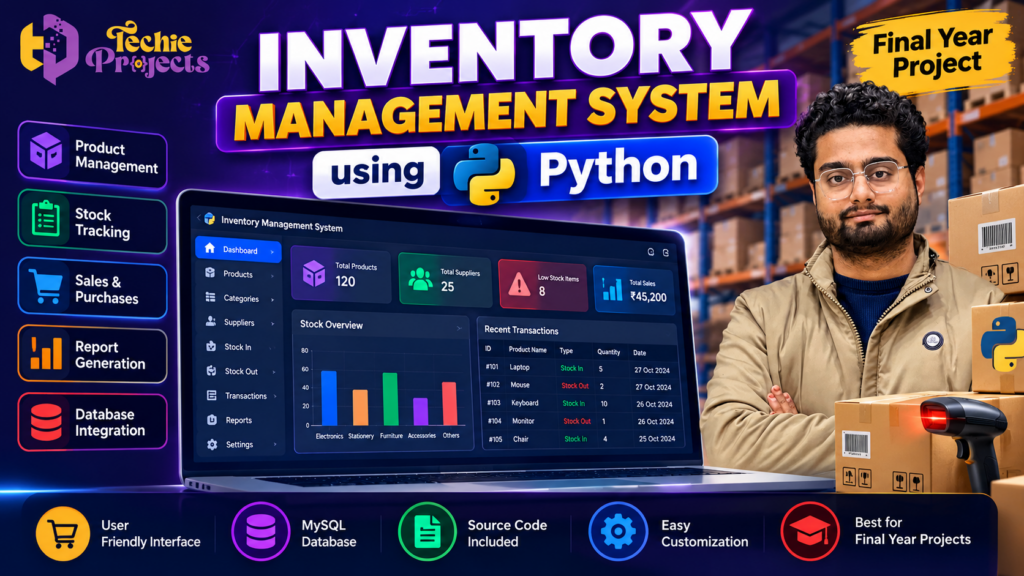
Inventory Management System Project Using Python: Features, Benefits and Source Code
Looking for a practical Python project for your college submission, final-year engineering project, or portfolio? The Inventory Management System Project Using Python is an excellent topic to explore because it combines programming, database management, product tracking, and real-world business logic in one application.
If you want to save development time and get started with a project relevant to real business operations, Techie Projects can help you explore a suitable inventory management project. Instead of spending weeks planning the complete application from scratch, you can enquire about project availability, implementation details, and deliverables before purchasing.
An inventory management application can help businesses maintain product records, monitor stock quantities, organize inventory information, and review stock movements. For students, it offers an opportunity to understand how Python programming can solve practical problems in retail shops, warehouses, small businesses, and other organizations.
Explore the Inventory Management System Project Using Python from Techie Projects and contact us to confirm the available source code, installation requirements, documentation, and project support before placing your order.
🎬 Watch the Inventory Management System Project Demo
Explore the project demonstration to understand the application interface, inventory workflow, and the types of operations shown in the implementation. Reviewing a demo can help you decide whether the project matches your academic requirements and learning objectives.
The actual functionality depends on the implemented version, so confirm the available modules with Techie Projects before purchasing.
📦 What Is an Inventory Management System?
An inventory management system is a software application designed to organize and manage information about products and stock. It helps users maintain records such as product names, item codes, quantities, prices, and other relevant details.
Businesses use inventory systems to reduce manual recordkeeping, improve visibility into available stock, and make product information easier to manage.
For example, imagine a computer accessories shop that sells keyboards, mice, monitors, and laptops. Maintaining every product record in a notebook or separate spreadsheet can become difficult as the business grows. A digital inventory application provides a structured way to store and retrieve product information.
The Inventory Management System Project Using Python demonstrates how programming concepts can be applied to this type of business requirement. Depending on its implementation, the application may include product entry, record updates, stock monitoring, search functions, and database connectivity.
🐍 Why Choose an Inventory Management System Project Using Python?
Python is a popular programming language for students because its syntax is readable and it supports a wide range of application-development libraries. It can be used to build desktop applications, web applications, automation tools, and database-driven software.
This project is particularly useful for learners who want to understand how multiple programming concepts work together in a practical application.
1. Learn Python Programming
Developing an inventory application can help students practise variables, functions, conditional statements, loops, classes, and exception handling, depending on the project’s design.
2. Understand Database Management
Inventory applications often need persistent storage for product details and stock records. Working with a database helps students understand how information is inserted, retrieved, updated, and deleted.
3. Explore Business Application Development
Unlike a program that performs only a mathematical calculation, an inventory application represents a recognizable business process. Students can explore how software supports product management and routine operations.
4. Build a Portfolio Project
A properly understood and documented project can demonstrate practical programming knowledge during interviews, internships, and technical discussions.
5. Practise Problem-Solving
Students can examine common inventory challenges, such as maintaining accurate quantities, validating product entries, finding records quickly, and handling incorrect input.
⚙️ Key Features of an Inventory Management System
The available features depend on the actual version of the project. The following are common features found in inventory management applications and useful points to verify before purchasing.
Product Management
Product management involves maintaining records for individual items. A typical application may allow users to add new products, view existing records, edit product details, or remove entries when appropriate.
Product records may include:
- Product name
- Product ID or item code
- Product category
- Quantity available
- Unit price
- Supplier information, where implemented
These fields help organize inventory information and make records easier to locate.
Stock Quantity Tracking
Stock tracking helps users understand how many units of a product are currently recorded in the system. A well-designed application should apply consistent rules when stock quantities change.
For example, if a shop records 40 units of a product and sells 5 units, the recorded quantity should be updated according to the application’s stock-management logic.
Before purchasing, ask whether the project supports stock-in and stock-out operations or only basic quantity editing.
Search and Record Retrieval
Search functionality can make it easier to locate a product by name, code, or another supported field. This is useful when an inventory contains many records.
The search options available will depend on the implementation.
Database Integration
A database can store product details beyond the lifetime of a single program session. Depending on the project, storage may use SQLite, MySQL, or another database technology.
Ask Techie Projects which database is used in the version you intend to purchase and whether database setup instructions are provided.
User Interface
A graphical user interface can make an application easier to operate than a command-line interface. Python desktop applications may use Tkinter or another GUI framework.
The interface and its available screens should be checked in the project demo before making a purchase.
Reports and Stock Summaries
Some inventory systems provide summaries of product quantities, inventory values, or stock movements. These functions are useful for reviewing inventory information.
Confirm whether reporting, low-stock alerts, sales tracking, or dashboard visualizations are included in the specific project package rather than assuming they are available.
📦 Features of the Inventory Management System Project Using Python
The Inventory Management System Project Using Python demonstrates how a software application can organize product details and simplify inventory record management. Depending on the implementation, it may support adding products, updating quantities, searching records, and storing information in a database.
Students can explore how Python programming connects application logic with data storage to create a practical inventory management solution.
🔄 How the Inventory Management System Works
The general workflow of an inventory application can be divided into several stages.
Step 1: Enter Product Information
The user enters details for a product, such as its name, identifier, quantity, and price. The application should validate required fields before saving a record.
Step 2: Save the Record
The application stores the product information in its configured database or storage system. Database integration helps preserve records between sessions.
Step 3: View or Search Products
Users retrieve stored records to review product details. Search and filtering options, if implemented, can make this process more efficient.
Step 4: Update Stock
When products are received, sold, or otherwise moved, their quantities need to be updated. The application should apply the appropriate rules to avoid inconsistent stock records.
Step 5: Review Inventory Information
The user checks current product records and any available summaries or reports. Reporting capabilities depend on the actual implementation.
This workflow provides students with a practical example of how user input, business logic, and data storage work together in a software application.
🛠️ Technologies Used in the Project
The technology stack depends on the version offered. The following technologies are commonly used to develop Python inventory applications.
Python: Handles application logic, data processing, validation, and other programmed operations.
Tkinter: A Python GUI toolkit that can be used to build desktop interfaces. Confirm whether it is used in the selected version.
SQLite or MySQL: Database options for storing product and inventory records. The actual database must be confirmed before installation.
SQL: Used with relational databases to create, retrieve, update, and delete records.
Visual Studio Code or PyCharm: Development environments that can help students inspect, edit, and run Python code.
Not every implementation uses all these technologies. Check the project’s actual requirements before installing packages or configuring a database.
⚙️ Database Management in the Inventory Management System Project Using Python
Database management is an important part of an Inventory Management System Project Using Python because product information must be organized and retrieved consistently. Depending on the selected version, the application may use SQLite, MySQL, or another database solution.
Before purchasing, confirm which database is included, how the application connects to it, and whether setup instructions are provided.
💻 Software and Hardware Requirements
The exact requirements depend on the implementation and should be confirmed before purchase.
Possible Software Requirements
- A compatible Python installation
- A supported operating system, such as Windows
- The required Python libraries
- A database engine, if the project uses one
- A compatible code editor or IDE
- Additional configuration tools, if required
Possible Hardware Requirements
A standard computer suitable for running Python development tools is generally sufficient for a basic inventory application.
The recommended hardware configuration will depend on the operating system, database, and other software installed on your computer. Ask for the project’s verified requirements if your system has limited memory or storage.
🎓 Benefits for Engineering and Computer Science Students
The Inventory Management System Project Using Python can be useful for students who want to connect classroom concepts with software development.
Practical Programming Experience
Students can examine how Python functions, conditions, loops, and data structures support a larger application.
Database Concepts
The project can provide a practical setting for understanding tables, records, queries, and database operations.
Software Development Workflow
A database-driven application introduces students to the relationship between interface design, application logic, data storage, and testing.
Project Demonstration and Viva Preparation
Understanding the code and workflow can help students explain their project during academic presentations. Students should be prepared to describe the design choices, limitations, and implementation details themselves.
Portfolio Development
After understanding and appropriately customizing the project, students may use their work to demonstrate relevant skills in a portfolio, subject to their institution’s rules and the applicable licence.
Important: Follow your college’s academic integrity policy. Use any purchased project as a learning resource and ensure that your submission, modifications, and explanations comply with your institution’s requirements.
🎓 Why Is the Inventory Management System Project Using Python Useful for Students?
The Inventory Management System Project Using Python is a useful learning topic for computer science and engineering students who want practical experience with Python and database operations. It can help learners understand product records, data validation, application workflows, and the relationship between a user interface and a database.
By studying the implementation and testing its functions, students can improve their programming knowledge and prepare to explain the project’s workflow during academic presentations.
🏪 Real-World Applications of Inventory Management
Inventory management is relevant to many types of organizations. The following examples illustrate where this kind of software can be useful.
Retail Shops
Retailers need to organize product records and maintain visibility into available stock. A digital inventory system can help structure these records.
Warehouses
Warehouses handle products arriving from suppliers and leaving for customers or other locations. Inventory applications can support stock-record management.
Computer and Electronics Stores
Electronics retailers often manage products with different models, prices, and item codes. A structured database can make these records easier to maintain.
Small Businesses
Small businesses may benefit from replacing scattered records with a more consistent digital process, depending on their operational needs.
Educational Demonstrations
Students can use an inventory project to explore how software models a common business process and how database operations support it.
A student-level project is not automatically suitable for production use. Businesses requiring multiple users, audit trails, secure access, backups, integrations, or high reliability need appropriate testing and additional engineering.
🧪 Testing and Possible Improvements
Testing is an important part of developing an inventory application. Students should check that the software handles valid entries correctly and responds appropriately to invalid data.
Useful test cases include:
- Adding a product with complete information
- Attempting to save a record with missing required fields
- Searching for an existing product
- Updating a product’s details
- Checking how stock quantities are changed
- Verifying that saved records remain available after restarting the application
- Testing invalid quantities or prices
- Checking how the application responds to database errors
Depending on the original implementation, possible future enhancements include role-based access, barcode scanning, low-stock notifications, exportable reports, supplier management, and a web-based interface.
These are potential extensions, not guaranteed features of every project. Confirm the existing functionality before purchasing.
🛒 Purchase the Inventory Management System Project Using Python from Techie Projects
Looking for a practical Python project for your academic work? Contact Techie Projects to enquire about the Inventory Management System Project Using Python, including its current price, features, source-code availability, and installation requirements.
The Inventory Management System Project Using Python may be a suitable choice if you want to study product records, inventory workflows, database operations, and Python application development.
Before placing your order, contact us to confirm:
- The current project version and its functionality
- Whether source code is included
- Supported Python and database versions
- Installation instructions and documentation availability
- Whether customization or technical assistance is available
- The current price and delivery details
This confirmation helps you choose a project that matches your syllabus, computer configuration, and budget.
📲 Contact Techie Projects
- 📲 Call/WhatsApp: +91-9460060699
- 🌎 Website: www.techieprojects.com
- 📺 Instagram: @pythonprojects_
Send a message mentioning Inventory Management System Project Using Python to enquire about availability, pricing, and deliverables. Our team can help you clarify the available options before you decide to purchase.
🔗 Explore Related Python Projects
If you are comparing project ideas, explore other topics available through Techie Projects:
- Student Management System
- Library Management System
- Hospital Management System
- Billing Management System
- Employee Management System
- Online Shopping System
- Database Management Projects
Choose a project based on your academic requirements, programming experience, and the concepts you want to learn. Check the individual project page for its actual features and availability.
❓ Frequently Asked Questions
1. What is an Inventory Management System Project Using Python?
It is a software project that demonstrates how Python can be used to manage product information and inventory records. Depending on the implementation, it may support stock updates, searching, database storage, and other inventory operations.
2. Is this project suitable for beginners?
It can be a useful learning project for beginners who understand basic Python programming and want to explore database-driven applications. The difficulty depends on the code structure and the features included.
3. Which database is used in the project?
The database depends on the available implementation. Ask Techie Projects whether the version uses SQLite, MySQL, or another storage technology before purchasing.
4. Can I customize the application?
Customization depends on the source code, project licence, and the features supported by the implementation. Confirm the permitted modifications and available assistance before placing your order.
5. Does the project include source code?
Source-code availability should be confirmed for the specific package. Contact Techie Projects to verify the deliverables, documentation, and installation instructions.
6. Can I use the project for a final-year submission?
It may be suitable for academic learning or as a project reference, but acceptance depends on your college’s requirements and academic integrity rules. Review the project with your faculty and make sure you understand and appropriately develop the work you submit.
7. How can I purchase this Python project?
Visit https://techieprojects.com/ or contact Techie Projects through https://wa.me/919460060699. Mention the project name and ask about its current price, availability, features, and deliverables.
🎯 Conclusion
An inventory management application is a practical way to explore Python programming, database management, record validation, and business software workflows. It connects technical concepts with a familiar problem faced by retailers, warehouses, and other organizations.
If you are looking for an Inventory Management System Project Using Python, review the demonstration, verify the implementation requirements, and confirm the deliverables before purchasing from Techie Projects.
Ready to enquire? Visit Techie Projects or contact us on WhatsApp to discuss project availability, pricing, and the version that best matches your learning goals.