
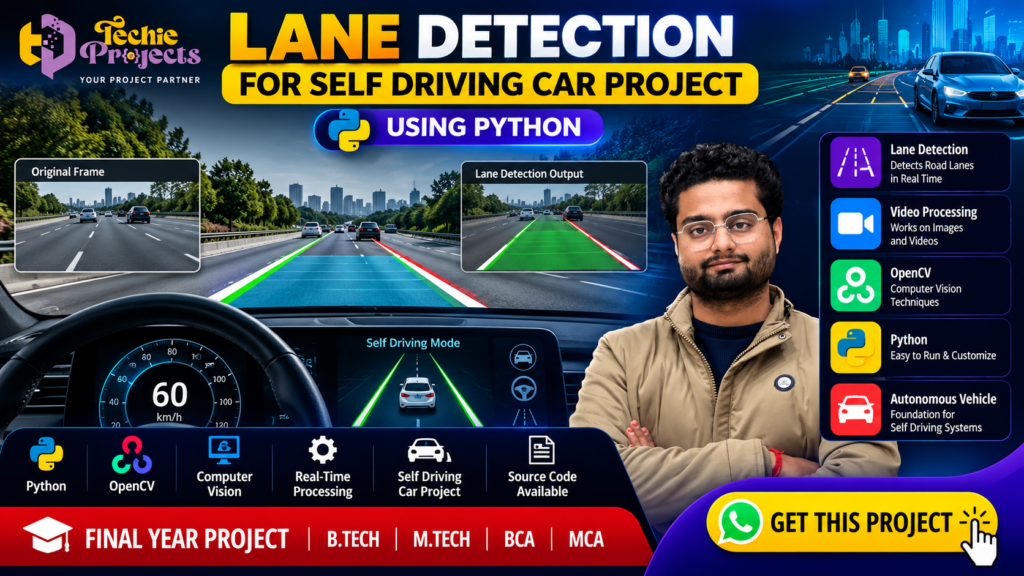
Are you looking for a practical computer vision project that demonstrates how autonomous vehicles identify road lanes? The Lane Detection for Self Driving Car Project Using Python is an excellent option for engineering students who want to explore artificial intelligence, image processing, and self-driving vehicle technology through a hands-on software project.
At Techie Projects, you can enquire about this project to understand the available implementation, source code, installation requirements, demonstration, and technical support options. Instead of spending time assembling different resources from scratch, discuss your requirements with our team and choose a project package that matches your academic objectives, programming experience, and system configuration.
This project demonstrates how Python and OpenCV can process road images or video frames to identify lane markings and highlight the driving path. It provides an opportunity to learn important computer vision concepts while developing a project that can be explained and demonstrated during an academic presentation.
🎬 Lane Detection for Self Driving Car Project Using Python – Project Demo
Watch the project demonstration to understand how lane detection works, how road markings can be highlighted, and how computer vision techniques can support autonomous driving research.
The demonstration helps you explore the expected workflow and visual output before enquiring about the project package. Confirm the exact features, supported inputs, and implementation included in the version available from Techie Projects.
🚗 What Is a Lane Detection Project?
Lane detection is a computer vision task that identifies lane markings on a road using images or video frames. These markings help describe the road’s structure and can provide useful information for driver-assistance systems and autonomous driving research.
The Lane Detection for Self Driving Car Project Using Python processes visual information to locate possible lane boundaries. Depending on the implementation, the system may highlight detected lines, mark the drivable region, or display the result on the original frame.
For example, a road video can be supplied to the application, processed frame by frame, and displayed with coloured lane indicators. This visual output makes the project easier to understand and useful for demonstrating image-processing techniques.
However, detecting lane markings in a demonstration is not the same as building a complete self-driving vehicle. A real autonomous driving system also requires perception, localisation, planning, vehicle control, safety mechanisms, and extensive real-world validation.
🎯 Objectives of Lane Detection for Self Driving Car Project Using Python
The primary objective is to develop a Python-based application that demonstrates lane identification using computer vision.
The main learning objectives include:
- Understanding the fundamentals of image processing.
- Identifying lane markings in road images or video.
- Applying image filtering and edge detection.
- Detecting suitable lines or lane boundaries.
- Displaying detected lanes on the original frame.
- Learning how to process video frames efficiently.
- Evaluating the effect of lighting, road conditions, and image quality.
- Understanding the limitations of conventional computer vision techniques.
These objectives can help students connect theoretical concepts with a practical implementation.
🚗 Benefits of the Lane Detection for Self Driving Car Project Using Python
The Lane Detection for Self Driving Car Project Using Python helps students understand how computer vision can identify lane markings and analyse road images. By implementing image preprocessing, edge detection, and line detection, students can explore the techniques used in road-scene analysis. This project is also useful for learning how Python and OpenCV work together in a practical computer vision application.
⚙️ Key Features of the Lane Detection Project
The available features depend on the particular project implementation and should be confirmed before purchase.
🛣️ Road Lane Identification
The system analyses road images to identify potential lane markings. Depending on the technique used, it may detect white or yellow lane lines and highlight the corresponding regions.
🎥 Image and Video Processing
Video processing allows the application to analyse consecutive frames rather than a single still image. This makes it possible to demonstrate how lane markings change as the vehicle or camera moves.
🖼️ Visual Lane Overlay
Detected lines can be drawn over the original road image. Coloured overlays make the results easier to interpret during a project demonstration.
🐍 Python-Based Implementation
Python provides access to widely used computer vision libraries and makes the application suitable for learning, experimentation, and further development.
🔬 Image Processing Techniques
Depending on the implementation, the project may use grayscale conversion, Gaussian smoothing, edge detection, region-of-interest masking, and line detection.
📊 Result Evaluation
Students can test different images or video clips and compare the output under different conditions. Evaluation can include detection quality, processing speed, and failure cases.
💻 Source Code and Implementation Details
When you enquire about the Lane Detection for Self Driving Car Project Using Python from Techie Projects, confirm the available source code, required libraries, installation procedure, and supported input formats. Understanding these details before purchasing helps you choose a compatible project package and prepare for implementation, testing, and academic demonstration.
🧠 How the Lane Detection Project Works
The overall workflow can be divided into several processing stages.
1. 📥 Input Image or Video
The application receives an image or video containing a road scene. The quality of the input affects how clearly lane markings can be detected.
2. 🎨 Image Preprocessing
The input frame may be converted to grayscale to simplify processing. Smoothing filters can reduce noise and help limit unwanted edges.
3. ✨ Edge Detection
An edge detector, such as the Canny algorithm, can identify strong changes in pixel intensity. These edges may correspond to lane markings, road boundaries, vehicles, or other objects.
4. 🎯 Region of Interest
A region-of-interest mask restricts processing to the part of the image where road lanes are expected. This can reduce distractions from buildings, trees, and the sky.
5. 📐 Line Detection
A line-detection technique, such as the Hough transform, may identify candidate lane segments from the detected edges. Additional filtering can help separate likely lane boundaries from irrelevant lines.
6. 🖍️ Lane Overlay
The selected lines or lane regions are drawn on the original frame. The output can then be displayed or saved, depending on the software features.
7. 🔄 Video Frame Processing
For video input, the same workflow can be repeated for consecutive frames. Processing speed and consistency are important when evaluating the results.
Not every lane detection system uses this exact pipeline. The actual algorithms should be checked against the source code supplied with the selected project.
💻 Technologies Used in Lane Detection Using Python
🐍 Python
Python is the primary programming language for implementing the application logic, processing inputs, and connecting computer vision components.
👁️ OpenCV
OpenCV is a widely used computer vision library that provides tools for reading images and videos, applying filters, detecting edges, drawing lines, and displaying output.
📐 NumPy
NumPy supports numerical operations and array manipulation. Images represented as arrays can be processed and transformed efficiently.
🎬 Video Input Tools
Depending on the implementation, OpenCV’s video capture functionality can be used to read video files or supported camera streams.
🖥️ Development Environment
The project may be developed using a Python-compatible editor or IDE. The required Python version and library versions should be confirmed before installation.
🎓 Why Choose This Python Lane Detection Project?
The Lane Detection for Self Driving Car Project Using Python offers an opportunity to explore autonomous driving concepts through a visual software application. Students can study how road images are processed, how lane boundaries are identified, and how the results are displayed. These concepts provide a foundation for further learning in artificial intelligence, image processing, and intelligent transportation systems.
🛠️ Software and Hardware Requirements
Software Requirements
- Programming language: Python
- Computer vision library: OpenCV
- Numerical processing: NumPy
- Operating system: Compatible Windows or Linux environment, subject to the package requirements
- Development tool: A suitable Python IDE or code editor
Hardware Requirements
- A computer capable of running the required Python environment
- Sufficient RAM for the selected input resolution and processing workload
- Keyboard, mouse, and display
- Video files or a compatible camera if the implementation supports them
A dedicated GPU is not necessarily required for a traditional OpenCV lane detection pipeline. Confirm the actual requirements before purchasing or installing the project.
📈 Applications of Lane Detection Technology
🚘 Advanced Driver-Assistance Systems
Lane detection is relevant to research into lane departure warnings and lane-keeping assistance. Production systems require substantially more testing and safety engineering than a basic academic demonstration.
🤖 Autonomous Driving Research
Researchers can use lane information as one input to broader perception and planning systems. Lane detection alone cannot safely control a vehicle.
🎓 Engineering Education
The project demonstrates image processing, edge detection, video analysis, and algorithmic problem-solving in a practical context.
🧪 Computer Vision Experiments
Students can experiment with different filters, thresholds, input resolutions, and detection techniques to compare how each change affects the results.
🚦 Smart Transportation Research
Lane analysis can be studied alongside traffic monitoring, road scene understanding, and other intelligent transportation applications.
🏆 Why Choose This Project for Your Final-Year Submission?
A good engineering project should be more than a title and a code file. Students need to understand the workflow, explain the algorithms, demonstrate the output, and discuss the limitations of their implementation.
The Lane Detection for Self Driving Car Project Using Python offers several useful learning opportunities:
- A visual output that can be demonstrated during a presentation.
- Exposure to commonly used computer vision tools.
- Opportunities to test and improve detection behaviour.
- A foundation for further study in autonomous driving.
- Technical concepts that can be discussed during a viva or project review.
Use the project as a learning resource and follow your institution’s rules on source code, project originality, and permitted assistance.
🛒 Purchase the Lane Detection for Self Driving Car Project Using Python
Looking for a computer vision project for your engineering course? Contact Techie Projects to enquire about the Lane Detection for Self Driving Car Project Using Python. Ask about the available implementation, source code, project documentation, installation support, pricing, and delivery details before placing your order.
Before placing an order, ask our team to confirm the package contents, available source code, demonstration, documentation, installation assistance, compatible library versions, price, and delivery timeline. These details help you make an informed decision and avoid compatibility issues later.
📦 What to Confirm Before Ordering
- Whether the complete source code is included.
- Which lane detection algorithms are implemented.
- Whether the package supports images, recorded videos, or live camera input.
- Whether installation instructions and documentation are provided.
- What technical support is available after delivery.
- Whether the package meets your project guidelines and deadline.
The exact deliverables and support terms should be confirmed before payment.
📞 Contact Techie Projects for Project Enquiries
- 📲 Call/WhatsApp: +91-9460060699
- 🌎 Website: www.techieprojects.com
- 📺 Instagram: @pythonprojects_
Send the project name, your course or degree, and your required features to receive information about availability and pricing.
🎬 Project Demonstration and Testing
A useful demonstration should show the input road scene, the detected lane boundaries, and the final processed output. If video processing is supported, test clips with straight roads and curves to understand the behaviour of the selected method.
Students can record observations about missed lane markings, false detections, processing delays, and changes caused by lighting or road conditions. These observations provide useful material for the results and limitations sections of a project report.
Do not claim a particular accuracy percentage or real-time performance unless it has been measured and documented for the actual implementation.
🔮 Future Scope of the Project
The project can be extended in several directions, depending on the current architecture and available resources.
🚀 Deep Learning-Based Lane Detection
Deep learning models can be explored for more complex road scenes. Such models require suitable datasets, training or pretrained weights, and careful evaluation.
🌧️ Improved Performance in Difficult Conditions
Further experiments could investigate shadows, faded lane markings, rain, glare, and low-light conditions. No method should be assumed to work reliably in all conditions without testing.
📊 Performance Measurement
Future versions can measure processing time, detection consistency, and performance across a collection of test videos. These metrics make comparisons more meaningful than visual inspection alone.
🧩 Integration with Other Modules
Lane detection can be combined with road sign recognition, vehicle detection, or road scene analysis as part of a broader research prototype. These additional features should be treated as extensions unless they are already included.
🛡️ Safety and Validation
Any attempt to use lane detection in a real vehicle would require much more extensive validation, redundancy, fail-safe design, and compliance with applicable safety requirements.
❓ Frequently Asked Questions
1. What is the Lane Detection for Self Driving Car Project Using Python?
It is a computer vision project that processes road images or video to identify lane markings and display the detected boundaries.
2. Which programming language is used?
Python is the main programming language. OpenCV and NumPy are commonly used libraries for image and video processing.
3. Is a GPU required?
A GPU is not necessarily required for a traditional OpenCV-based implementation. Requirements depend on the algorithms, video resolution, and processing workload.
4. Can the project process videos?
Video processing is possible when the selected implementation includes video input support. Confirm whether recorded video or live camera input is included in the package.
5. Can beginners understand this project?
Beginners can study it by learning Python basics, image processing, edge detection, and line detection step by step. Some familiarity with programming is helpful.
6. Does lane detection make a car fully autonomous?
No. Lane detection is only one perception capability. A complete autonomous driving system requires additional sensing, localisation, planning, control, and safety systems.
7. Can I purchase this project from Techie Projects?
You can enquire through WhatsApp or the Techie Projects website to confirm availability, package contents, pricing, delivery, and technical support.
🎓 Explore Related Python Projects
If you are exploring computer vision and intelligent transportation, you may also be interested in:
- Vehicle Detection and Counting Using Python
- Helmet and Number Plate Detection Using Deep Learning
- Traffic Sign Recognition Using Python
- Road Pothole Detection Using Computer Vision
- Driver Drowsiness Detection Using Python
- Object Detection Using OpenCV
- Accident Detection Using Computer Vision
Explore the available project listings on Techie Projects and choose a topic that matches your interests and academic requirements.
✅ Conclusion
The Lane Detection for Self Driving Car Project Using Python provides a practical introduction to computer vision techniques used to identify road lane markings. By working with image preprocessing, edge detection, line detection, and visual overlays, students can develop a better understanding of how road-scene analysis works.
For students who need a project package, Techie Projects can provide information about available implementations, source code, documentation, installation requirements, and support options. Confirm the deliverables and compatibility before ordering, and make sure you understand the project well enough to explain its design, results, and limitations.
Ready to discuss your project requirements? Contact Techie Projects on WhatsApp to enquire about availability and pricing.