
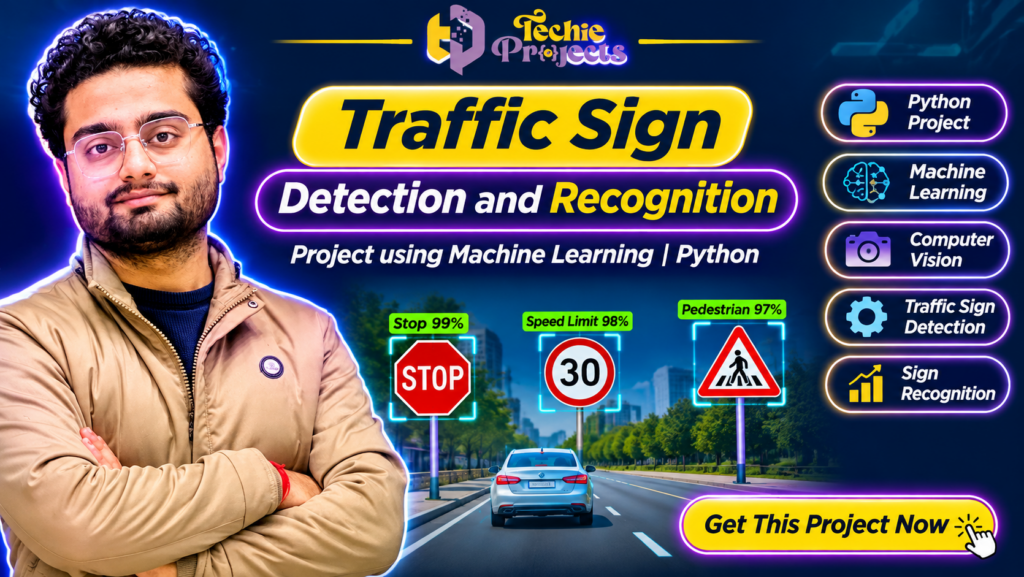
Are you looking for an advanced Traffic Sign Detection and Recognition Project for your final-year engineering project, computer science assignment, or machine learning portfolio? Get a practical Python-based project from Techie Projects and explore how Artificial Intelligence, Machine Learning, and Computer Vision can be used to identify and recognize different road traffic signs.
🎓 Get This Project Now! If you want to save development time and work with a ready-to-explore engineering project, Techie Projects can help you get started with the Traffic Sign Detection and Recognition project. Contact our team for project availability, source code details, demonstration, and purchase assistance.
📞 Contact Techie Projects for Project Enquiries
Interested in purchasing the IoT-Based Smart Home Automation System Project? Contact us to enquire about package availability, pricing, source code, documentation, installation guidance, and technical support options.
💬 WhatsApp Enquiry: Chat with Techie Projects
📱 Contact Number: +91 94600 60699
🌐 Official Website: www.techieprojects.com
📸 Instagram: Follow Techie Projects
🎓 Project Areas: Robotics, Machine Learning, Arduino, Deep Learning, Artificial Intelligence, and Android App.
✅ Request Project Details: Share your engineering branch, preferred features, and technical requirements to enquire about the most suitable available package.
🚀 Ready to get started? Click here to enquire on WhatsApp and mention IoT-Based Smart Home Automation System Project.
Package contents, prices, hardware availability, and support options should be confirmed before purchase.
🎬 Watch the Traffic Sign Detection and Recognition Project Demo
Explore the project demonstration to understand how the system identifies different traffic signs using computer vision and machine learning techniques.
The demonstration gives students an overview of the project interface, traffic sign identification process, and practical working concept.
🚦 What Is Traffic Sign Detection and Recognition?
Traffic Sign Detection and Recognition is an intelligent computer vision application designed to identify and classify road traffic signs from images or video frames.
Traffic signs provide important information to drivers, including speed limits, road directions, warnings, restrictions, and pedestrian crossings. Recognizing these signs correctly is an important part of modern intelligent transportation systems.
Traditional traffic sign identification depends on human attention. However, Artificial Intelligence makes it possible to automate the process using image processing and machine learning algorithms.
The Traffic Sign Detection and Recognition project demonstrates how a computer system can analyze visual information, locate traffic signs, and identify their categories.
Using Python and computer vision technologies, the system processes image information and produces predictions about recognized traffic signs.
This project is particularly useful for students interested in:
- Computer Science Engineering
- Electronics and Communication Engineering
- Electrical Engineering
- Internet of Things
- Artificial Intelligence Projects
- Machine Learning Projects
- Web Development Projects
🎯 Objectives of the Project
The main objective of this Traffic Sign Detection and Recognition project is to develop an intelligent system capable of identifying different traffic signs.
The important objectives include:
- Traffic Sign Identification: Detect traffic signs from input images.
- Image Processing: Process images to extract useful visual information.
- Sign Classification: Identify the category of a detected traffic sign.
- Machine Learning Implementation: Apply machine learning techniques for automated recognition.
- Python Development: Build the application using Python-based technologies.
- Practical Learning: Understand how computer vision can solve real-world transportation problems.
The project also helps students understand the complete workflow of an AI-based image recognition application.
⚙️ How Does Traffic Sign Detection and Recognition Work?
The system generally follows a sequence of image-processing and classification operations.
1. Input Image Acquisition
The first step involves collecting input images containing different traffic signs.
Images can contain signs such as:
- Stop signs
- Speed limit signs
- No-entry signs
- Pedestrian crossing signs
- Directional signs
- Warning signs
The input images are passed to the application for processing.
2. Image Preprocessing
Image preprocessing improves the quality and consistency of input images.
Depending on the implementation, preprocessing may include:
- Image resizing
- Color conversion
- Noise reduction
- Image normalization
- Contrast adjustment
These operations prepare the input images for further analysis.
3. Traffic Sign Detection
The detection stage identifies the location of traffic signs within an image.
Computer vision techniques can analyze image patterns, colors, shapes, and visual features to locate relevant objects.
Depending on the selected implementation, detection can use traditional image processing or deep learning-based object detection techniques.
4. Feature Extraction
After identifying the relevant image region, the system extracts useful information.
Features may include:
- Shape information
- Color patterns
- Edges and contours
- Visual characteristics
- Image representations learned by a neural network
These features help distinguish different traffic sign categories.
5. Traffic Sign Classification
The classification stage determines which category a traffic sign belongs to.
A trained machine learning or deep learning model can compare the extracted visual information with learned patterns and generate a predicted class.
For example, the system may recognize a STOP sign or identify a speed-limit sign.
6. Result Display
Finally, the system displays the predicted traffic sign category.
Depending on the implementation, results can include the detected object, predicted class, bounding box, and confidence score.
This completes the basic Traffic Sign Detection and Recognition workflow.
🧠 Technologies Used in the Project
The project combines several technologies used in modern Artificial Intelligence applications.
🐍 Python
Python is the primary programming language used to develop the application.
It provides a flexible environment for image processing, machine learning, data handling, and application development.
👁️ OpenCV
OpenCV is a popular computer vision library used for image processing and visual analysis.
It provides functions for:
- Reading and displaying images
- Resizing images
- Color conversion
- Image filtering
- Contour detection
- Video processing
🤖 Machine Learning
Machine Learning techniques allow computers to learn patterns from training data.
In this project, machine learning concepts help the system distinguish between different traffic sign categories.
🧠 Deep Learning
Deep Learning can be used to recognize complex visual patterns through neural network architectures.
Depending on the project implementation, convolutional neural networks or object detection models may be used.
📊 Dataset Processing
A traffic sign dataset provides the images and labels required to train and evaluate a recognition model.
Dataset preparation is important because image quality, class distribution, and correct annotations can influence model performance.
⭐ Key Features of the Traffic Sign Detection and Recognition Project
The project demonstrates several useful features related to automated traffic sign identification.
1. Automated Traffic Sign Recognition
The application is designed to recognize traffic sign categories automatically rather than depending entirely on manual identification.
2. Image-Based Detection
Users can provide images for processing and explore how the system identifies traffic signs.
3. Multiple Traffic Sign Categories
The system can be configured to recognize multiple traffic sign classes depending on the dataset used for training.
4. Python-Based Implementation
Python provides an accessible development environment for students learning AI and computer vision.
5. Machine Learning Integration
Machine learning techniques help the application learn visual patterns from training examples.
6. Computer Vision Application
The project demonstrates a practical application of computer vision in intelligent transportation.
7. Educational Demonstration
Students can explore image preprocessing, classification, model training, and prediction workflows.
🚗 Real-World Applications of Traffic Sign Detection and Recognition
Traffic sign recognition is an important concept in intelligent transportation and driver assistance technologies.
Some potential applications include:
1. Autonomous Vehicles
Self-driving vehicle systems use environmental perception technologies to understand roads, traffic signs, and surrounding objects.
Traffic sign recognition can contribute to understanding road instructions.
2. Advanced Driver Assistance Systems
Advanced Driver Assistance Systems (ADAS) can use traffic sign information to support drivers with road awareness.
3. Smart Transportation Systems
Intelligent transportation systems can combine computer vision with other technologies to improve traffic monitoring and road safety.
4. Road Safety Monitoring
Automated recognition can help analyze traffic signs and road conditions in different environments.
5. Intelligent Traffic Management
Traffic information can be combined with other road-monitoring technologies to support smart city transportation applications.
6. Research and Development
Researchers and engineering students can use traffic sign recognition as a foundation for developing more advanced computer vision applications.
📂 Dataset Used for Traffic Sign Recognition
A dataset is an important component of any machine learning-based image recognition project.
For Traffic Sign Detection and Recognition, the dataset generally contains images belonging to different traffic sign categories.
A commonly used research dataset is the German Traffic Sign Recognition Benchmark (GTSRB).
It provides labeled traffic sign images that can be used for classification experiments.
Students can also explore other datasets depending on project requirements.
Dataset preparation generally involves:
- Collecting relevant images
- Organizing images into categories
- Assigning correct labels
- Splitting data into training and testing sets
- Applying preprocessing operations
- Checking class distribution
The quality of the dataset plays an important role in the performance of the trained model.
📈 Advantages of the Traffic Sign Detection and Recognition Project
This project offers several educational and practical advantages.
1. Automation: Demonstrates how traffic signs can be identified automatically.
2. Improved Understanding of AI: Helps students understand practical machine learning and computer vision applications.
3. Python Programming Experience: Provides exposure to Python-based development.
4. Image Processing Knowledge: Introduces preprocessing and visual feature analysis.
5. Expandable Architecture: The project concept can be extended with additional traffic sign categories and detection techniques.
6. Research Opportunities: Provides a foundation for exploring intelligent transportation technologies.
7. Portfolio Development: Students can use their understanding of the project when building an AI and machine learning portfolio.
⚠️ Limitations and Challenges
Although Traffic Sign Detection and Recognition is a useful computer vision application, it has certain challenges.
Lighting Conditions
Images captured during nighttime or under poor lighting conditions may affect recognition performance.
Weather Conditions
Rain, fog, and dust can reduce image clarity and make traffic signs difficult to identify.
Occlusion
Traffic signs may be partially hidden by trees, vehicles, buildings, or other objects.
Image Quality
Low-resolution images can make it difficult to extract useful visual information.
Similar Sign Categories
Some traffic signs have similar shapes, colors, or visual patterns, which can make classification challenging.
Model Generalization
A model trained on one dataset may not perform equally well in different countries or road environments.
Understanding these limitations is important when developing and evaluating real-world traffic recognition applications.
💻 Software and Hardware Requirements
The following are general development requirements. Exact requirements depend on the implementation and model used.
Software Requirements
- Programming Language: Python
- Operating System: Windows 10/11 or compatible environment
- Image Processing: OpenCV
- Machine Learning: Scikit-learn or relevant ML framework
- Deep Learning: TensorFlow or PyTorch, if used
- Development Environment: VS Code, PyCharm, or Jupyter Notebook
Hardware Requirements
- Processor: Intel Core i3 or higher recommended
- RAM: 4 GB minimum; 8 GB or more recommended
- Storage: Sufficient space for datasets and project files
- GPU: Optional for compatible deep learning implementations
- Input Devices: Keyboard and mouse
🎓 Why Choose This Project for Your Final Year Engineering Project?
The Traffic Sign Detection and Recognition project is a suitable topic for students who want to explore the practical implementation of Artificial Intelligence.
It combines programming, image processing, dataset preparation, and model-based prediction.
Students from the following academic backgrounds may find this project relevant:
- Computer Science Engineering
- Information Technology
- Artificial Intelligence and Machine Learning
- Data Science
- Electronics and Communication Engineering
The project can also provide a useful starting point for understanding how AI applications are developed.
Students can study the implementation, understand the algorithms, run experiments, and explore possible improvements.
💰 Get the Traffic Sign Detection and Recognition Project with Source Code
Are you ready to work on your final-year engineering project?
Instead of spending excessive time searching for different implementations, get in touch with Techie Projects to enquire about the Traffic Sign Detection and Recognition project.
We provide project development and technical assistance across multiple engineering domains.
🎁 What Can You Enquire About?
Contact our team to confirm the available project package and deliverables, including:
- Python project implementation
- Source code availability
- Project execution guidance
- Software and library requirements
- Project demonstration
- Documentation availability
- Installation and configuration assistance
- Technical support options
The exact deliverables and support arrangements can be confirmed before purchase.
🚀 Why Choose Techie Projects?
Techie Projects works on engineering projects and technology-based solutions across multiple domains.
Our areas of expertise include:
- Artificial Intelligence
- Machine Learning
- Deep Learning
- Python Development
- Data Science
- Computer Vision
- Image Processing
- Natural Language Processing
- Web Development
- Internet of Things (IoT)
We aim to help engineering students explore practical technology implementations and understand how software projects work.
📞 Contact Techie Projects for Project Enquiries
Interested in purchasing the Traffic Sign Detection and Recognition project?
Get in touch with our team for pricing, availability, source code details, and project assistance.
🔥 Get This Project Now!
📞 Contact / WhatsApp: +91 94600 60699
🌐 Website: www.techieprojects.com
📸 Instagram: @pythonprojects_
📩 Contact us with your academic requirements, preferred technology, and project details. Our team can help you understand the available project options.
💡 Recommended Projects
Explore more engineering projects and practical technology implementations from Techie Projects.
- Artificial Intelligence Projects
- Machine Learning Projects
- Python Projects
- Computer Vision Projects
- Deep Learning Projects
- Image Processing Projects
- Data Science Projects
- IoT Projects
- Web Development Projects
- Final Year Engineering Projects
❓ Frequently Asked Questions (FAQs)
1. What is the Traffic Sign Detection and Recognition project?
It is a computer vision application that identifies and classifies traffic signs from images or video frames using image processing and machine learning techniques.
2. Which programming language is used?
Python is the primary programming language used for this project.
3. Which technologies are used?
Depending on the implementation, the project may use Python, OpenCV, Machine Learning, Deep Learning, and relevant image-processing libraries.
4. Can this project be used for a final-year engineering submission?
Yes. It is a relevant project topic for computer science, IT, AI and ML, and other related engineering branches. Students should understand the implementation and follow their institution’s academic submission guidelines.
5. Is a dataset required?
Yes. A labeled traffic sign dataset is generally required for training and evaluating a machine learning-based recognition model.
6. Can the system recognize multiple traffic signs?
Yes. The system can be trained or configured to recognize multiple traffic sign categories, depending on the dataset and model implementation.
7. How can I purchase this project?
You can contact Techie Projects through WhatsApp at +91 94600 60699 or visit www.techieprojects.com to enquire about pricing, availability, and deliverables.
🏁 Conclusion
The Traffic Sign Detection and Recognition Project demonstrates how Artificial Intelligence, Machine Learning, and Computer Vision can be combined to develop intelligent image recognition applications.
From image preprocessing and feature extraction to traffic sign classification, the project introduces students to important concepts used in modern AI development.
It also provides opportunities to explore intelligent transportation systems, autonomous vehicles, and advanced driver assistance technologies.
If you are looking for a Python-based computer vision project for your academic work, contact Techie Projects to enquire about the Traffic Sign Detection and Recognition project, source code availability, and technical assistance.
🚀 Start your engineering project journey with Techie Projects!
📞 Contact / WhatsApp: +91 94600 60699
📸 Instagram: pythonprojects_

