
Introduction
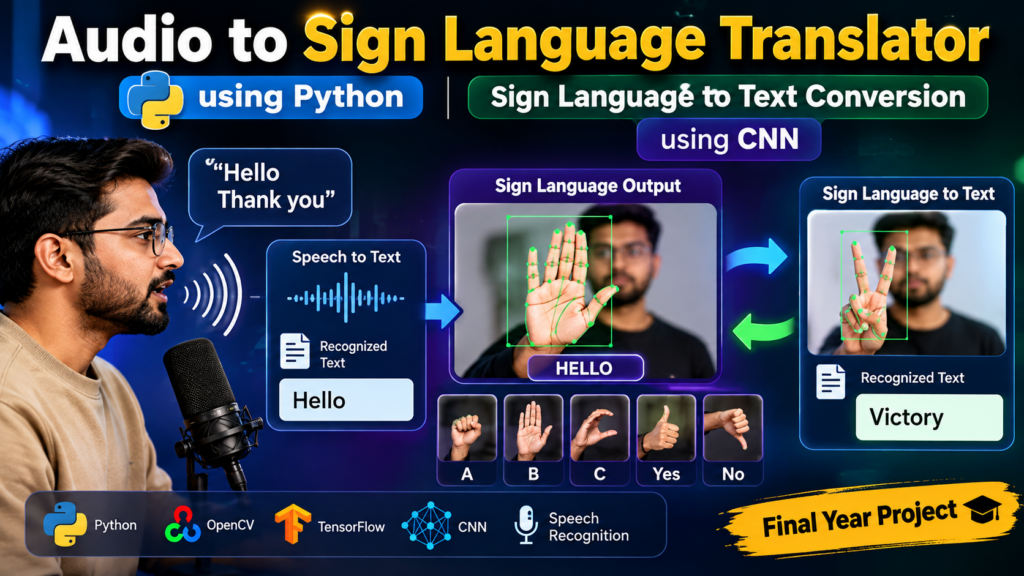
Audio to Sign Language Translator using Python is an AI-based project that combines Speech Recognition, Python, Computer Vision, Deep Learning and Convolutional Neural Networks (CNN) to explore communication between spoken language and sign language.
This project is suitable for B.Tech, BE, BCA, MCA and final-year computer science students looking for an innovative Artificial Intelligence, Machine Learning, Python or Computer Vision project.
The system can be developed with features such as speech-to-text conversion, sign language recognition, CNN-based gesture classification and a user-friendly interface.
What Is an Audio to Sign Language Translator?
An Audio to Sign Language Translator is an AI-based system that processes human speech and converts the recognized speech into corresponding sign language representations.
The basic workflow is:
Voice Input → Speech Recognition → Text Processing → Sign Mapping → Sign Language Output
The project combines several technologies, including:
- Python
- Artificial Intelligence
- Machine Learning
- Computer Vision
- Deep Learning
- Speech Recognition
- Natural Language Processing
- Convolutional Neural Networks
Because of this combination, it can be an interesting AI-based final-year project for students.
How Does the Audio to Sign Language Translator Work?
The system can be divided into several stages.
1. Audio Input
The user provides speech through a microphone. The Python application captures the audio and sends it to the speech recognition module.
2. Speech-to-Text Conversion
The captured audio is processed using a speech recognition system and converted into text.
For example:
Voice Input:
Hello
Recognized Text:
Hello
3. Text Processing
The recognized text is processed by the application. The system identifies words, characters or phrases and maps them to their corresponding sign language representation.
4. Sign Language Recognition
Computer vision and deep learning techniques can be used to recognize different hand gestures.
A CNN (Convolutional Neural Network) can be trained using a dataset containing different sign language gestures.
The model can learn patterns such as:
- Hand shape
- Finger position
- Hand orientation
- Gesture structure
5. Sign Language Output
The corresponding sign can be displayed using:
- Sign language images
- Gesture videos
- Animated signs
- Real-time visual representations
Technologies Used
| Technology | Purpose |
|---|---|
| Python | Main programming language |
| OpenCV | Image and video processing |
| CNN | Gesture classification |
| Speech Recognition | Audio-to-text conversion |
| NumPy | Numerical processing |
| TensorFlow/Keras | Deep learning |
| Machine Learning | Pattern recognition |
| Computer Vision | Gesture recognition |
| Streamlit/Tkinter | User interface |
Major Features of the Project
Speech Input
The system can capture speech through a microphone.
Speech-to-Text
Spoken words can be converted into text using speech recognition.
AI-Based Processing
Machine learning and deep learning techniques can be integrated into the project.
Sign Language Recognition
CNN and computer vision techniques can be used to classify different gestures.
Sign Representation
Recognized words can be represented using images, videos or other visual formats.
User-Friendly Interface
A simple graphical or web interface can make the project easier to operate and demonstrate.
Real-Time Processing
The system can be extended to process audio and gestures in near real time.
Why Use CNN for Sign Language Recognition?
A Convolutional Neural Network (CNN) is widely used for image classification and computer vision applications.
In this project, CNN can learn visual patterns from sign language images.
The basic process is:
Input Image → CNN Layers → Feature Extraction → Classification → Recognized Sign
The model can be trained using a dataset containing different hand gestures.
After training, the model can predict the corresponding gesture from a new image captured using a camera.
Dataset for Sign Language Recognition
The performance of a deep learning model depends significantly on the quality and diversity of its dataset.
A dataset can contain images representing different signs, alphabets or gestures.
For example:
Dataset
│
├── Hello
├── Thank You
├── Yes
├── No
├── A
├── B
├── C
└── ...
Students can also create a custom sign language dataset using a webcam and train their own CNN model.
This makes the project more customizable and provides an opportunity to understand the complete machine learning workflow.
Project Architecture
A basic system architecture can look like this:
             Microphone
                  ↓
             Audio Input
                  ↓
         Speech Recognition
                  ↓
             Text Output
                  ↓
          Text Processing
                  ↓
       Sign Language Mapping
                  ↓
        Sign Language Output
The computer vision component can follow:
Webcam
   ↓
Image Capture
   ↓
Image Preprocessing
   ↓
CNN Model
   ↓
Gesture Classification
   ↓
Recognized Sign
Advantages of the Project
The Audio to Sign Language Translator provides an opportunity to combine several important technologies into one project.
Accessibility
The project explores technology that can assist communication accessibility.
Real-World AI Application
It demonstrates how AI can be applied to a communication-related problem.
Strong Final-Year Project
Students can demonstrate knowledge of:
- Python
- Artificial Intelligence
- Machine Learning
- Deep Learning
- Computer Vision
- CNN
- Speech Recognition
Customizable Project
The project can be modified according to the student’s academic requirements and project scope.
Future Scope
The project can be extended with several advanced features.
Real-Time Sign Language Translation
The system can be developed to continuously process conversations.
Mobile Application
The project can be converted into an Android or cross-platform application.
Multi-Language Support
Speech recognition can be extended to support multiple languages.
Sentence-Level Translation
Instead of processing individual words, the system can process complete sentences.
3D Avatar-Based Signs
A 3D animated character can be used to represent sign language.
Advanced NLP
Natural Language Processing models can be integrated to understand sentence context and improve the translation process.
Applications of Audio to Sign Language Translator
This type of technology can be explored in:
- Educational institutions
- Accessibility applications
- Communication assistance
- Healthcare communication
- Customer service
- Public service applications
- AI research
- Human-computer interaction
- Assistive technology
Why Is This a Good Final-Year Project?
Students searching for a Python final-year project or AI/ML project often want something more than a basic application.
This project combines:
Python + Speech Recognition + CNN + Computer Vision + Deep Learning + AI
Because multiple technologies are involved, the project can provide students with a strong topic for their project demonstration, presentation and viva.
Can This Project Be Customized?
Yes. The project can be customized according to your college requirements, project scope and preferred technologies.
Possible customization options include:
- Python-based implementation
- CNN-based implementation
- Real-time webcam recognition
- Speech-to-text integration
- Web-based interface
- Desktop application
- Custom dataset
- Additional sign classes
- Database integration
- Advanced AI features
Looking for the Complete Project?
If you are planning to develop an Audio to Sign Language Translator using Python as your final-year or academic project, you may need more than just the basic concept.
A complete project package can include:
- Complete Python Source Code
- AI/ML Model
- Dataset
- Project Setup
- User Interface
- Project Documentation
- Flowcharts and Diagrams
- PPT Presentation
- Project Report
- Demo Explanation
- Viva Preparation
- Customization According to Requirements
Need a Customized Project?
Techie Projects provides project development and customization assistance for students working on Python, Artificial Intelligence, Machine Learning, Computer Vision, Deep Learning, NLP and other technology projects.
If you already have a project idea or need help selecting a suitable project, you can contact us and discuss your requirements.
Have a project idea? Need source code, documentation or a customized final-year project?
☎️ Contact Us For More Queries:-
📲 Call/WhatsApp: +91-9460060699
🌎 Website: www.techieprojects.com
Share your project requirements with us and discuss the scope, features and customization options.
Recommended AI & Python Final Year Projects
- Face Recognition Based Attendance System Using Python
- Gesture Control Virtual Steering Using OpenCV
- Sign Language Recognition Using CNN
- Object Detection and Recognition Using Python
- AI Exam Proctoring System Using Python
- Fake News Detection Using Machine Learning
- DeepFake Detection Using Python
- Helmet and Number Plate Detection Using Python
Frequently Asked Questions
What is an Audio to Sign Language Translator?
It is an AI-based system that processes spoken audio, converts speech into text and maps the recognized communication to sign-language representations.
Which programming language is used for this project?
Python is one of the most suitable languages because it provides libraries for speech recognition, computer vision and deep learning.
Can CNN be used for sign language recognition?
Yes. CNN models can be trained to classify images of different hand gestures and sign-language classes.
Is this project suitable for B.Tech final-year students?
Yes. It can be developed as an AI, Machine Learning, Computer Vision or Python-based final-year project.
Can this project work in real time?
Yes. The project can be extended to support real-time audio processing and webcam-based gesture recognition.
Can I customize the project?
Yes. The dataset, sign classes, user interface, model and additional features can be customized according to your requirements.
Can I get the source code and documentation?
Project source code, documentation, presentation and other project materials can be provided according to the selected project scope.
Do you develop other AI and Python projects?
Yes. You can contact Techie Projects for requirements related to Artificial Intelligence, Machine Learning, Python, Computer Vision, NLP, Deep Learning, IoT and Data Science projects.
Conclusion
The Audio to Sign Language Translator using Python is an interesting combination of Speech Recognition, Computer Vision, Deep Learning and Artificial Intelligence.
It provides students with an opportunity to work on a practical AI project while learning technologies such as Python, CNN, OpenCV, Speech Recognition and TensorFlow/Keras.
For students looking for a unique B.Tech final-year project, AI project, Python project or Machine Learning project, this project can be further enhanced with real-time recognition, custom datasets, web interfaces and advanced AI features.
Have a similar project idea?
📲 Call/WhatsApp: +91-9460060699
🌎 Visit: www.techieprojects.com
Discuss your requirements with Techie Projects and get started with your project.