
Introduction
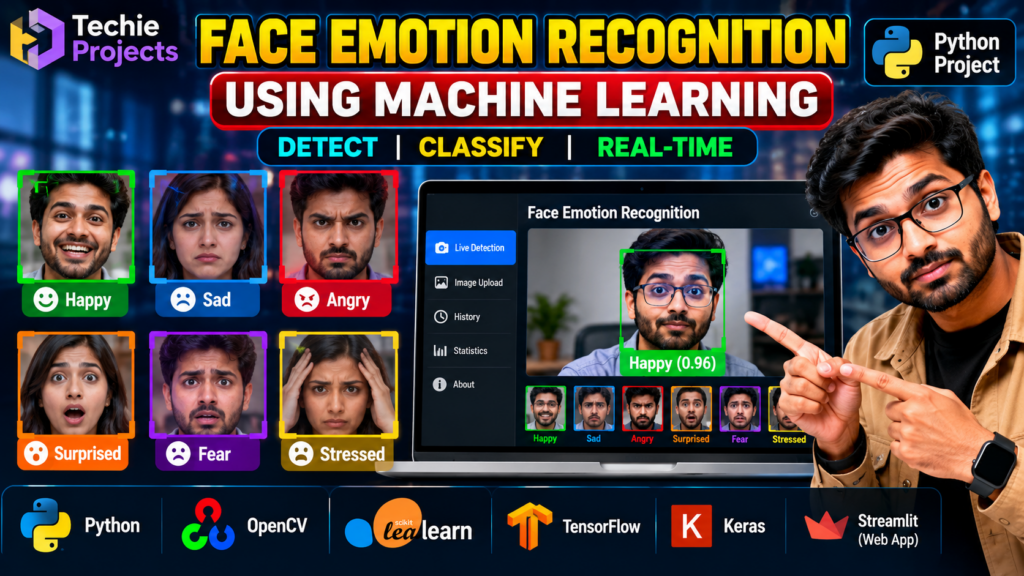
Face emotion recognition using machine learning is an interesting artificial intelligence project that analyzes facial expressions to identify emotions such as happiness, sadness, anger, surprise, and stress-related expressions. This project demonstrates how Python, computer vision, and machine learning techniques can be combined to build an intelligent facial expression recognition system.
Face emotion recognition using machine learning combines facial image processing with trained models to classify visible expressions. This project demonstrates how Python and computer vision can be used to develop an interactive facial expression recognition application.
The project is suitable for B.Tech, BCA, MCA, computer science engineering, and final-year students looking for a practical AI or machine learning project. It can help students understand image processing, facial expression analysis, model prediction, and real-time computer vision applications.
🎬 Project Demo – Face Emotion Recognition Using Machine Learning
Watch the project demonstration to understand how the system analyzes facial expressions and displays predicted emotion labels. The demo can help you explore the interface, project workflow, and major features before choosing the project for your academic work.
🎯 Project Objectives
The main objectives of this face emotion recognition project are:
- Detect a human face from an image or camera feed, depending on the implementation.
- Analyze facial expression patterns using a trained machine learning model.
- Classify supported expressions into emotion categories.
- Display predicted emotion labels through a graphical user interface.
- Demonstrate the practical use of Python and computer vision in AI applications.
- Help students understand model training, prediction, and system integration.
⚙️ Key Features of the Project
1. Facial Expression Detection
The system processes facial images and identifies the face region for further analysis. Face detection may be implemented using OpenCV or another compatible computer vision method.
2. Emotion Classification
A trained model can classify supported facial expressions into categories such as happy, sad, angry, surprised, neutral, or fearful, depending on the dataset and model configuration.
3. Python-Based Implementation
Python provides a flexible development environment for image processing, model integration, and application development.
4. Graphical User Interface
A graphical interface can make the application easier to operate by allowing users to provide input, view predictions, and interact with the system.
5. Real-Time Analysis
If webcam support is implemented, the system can process camera frames and display predicted expressions during operation. Performance depends on the model, hardware, lighting, and camera quality.
6. Learning-Oriented Design
The project demonstrates the integration of machine learning and computer vision in a single application, making it useful for academic demonstrations and practical learning.
🧠 How Does Face Emotion Recognition Using Machine Learning Work?
The system generally follows these steps:
- Input collection: Provide a facial image or live camera feed, depending on the available features.
- Face detection: Locate the face within the input image.
- Image preprocessing: Resize the face image and apply the preprocessing required by the trained model.
- Model prediction: Pass the processed image to the machine learning or deep learning model.
- Emotion classification: Obtain prediction scores for the emotion categories supported by the model.
- Result display: Show the predicted label and, if implemented, its confidence score in the interface.
The exact workflow depends on the model architecture, training dataset, and features included in the delivered project.
The face emotion recognition using machine learning workflow includes face detection, image preprocessing, model prediction, and displaying the predicted emotion. Each stage contributes to the overall facial expression classification process.
🛠️ Technologies Used
The following technologies may be used in a Python-based implementation:
- Programming language: Python
- Computer vision: OpenCV
- Machine learning: Scikit-learn or a compatible machine learning framework
- Deep learning: TensorFlow or Keras, if the project uses a neural network
- Image processing: NumPy and image preprocessing utilities
- User interface: Tkinter or another GUI framework, depending on the implementation
- Development environment: Visual Studio Code, PyCharm, or another Python IDE
Confirm the actual libraries and versions with the project package before installation.
💻 Software and Hardware Requirements
Software Requirements
- Windows, Linux, or another compatible operating system
- Python installation compatible with the project’s dependencies
- Required Python libraries and trained model files
- A suitable code editor or IDE
- Webcam, if live camera functionality is included
Hardware Requirements
- Computer or laptop
- Recommended 8 GB RAM for a more comfortable development experience
- Processor capable of running the selected model
- Webcam for real-time input, if supported
Actual hardware requirements depend on the model size and whether inference runs on the CPU or GPU.
🎓 Applications of Face Emotion Recognition
Face emotion recognition using machine learning can be explored in several educational and research settings:
- Human-computer interaction: Demonstrating expression-aware interfaces.
- Academic research: Studying facial expression classification methods.
- Computer vision learning: Understanding face detection and image preprocessing.
- Interactive applications: Building prototypes that respond to predicted expression categories.
- AI demonstrations: Presenting a practical machine learning application during project reviews.
Facial expressions do not reliably reveal a person’s true feelings or mental health. Predictions may be affected by lighting, camera angle, cultural differences, and individual variation. The project should therefore be treated as an educational prototype, not a reliable psychological assessment system.
📊 Advantages of the Project
- Provides practical experience with Python and AI.
- Demonstrates an end-to-end computer vision workflow.
- Helps students learn how trained models make predictions.
- Can be extended with additional datasets and model architectures.
- Offers a visual demonstration suitable for academic presentations.
- Introduces students to real-time image processing when webcam support is available.
- One advantage of face emotion recognition using machine learning is that it gives students practical experience with Python, image processing, and AI model integration in a single project.
🚀 Future Scope
Students can extend the project with additional features, subject to the capabilities of their implementation:
- Add support for more facial expression categories.
- Improve preprocessing and evaluate alternative model architectures.
- Display prediction confidence scores.
- Add a webcam-based interface.
- Create a dashboard for reviewing model predictions.
- Explore speech emotion recognition as a separate module.
- Evaluate the model using precision, recall, F1-score, and a confusion matrix.
Speech emotion recognition requires audio input and a suitable audio-processing model; it should not be described as an existing feature unless it is included in the project.
🛒 Get the Face Emotion Recognition Project
Are you looking for a face emotion recognition using machine learning project for your final-year submission, practical learning, or college demonstration?
Techie Projects can help you explore project availability and discuss the implementation requirements before purchasing.
Contact us to ask about the project package, source code availability, setup instructions, supported features, and customization options. Confirm the deliverables and compatibility before placing your order.
📲 Call/WhatsApp: +91-9460060699
🌎 Website: www.techieprojects.com
📺 Instagram: @pythonprojects_
🔗 Explore Related Projects
Explore related project categories and discover more ideas for your academic work:
- Facial Expression Recognition Using Deep Learning
- Sign Language to Text Conversion Using Machine Learning
- Stress Detection Using Facial Expressions
- Gender and Age Detection Using Machine Learning
- Face Recognition Attendance System Using Python
- Speech Emotion Recognition Using Deep Learning
❓ Frequently Asked Questions
1. What is face emotion recognition using machine learning?
It is a computer vision application that uses a trained model to classify facial images into supported expression categories.
2. Which programming language is used in this project?
Python is commonly used because it supports machine learning, image processing, and computer vision libraries.
3. Can this project run in real time?
Yes, if webcam input and real-time inference are implemented. Performance depends on the model and computer hardware.
4. Is this project suitable for final-year students?
Yes. It can be suitable for B.Tech, BCA, MCA, and computer science students interested in machine learning and computer vision.
5. Can I customize the project?
Customization may be possible depending on the available source code and model. Discuss your requirements before purchasing.
6. Where can I enquire about the project price?
You can contact Techie Projects through WhatsApp to ask about pricing, deliverables, and availability.
Conclusion
Face emotion recognition using machine learning is a useful educational project for exploring facial expression classification, Python programming, image processing, and artificial intelligence. It provides students with an opportunity to understand how computer vision models process images and generate predictions.
Students exploring face emotion recognition using machine learning can extend the project by testing different models, improving preprocessing, and evaluating classification performance on suitable datasets.
If you want to use this project for your final-year submission or practical learning, contact Techie Projects to discuss the available implementation, source code, setup requirements, and pricing before purchasing.