
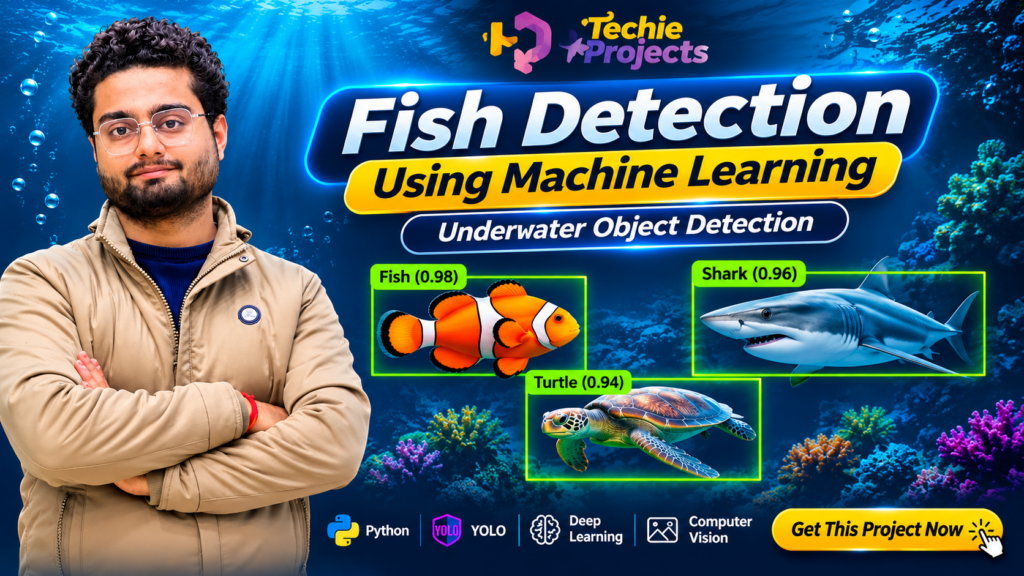
🐟 Looking for a ready-to-use Fish Detection Using Machine Learning project for your final-year engineering submission? Get a practical underwater object detection project from Techie Projects and save time on initial development, model implementation, and project preparation. This project explores how deep learning and computer vision can identify fish and other underwater objects from supported images or video inputs.
Instead of spending weeks searching for a suitable project topic and building every component from scratch, you can enquire about the Fish Detection Using Machine Learning project package from Techie Projects. Get details about the available source code, documentation, implementation requirements, demonstration, and technical support before purchasing.
Whether you are pursuing B.Tech, M.Tech, BCA, MCA, or another computer science programme, this project can help you explore an interesting application of artificial intelligence in underwater image analysis.
🎓 Get your project details today!
📞 Contact Techie Projects for Project Enquiries
- WhatsApp: https://wa.me/919460060699
- Contact Number: +91 94600 60699
- Website: https://techieprojects.com/
- Instagram: https://www.instagram.com/pythonprojects_/
🎬 Watch the Fish Detection Using Machine Learning Project Demo
Explore the project demonstration to understand how underwater objects can be processed and detected using computer vision and deep learning techniques.
The demonstration can help you understand the expected interface, detection workflow, and visual output. Check the available project demo and package details with Techie Projects before purchasing.
🐠 What Is Fish Detection Using Machine Learning?
Fish Detection Using Machine Learning is a computer vision application that uses trained machine learning or deep learning models to identify fish in underwater images and video footage.
Underwater environments contain different types of objects, including fish, aquatic plants, rocks, coral reefs, and other marine organisms. Manually observing and identifying these objects in large collections of images or videos can require considerable time and effort.
Computer vision provides techniques for analysing visual information automatically. A detection model can process an image or video frame, identify objects that match its trained classes, and display the detection results.
Depending on the model and dataset used, a fish detection system may identify selected fish categories and other supported underwater objects. Object detection models can also display bounding boxes and confidence scores around detected objects.
The Fish Detection Using Machine Learning project provides an academic opportunity to understand the combination of Python programming, image processing, deep learning, and object detection.
🎯 Objectives of the Fish Detection Project
The primary objective of this project is to demonstrate how artificial intelligence can be applied to underwater object detection.
Important project objectives include:
- Underwater image analysis: Process underwater images and visual inputs using computer vision techniques.
- Fish identification: Detect fish categories supported by the trained model.
- Object detection: Explore how deep learning models locate objects within images.
- Visual result presentation: Display detection results in an understandable format.
- Python implementation: Understand the use of Python libraries for computer vision and machine learning.
- Model understanding: Learn about datasets, model training, inference, and prediction.
- Academic learning: Explore a practical application of AI and deep learning.
These objectives make the project relevant to students interested in computer vision, artificial intelligence, and machine learning.
⚙️ How Does Fish Detection Using Machine Learning Work?
The general workflow of a fish detection application involves several stages. The exact implementation depends on the model, dataset, and software package supplied with the project.
1. Image or Video Input
The system receives an underwater image or video as input. Depending on the available implementation, users may select an image from their computer or provide a supported video source.
The quality of the input image can affect detection results. Clear images with visible objects generally provide better conditions for model inference.
2. Image Preprocessing
Before object detection, the input may be prepared for the model.
Common preprocessing operations include:
- Resizing images to the required dimensions.
- Converting image formats when necessary.
- Normalising pixel values.
- Preparing image data for model inference.
- Extracting individual frames from video input.
Preprocessing helps ensure that the input follows the model’s expected format.
3. Deep Learning Model
The trained deep learning model analyses the image and identifies objects belonging to its supported classes.
Depending on the implementation, the project may use a YOLO-based object detection architecture or another suitable deep learning model.
The model learns visual patterns from labelled training images. These patterns help it recognise objects during prediction.
4. Fish and Underwater Object Detection
After processing the input, the model generates predictions for objects it recognises.
The output may include:
- Detected object labels.
- Bounding boxes around recognised objects.
- Confidence scores.
- Processed images showing detection results.
The exact object categories depend on the dataset and trained model.
5. Displaying Detection Results
The final stage presents the output to the user. A graphical interface or visual output window may show the processed image with detection information.
This makes it easier to understand how an object detection model works in a practical application.
🧠 Technologies Used in the Fish Detection Project
The project introduces several technologies commonly used in artificial intelligence and computer vision.
Python
Python is widely used for machine learning and deep learning development. Its libraries make it suitable for image processing, model inference, data preparation, and application development.
Deep Learning
Deep learning models learn patterns from training data and can perform complex visual recognition tasks.
In this project, deep learning is used to analyse underwater images and detect supported object categories.
YOLO Object Detection
YOLO is a family of object detection models designed to identify and locate objects in images.
A YOLO-based implementation can produce object labels and bounding boxes. The model’s accuracy and supported classes depend on the selected architecture, training dataset, and configuration.
OpenCV
OpenCV is a computer vision library used for image and video processing. It can support tasks such as reading images, resizing frames, displaying results, and handling video input.
Computer Vision
Computer vision enables computers to extract useful information from images and videos. It is an important part of underwater object detection and automated visual analysis.
📊 Features of the Fish Detection Using Machine Learning Project
The available features depend on the selected project package and its implementation. The project may demonstrate the following capabilities:
- Underwater Object Detection: Analyse supported underwater images.
- Fish Detection: Identify fish categories included in the trained model.
- Deep Learning Integration: Apply a trained model for object recognition.
- Bounding Box Display: Visualise detected objects with bounding boxes when supported.
- Confidence Scores: Display model confidence values where available.
- Image Processing: Prepare input images for model prediction.
- Video Processing: Process video frames if video support is included.
- Graphical Interface: Use the supplied interface, if included in the package.
Before ordering, contact Techie Projects to confirm the exact features, supported object classes, input formats, and deliverables included in the current version.
🌊 Applications of Underwater Fish Detection
Underwater object detection has potential applications in different research and technology areas.
1. Marine Research
Researchers can use computer vision techniques to analyse underwater images and study selected marine organisms.
2. Aquatic Life Monitoring
Automated image analysis can support the observation of aquatic life in controlled research environments.
3. Fisheries Research
Image-based detection techniques can be explored for studying fish populations and underwater visual data.
4. Underwater Robotics
Computer vision can be integrated into underwater robotic systems to help analyse visual information from cameras.
5. Marine Biodiversity Studies
Deep learning-based image analysis can assist researchers in organising and examining large collections of underwater images.
These are potential application areas of the technology. The academic project itself should not be considered a complete commercial marine monitoring solution.
🎓 Why Choose This Project for Your Final-Year Submission?
Selecting an appropriate final-year project is an important part of an engineering or computer science programme. A good project should help you understand practical implementation concepts and explain the technology used.
The Fish Detection Using Machine Learning project offers several learning opportunities.
1. Practical AI Experience
Understand how artificial intelligence models can analyse real-world visual data.
2. Python Programming Knowledge
Explore Python-based development and commonly used computer vision libraries.
3. Deep Learning Concepts
Learn about model inference, training data, object classes, and prediction results.
4. Computer Vision Implementation
Understand image processing and object detection workflows.
5. Project Demonstration
Use the available demonstration to understand the system’s expected behaviour and prepare to explain its workflow.
6. Technical Presentation
The project provides an interesting topic for discussing AI applications, model architecture, datasets, and visual recognition.
💼 Why Purchase the Fish Detection Project from Techie Projects?
Building a complete machine learning project independently can take time, particularly when you are learning new libraries and model architectures.
Techie Projects helps students explore ready-made academic project options across artificial intelligence, machine learning, Python, computer vision, data analytics, and other technical domains.
When you enquire about the Fish Detection Using Machine Learning project, you can discuss:
- Available project source code.
- Project documentation availability.
- Software installation requirements.
- Model and dataset details.
- Demonstration and implementation workflow.
- Technical support options.
- Package pricing and delivery details.
- Possible customisation requirements.
Our goal is to help students identify a suitable project package according to their academic requirements.
Why wait? Contact Techie Projects today to check availability and purchase details for your Fish Detection project.
🛒 How to Purchase the Fish Detection Using Machine Learning Project
Getting project details from Techie Projects is simple.
Step 1: Contact Our Team
Send your enquiry through WhatsApp or the official website.
Step 2: Share Your Requirements
Tell us your course, academic level, preferred programming language, and project requirements.
Step 3: Confirm Package Details
Ask about the available source code, documentation, model, dataset, demonstration, and technical support.
Step 4: Confirm Pricing
Review the package price and included deliverables before placing your order.
Step 5: Receive Project Details
After confirming your order, follow the agreed delivery process and review the supplied project materials.
📞 Contact Techie Projects
- 📲 WhatsApp: https://wa.me/919460060699
- ☎️ Phone: +91 94600 60699
- 🌐 Website: https://techieprojects.com/
- 📸 Instagram: https://www.instagram.com/pythonprojects_/
Techie Projects – Your Partner in Engineering Projects.
🧪 Future Enhancements for Fish Detection
Students can explore several possible improvements to understand the broader scope of underwater computer vision.
Some possible future enhancements include:
- Multiple Fish Classification: Train a model to recognise additional fish categories using a suitable labelled dataset.
- Improved Underwater Image Quality: Explore image enhancement techniques to improve visibility in low-light or unclear underwater images.
- Real-Time Video Detection: Extend the application to process supported live video streams.
- Object Tracking: Investigate tracking methods to follow detected objects across consecutive video frames.
- Detection Performance Evaluation: Evaluate model performance using suitable metrics such as precision, recall, and mean average precision.
- Web-Based Interface: Explore deploying the model through a web application.
- Larger Training Dataset: Experiment with additional labelled underwater images to improve model generalisation.
These enhancements are ideas for further development and may require additional datasets, hardware, and implementation work.
📚 Software and Hardware Requirements
The exact requirements depend on the model architecture and project package.
Software Requirements
- Programming Language: Python.
- Operating System: Windows or another supported platform.
- Computer Vision Library: OpenCV, if used.
- Deep Learning Framework: As specified by the supplied model.
- Object Detection Model: As specified in the project package.
- Development Environment: A compatible Python IDE or code editor.
Hardware Requirements
- Processor: A modern computer processor.
- RAM: Sufficient memory for the selected model and input data.
- Storage: Adequate space for source code, libraries, model weights, and datasets.
- GPU: Optional for some implementations; requirements depend on the model and processing workload.
Confirm the exact software versions and hardware requirements before installation.
🔍 Benefits of Fish Detection Using Machine Learning
Implementing Fish Detection Using Machine Learning offers students an opportunity to understand how artificial intelligence can solve practical image recognition problems. By analysing underwater images, students can explore how computer vision models identify visual patterns and detect supported aquatic objects.
Some important benefits include:
- Automated Detection: Reduce the need for manually inspecting every image.
- Deep Learning Experience: Understand how trained models perform object detection.
- Visual Recognition: Explore how computers identify fish using image features.
- Practical Python Development: Work with Python-based machine learning and computer vision tools.
- Research Opportunities: Explore applications related to marine research and aquatic image analysis.
🐟 Why Is Fish Detection Using Machine Learning an Interesting AI Project?
Fish Detection Using Machine Learning combines multiple important areas of computer science, including Python programming, image processing, artificial intelligence, and deep learning.
Students can understand how a detection model processes underwater images, recognises supported object categories, and presents prediction results. This makes the project useful for exploring practical computer vision concepts.
It also provides opportunities to experiment with different datasets, detection models, and image preprocessing techniques.
🎓 Skills You Can Learn from This Project
Working with Fish Detection Using Machine Learning can help students explore several technical skills:
- Python programming and library integration.
- Image preprocessing using computer vision.
- Deep learning model inference.
- Object detection and bounding box visualisation.
- Dataset preparation and model evaluation.
- Understanding real-world AI applications.
These concepts can help students explain the technical workflow during project demonstrations and academic presentations.
💡 Recommended AI, Machine Learning & Computer Vision Projects
Interested in exploring more artificial intelligence and computer vision applications? Check out these related engineering projects from Techie Projects.
🐟 1. Underwater Object Detection Using Deep Learning
Explore deep learning techniques to identify and locate objects in underwater images.
🚗 2. Vehicle Detection and Counting Using Python
Develop a computer vision application to detect vehicles and count them in images or video footage.
🪖 3. Helmet Detection Using Machine Learning
Explore how computer vision models identify motorcycle riders wearing or not wearing helmets.
🔢 4. Automatic Number Plate Recognition Using Python
Learn how image processing and object detection techniques can be applied to vehicle number plate recognition.
🌿 5. Plant Leaf Disease Detection Using Deep Learning
Explore image classification techniques for identifying selected plant leaf diseases.
🐾 6. Animal Detection Using YOLO
Understand how YOLO-based models detect and classify supported animal categories.
👤 7. Face Recognition Attendance System
Explore face detection and recognition techniques for an automated attendance application.
🔍 8. Real-Time Object Detection Using YOLO
Build your understanding of object detection through a computer vision application that identifies supported objects.
❓ Frequently Asked Questions
1. What is the Fish Detection Using Machine Learning project?
It is an academic computer vision project that explores how machine learning and deep learning models can detect fish and supported underwater objects in images or videos.
2. Which programming language is used?
Python is commonly used for this type of project. Confirm the programming language included in the available package before purchasing.
3. Does the project use YOLO?
A YOLO-based model can be used for underwater object detection. Contact Techie Projects to confirm the exact model architecture supplied with the project.
4. Can it detect multiple fish?
The system can detect multiple objects when the trained model and implementation support multiple detections. The available object categories depend on the training dataset.
5. Does the project support real-time detection?
Real-time detection depends on whether live video input is included and whether the hardware can process frames at a suitable speed. Confirm this feature before ordering.
6. Is source code available?
Contact Techie Projects to confirm source code availability and the exact deliverables included in the selected package.
7. Is this project suitable for final-year engineering students?
Yes. It can be a relevant academic project for students interested in Python, artificial intelligence, machine learning, deep learning, and computer vision.
8. Can I get project documentation?
Ask the Techie Projects team about documentation availability and the materials included in the selected package.
9. Can the project be customised?
Customisation may be possible depending on the project implementation, technical requirements, and feasibility. Share your requirements before placing an order.
10. How can I purchase this project?
Contact Techie Projects through WhatsApp at +91 94600 60699 or visit https://techieprojects.com/ to enquire about pricing and availability.
🚀 Conclusion
The Fish Detection Using Machine Learning project is an interesting academic application of artificial intelligence, deep learning, and computer vision. It demonstrates how trained models can analyse underwater images and identify supported fish or other object categories.
For students pursuing computer science, information technology, artificial intelligence, or related engineering programmes, this project provides an opportunity to explore Python-based development and practical object detection concepts.
If you are looking for a Fish Detection Using Machine Learning project for your final-year submission, contact Techie Projects to discuss the available package, source code, documentation, demonstration, and technical support.
🎯 Don’t waste time searching for your next project. Enquire about the Fish Detection Using Machine Learning project today!