
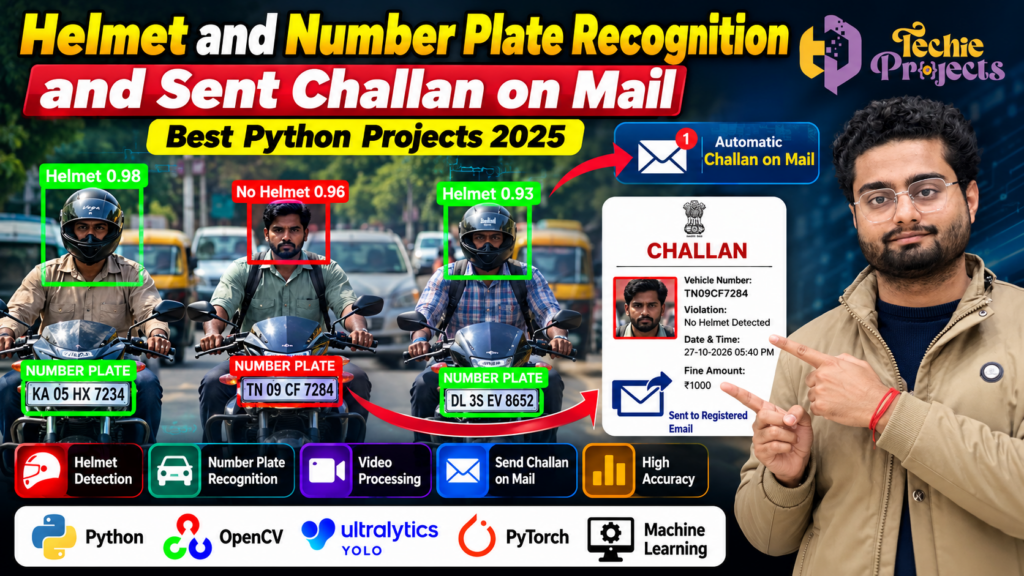
Are you looking for a practical Helmet and Number Plate Recognition project using Python for your final-year engineering submission, computer vision portfolio, or machine learning demonstration? Techie Projects helps students explore real-world software project concepts through practical, application-oriented project solutions.
This project combines vehicle monitoring, helmet detection, number plate recognition, and email-based challan notification into one computer vision application. Instead of choosing a basic project that only displays theoretical results, you can explore how Python, OpenCV, and object detection techniques can work together to address a road-safety problem.
🎓 Looking for a ready-to-explore engineering project? Contact Techie Projects to enquire about the availability, price, implementation details, and deliverables for this project before purchasing. Get a project that matches your academic requirements and gives you a useful opportunity to learn about computer vision and intelligent traffic monitoring.
🎬 Watch the Helmet and Number Plate Recognition Project Demo
Watch the Helmet and Number Plate Recognition project demonstration to understand the intended workflow, visual output, and application concept.
The demonstration can help you explore how a computer vision system may identify motorcycles, detect helmet-related violations, locate number plates, and prepare an email notification. Review the actual video output and confirm the implemented features before selecting the project for your submission.
🚦 What Is Helmet and Number Plate Recognition Using Python?
Helmet and Number Plate Recognition using Python is a computer vision project designed to demonstrate how video or image processing can support road-safety monitoring.
The system can combine object detection with number plate recognition to identify relevant objects in traffic footage. Depending on the implementation, it may detect motorcycles and riders, classify helmet usage, locate vehicle registration plates, extract plate characters, and generate a notification when a configured violation is identified.
The project brings together several important areas of software development:
- Computer vision and image processing
- Object detection using machine learning
- Helmet and vehicle identification
- Number plate localisation and character recognition
- Event handling and notification workflows
- Testing, evaluation, and result visualisation
The exact capabilities depend on the trained models, datasets, OCR method, and application code used in the implementation.
🎯 Why Choose This Python Project for Your Final Year?
Engineering students often need a project that demonstrates technical understanding while remaining practical to explain during a presentation or viva. This project offers several learning opportunities.
1. Practical computer vision experience
Students can explore how software analyses images and video frames to identify objects. This provides a practical introduction to image acquisition, preprocessing, object detection, and visual output.
2. Python programming skills
Python provides access to libraries for image processing, model inference, data handling, and application development. Working with these components helps students understand how separate modules can be integrated into a single application.
3. Machine learning and object detection
The project introduces the role of trained detection models in recognising objects such as motorcycles, riders, helmets, and number plates. Students can investigate confidence scores, detection boxes, classification results, and model limitations.
4. A real-world application
Road safety is a familiar problem with clear practical relevance. A traffic-monitoring application provides a useful way to discuss how automation might assist human operators while also considering privacy, reliability, and responsible use.
5. A demonstration-friendly concept
Visual results can make a project easier to demonstrate during academic presentations. A suitable demonstration may show video frames, detected objects, number plate regions, and any notification workflow supported by the actual implementation.
🚦 Benefits of Helmet and Number Plate Recognition for Engineering Students
The Helmet and Number Plate Recognition project provides an opportunity to explore practical applications of Python programming, computer vision, and machine learning. It combines multiple technical concepts in a single road-safety application, making it a useful topic for engineering students interested in intelligent transportation systems.
Students can learn how object detection models identify helmets and vehicles, how number plate regions are located, and how optical character recognition can extract registration characters. The project also introduces application integration through image processing, event handling, and notification workflows.
Another benefit of the Helmet and Number Plate Recognition system is its potential for visual demonstration. Students can study detection results, evaluate model performance, identify recognition errors, and explain the limitations of automated traffic monitoring.
⚙️ How Does the System Work?
A typical implementation can be organised into the following stages.
Step 1: Input image or video
The application receives traffic footage from a video file, sample images, or a camera feed, depending on the supported configuration.
Step 2: Frame preprocessing
Video frames may be resized, converted into the required format, or otherwise prepared for model inference. Preprocessing helps maintain consistency between the input and the model’s expected format.
Step 3: Helmet detection
A trained object detection model analyses the frame for relevant classes. Depending on the model, these may include helmets, riders, motorcycles, or people without helmets.
Detection results depend on training data, image quality, camera position, lighting, occlusion, and the model’s confidence threshold.
Step 4: Number plate detection
The application identifies the region containing a vehicle registration plate. A detection model or another image-processing technique can be used to locate the plate within the frame.
Step 5: Character recognition
After locating the plate, an optical character recognition (OCR) component may attempt to extract the registration characters. The output should be checked because blurred footage, unusual fonts, glare, and motion can cause recognition errors.
Step 6: Violation event processing
If the application identifies a configured violation, it can create an event record containing the available detection results. A practical system should include validation steps to reduce false detections before any consequential action is taken.
Step 7: Email notification
Where email functionality is implemented and configured, the application may prepare or send a notification associated with a detected event. Actual email delivery depends on the email service, credentials, configuration, and implemented workflow.
Important: An academic demonstration is not automatically an authorised traffic enforcement system. Real challan issuance requires appropriate legal authority, reliable verification, and compliance with applicable regulations.
🧰 Technologies Used in the Project
The specific technology stack depends on the version supplied. A typical implementation may use the following tools.
| Technology | Purpose |
|---|---|
| Python | Main programming language |
| OpenCV | Image and video processing |
| YOLO or another detection model | Object detection, if included |
| OCR library | Number plate character extraction, if included |
| Email library or service | Notification delivery, if implemented |
| Tkinter or another interface framework | Graphical interface, if included |
These are potential components, not a guarantee that every listed library is included in the available project package. Confirm the exact stack before purchasing.
⚙️ Features of Helmet and Number Plate Recognition Using Python
A Helmet and Number Plate Recognition using Python application may include several components depending on its implementation.
- Helmet detection: Identifies helmet-related objects in supported images or video footage.
- Vehicle identification: Detects motorcycles or other vehicle classes supported by the trained model.
- Number plate localisation: Identifies the plate region for further processing.
- Character recognition: Uses OCR, when implemented, to extract text from a detected number plate.
- Violation event handling: Records potential violations according to configured detection rules.
- Email notification: Supports email alerts if the notification module is implemented and configured.
- Visual results: Displays detection boxes, labels, or processed frames for demonstration.
These features make the project useful for studying how computer vision components can work together. Actual capabilities, accuracy, and included modules should be verified against the specific project version before purchase.
✨ Key Features to Explore
The following are common capabilities associated with this type of application. Confirm which features are available in the particular project version offered by Techie Projects.
- Helmet detection: Identifies helmet-related classes in supported images or videos.
- Vehicle monitoring: Processes traffic footage containing motorcycles or other configured vehicle classes.
- Number plate localisation: Finds the plate region for further analysis.
- Number plate recognition: Attempts to extract registration characters using an OCR component.
- Violation-related output: Displays or records a potential violation identified by the configured detection logic.
- Email notification: Supports a notification workflow if email functionality is implemented.
- Visual detection results: May display bounding boxes, labels, confidence values, or processed frames.
- Modular development: Provides opportunities to study how image processing, model inference, and application logic interact.
💻 Software and Hardware Requirements
The actual requirements depend on the model size, framework versions, and implementation.
Software requirements
- Python environment compatible with the project
- Required computer vision and machine learning libraries
- Model weights and configuration files, if applicable
- A supported operating system
- An OCR package, if plate recognition is included
- Email configuration, if notifications are included
Hardware requirements
- A computer or laptop capable of running the selected Python libraries
- Sufficient RAM and storage for dependencies and model files
- A camera or sample video files, depending on the input method
- A compatible GPU only if required or preferred by the model and runtime
Before purchasing, confirm the supported Python version, installation procedure, expected hardware, and whether pretrained model files are supplied.
📚 What Can Students Learn?
This project can help students connect classroom concepts with practical software development.
Image processing: Understand frames, image dimensions, preprocessing, and visualisation.
Object detection: Explore detection classes, bounding boxes, confidence thresholds, and evaluation.
OCR integration: Learn how text extraction can follow plate localisation.
Application integration: Understand how separate components communicate and pass data between stages.
Testing and evaluation: Investigate false positives, missed detections, character recognition errors, and performance under different lighting conditions.
Responsible AI: Discuss privacy, data security, model accuracy, and why automated results need appropriate verification.
These learning outcomes can support a project report, presentation, or viva preparation when students verify the implementation and understand the code themselves.
🏙️ Real-World Applications
Helmet and number plate recognition techniques may be relevant to several application areas:
- Road-safety research: Studying helmet usage in sample traffic footage.
- Smart-city prototypes: Demonstrating automated traffic observation concepts.
- Traffic analytics: Analysing selected vehicle-related events.
- Academic research: Comparing object detection and OCR approaches.
- Computer vision learning: Experimenting with model performance under different conditions.
- Fleet and campus demonstrations: Exploring controlled monitoring workflows where appropriate permissions are available.
These are potential application areas. The reliability and suitability of any real deployment must be assessed separately.
⚠️ Limitations and Challenges
Understanding limitations is an important part of a strong engineering project.
- Poor lighting, rain, glare, and low-resolution video can reduce detection quality.
- A helmet may be incorrectly classified because of camera angles or partial obstruction.
- Number plate OCR can produce incorrect characters.
- Real-time performance depends on the hardware, model, and video resolution.
- Email delivery can fail because of configuration or network problems.
- False detections may create incorrect violation records.
For responsible use, treat detections as preliminary results and validate them before sending notifications or making decisions. Real-world deployments should also address privacy, access control, data retention, and applicable laws.
🛒 Get the Helmet and Number Plate Recognition Project from Techie Projects
Looking for a Helmet and Number Plate Recognition project for your engineering coursework? Contact Techie Projects to enquire about the available package, pricing, software requirements, and included deliverables.
Before purchasing, confirm whether the package includes source code, installation instructions, project documentation, model files, and demonstration resources. You can also ask about the supported Python environment and any assistance included with the purchase.
Visit Techie Projects or contact us directly on WhatsApp to discuss your requirements and check project availability.
Choose a project that fits your academic objectives, review the implementation carefully, and prepare to explain its working process, technologies, results, and limitations during your presentation or viva.
Enquire or contact us:
- 📲 Call/WhatsApp: +91-9460060699
- 🌎 Website: www.techieprojects.com
- 📺 Instagram: @pythonprojects_
Send your requirements through WhatsApp to enquire about availability, pricing, and the deliverables for this project.
🎓 Recommended Related Projects
If you are exploring computer vision and machine learning, you may also be interested in these related project ideas:
- Car Number Plate Detection Using Python – Explore locating vehicle registration plates in images or videos.
- Vehicle Detection and Counting System – Study vehicle identification and counting in traffic footage.
- Traffic Sign Recognition Using Deep Learning – Investigate classification of road signs.
- Real-Time Object Detection Using YOLO – Learn how object detection models identify multiple classes.
- Face Recognition Attendance System – Explore face detection and identity-matching workflows.
- Pothole Detection Using Computer Vision – Investigate road-surface defect detection.
- Smart Traffic Management System – Study vehicle counts and traffic-flow indicators.
- Drowsiness Detection System – Explore visual indicators associated with driver fatigue.
These are related ideas; their availability as ready-made projects should be confirmed separately.
❓ Frequently Asked Questions
1. What is the Helmet and Number Plate Recognition project?
It is a computer vision application concept that combines helmet-related object detection with vehicle number plate localisation and, where implemented, character recognition and notification functionality.
2. Which programming language is used?
Python is commonly used for this type of project, often with OpenCV and a compatible object detection model. Confirm the exact libraries used in the available version.
3. Does the project automatically send challans by email?
That depends on the implementation. An email notification module may send a configured message, but automatic legal challan issuance requires authorised processes and cannot be assumed from a student demonstration alone.
4. Is this suitable for a final-year engineering project?
It can be suitable for students interested in computer vision, Python, and machine learning. Suitability depends on your department’s requirements, project scope, implementation quality, and evaluation criteria.
5. Can beginners understand the project?
Beginners can use it as a learning opportunity, but they may need to study Python, image processing, object detection, and OCR concepts. Review the documentation and support available before purchasing.
6. How can I purchase this project?
Visit Techie Projects or contact WhatsApp support to ask about availability, pricing, and included deliverables.
7. What should I confirm before ordering?
Confirm the project version, source code availability, installation steps, software requirements, documentation, demonstration, and any included support. Make sure these details match your academic needs.
✅ Conclusion
The Helmet and Number Plate Recognition using Python project is a practical way to explore computer vision, object detection, number plate recognition, and notification workflows through a road-safety use case. It brings together several technical concepts that students can investigate, test, and explain as part of an engineering project.
If you want to work on this topic for your final-year submission, contact Techie Projects to confirm the available project package, price, technical requirements, and deliverables before purchasing. Review the actual demonstration, understand the implementation, and choose a project that fits your academic objectives.
Ready to enquire? Visit techieprojects.com or message Techie Projects on WhatsApp for project availability and purchase details.