
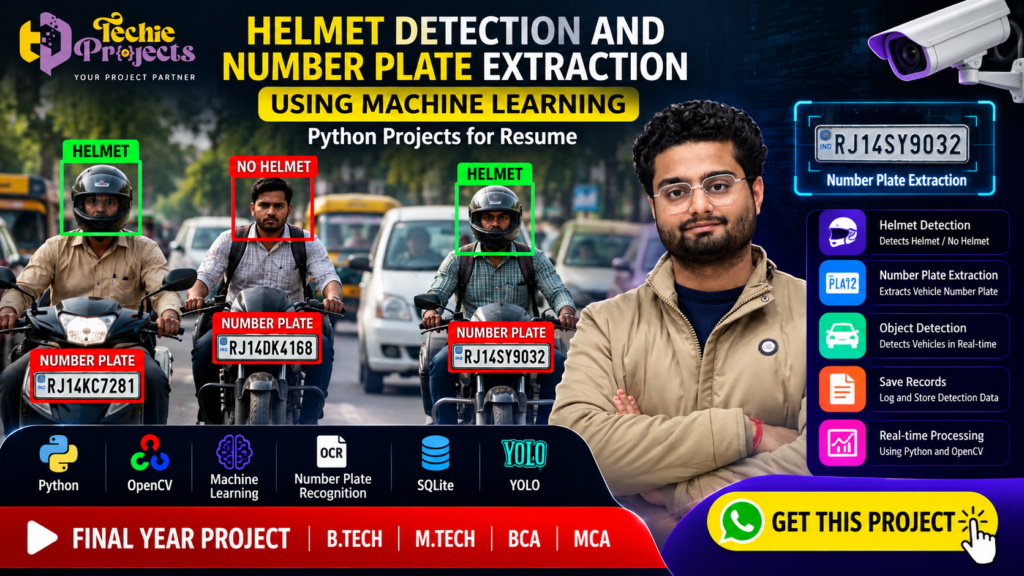
Looking for a practical machine learning project that combines Python, computer vision, vehicle monitoring, and number plate recognition? The Helmet Detection and Number Plate Extraction Using Machine Learning project is a valuable option for students who want to explore real-world AI applications while building their technical portfolio.
At Techie Projects, we help students explore engineering project solutions and understand their implementation. You can enquire about this project to discuss the available source code, installation guidance, technical documentation, project demonstration, and customization options before purchasing.
This project demonstrates how computer vision can identify helmet-related objects and vehicle number plates from images or video streams. It can help students understand object detection, image processing, model inference, and optical character recognition (OCR) through a practical application.
Whether you are preparing a final-year project, developing your portfolio, or looking for a machine learning demonstration, this project provides an opportunity to study several important AI concepts in one application.
🎬 Project Demo: Helmet Detection and Number Plate Extraction Using Machine Learning
Watch the project demonstration to understand how helmet detection and number plate extraction can work together in a computer vision application.
The demonstration can showcase vehicle frames, helmet-related detections, number plate localization, extracted text, and the application’s output. It also helps you understand the expected workflow before enquiring about the project package.
Explore the demo above and contact Techie Projects if you would like to discuss the source code, setup requirements, included documentation, and available technical support.
🚀 What Is Helmet Detection and Number Plate Extraction?
Helmet detection is a computer vision task that identifies whether a person riding a two-wheeler appears to be wearing a helmet. Number plate extraction involves locating a vehicle’s registration plate and, where supported, converting the visible characters into text.
The Helmet Detection and Number Plate Extraction Using Machine Learning project combines these tasks into a single workflow. A trained object detection model processes an image or video frame, identifies relevant objects, and passes the number plate region to a recognition component when implemented.
The system may use a camera feed or recorded video as input. Its output depends on the model, dataset, image quality, and recognition pipeline used in the implementation.
This type of application is useful for learning about intelligent transportation systems, road safety research, and automated visual monitoring. It should be treated as an educational prototype rather than a guaranteed replacement for verified traffic enforcement systems.
🎯 Key Objectives of the Project
The main objective is to develop a computer vision application that demonstrates helmet-related object detection and number plate processing.
The key objectives include:
- Detecting relevant helmet and vehicle-related classes using a trained model.
- Locating number plates in images or video frames.
- Exploring number plate text extraction using OCR, if included.
- Displaying detection results with bounding boxes and labels.
- Understanding the integration of Python, OpenCV, and machine learning.
- Exploring performance limitations under different lighting and traffic conditions.
- Creating a project that can be demonstrated during an academic presentation.
Students can also study how detection confidence, frame quality, and model selection influence the final output.
⚙️ How the Helmet Detection and Number Plate Extraction Using Machine Learning Project Works
The overall workflow can be divided into several stages. The exact implementation may vary according to the model and features included in the selected package.
1. 📷 Image or Video Input
The application receives images, recorded traffic videos, or a supported live camera stream. Each frame is prepared for processing by the computer vision pipeline.
Input quality matters because low resolution, motion blur, and poor lighting can reduce detection accuracy.
2. 🧠 Object Detection Using Machine Learning
A trained object detection model analyses the input frame and predicts the locations and classes of objects it has learned to recognize.
Depending on the model and training dataset, these classes may include helmet-related categories, motorcycles, people, and number plates. YOLO is one possible model family for this task.
3. 🪖 Helmet-Related Classification
The model identifies objects corresponding to the helmet-related classes available in its training configuration. The application can display labels and bounding boxes around detected regions.
The system’s output depends on the quality of the training data and the conditions in the input frames. It should not be assumed to identify every helmet correctly.
4. 🔍 Number Plate Localization
When a number plate is detected, the system identifies its region within the image. The cropped region can then be passed to an OCR component if text recognition is part of the implementation.
5. 🔤 Number Plate Text Extraction
OCR attempts to convert the visible characters on the number plate into machine-readable text. The output may require validation because blurred, tilted, damaged, or partially obscured plates can produce incorrect characters.
6. 📊 Display and Output
The application can show the processed frame, predicted labels, bounding boxes, and recognized text. If record storage is implemented, selected results may also be saved for later review.
This workflow helps demonstrate how several computer vision components can be integrated into a single Python application.
🛠️ Technologies Used
The technology stack depends on the particular implementation and the package supplied. Common components include the following.
🐍 Python
Python provides the main programming environment for image processing, model inference, data handling, and application logic. Its ecosystem makes it suitable for building computer vision prototypes.
👁️ OpenCV
OpenCV supports image loading, video capture, frame processing, cropping, resizing, and visualization. It is frequently used to connect the input source with a machine learning model.
🤖 YOLO and Object Detection
YOLO is a family of object detection models designed to predict object locations and classes. A suitable trained model can be used to detect the classes included in the project’s configuration.
Model versions, weights, and class labels should be verified against the actual implementation rather than assumed from the project title.
🔤 Optical Character Recognition
An OCR library can process a cropped number plate and attempt to extract its text. The specific library and recognition method depend on the implementation.
🗄️ Database or File Storage
Some versions may save detection results, timestamps, or extracted text in a database or local files. Database support should be confirmed before purchasing because it may not be included in every package.
✨ Important Project Features
The following are potential features of the system. Confirm the included functionality with Techie Projects before ordering.
🪖 Helmet Detection
The application can identify helmet-related classes supported by its trained model and display the predicted results on the processed frame.
🚘 Number Plate Detection
The object detection component can locate number plates in supported images or video frames, allowing the relevant region to be processed separately.
🔠 Number Plate Recognition
Where OCR is integrated, the application attempts to extract characters from the detected number plate. Recognition results can vary with image quality.
🎥 Video Processing
A supported implementation can process recorded videos frame by frame. Real-time camera processing depends on the available code, hardware, and model performance.
🖥️ Visual Output
Bounding boxes, class labels, and recognition results can make the system easier to demonstrate during a project presentation.
📁 Result Management
If included, result management may save selected detections or extracted text for review. Confirm whether database storage, export options, and reporting are part of the package.
🔧 Customization Opportunities
Students may explore changing model weights, adjusting detection thresholds, testing new images, or modifying the user interface, depending on their technical requirements and the code supplied.
💻 Software and Hardware Requirements
The exact requirements depend on the model, Python libraries, and input source. The following is a general planning guide.
Software Requirements
- Operating system: Windows or Linux, subject to package compatibility.
- Programming language: Python.
- Image processing: OpenCV.
- Machine learning: a compatible object detection framework.
- Model weights: trained weights compatible with the selected implementation.
- OCR: a compatible OCR library if text extraction is included.
- Development environment: Visual Studio Code, PyCharm, or another supported Python editor.
Hardware Requirements
- A computer capable of running the selected Python environment.
- Sufficient RAM and storage for dependencies, model weights, and test data.
- A webcam or video files if the implementation requires video input.
- A compatible GPU may improve inference speed, but a GPU is not always required.
Before purchasing, ask for the tested Python version, library versions, installation instructions, and minimum system requirements. This helps reduce compatibility problems during setup.
🎓 Why Choose This Project for Academic Learning?
The Helmet Detection and Number Plate Extraction Using Machine Learning project brings together several topics that students often study separately.
It offers opportunities to understand:
- Computer vision and image preprocessing.
- Object detection and model inference.
- Training datasets and class labels.
- OCR and text extraction.
- Python application development.
- Model evaluation and error analysis.
- Integration of different software libraries.
Students can use the project as a starting point for understanding the implementation and preparing their own demonstrations. For academic submissions, follow your institution’s rules regarding external code, attribution, and permitted assistance. Make sure you understand the system well enough to explain its design and limitations.
🌐 Real-World Applications
Helmet detection and number plate recognition are relevant to several research and prototype applications.
🚦 Road Safety Research
Researchers can explore how computer vision models identify helmet-related classes in traffic footage and investigate the factors that affect their predictions.
🏙️ Intelligent Transportation Prototypes
The project can demonstrate visual data processing concepts used in broader intelligent transportation research.
🅿️ Vehicle Monitoring
Number plate localization and OCR can be studied in controlled vehicle monitoring applications, subject to privacy and legal requirements.
📚 Computer Vision Education
Students can use the project to learn about detection models, image processing, OCR, and the challenges of processing real-world visual data.
These applications are illustrative. A student prototype does not automatically provide the accuracy, reliability, or legal authorization required for operational surveillance or enforcement.
🧪 Testing and Performance Evaluation
Testing is important for understanding what the model can and cannot do. A useful evaluation should include different images and video conditions rather than relying on a single successful demonstration.
Consider testing:
- Daylight and low-light images.
- Clear and blurred number plates.
- Different camera angles and distances.
- Partial occlusion of helmets or number plates.
- Crowded scenes containing multiple vehicles.
- Changes in video resolution and frame rate.
For object detection, students can examine precision, recall, and suitable detection metrics when ground-truth annotations are available. For OCR, they can compare extracted text with the actual plate text and record character-level errors.
The Helmet Detection and Number Plate Extraction Using Machine Learning project should be evaluated using documented test cases and actual results. Avoid reporting accuracy percentages unless they have been measured on a defined dataset using a reproducible evaluation method.
⚠️ Limitations and Considerations
Like other computer vision systems, this project can make incorrect predictions.
Lighting conditions, camera angle, motion blur, occlusion, dataset bias, and differences between training and test environments may affect detection performance. OCR can also confuse visually similar characters.
Number plates may contain personal information. If you collect or store images or registration numbers, use appropriate access controls, minimize unnecessary retention, and follow applicable privacy and legal requirements.
These limitations are valuable discussion points for a project report because they show that you understand both the potential and the boundaries of machine learning.
🛒 Purchase the Helmet Detection and Number Plate Extraction Project
Need a Python machine learning project for your academic work? Techie Projects can help you enquire about the available implementation and select a package that fits your requirements.
Before placing an order, contact us to confirm:
- Whether complete source code is included.
- Supported Python and library versions.
- Installation and execution instructions.
- Whether OCR and database features are included.
- Available project documentation and report support.
- Demonstration availability and customization options.
- Price, delivery method, and technical support terms.
Why enquire before purchasing? Confirming the package details helps you understand what you will receive and whether the implementation matches your academic requirements.
📲 Contact Techie Projects
Discuss the project and request current package details using the official contact options below.
- 📲 Call/WhatsApp: +91-9460060699
- 🌎 Website: www.techieprojects.com
- 📺 Instagram: @pythonprojects_
When contacting us, mention Helmet Detection and Number Plate Extraction Using Machine Learning so we can identify the project you are interested in.
🔗 Explore Related Python Projects
Students interested in AI, machine learning, and computer vision can also explore these project areas on Techie Projects:
- Vehicle Detection and Counting Using Python
- AI-Based Traffic Monitoring System
- Real-Time Object Detection Using YOLO
- Automatic Number Plate Recognition System
- Face Recognition Attendance System
- AI Exam Proctoring System
- Smart Surveillance Using Computer Vision
Availability, technology stack, and included features may vary by project. Visit the website or contact us to learn more about the available options.
❓ Frequently Asked Questions
1. What is the Helmet Detection and Number Plate Extraction project?
It is a computer vision application that combines helmet-related object detection with number plate localization and, where implemented, OCR-based text extraction.
2. Which programming language is used?
Python is commonly used for this type of implementation because it supports image processing, machine learning, and OCR libraries.
3. Is YOLO required for this project?
Not necessarily. YOLO is one possible object detection approach. The actual model depends on the implementation and trained weights supplied.
4. Does the project extract number plate text automatically?
Automatic text extraction requires an OCR component in addition to number plate detection. Confirm that OCR is included in the package you intend to purchase.
5. Can the project process live video?
Live video processing depends on the implementation, camera support, hardware, and model performance. Some implementations may support only images or recorded videos.
6. Do I need a GPU?
Not always. Some models can run on a CPU, although processing speed may be lower. Check the package’s tested hardware requirements before purchasing.
7. Can the project be customized?
Customization depends on the source code and package terms. Ask Techie Projects which changes are supported and whether additional charges apply.
8. How can I purchase this project?
Contact Techie Projects through WhatsApp or visit techieprojects.com. Request the current price, deliverables, installation requirements, and support details before ordering.
🎯 Conclusion
The Helmet Detection and Number Plate Extraction Using Machine Learning project offers a practical way to explore Python, object detection, computer vision, and number plate text extraction in one application. It can support academic learning, technical demonstrations, and further experimentation with intelligent transportation concepts.
Understanding the workflow, checking the actual implementation, and testing its limitations are important parts of building a reliable project.
If you are interested in obtaining this project, contact Techie Projects to confirm the available source code, installation guidance, documentation, features, and purchase options. Choose a package that matches your requirements and make sure you understand the implementation before presenting or extending it.