
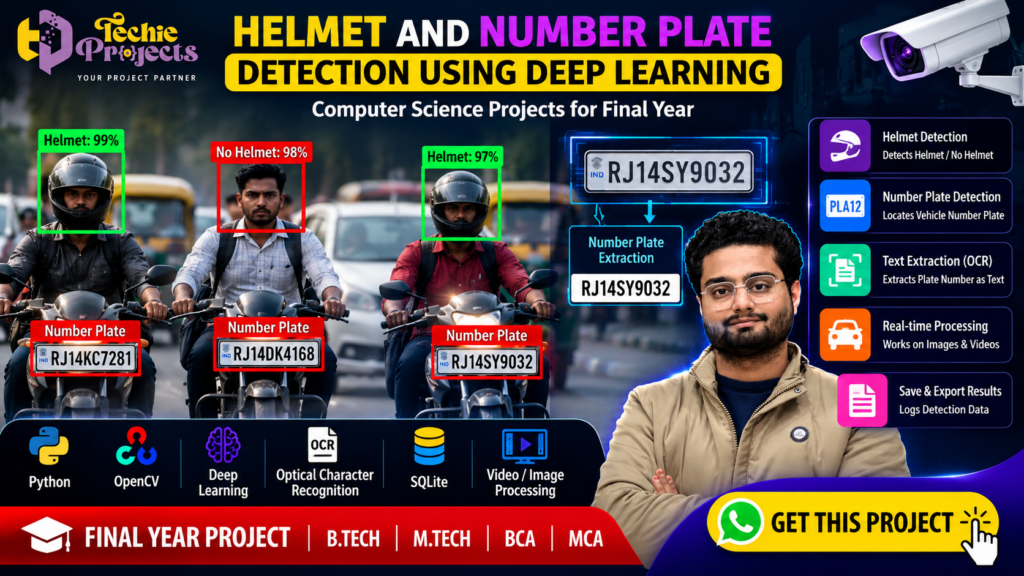
Are you searching for an impressive final-year engineering project that combines Artificial Intelligence, computer vision, and real-world traffic applications? The Helmet and Number Plate Detection Using Deep Learning project from Techie Projects is a practical option for students who want to explore intelligent vehicle monitoring, helmet compliance detection, and automatic number plate recognition in one integrated system.
Instead of spending weeks assembling a project from scattered tutorials, you can enquire about our project package to understand the available source code, implementation requirements, installation process, and technical guidance before making a decision. This project can help you demonstrate important concepts in Python, OpenCV, deep learning, image processing, and Optical Character Recognition (OCR).
Whether you are pursuing B.Tech, M.Tech, BCA, MCA, or a computer science-related degree, this project offers a practical way to study how computer vision can support traffic monitoring. Contact Techie Projects to discuss the available version, features, deliverables, and pricing for your academic requirements.
- 📲 Call/WhatsApp: +91-9460060699
- 🌎 Website: www.techieprojects.com
- 📺 Instagram: @pythonprojects_
🎬 Project Demo: Helmet and Number Plate Detection Using Deep Learning
Watch the project demonstration to understand how helmet detection, vehicle number plate identification, and text extraction can work together in a computer vision application.
The demonstration can help you evaluate the user interface, detection workflow, and expected output before enquiring about the project package. Review the actual demo and confirm which features are included in the version available from Techie Projects.
🚦 What Is Helmet and Number Plate Detection Using Deep Learning?
Helmet and Number Plate Detection Using Deep Learning is a computer vision project designed to identify helmet usage and locate vehicle number plates from images or video frames. Depending on the implementation, the system can apply an object detection model to identify relevant objects and an OCR component to extract readable text from detected number plates.
The helmet detection component can classify or detect riders wearing helmets and riders who are not wearing helmets. The number plate detection component locates a vehicle’s registration plate, while the OCR stage attempts to convert the plate image into text.
Combining these functions creates a useful academic example of how several AI techniques can operate within one application. The actual detection accuracy depends on the model, training data, image quality, camera angle, lighting conditions, and implementation.
🎯 Why Choose This Project for Your Final Year?
Students often need a project that demonstrates more than basic programming. A computer vision system combines software development, model integration, image processing, testing, and problem-solving.
The Helmet and Number Plate Detection Using Deep Learning project can help you explore:
- Object detection and image classification concepts.
- Python programming and OpenCV operations.
- Real-time or recorded-video processing.
- Number plate localization and image preprocessing.
- OCR-based text extraction.
- Data handling and detection-result reporting.
- Model evaluation and practical limitations.
It is also a suitable topic for a technical presentation because you can explain the problem, proposed solution, system architecture, processing pipeline, results, and possible future improvements.
🔍 Benefits of Helmet and Number Plate Detection Using Deep Learning
The Helmet and Number Plate Detection Using Deep Learning project combines two important computer vision tasks in a single application. It demonstrates how an AI model can identify helmet-related objects and locate vehicle registration plates in supported images or video frames.
For engineering students, this implementation provides an opportunity to understand object detection, image preprocessing, OCR, and model inference. It also helps demonstrate how multiple processing stages can work together to produce useful visual results.
Students can explore how the system handles different vehicle types, lighting conditions, camera angles, and image resolutions. Testing these conditions is important because detection results may vary depending on the quality of the input data and the model configuration.
⚙️ Key Features of the Project
1. Helmet Detection
The helmet detection module identifies helmet-related objects in supported images or video frames. Depending on the model, the system can distinguish between helmet and no-helmet classes.
This functionality provides a foundation for studying AI-based traffic safety monitoring. Results should be reviewed carefully because occlusion, unusual helmet designs, poor lighting, and camera placement can affect predictions.
2. Vehicle Number Plate Detection
The number plate detection module locates a registration plate within an image. Object detection or image-processing techniques can be used to isolate the plate region for further analysis.
Accurate plate localization is important because OCR performance depends heavily on the quality of the cropped image.
3. Automatic Number Plate Recognition Using OCR
After detecting the plate, the application can process the cropped region and attempt to extract the registration number using an OCR engine.
Preprocessing methods such as resizing, grayscale conversion, thresholding, and noise reduction may improve text recognition in suitable conditions. OCR results should not automatically be treated as verified vehicle-registration information.
4. Image and Video Processing
Depending on the supplied version, the project may support uploaded images, recorded videos, or webcam input. Video processing generally involves reading frames, applying detection, and displaying the resulting annotations.
Confirm the exact supported input modes before purchasing.
5. Detection Results and Visual Output
A user interface can display detected objects, bounding boxes, confidence scores, and extracted plate text. These visual outputs make the application easier to demonstrate during project reviews.
Additional capabilities, such as saving results or maintaining detection logs, depend on the implementation.
🧠 Implementation of Helmet and Number Plate Detection Using Deep Learning
The implementation generally begins by loading the required detection model and preparing the input image or video. The application then processes each frame, detects relevant objects, and identifies the number plate region when visible.
After locating a plate, the system can crop the region and send it to an OCR engine for text extraction. The extracted text can then be displayed alongside the detection results, depending on the application’s features.
Helmet and Number Plate Detection Using Deep Learning also provides a useful opportunity to study the interaction between different software components. Python manages the application workflow, OpenCV supports image and video processing, and the selected deep learning framework performs model inference.
The actual model, OCR library, and supported input modes should be verified against the project package before installation.
🧠 Technologies Used in the Project
Python
Python provides the main programming environment for connecting the detection model, image-processing functions, OCR component, and application interface.
Deep Learning and Object Detection
Deep learning models learn visual patterns from training data. An object detection model can identify the location and class of objects within an image. The exact model architecture and pretrained weights should be confirmed for the available project version.
OpenCV
OpenCV is commonly used to read images and videos, resize frames, crop regions of interest, convert color spaces, draw bounding boxes, and prepare images for further processing.
Optical Character Recognition
An OCR engine converts text-like patterns in an image into machine-readable characters. Recognition quality can vary with plate resolution, font, motion blur, glare, and image orientation.
Additional Libraries
Depending on the implementation, the project may use NumPy, a deep learning framework, an OCR library, and a graphical user interface toolkit. Check the supplied requirements file for the actual library names and compatible versions.
📚 Learning Outcomes for Engineering Students
Working with Helmet and Number Plate Detection Using Deep Learning can help students develop a better understanding of AI-based applications and their practical limitations.
Students can learn how image data is prepared, how a detection model produces predictions, and how confidence scores help interpret its output. They can also investigate why OCR may fail when a plate is blurred, partially hidden, or poorly illuminated.
These concepts can support project demonstrations, technical discussions, and portfolio development. Students should understand the implementation and accurately explain their own contribution during academic evaluations.
🔄 How the System Works
The general workflow for Helmet and Number Plate Detection Using Deep Learning can be divided into the following stages.
Step 1: Input Collection
The application receives an image or video source supported by the selected implementation. Video input is processed frame by frame.
Step 2: Image Preprocessing
Frames may be resized or otherwise prepared for the detection model. Preprocessing helps provide input in the format expected by the model.
Step 3: Helmet Detection
The model evaluates the frame and predicts helmet-related classes. The application can display the predicted class and associated confidence score when supported.
Step 4: Number Plate Localization
The system detects the vehicle’s number plate and identifies its region within the frame.
Step 5: Text Extraction
The cropped plate image is passed to the OCR component. The resulting text may be cleaned or formatted to remove unnecessary characters.
Step 6: Display and Record Results
The application displays annotated output. If the selected version includes a logging feature, detection details may also be stored for later review.
Step 7: Testing and Evaluation
The system should be tested using different lighting conditions, distances, vehicle types, and camera angles. Evaluate false detections, missed detections, and OCR errors rather than relying on a few successful examples.
💻 Software and Hardware Requirements
The exact requirements depend on the model architecture and software libraries supplied with the project.
Possible software requirements
- Operating system: Windows or Linux, subject to compatibility.
- Programming language: Python.
- Image processing: OpenCV.
- Numerical processing: NumPy.
- AI framework: As specified by the project implementation.
- OCR engine: As specified in the requirements.
- Development environment: Visual Studio Code, PyCharm, or another compatible Python IDE.
Hardware considerations
- A computer with sufficient RAM and storage.
- A compatible CPU for basic testing.
- A webcam or suitable video files if required.
- A supported NVIDIA GPU if the selected model benefits from GPU acceleration.
A GPU is not always mandatory. Processing speed depends on the model, input resolution, hardware, and software configuration. Ask Techie Projects for the tested configuration before purchasing.
🛒 Purchase Enquiry for Helmet and Number Plate Detection Using Deep Learning
Looking for a computer vision project for your final-year submission? Contact Techie Projects to enquire about the Helmet and Number Plate Detection Using Deep Learning package, including its available source code, installation requirements, supported features, documentation, and technical guidance.
Before ordering, confirm the exact deliverables, compatible software versions, pricing, delivery timeline, and support terms. This ensures that the selected project matches your academic requirements and computer configuration.
What to Confirm Before Purchase
- Whether the project includes complete source code.
- Which helmet and number plate detection models are used.
- Whether image, video, and webcam inputs are supported.
- Which OCR engine is included.
- Whether a project report or presentation is available.
- Which Python and library versions are required.
- What installation assistance and post-purchase support are included.
This information helps you choose a package that matches your system, academic guidelines, and project objectives.
Why Contact Techie Projects?
Techie Projects focuses on practical engineering and computer science project solutions. Students can enquire about AI, machine learning, deep learning, Python, computer vision, IoT, and software development projects.
Our goal is to help students understand project implementation and prepare to explain the technical concepts involved. Review the available deliverables and support terms before placing an order.
Ready to enquire about this project?
- 📲 Call/WhatsApp: +91-9460060699
- 🌎 Website: www.techieprojects.com
- 📺 Instagram: @pythonprojects_
Send a message with the project name, your degree or branch, your preferred operating system, and the features you need. You can then discuss availability, pricing, and delivery details.
🎓 Academic Applications and Learning Outcomes
Traffic Safety Monitoring
Helmet detection can be studied as a potential component of traffic safety monitoring systems. Real-world deployment would require extensive validation, suitable camera placement, and appropriate procedures for handling incorrect detections.
Automatic Vehicle Identification
Number plate recognition demonstrates how image processing and OCR can extract text from vehicle images. Recognition results should be verified before being used for official or enforcement purposes.
Computer Vision Learning
The project offers opportunities to learn about image preprocessing, object detection, model inference, OCR, and performance evaluation.
Resume and Portfolio Development
Students can use their understanding of the project to explain a technical workflow during interviews, provided they accurately describe their own contribution and do not claim work they did not perform.
📊 Advantages of the Project
- Integrates multiple computer vision components in one application.
- Demonstrates practical Python and AI concepts.
- Provides visual outputs suitable for technical demonstrations.
- Can be extended with additional features when supported by the architecture.
- Offers opportunities to study detection errors and model performance.
- Connects academic concepts with a recognizable traffic-monitoring use case.
⚠️ Limitations and Future Improvements
No detection system performs perfectly in every environment. Low-resolution images, glare, shadows, occluded plates, motion blur, unusual camera angles, and crowded scenes can reduce accuracy.
Possible future improvements include training with a more diverse dataset, evaluating different detection architectures, improving plate-image preprocessing, adding confidence thresholds, and measuring inference speed.
A more advanced implementation could include a dashboard, database-backed reports, or an interface for reviewing uncertain detections. These are potential extensions, not guaranteed features of the current package.
Because vehicle registration data can be sensitive, any real-world deployment should follow applicable privacy, data-retention, and legal requirements. Academic demonstrations should use appropriate sample data and avoid unauthorized collection or publication of personal information.
❓ Frequently Asked Questions
1. What is Helmet and Number Plate Detection Using Deep Learning?
It is a computer vision project that combines helmet-related object detection, number plate localization, and potentially OCR-based text extraction.
2. Which programming language is used?
Python is a common choice for this type of project. Confirm the actual language and framework requirements for the version you intend to purchase.
3. Does the project recognize number plates automatically?
The OCR component can attempt to extract registration text from detected plate images. Recognition quality depends on image quality, plate visibility, and the OCR implementation.
4. Can the project process live video?
Some implementations support webcam or live-video input, while others support only images or recorded videos. Confirm this feature before ordering.
5. Is a GPU required?
Not necessarily. A compatible CPU may be sufficient for testing, although a supported GPU can improve performance for some deep learning models.
6. Can I customize the project?
Customization depends on the source code, model architecture, and available support. Discuss your requirements with Techie Projects before purchasing.
7. What should I ask before buying?
Ask about source code, installation, tested library versions, project documentation, demo availability, included features, price, and technical support.
8. How can I enquire about the project?
Contact Techie Projects through https://wa.me/919460060699 or visit https://techieprojects.com/ to discuss availability and pricing.
🔗 Explore Related Python Projects
Students interested in artificial intelligence and computer vision can also explore these project topics on Techie Projects:
- Vehicle Detection and Counting Using Python
- AI Exam Proctoring System
- Intrusion Detection System Using Machine Learning
- Face Recognition Attendance System
- Real-Time Object Detection Using Python
- Traffic Sign Recognition Using Deep Learning
- Automatic Number Plate Recognition System
Explore the available project pages to compare technologies, requirements, and use cases before selecting your project.
🚀 Future Scope of Helmet and Number Plate Detection Using Deep Learning
Future improvements could include a dashboard for viewing detection results, improved OCR preprocessing, additional vehicle categories, and performance evaluation across different environmental conditions.
Helmet and Number Plate Detection Using Deep Learning could also be extended with database logging or reporting features if the software architecture supports them. Any proposed extension should be tested rather than presented as an existing feature.
For real-world use, developers should evaluate false positives, missed detections, privacy requirements, and applicable regulations before relying on the system for traffic enforcement.
🚀 Conclusion
The Helmet and Number Plate Detection Using Deep Learning project brings together important concepts in Python programming, object detection, image processing, and OCR. It provides a practical topic for students who want to explore AI-powered traffic monitoring and build a deeper understanding of computer vision workflows.
If you want to study this implementation for your academic project, contact Techie Projects to confirm the available source code, supported features, system requirements, documentation, pricing, and technical guidance.
📲 Start your project enquiry today: +91-9460060699
Visit www.techieprojects.com to explore more engineering projects and find an option suited to your learning objectives.