
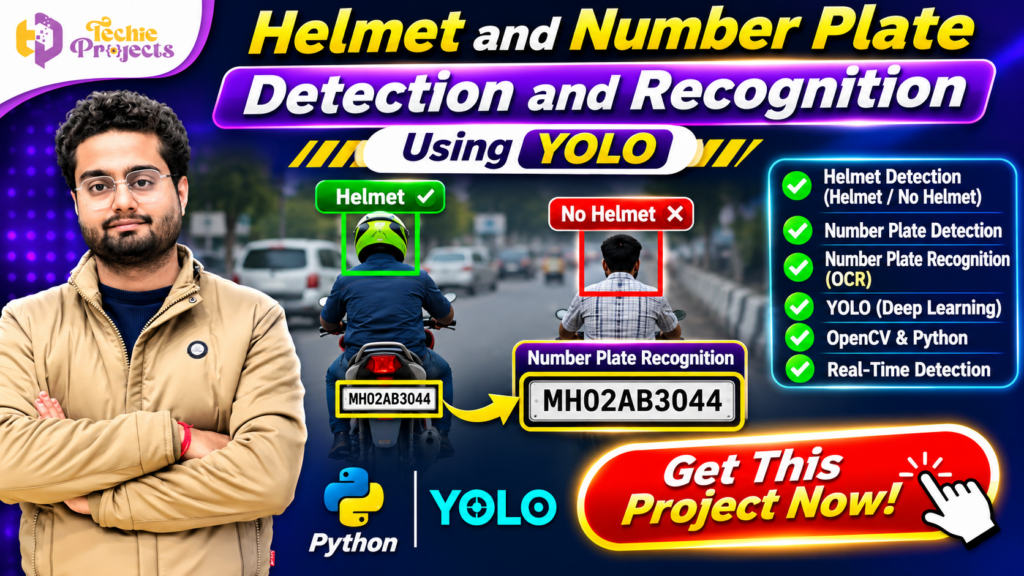
The Helmet and Number Plate Detection Using YOLO project is an intelligent computer vision application developed using Python, deep learning, and OpenCV. It combines helmet detection, vehicle number plate localisation, and OCR-based character recognition to demonstrate an AI-powered traffic monitoring solution. This project is suitable for students interested in developing practical artificial intelligence and final-year engineering applications.
🚀 Looking for an impressive final-year major project in Artificial Intelligence and Deep Learning? Get the Helmet and Number Plate Detection and Recognition Using YOLO project from Techie Projects!
If you are a B.Tech, BCA, MCA, M.Tech, or Computer Science Engineering student searching for a practical AI-based project, this is an excellent topic to explore. The Helmet and Number Plate Detection and Recognition Using YOLO project combines deep learning, Python programming, computer vision, object detection, and optical character recognition (OCR) in one application.
Imagine a system that can analyse traffic images or video, identify riders wearing helmets, detect potential no-helmet cases, locate vehicle number plates, and recognise visible registration characters. This project demonstrates how artificial intelligence can be applied to intelligent traffic monitoring and road-safety research.
🎓 At Techie Projects, we help students explore practical engineering projects with project-related resources. Enquire about this project to get information about the available source code, documentation, installation guidance, and implementation support.
Whether you need a project for your final-year submission, academic demonstration, or technical learning, our team can help you understand the available project package.
📞 Contact Techie Projects for Project Enquiries
Want to purchase the Helmet and Number Plate Detection and Recognition Using YOLO project? Contact Techie Projects to check pricing, availability, and package details.
- 📲 WhatsApp: Get Project Details
- 📞 Contact Number: +91 94600 60699
- 🌐 Website: www.techieprojects.com
- 📸 Instagram: @pythonprojects_
🎬 Helmet and Number Plate Detection and Recognition Using YOLO – Project Demo
The demonstration video should show the project interface, helmet detection results, number plate localisation, and recognition output. Students can use the demonstration to understand the application’s workflow and prepare for their project presentation.
🚦 What Is Helmet and Number Plate Detection and Recognition Using YOLO?
The Helmet and Number Plate Detection and Recognition Using YOLO project is an AI-based computer vision application designed to analyse traffic images and video frames.
The system combines two major functionalities:
- Helmet Detection: Identifies helmet-related objects and potential no-helmet cases using a trained object detection model.
- Number Plate Detection and Recognition: Locates vehicle registration plates, extracts the plate region, and applies OCR to recognise visible characters.
YOLO (You Only Look Once) is an object detection approach that can identify multiple objects in an image and predict their locations. It is widely used in computer vision applications because it supports efficient object detection.
The project uses Python and computer vision technologies to process input images or video frames. Its output can include detection labels, bounding boxes, cropped number plate images, and recognised text where OCR succeeds.
This makes it a useful academic project for students interested in artificial intelligence, machine learning, deep learning, and intelligent transportation systems.
🎯 Objectives of the Project
The main objectives of this project are:
- To develop an AI-based helmet detection application.
- To identify potential riders without helmets.
- To detect vehicle number plates from traffic images.
- To extract number plate regions for further processing.
- To apply OCR for number plate character recognition.
- To process images and video frames using computer vision.
- To display detection results with labels and bounding boxes.
- To demonstrate the application of YOLO in real-world-inspired traffic scenarios.
The project also helps students understand how different AI modules can work together to solve a practical computer vision problem.
🚀 Key Features of Helmet and Number Plate Detection Using YOLO
The following are the major features of the Helmet and Number Plate Detection and Recognition Using YOLO application.
1. 🪖 Helmet Detection
The system analyses traffic images or video frames and detects helmet-related objects using a trained deep learning model.
It can identify the classes supported by the model, such as helmet and no helmet. The results are displayed using bounding boxes and detection labels.
2. 🚫 No-Helmet Detection
One of the important functionalities is identifying potential cases where a rider is not wearing a helmet.
The model predicts the relevant class based on its training data. The accuracy depends on the quality of the dataset, camera angle, lighting conditions, and model configuration.
3. 🚘 Number Plate Detection
The application identifies the location of a vehicle registration plate within an image or video frame.
The detected plate region is highlighted with a bounding box. This allows the system to isolate the number plate from the surrounding traffic scene.
4. 🔍 Number Plate Extraction
After locating the plate, the application extracts the corresponding image region.
Image preprocessing techniques can be applied to improve the extracted image before sending it to the OCR module.
5. 🔠 Number Plate Recognition Using OCR
Optical Character Recognition converts visible characters in an image into machine-readable text.
In this project, OCR is applied to the extracted number plate image. The recognised text can be displayed as output, depending on image quality and recognition performance.
6. 🎥 Video Processing
The project can analyse recorded video or supported camera input, depending on the implementation.
Video frames are processed individually to identify helmet-related objects and vehicle number plates.
7. 📊 Visual Detection Output
The system displays results using bounding boxes, class labels, and recognised number plate text where available.
This visual output makes the application easier to understand and demonstrate during college project reviews.
🧠 Technologies Used in Helmet and Number Plate Detection Using YOLO
The project combines several technologies used in artificial intelligence and computer vision.
| Technology | Application |
|---|---|
| Python | Main programming language |
| YOLO | Object detection |
| Deep Learning | Training and model inference |
| OpenCV | Image and video processing |
| OCR | Number plate character recognition |
| NumPy | Numerical and array operations |
| Computer Vision | Image analysis and object localisation |
🐍 Python Programming
Python is the primary programming language used in this project. It provides a flexible environment for developing AI applications and integrating computer vision libraries.
Students can understand Python functions, libraries, image processing, model execution, and application development through this project.
🤖 YOLO Object Detection
YOLO is used to detect objects and predict their locations in an image. A trained model can identify supported categories, including helmet-related classes and number plate regions.
The model produces detection results that can be visualised using bounding boxes and labels.
📷 OpenCV
OpenCV is a popular computer vision library used for image and video processing.
It can perform operations such as:
- Reading images and videos
- Resizing frames
- Converting colour spaces
- Cropping detected regions
- Displaying detection results
- Preparing images for OCR
🔤 Optical Character Recognition
OCR is used to recognise characters from the extracted number plate image.
The recognition process may include image resizing, grayscale conversion, thresholding, and other preprocessing techniques.
⚙️ Working Process of Helmet and Number Plate Detection Using YOLO
The working process of the Helmet and Number Plate Detection and Recognition Using YOLO project can be divided into several steps.
Step 1: Input Image or Video
The application receives an input image, recorded video, or supported camera stream.
This input contains the traffic scene that needs to be analysed.
Step 2: Frame Extraction
If the input is a video, the application extracts individual frames for processing.
Each frame is prepared for the object detection model.
Step 3: Helmet Detection
The YOLO model analyses the frame and identifies objects belonging to its trained classes.
The detected objects are displayed with bounding boxes and confidence scores.
Step 4: No-Helmet Classification
If the model supports a no-helmet class, it identifies potential cases and displays the corresponding detection label.
Step 5: Number Plate Localisation
The application identifies the vehicle number plate region and marks its location within the frame.
Step 6: Number Plate Cropping
The detected number plate region is extracted from the original frame.
This cropped image is passed to the image-processing and OCR workflow.
Step 7: Image Preprocessing
The extracted plate image may be resized, converted to grayscale, or enhanced to improve character visibility.
Step 8: OCR-Based Recognition
The OCR module attempts to recognise the characters displayed on the number plate and converts them into text.
Step 9: Display Final Output
The application displays the helmet detection results, number plate detection results, and recognised text where available.
🏍️ Applications of Helmet and Number Plate Detection Using YOLO
The Helmet and Number Plate Detection Using YOLO system demonstrates how computer vision can support intelligent traffic monitoring and vehicle analysis. Its potential applications include:
- 🚦 Traffic Monitoring: Analyse traffic footage and identify motorcycles and other vehicles.
- 🪖 Helmet Detection: Identify riders wearing helmets and flag possible helmet violations for review.
- 🔢 Number Plate Recognition: Locate vehicle registration plates and extract readable characters using OCR.
- 📹 Smart Surveillance: Demonstrate AI-powered analysis of recorded or live video streams.
- 🏙️ Smart City Research: Explore how automated visual monitoring can contribute to intelligent transportation systems.
- 🎓 Academic Demonstrations: Present a practical application of YOLO, Python, OpenCV, and deep learning.
The Helmet and Number Plate Detection Using YOLO project is an educational prototype. Real-world enforcement requires appropriate validation, camera quality, privacy safeguards, and authorised human review.
📦 What Do You Get When You Purchase This Project?
Are you planning to purchase the Helmet and Number Plate Detection and Recognition Using YOLO project for your college?
Techie Projects provides project-related resources for students. Depending on the selected package, available deliverables may include:
- Python project source code
- Model and configuration files, where applicable
- Dataset information, where applicable
- Project documentation
- Installation and execution guidance
- Demonstration details
- Implementation guidance and support options
Important: Please confirm the exact deliverables, pricing, software compatibility, and support arrangements with our team before placing your order.
🚀 Why Choose Helmet and Number Plate Detection Using YOLO?
Selecting a practical final-year project can help you demonstrate your technical knowledge and problem-solving skills.
The Helmet and Number Plate Detection and Recognition Using YOLO project combines multiple important concepts in a single application.
Learn Practical AI Concepts
Students can explore object detection, deep learning, image processing, and OCR.
Understand Real-World Applications
The traffic-monitoring scenario makes it easier to explain how computer vision can be applied outside the classroom.
Prepare for Project Demonstrations
The visual output provides useful material for explaining the project workflow during academic presentations.
Explore Different Technologies
Students can work with Python, YOLO, OpenCV, and OCR tools.
Extend the Application
The project can be further developed with additional classes, datasets, dashboards, and performance improvements.
💻 Software Requirements
The general software requirements for developing or running this type of application include:
- Operating System: Windows 10/11 or compatible operating system
- Programming Language: Python
- Object Detection: Compatible YOLO framework
- Image Processing: OpenCV
- Numerical Library: NumPy
- OCR: Compatible OCR library
- IDE: Visual Studio Code, PyCharm, or another Python IDE
The exact library versions depend on the supplied implementation.
🖥️ Hardware Requirements
Suggested hardware requirements include:
- Processor: Modern Intel or AMD processor
- RAM: 8 GB recommended as a starting point
- Storage: Adequate space for source code, datasets, and model files
- Camera: Optional, depending on the input mode
- GPU: Compatible NVIDIA GPU recommended for faster model training or inference
Actual requirements may vary depending on model size, video resolution, and whether training or inference is performed.
📈 Advantages of the Project
The Helmet and Number Plate Detection and Recognition Using YOLO project offers several academic and technical benefits.
- Multiple functionalities: Combines helmet detection and number plate recognition.
- Practical learning: Demonstrates computer vision concepts through traffic-related examples.
- AI implementation: Introduces students to YOLO-based object detection.
- Image processing: Helps students understand image cropping and preprocessing.
- OCR integration: Demonstrates conversion of image-based text into machine-readable text.
- Future development: Provides opportunities to explore additional AI features.
🔬 Future Scope of the Project
The project can be extended with several advanced features.
1. Improved Model Accuracy
Students can experiment with additional training data, model configurations, and evaluation methods.
2. Night-Time Detection
Image enhancement techniques can be explored to improve detection under low-light conditions.
3. Multiple Vehicle Detection
The application can be extended to detect multiple vehicles and riders in a single frame.
4. Database Integration
Detection results can be stored in a database for authorised research and analysis.
5. Web-Based Dashboard
A web interface can be developed to display detection statistics and processed results.
6. Improved OCR Performance
Different OCR engines and preprocessing techniques can be compared to improve number plate character recognition.
7. Edge Device Deployment
Optimised models can be explored for deployment on suitable edge-computing devices.
🎓 Benefits of Helmet and Number Plate Detection Using YOLO for Final-Year Students
The Helmet and Number Plate Detection Using YOLO project offers several benefits for final-year engineering students, especially those studying Computer Science, Information Technology, Artificial Intelligence, and Data Science.
- 🎓 Practical AI Knowledge: Understand how artificial intelligence and deep learning models are applied to real-world traffic monitoring problems.
- 💻 Python Programming Experience: Gain practical experience with Python, OpenCV, YOLO, and image processing techniques.
- 🚗 Object Detection Skills: Learn how to identify vehicles, detect riders wearing or not wearing helmets, and locate vehicle number plates.
- 🔍 OCR Integration: Explore Optical Character Recognition (OCR) to extract text from detected number plates.
- 🧠 Deep Learning Implementation: Understand model training, dataset preparation, object localisation, and prediction workflows.
- 📊 Resume and Portfolio Development: Showcase a practical computer vision project that demonstrates your technical knowledge and problem-solving abilities.
- 🎤 Project Demonstration and Viva Preparation: Use the working application to explain the system architecture, algorithms, implementation, and results during academic presentations.
This project is also useful for students looking to build a strong foundation in computer vision and intelligent surveillance applications. Techie Projects can provide project-related resources, source code availability details, documentation, and implementation guidance to help students understand and demonstrate the application.
Interested in getting this project? Contact Techie Projects to enquire about the complete project package and available support.
Add a stronger purchase-focused openingExplain the project workflow briefly
🛒 How to Purchase the Helmet and Number Plate Detection Using YOLO Project
Looking for a practical final-year AI project? Get in touch with Techie Projects to enquire about the Helmet and Number Plate Detection Using YOLO project.
Students can ask about:
- Python project source code availability
- Project documentation and report
- Installation and execution guidance
- YOLO model implementation details
- Number plate recognition and OCR integration
- Project demonstration and technical support
Whether you are preparing a college submission, building your technical portfolio, or learning computer vision, the Helmet and Number Plate Detection Using YOLO project can help you explore an applied deep learning solution.
📲 WhatsApp: +91-9460060699
🌐 Website: www.techieprojects.com
📞 Contact: +91 94600 60699
❓ Frequently Asked Questions (FAQs)
1. What is Helmet and Number Plate Detection and Recognition Using YOLO?
It is a computer vision project that uses a YOLO-based object detection model to identify helmet-related objects and vehicle number plates. OCR can then be used to recognise characters from extracted plate images.
2. Which programming language is used in this project?
Python is used as the primary programming language.
3. What is YOLO in this project?
YOLO is an object detection approach used to identify objects and their locations in images or video frames.
4. Can the system detect riders without helmets?
Yes, if the trained model includes a no-helmet class and performs adequately on the input images or video.
5. Can the project recognise vehicle number plates?
The system can detect and crop number plate regions and use OCR to attempt character recognition. Accuracy depends on image quality and other conditions.
6. Is this project suitable for final-year CSE students?
Yes. It is relevant to students interested in artificial intelligence, computer vision, machine learning, deep learning, and Python programming.
7. Can the project process video?
Video processing is possible when supported by the implementation and available hardware. Confirm the exact functionality before purchase.
8. Can students modify or extend this project?
Students can explore additional features, improve the model, experiment with OCR, and develop further modules according to their academic requirements.
9. How can I purchase this project from Techie Projects?
You can contact Techie Projects through WhatsApp at +91 94600 60699 to enquire about the price, source code, documentation, and available package details.
10. Does the project include documentation?
Documentation availability depends on the selected package. Contact our team to confirm the deliverables before ordering.
🔗 Explore Related Python and AI Projects
Explore more project categories and ideas on Techie Projects:
- Python Projects
- Artificial Intelligence Projects
- Machine Learning Projects
- Deep Learning Projects
- Computer Vision Projects
- Image Processing Projects
- OpenCV Projects
- Data Science Projects
- Final Year Engineering Projects
Visit Techie Projects to explore more engineering project ideas.
🎯 Conclusion
The Helmet and Number Plate Detection and Recognition Using YOLO project is a practical academic application that combines deep learning, Python programming, computer vision, and OCR.
It demonstrates how AI models can identify helmet-related objects, locate vehicle number plates, and attempt to recognise registration characters from images or video frames.
For students looking to explore modern AI technologies through a final-year engineering project, this application provides an opportunity to learn multiple concepts and develop practical technical skills.
🚀 Purchase your project from Techie Projects and start exploring AI-based computer vision!
👉 Get This Project Now – WhatsApp Techie Projects
📲 Call/WhatsApp: +91-9460060699
🌎 Website: www.techieprojects.com
📺 Instagram: @pythonprojects_