
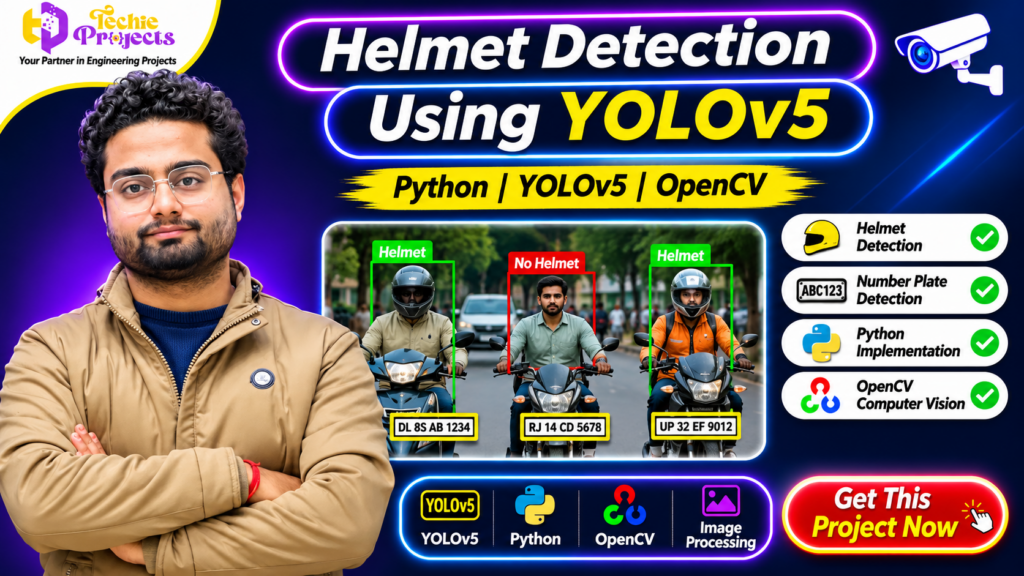
🚀 Get the Helmet Detection Using YOLOv5 Project with Source Code
Looking for an impressive final-year engineering project based on Artificial Intelligence, Machine Learning, and Computer Vision? The Helmet Detection Using YOLOv5 project from Techie Projects is an excellent option for students who want to explore real-time object detection and practical road-safety applications.
Instead of spending weeks developing an entire project from scratch, you can enquire about our ready project package and get the technical resources required to understand, demonstrate, and present your implementation. This project combines Python, YOLOv5, and OpenCV to demonstrate how computer vision can identify motorcycle riders, detect helmet usage, and support number plate recognition when these features are included in the implementation.
🎓 Whether you are pursuing B.Tech, M.Tech, BCA, MCA, or another technical course, this project can help you understand how modern object detection techniques are applied to real-world problems.
Get the Helmet Detection Using YOLOv5 project from Techie Projects and take your final-year project preparation forward!
📞 Contact Techie Projects for Project Enquiries
Interested in purchasing the Helmet Detection Using YOLOv5 Project? Contact Techie Projects to enquire about package availability, pricing, source code, documentation, installation guidance, and technical support options.
💬 WhatsApp Enquiry: Chat with Techie Projects
📱 Contact Number: +91 94600 60699
🌐 Official Website: www.techieprojects.com
📸 Instagram: Follow Techie Projects
🎓 Project Categories: Artificial Intelligence, Machine Learning, Python, YOLO, OpenCV, Computer Vision, and Image Processing.
✅ Request Project Details: Share your engineering branch, preferred features, and technical requirements to enquire about the most suitable available package.
🚀 Ready to get started? Click here to enquire on WhatsApp and mention Helmet Detection Using YOLOv5 Project.
Package contents, prices, hardware requirements, and support options should be confirmed before purchase.
🎬 Watch the Helmet Detection Using YOLOv5 Project Demo
Explore the project demonstration to understand its interface, object detection workflow, and potential applications.
Helmet Detection and Number Plate Recognition Using YOLOv5 – Python Project Demo
Watch the demonstration to see how the implemented system processes visual input and displays detection results. Actual detection classes and features depend on the supplied project version and trained model.
📌 What Is Helmet Detection Using YOLOv5?
Helmet detection is a computer vision application designed to identify whether motorcycle riders are wearing helmets. It uses object detection techniques to analyse images or video frames and locate objects belonging to trained categories.
The Helmet Detection Using YOLOv5 project demonstrates how deep learning can be applied to road-safety monitoring. YOLOv5 is an object detection model that can identify multiple objects in a frame and display their locations using bounding boxes and class labels.
In a typical implementation, the system receives an image or video as input, processes the frames, and detects objects such as motorcycles, riders, helmets, and people without helmets, depending on the trained dataset.
The project can also demonstrate number plate detection or recognition as an additional module. This functionality depends on the model, image-processing pipeline, and OCR components included in the implementation.
By combining Python, YOLOv5, and OpenCV, students can explore how artificial intelligence can be used to build practical computer vision applications.
🎯 Objectives of the Project
The main objective of the project is to demonstrate an automated approach to identifying helmet usage through computer vision.
Important project objectives include:
- Helmet Detection: Identify helmet-related objects in images or video frames using a trained detection model.
- Rider Identification: Detect motorcycle riders and relevant objects when supported by the trained model.
- No-Helmet Detection: Identify riders classified as not wearing helmets, depending on the dataset and model configuration.
- Number Plate Detection: Locate vehicle number plates through an additional detection module.
- Video Processing: Process video input frame by frame to demonstrate object detection.
- Visual Results: Display detection results using bounding boxes, labels, and confidence scores.
- Learning Computer Vision: Help students understand practical applications of deep learning and image processing.
These objectives make the project useful for exploring the relationship between artificial intelligence and transportation safety.
⚙️ How Does the Helmet Detection System Work?
The system follows a computer vision pipeline in which visual input is processed by an object detection model.
1. 📷 Input Image or Video
The process begins when the user provides an image or video. Depending on the implementation, the system may also support a camera as a live input source.
2. 🖥️ Frame Processing Using OpenCV
OpenCV can be used to read images, capture video frames, resize input, and prepare visual data for the detection model.
Preprocessing helps maintain the expected input format required by the model.
3. 🤖 Object Detection Using YOLOv5
The processed frame is passed to the YOLOv5 model. The model analyses the image and predicts the locations and classes of objects learned during training.
Possible detection classes include:
- Helmet
- No Helmet
- Motorcycle
- Rider
- Number Plate
The actual classes depend on the dataset and trained model supplied with the project.
4. 📦 Bounding Box Generation
The model produces object locations and confidence scores. These predictions can be displayed as bounding boxes around detected objects.
Labels help users understand which objects the model has identified.
5. 📊 Display Detection Results
Finally, the application displays the processed image or video with detection results. Users can observe how the model identifies objects in different visual conditions.
This complete workflow provides students with a practical introduction to object detection using Python.
🔥 Key Features of the Helmet Detection Using YOLOv5 Project
The project can demonstrate several useful computer vision concepts.
1. Helmet Detection
The primary functionality is to identify helmets in images or video frames. The trained model predicts helmet-related objects and displays the detection results.
2. No-Helmet Identification
A model trained with suitable categories can identify riders classified as not wearing helmets. This feature demonstrates how object detection can support road-safety monitoring.
3. Number Plate Detection
An additional number plate detection module can locate vehicle registration plates. If OCR is included, the system may also extract text from detected plates.
4. Video-Based Detection
Video processing allows the system to analyse consecutive frames and demonstrate object detection in motion.
5. OpenCV Integration
OpenCV provides image and video processing functionality and can help display detection results.
6. YOLOv5 Model Integration
YOLOv5 demonstrates deep-learning-based object detection and helps students understand model inference, bounding boxes, and object classification.
7. Visual Detection Output
The application can display detected objects with labels and bounding boxes, making the results easier to understand during a project demonstration.
Note: The final features depend on the specific source code, trained model, and package selected.
🧠 Technologies Used in This Project
The project introduces students to several important technologies used in artificial intelligence and computer vision.
| Technology | Purpose |
|---|---|
| Python | Main programming language |
| YOLOv5 | Object detection |
| OpenCV | Image and video processing |
| Deep Learning | Learning object patterns from training data |
| PyTorch | Model development and inference, where used |
| Dataset | Training and evaluation of detection classes |
Python
Python is widely used in machine learning and computer vision because of its libraries and development ecosystem. In this project, Python connects the detection model with the image and video processing workflow.
YOLOv5
YOLOv5 is an object detection framework based on the You Only Look Once approach. It predicts object classes and their locations in images.
Students can explore concepts such as model weights, inference, confidence thresholds, and object detection results.
OpenCV
OpenCV is a computer vision library used for image reading, video capture, frame processing, and visual output.
Deep Learning
Deep learning enables models to learn patterns from labelled training data. The quality of detection depends on the dataset, training process, model configuration, and testing conditions.
🛠️ Software Requirements
The following software may be required depending on the project implementation:
- Programming Language: Python
- Object Detection Framework: YOLOv5
- Image Processing Library: OpenCV
- Deep Learning Framework: PyTorch
- Operating System: Windows 10/11 or a compatible Linux environment
- Code Editor: Visual Studio Code, PyCharm, or another Python IDE
💻 Hardware Requirements
A typical development setup may include:
- Processor: Intel Core i3 or equivalent and above
- RAM: 8 GB recommended
- Storage: Sufficient free disk space for Python packages, model weights, and datasets
- Camera: Webcam or video input, if live detection is supported
- GPU: Optional, but a compatible NVIDIA GPU can accelerate model inference and training
Actual hardware requirements depend on the model size, input resolution, and whether the application uses CPU or GPU processing.
🌍 Real-World Applications of Helmet Detection
Helmet detection has several potential applications in transportation and road-safety research.
1. Traffic Monitoring
Computer vision systems can be explored for analysing traffic footage and identifying helmet-related events.
2. Road Safety Research
Researchers can use detection models to study helmet usage patterns in selected images or video datasets.
3. Smart City Projects
Helmet detection can be included as a component of broader smart-city and intelligent transportation system demonstrations.
4. Intelligent Transportation Systems
Object detection is an important area of intelligent transportation research. It can support the development of systems that analyse road users and traffic conditions.
5. Academic Research
Students can experiment with different datasets, detection models, and image-processing techniques to understand how computer vision performs in practical environments.
Important: A student project is an educational demonstration, not a certified traffic enforcement system. Real-world deployment requires appropriate testing, validation, privacy safeguards, and legal approvals.
🎓 Why Choose This Project for Your Final-Year Engineering Project?
Choosing a suitable final-year project is important because it gives students an opportunity to demonstrate their technical knowledge and problem-solving abilities.
The Helmet Detection Using YOLOv5 project combines multiple concepts in one practical application.
Here are some reasons to consider this project:
- Practical Application: Explore a real-world road-safety problem through computer vision.
- AI and Deep Learning: Understand how trained models identify objects.
- Python Programming: Learn how Python libraries work together in an application.
- Visual Demonstration: Show detection results through images or video.
- Project Presentation: Explain model architecture, dataset preparation, inference, and output.
- Future Development: Explore additional features such as improved number plate recognition or different object classes.
Students can also customise the project based on their academic requirements and the features available in their selected package.
💡 Benefits of Purchasing the Project from Techie Projects
Developing an object detection project independently can require time for dataset preparation, model configuration, coding, testing, and debugging.
If you want a structured starting point, you can enquire about purchasing the project from Techie Projects.
Potential package components may include:
- Python project source code.
- Required project files and model weights, where included.
- Project documentation, subject to package availability.
- Installation and execution guidance.
- Demonstration resources, where available.
- Technical assistance options, as confirmed before purchase.
Before placing an order, share your requirements and confirm the exact deliverables. This helps ensure that the selected package matches your college guidelines and technical expectations.
🚀 Future Scope and Project Enhancements
The project can be extended with additional computer vision and machine learning features.
1. Improved Detection Accuracy
Students can experiment with different training datasets, image augmentation techniques, and model configurations to improve detection performance.
2. Real-Time Camera Integration
A compatible camera can be connected to support live video input if the application implementation includes this functionality.
3. Number Plate Recognition
The number plate detection module can be extended with an OCR system to extract registration text from suitable images.
4. Web-Based Dashboard
A web dashboard can be developed to display uploaded videos, detection results, and selected analysis information.
5. Detection Data Storage
A database can be integrated to store selected detection records for academic analysis, subject to appropriate privacy and data-handling practices.
6. Improved User Interface
Students can develop a more interactive interface for uploading images, selecting videos, and viewing detection results.
These enhancements provide opportunities to customise the project and explore more advanced applications of artificial intelligence.
📚 Learning Outcomes for Students
By studying this project, students can develop an understanding of:
- Python programming for computer vision.
- YOLO-based object detection.
- Image and video processing with OpenCV.
- Deep learning model inference.
- Dataset preparation and object labelling.
- Bounding boxes and confidence scores.
- Model testing and performance evaluation.
- Integration of machine learning models into applications.
These concepts can also help students prepare for further learning in artificial intelligence, machine learning, and computer vision.
🔍 Why Choose Helmet Detection Using YOLOv5 for Your Final-Year Project?
The Helmet Detection Using YOLOv5 project is a valuable choice for students interested in artificial intelligence, Python programming, and computer vision. It demonstrates how a deep learning model can analyse visual data and identify helmet-related objects.
Unlike basic Python applications, this project introduces students to object detection, model inference, image processing, and practical AI implementation. Students can explore how detection models work with images and video frames while understanding the importance of training data and model accuracy.
If you are planning an AI-based final-year project, this implementation offers an opportunity to study a real-world road-safety application.
💻 Helmet Detection Using YOLOv5 – Project Development and Implementation
Developing a Helmet Detection Using YOLOv5 application involves several important stages, including environment setup, model integration, input processing, and result visualisation.
The development process generally begins with installing Python and the required libraries. The YOLOv5 model is then configured with suitable weights and detection classes. OpenCV can be integrated to read images or video frames and display the resulting predictions.
Students can further explore confidence thresholds, image resolution, object labels, and bounding box generation. These practical activities help explain how an object detection application works.
By purchasing the Helmet Detection Using YOLOv5 project from Techie Projects, students can enquire about available source code, documentation, implementation details, and technical assistance before placing an order.
🎯 Who Should Purchase This Helmet Detection Project?
The Helmet Detection Using YOLOv5 project can be considered by:
- B.Tech and M.Tech Computer Science students.
- Artificial Intelligence and Machine Learning students.
- Electronics and Communication Engineering students.
- MCA and BCA students interested in Python applications.
- Students exploring deep learning and computer vision.
- Engineering students looking for an object detection project.
Before purchasing, share your academic requirements with Techie Projects so that the available project package can be checked against your expected features and submission guidelines.
🛒 How to Helmet Detection Using YOLOv5 Project from Techie Projects
Ready to explore a practical computer vision application? Enquire about the Helmet Detection Using YOLOv5 project and confirm the available source code, model files, documentation, installation requirements, and support options.
Step 1: Contact Us
Send your enquiry through WhatsApp or the official website.
Step 2: Share Your Requirements
Mention your course, engineering branch, project title, required features, and submission timeline.
Step 3: Confirm the Package
Ask about source code, documentation, model files, installation requirements, pricing, and available support.
Step 4: Confirm Your Order
Proceed after confirming the package contents and payment details with Techie Projects.
Step 5: Get Started
Use the supplied project resources to install, understand, test, and prepare your academic demonstration.
📲 Purchase Enquiry: Chat with Techie Projects on WhatsApp
🌐 Visit: www.techieprojects.com
❓ Frequently Asked Questions
1. What is Helmet Detection Using YOLOv5?
It is a computer vision project that uses a trained YOLOv5 model to identify helmet-related objects in images or video frames.
2. Which programming language is used?
Python is the primary programming language used in the project.
3. Is OpenCV used in this project?
OpenCV can be used for image reading, video processing, frame handling, and displaying detection results.
4. Can the project detect riders without helmets?
Yes, if the supplied model has been trained to identify a no-helmet class and the implementation supports that detection.
5. Does the project include number plate recognition?
The project title and demonstration may include number plate functionality. Confirm whether plate detection and OCR-based text recognition are both included in the package before purchasing.
6. Is this project suitable for final-year engineering students?
It can be a suitable academic project for students interested in Python, artificial intelligence, deep learning, and computer vision. Students should confirm their department’s project requirements before selecting it.
7. Can I customise the project?
Customisation may be possible depending on the source code, model, and requested changes. Discuss your requirements with Techie Projects before ordering.
8. How can I purchase this project?
Contact Techie Projects through WhatsApp at +91 94600 60699 or visit www.techieprojects.com to enquire about availability, pricing, and package details.
💡 Recommended Projects
Explore more AI, Machine Learning, Python, and Computer Vision projects from Techie Projects.
- Helmet Detection Using Machine Learning – Explore helmet identification using machine learning techniques.
- Number Plate Recognition System – Detect and recognize vehicle registration plates.
- Vehicle Detection and Counting – Identify vehicles and count them in images or video.
- Traffic Sign Recognition Using Deep Learning – Classify traffic signs using image recognition.
- Accident Detection Using Machine Learning – Explore accident-related event detection through visual data.
- Real-Time Object Detection Using YOLO – Identify multiple object categories in images and video.
- Face Recognition Attendance System – Develop an automated attendance application using face recognition.
- AI-Based Traffic Management System – Explore intelligent traffic monitoring concepts.
- Pothole Detection Using Deep Learning – Identify road potholes using computer vision.
- People Counting System Using OpenCV – Detect and count people in visual input.
🌐 Explore More Engineering Projects: www.techieprojects.com
🏆 Conclusion
The Helmet Detection Using YOLOv5 project is a practical way to explore the application of artificial intelligence and computer vision in road-safety research. By combining Python, YOLOv5, and OpenCV, students can understand how object detection models process visual information and identify objects in images or video frames.
From helmet identification and rider detection to optional number plate processing, the project provides opportunities to learn important concepts in deep learning and image processing.
If you are searching for a Python-based AI project for your academic submission, contact Techie Projects to check the available package, source code, documentation, and technical support options.
🚀 Don’t wait until your project submission deadline approaches!
Get in touch with Techie Projects today and enquire about purchasing the Helmet Detection Using YOLOv5 Project.
💬 WhatsApp: https://wa.me/919460060699
🌐 Website: www.techieprojects.com
📸 Instagram: @pythonprojects_
Techie Projects – Your Partner in Engineering Projects!