
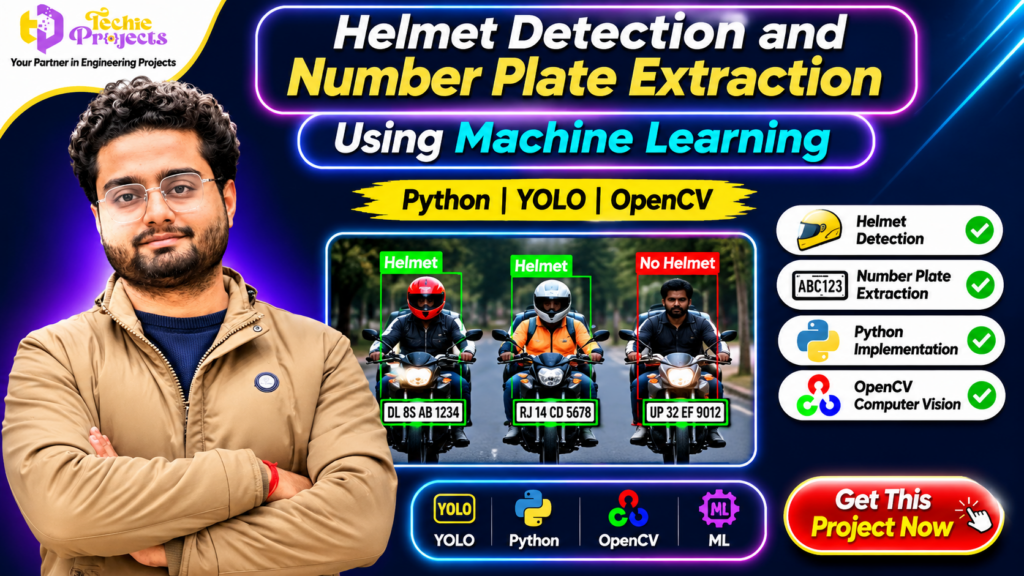
🚀 Looking for an impressive final-year engineering project in Artificial Intelligence, Machine Learning, and Computer Vision? The Helmet Detection and Number Plate Extraction Using Machine Learning project is an excellent choice for students who want to explore real-world computer vision applications using Python, YOLO, and OpenCV.
If you are planning to purchase a ready-to-explore engineering project with source code and technical guidance, Techie Projects can help you get started. This project demonstrates how computer vision techniques can identify motorcycle riders, detect helmet usage, and extract vehicle number plate information from images or video frames, depending on the implemented system.
Instead of spending weeks building every component from scratch, you can enquire about the available project package, understand its implementation, and prepare your academic demonstration more efficiently. Contact Techie Projects to check the available source code, documentation, project features, and technical support options.
📞 Contact Techie Projects for Project Enquiries
Interested in purchasing the Helmet Detection and Number Plate Extraction Using Machine Learning project? Contact us to enquire about package availability, pricing, source code, documentation, installation guidance, and technical support.
💬 WhatsApp Enquiry: Chat with Techie Projects
📱 Contact Number: +91 94600 60699
🌐 Official Website: www.techieprojects.com
📸 Instagram: Follow Techie Projects
🎓 Project Categories: Machine Learning, YOLO, Python, OpenCV, Computer Vision, and Image Processing.
✅ Request Project Details: Share your engineering branch, preferred features, and project requirements to enquire about the most suitable available package.
🚀 Ready to get started? Click here to enquire on WhatsApp and mention Helmet Detection and Number Plate Extraction Using Machine Learning.
Package contents, pricing, hardware or software requirements, and support options should be confirmed before purchase.
🎬 Watch the Helmet Detection and Number Plate Extraction Project Demo
Explore the project demonstration to understand its interface, detection workflow, and possible output.
Demo Video: Helmet Detection and Number Plate Extraction Using Machine Learning | Python | YOLO | OpenCV
📌 Introduction to Helmet Detection and Number Plate Extraction
Road safety is an important concern in modern transportation systems. With the increasing number of vehicles on roads, monitoring traffic rules and identifying vehicles have become significant challenges. Traditional monitoring methods often require continuous human observation, which can be time-consuming.
Artificial Intelligence and Computer Vision provide useful techniques for developing automated traffic-monitoring applications. Object detection models can identify different objects in images and video streams, while image processing techniques can help extract useful information from detected regions.
The Helmet Detection and Number Plate Extraction Using Machine Learning project combines these concepts in an educational computer vision application. It demonstrates how a system can identify riders wearing helmets, detect riders without helmets, and locate vehicle number plates for further processing.
The project is developed using Python and computer vision technologies such as YOLO and OpenCV. Depending on the implementation and available model, the system can process images, video files, or camera input.
This project is suitable for students interested in Artificial Intelligence, Machine Learning, Python development, and intelligent transportation applications.
🎯 Objectives of the Project
The primary objective is to demonstrate how machine learning and image processing can be used to support automated traffic observation.
The major objectives include:
- Detect motorcycles and riders in visual input.
- Identify helmet-related objects using an object detection model.
- Classify detected riders into helmet and no-helmet categories, where supported by the trained model.
- Locate vehicle number plates in images or video frames.
- Extract number plate regions for further image processing.
- Demonstrate how computer vision can support traffic-monitoring applications.
- Provide an academic implementation of an intelligent transportation concept.
These objectives make the project useful for understanding how multiple computer vision tasks can be combined into a single application.
⚙️ How Does the System Work?
The project follows a sequence of image acquisition, object detection, region extraction, and result display.
1. Image or Video Input
The system receives visual input through a supported source. This may include an uploaded image, recorded video, or live camera feed, depending on the project implementation.
OpenCV can be used to read images and video frames and prepare them for further processing.
2. Image Preprocessing
Before detection, input frames may undergo preprocessing operations such as resizing, color conversion, and normalization.
Preprocessing helps prepare the input in a suitable format for the object detection model.
3. Helmet Detection Using YOLO
YOLO is a popular object detection approach that identifies objects and their locations within an image.
In this project, a trained YOLO model can be used to identify relevant classes such as motorcycles, riders, helmets, or no-helmet cases, depending on the dataset and model configuration.
The model can produce bounding boxes, class labels, and confidence scores for detected objects.
4. Number Plate Detection
After identifying relevant vehicles, the system can locate the number plate region using an object detection model or image processing techniques.
The detected region can then be cropped for further processing.
5. Number Plate Extraction
The cropped number plate image can be processed to improve its readability. Techniques such as grayscale conversion, thresholding, noise reduction, and image enhancement may be used.
Optical Character Recognition (OCR) can be integrated to convert visible plate characters into text. The accuracy depends on image quality, lighting, camera angle, and the OCR implementation.
6. Result Display
The application can display detection results using bounding boxes, labels, and extracted image regions. The exact output depends on the selected implementation and included modules.
🧠 Technologies Used in the Project
The project combines several technologies commonly used in Artificial Intelligence and Computer Vision.
Python
Python is the primary programming language. It provides a flexible environment for implementing machine learning models, image processing operations, and application logic.
YOLO Object Detection
YOLO is used for detecting objects in images and video frames. A suitable trained model can identify the classes included in its training dataset.
OpenCV
OpenCV is a computer vision library used for reading images, processing video frames, resizing images, drawing bounding boxes, and performing image transformations.
Machine Learning and Deep Learning
Machine learning and deep learning techniques help the system recognize patterns from visual data. The detection performance depends on the training dataset, model architecture, and evaluation process.
OCR Technology
An OCR component may be used to recognize alphanumeric characters from extracted number plate images. OCR integration should be confirmed in the selected project package.
🚦 Key Features of the Project
The following features describe the main capabilities and possible modules of this project. Actual features depend on the selected implementation.
Helmet Detection
The object detection model can identify helmet-related objects in visual input. This helps demonstrate how automated systems can recognize helmet usage in traffic scenes.
No-Helmet Detection
A model trained with appropriate classes can identify riders without helmets. The result can be displayed using class labels and bounding boxes.
Vehicle Number Plate Detection
The system can locate number plate regions within an image or video frame. These regions can be used for additional processing.
Number Plate Image Extraction
The detected number plate can be cropped and displayed separately, making it easier to examine the extracted region.
Real-Time Processing Possibility
A compatible implementation can process live camera frames. Actual processing speed depends on the hardware, model size, input resolution, and optimization.
Visual Result Display
Detection outputs can be presented using bounding boxes, class names, and confidence values to make the results easier to understand.
💡 Applications of Helmet Detection and Number Plate Extraction
The project demonstrates concepts that are relevant to several intelligent transportation applications.
1. Traffic Monitoring
Computer vision systems can assist in observing traffic scenes and identifying selected objects or activities.
2. Road Safety Research
Helmet detection provides an educational example of how AI can be applied to study helmet usage patterns.
3. Smart City Projects
Intelligent transportation systems are an important part of smart city research. Object detection and vehicle identification are useful topics for academic exploration.
4. Vehicle Identification Research
Number plate detection and OCR can be studied as part of automated vehicle identification workflows.
5. Academic Computer Vision Experiments
Students can use this project to understand object detection, image preprocessing, model inference, and result visualization.
This project is an academic demonstration. It should not be treated as a certified traffic enforcement or legal vehicle identification system.
🛠️ Software Requirements
The following tools may be required, depending on the implementation and package configuration.
- Programming Language: Python
- Computer Vision Library: OpenCV
- Object Detection: YOLO
- Development Environment: VS Code, PyCharm, or another Python IDE
- Operating System: Windows or Linux
- Additional Libraries: NumPy and other model-specific dependencies
- OCR: An OCR library, if character recognition is included
💻 Hardware Requirements
A general development setup may include:
- Computer or laptop
- Intel or AMD processor
- Minimum 8 GB RAM recommended for a comfortable development environment
- Adequate storage for datasets, model files, and project dependencies
- Webcam or camera if live video input is supported
A compatible NVIDIA GPU may help accelerate model inference and training, but the actual hardware requirement depends on the selected model and implementation.
📊 Advantages of the Project
The Helmet Detection and Number Plate Extraction Using Machine Learning project offers several learning benefits for engineering students.
- Practical Computer Vision Experience: Understand how image and video data can be processed using Python.
- YOLO Implementation: Learn the basic workflow of object detection and bounding box prediction.
- Machine Learning Knowledge: Explore trained models, datasets, classes, and model inference.
- Image Processing Skills: Work with image resizing, cropping, filtering, and preprocessing.
- Multiple Module Integration: Understand how helmet detection and number plate extraction can be combined.
- Project Demonstration: Present a visual application during an academic project demonstration.
- Future Development Scope: Extend the system with additional object detection or OCR functionality.
🎓 Why Choose This Project for Your Final Year?
Engineering students often look for projects that demonstrate practical technical knowledge rather than only theoretical concepts.
This project combines Python programming, machine learning, YOLO object detection, and image processing in one application. It can help students explain the complete workflow, from image input to detection output.
Students can explore how the model identifies objects, how number plate regions are extracted, and how image processing techniques improve the input for further analysis.
It can be suitable for Computer Science Engineering, Information Technology, Artificial Intelligence, Data Science, and related branches, depending on the academic requirements.
Before selecting the project, students should review the implementation details and confirm that the included features match their university requirements.
🛒 Why Purchase the Project from Techie Projects?
If you are looking for a project implementation to study, demonstrate, and customize, Techie Projects provides an enquiry-based project service for engineering students.
Purchasing an available project package can help you understand the implementation without having to develop every component independently.
You can contact Techie Projects to discuss:
- Available Python source code.
- Project documentation availability.
- Installation and execution requirements.
- Model and dataset details, where applicable.
- Demonstration video availability.
- Customization possibilities.
- Technical guidance and support options.
- Package pricing and delivery details.
Our objective is to help students explore practical engineering projects and understand the technologies used in their implementation.
Do not wait until the final submission deadline. Enquire early, review the available package, and confirm whether the project meets your academic requirements.
👉 Purchase Enquiry – Helmet Detection and Number Plate Extraction Project
🔧 Future Scope of the Project
The project can be extended with additional features to explore more advanced intelligent transportation applications.
1. Improved Detection Accuracy
The model can be retrained or fine-tuned using a more diverse dataset containing different lighting conditions, vehicle types, camera angles, and helmet appearances.
2. Advanced OCR Integration
An OCR module can be added or improved to recognize number plate characters from cropped images.
3. Database Integration
Detected events and extracted plate text, where available, can be stored in a database for academic analysis and reporting.
4. Web-Based Dashboard
A web dashboard can be developed to display detection results, uploaded images, and selected analysis information.
5. Multiple Vehicle Detection
The model can be extended to detect multiple vehicles and riders in the same frame, subject to model capability.
6. Improved Video Processing
Video processing can be optimized to improve frame handling and inference performance.
7. Additional Traffic Object Detection
Other traffic-related objects can be added if suitable training data and model classes are available.
❓ Frequently Asked Questions
1. What is Helmet Detection and Number Plate Extraction Using Machine Learning?
It is a computer vision project that demonstrates how machine learning models can detect helmet-related objects and locate vehicle number plates in images or video frames.
2. Which programming language is used?
Python is the primary programming language used in this project.
3. Which technologies are used?
The project can use Python, YOLO, OpenCV, machine learning, image processing, and OCR integration depending on the implementation.
4. Is this project suitable for final-year engineering students?
Yes. It can be suitable for students interested in Artificial Intelligence, Machine Learning, Computer Vision, and Image Processing, subject to university requirements.
5. Can the system detect riders without helmets?
A trained model with the appropriate detection classes can identify riders without helmets. The actual capability depends on the model and dataset.
6. Does the project extract number plate text?
Number plate region detection and text recognition are separate tasks. Text extraction requires an OCR component. Confirm whether OCR is included in the package before purchasing.
7. Can this project work with a live camera?
Live camera processing is possible if the selected implementation supports webcam or camera input and the system has compatible hardware.
8. Can I purchase the source code?
You can contact Techie Projects to check the availability of the source code, documentation, and other package components.
9. Can the project be customized?
Customization may be possible depending on the requested changes and available implementation. Discuss your requirements before purchasing.
10. How can I contact Techie Projects?
You can contact us through WhatsApp at +91 94600 60699 or visit www.techieprojects.com.
💡 Recommended Projects
If you are interested in the Helmet Detection and Number Plate Extraction Using Machine Learning project, you may also explore these related engineering projects from Techie Projects.
- Vehicle Detection and Counting Project – Detect and count vehicles using computer vision techniques.
- Automatic Number Plate Recognition Project – Explore number plate detection and character recognition.
- Traffic Sign Recognition Using Machine Learning – Identify and classify traffic signs using image processing and machine learning.
- Accident Detection Using Machine Learning – Explore an AI-based approach to identifying accident-related events.
- Driver Drowsiness Detection System – Study facial landmarks and eye-state analysis for driver monitoring.
- Real-Time Object Detection Using YOLO – Detect multiple object classes from images or video.
- Face Recognition Attendance System – Develop an attendance application using face recognition techniques.
- Pothole Detection Using Deep Learning – Identify road surface defects using computer vision.
Explore more engineering projects, source code options, and project ideas at www.techieprojects.com.
🔍 Why Choose Helmet Detection and Number Plate Extraction Using Machine Learning?
The Helmet Detection and Number Plate Extraction Using Machine Learning project brings two important computer vision applications together. It allows students to understand how object detection models can identify helmet usage and locate vehicle number plates from visual data.
One major advantage of the Helmet Detection and Number Plate Extraction Using Machine Learning system is its practical approach to AI-based traffic monitoring. Students can explore how YOLO identifies objects, how OpenCV processes images, and how detected number plate regions can be extracted for further analysis.
For engineering students, the Helmet Detection and Number Plate Extraction Using Machine Learning project provides an opportunity to study Python programming, image preprocessing, object detection, and model inference through a practical application.
🧪 Project Implementation and Learning Opportunities
During implementation, students can explore different stages of the Helmet Detection and Number Plate Extraction Using Machine Learning workflow, including image acquisition, model loading, object detection, bounding box visualization, and number plate extraction.
The Helmet Detection and Number Plate Extraction Using Machine Learning application can also help students understand the relationship between trained datasets and detection results. They can study how image quality, camera position, lighting conditions, and model configuration influence the output.
Another useful learning area is integrating OCR with the number plate detection module. This allows students to explore how detected plate images can be converted into readable characters using a suitable recognition library.
📞 Purchase Helmet Detection and Number Plate Extraction Using Machine Learning Project Project Today!
Are you looking for a practical final-year project with Python and computer vision? Techie Projects can help you enquire about the Helmet Detection and Number Plate Extraction Using Machine Learning project package.
Before purchasing, you can ask about the available source code, YOLO model, documentation, number plate extraction module, installation instructions, and demonstration video.
The Helmet Detection and Number Plate Extraction Using Machine Learning project is a useful academic topic for students who want to demonstrate their understanding of AI-based object detection and image processing.
Get in touch with Techie Projects to check the available project package, source code, documentation, demonstration, and technical support options.
🎓 Build your engineering knowledge with practical projects.
💬 WhatsApp: https://wa.me/919460060699
📱 Call: +91 94600 60699
🌐 Website: www.techieprojects.com
📸 Instagram: @pythonprojects_
🚀 Enquire Now and Get Started with Your Project!