
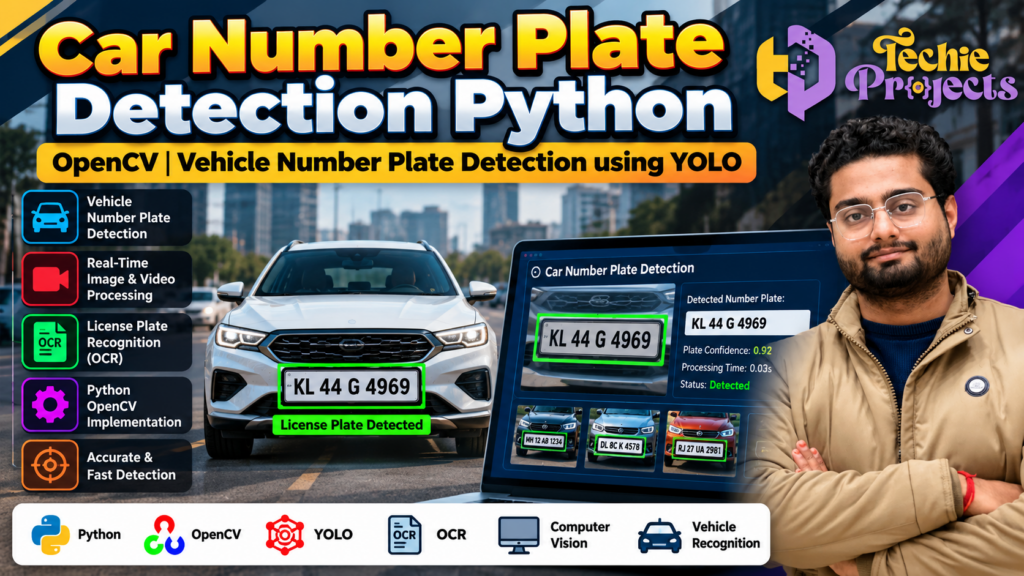
Car Number Plate Detection Using Python is a practical computer vision project for engineering students interested in artificial intelligence, machine learning, OpenCV, and YOLO. This project demonstrates how vehicle number plates can be detected from images or video, with optical character recognition (OCR) optionally used to extract registration characters.
If you are looking for a Python project for your B.Tech, B.E., MCA, or final-year submission, Techie Projects can help you explore this project and enquire about its availability, pricing, and included deliverables.
🎬 Watch the Car Number Plate Detection Project Demo
Watch the Car Number Plate Detection Using Python project demo to understand its interface, detection process, and expected workflow.
Reviewing the demonstration can help you decide whether this project matches your academic requirements. If you need clarification about the implementation, technologies, or available project materials, contact Techie Projects before placing your order.
Car Number Plate Detection Using Python: Project Overview
Car Number Plate Detection Using Python combines image processing and object detection to locate vehicle registration plates. Depending on the implementation, OpenCV can process images and video, YOLO can identify number plate regions, and an OCR component can attempt to read the detected characters.
🚘 What Is Car Number Plate Detection Using Python?
Car number plate detection is a computer vision application that identifies the license plate region in a vehicle image or video frame. The system processes visual input to locate the plate, after which an optical character recognition (OCR) component may extract the characters.
The Car Number Plate Detection Using Python project demonstrates how tools such as Python and OpenCV can be used to build a vehicle-related image processing application. Depending on the implementation, a YOLO-based object detection model can help locate vehicles or number plates in visual data.
A typical system may contain two main stages:
- Number plate detection: The model identifies the location of a license plate within an image or video frame.
- Character recognition: An OCR tool processes the detected plate region and attempts to read its characters.
Detection and recognition are different tasks. A system may locate a plate correctly but still read its characters incorrectly because of poor lighting, motion blur, low image quality, or an unusual viewing angle.
🎯 Why Choose This Python Project for Your Final Year?
Engineering students often need a project that combines programming concepts with a practical application. This topic connects several areas of computer science in one implementation.
1. Practical computer vision experience
Learn how visual data can be processed to identify important objects in images and video. This introduces you to a major application area of artificial intelligence.
2. Python programming skills
Explore Python libraries, image processing operations, model inference, and the integration of different software components.
3. Understanding object detection
A YOLO-based implementation can demonstrate how an object detection model identifies objects and returns their locations. The exact model, classes, and capabilities depend on the version used in the project.
4. Useful academic demonstration
The project can support a presentation about image processing, detection models, OCR, system architecture, testing, and limitations.
5. Opportunities for further development
Students can investigate improvements such as better image preprocessing, multiple vehicle detection, confidence thresholds, or performance evaluation, subject to the available implementation.
⚙️ How the Car Number Plate Detection System Works
The workflow depends on the model and libraries used, but a typical implementation follows these steps.
Step 1: Input image or video
The application receives a vehicle image, a video file, or a live camera feed if webcam support is included.
Step 2: Image preprocessing
The input may be resized, converted into a suitable format, or processed to improve compatibility with the detection model.
Step 3: Object detection using YOLO
The YOLO model analyzes the image and predicts object locations. If trained or configured to recognize number plates, it can return bounding boxes around the detected plate regions.
Step 4: Extract the number plate region
The system crops the detected region for further processing. This step helps isolate the plate from the rest of the vehicle image.
Step 5: Character recognition using OCR
If OCR is integrated, the cropped image is passed to a text-recognition component. The component attempts to read the registration characters from the plate.
Step 6: Display the result
The application may display the original image, detection boxes, and recognized text. The exact output depends on the project’s implementation.
Step 7: Evaluate the results
Test the system with different images and conditions. Record detection failures and recognition errors to understand the system’s strengths and limitations.
🧰 Technologies Used in the Project
The following technologies are commonly associated with this type of project. Confirm the actual versions and components included in the package before purchasing.
- Python: Main programming language for application logic.
- OpenCV: Image and video processing.
- YOLO: Object detection, when included in the implementation.
- OCR library: Optional character recognition component, such as EasyOCR or Tesseract.
- NumPy: Numerical operations and array processing.
- Development environment: A Python-compatible editor or IDE, depending on the setup.
Not every implementation uses all these technologies. Ask Techie Projects for the exact library list and compatible versions for the available project.
💻 Software and Hardware Requirements
The requirements depend on the model size, processing method, and application interface.
Software requirements
- Python environment compatible with the project’s dependencies
- OpenCV and other required Python packages
- Model weights and configuration files, if applicable
- A supported operating system
- A compatible IDE or code editor
Hardware requirements
- Laptop or desktop computer
- Adequate RAM and storage for the dependencies and model files
- Webcam or camera if live video input is supported
- A compatible GPU only if required or beneficial for the selected model
Before purchasing, ask for the minimum system requirements and installation instructions. Do not assume that every version supports live camera input or GPU acceleration.
🌍 Real-World Applications of Number Plate Recognition
Automatic number plate recognition has several potential applications when implemented and tested appropriately.
Parking management
A number plate recognition system may help identify vehicles entering or leaving a parking facility.
Traffic monitoring
Traffic-related applications can use plate recognition as one component of a larger monitoring system.
Access control
Authorized vehicle entry systems may use number plate information alongside other security checks.
Vehicle fleet management
Businesses may investigate plate recognition to support vehicle identification and movement records.
Intelligent transportation research
Students can use the project to explore how computer vision may contribute to transportation automation.
These are potential application areas, not a guarantee that a student project is ready for real-world deployment. Operational systems require reliability testing, appropriate security, privacy safeguards, and compliance with applicable laws.
📊 Features to Explore
Depending on the available implementation, the project may demonstrate some of the following capabilities:
- Detection of number plates in images
- Vehicle image processing using OpenCV
- YOLO-based object localization
- OCR integration for character extraction
- Bounding boxes and detection labels
- Processing of video frames, if supported
- Display of detection results through an application interface
Important: Confirm each feature with Techie Projects before ordering. The actual features depend on the delivered code, model, and configuration.
🎓 What Students Can Learn
Working with this project can help students understand several technical concepts:
- Image acquisition and preprocessing
- Object detection and bounding boxes
- Python package installation and dependency management
- The difference between object detection and OCR
- Model testing and error analysis
- Limitations caused by lighting, blur, and image resolution
- How to explain a software project’s workflow during a presentation
Students should run the project, examine its implementation, and prepare their own explanation of the code. This will help them understand the system rather than relying only on its final output.
⚠️ Challenges and Limitations
A good engineering project should explain its limitations as well as its features.
Poor image quality: Blurred, distant, or low-resolution plates can reduce detection and recognition performance.
Lighting conditions: Nighttime images, glare, and strong shadows may affect results.
Plate variations: Different fonts, layouts, and regional formats can make character recognition more difficult.
Detection errors: A model can miss a plate or detect the wrong region. OCR can also return incorrect characters.
Real-world deployment: A demonstration project should not be treated as a production-ready traffic enforcement or security system without extensive validation.
Understanding these challenges gives students useful material for their project report, testing section, and viva presentation.
🛒 Purchase the Car Number Plate Detection Project from Techie Projects
Need a computer vision project for your engineering coursework? Contact Techie Projects to enquire about the Car Number Plate Detection Using Python project, confirm its deliverables, and check whether it suits your requirements before purchasing.
Before placing an order, clarify:
- Whether the source code is included
- Whether model weights and required files are provided
- Which Python and library versions are supported
- Whether installation instructions or documentation are included
- Whether the project supports images, recorded videos, or live camera input
- What technical assistance, if any, is included
- The current price and delivery terms
📲 Contact Techie Projects
- 📲 Call/WhatsApp: +91-9460060699
- 🌎 Website: www.techieprojects.com
- 📺 Instagram: @pythonprojects_
Send your course, project requirements, and preferred features through WhatsApp to discuss the available option.
🔗 Explore Related Python Projects
If you are interested in computer vision and artificial intelligence, you can also explore related topics on Techie Projects:
- Vehicle Detection and Counting
- Helmet Detection Using Computer Vision
- Face Recognition Attendance System
- Object Detection Using YOLO
- Traffic Sign Recognition
- Real-Time Object Detection Using Python
Choose a project that fits your course requirements, available development time, and technical interests.
❓ Frequently Asked Questions
1. What is the Car Number Plate Detection Using Python project?
It is a computer vision application that identifies the location of a vehicle registration plate in an image or video. OCR may be used to read the characters after detection.
2. Which programming language is used?
Python is commonly used for the application’s processing logic and integration with libraries such as OpenCV and YOLO.
3. Does the project automatically read number plate characters?
That depends on whether OCR is included and correctly configured. Number plate detection alone identifies the plate region; it does not necessarily read the text.
4. Can the project process live video?
Some implementations support webcam or live video processing, while others work only with images or recorded videos. Confirm this feature before purchase.
5. Is this project suitable for final-year engineering students?
It can be a suitable academic topic for students interested in computer vision, machine learning, and Python, subject to their institution’s requirements.
6. Can I purchase the project from Techie Projects?
You can contact Techie Projects through WhatsApp to ask about current availability, pricing, deliverables, and compatibility.
7. Will the system always recognize every number plate correctly?
No. Detection and recognition accuracy can vary with lighting, image quality, plate format, and model configuration. Results should be tested rather than assumed.
🚀 Benefits of Car Number Plate Detection Using Python
Car Number Plate Detection Using Python helps students explore practical computer vision concepts through vehicle image processing, YOLO-based object detection, and optional OCR integration. This project is useful for understanding how AI techniques can support vehicle identification and intelligent transportation research. Contact Techie Projects to enquire about the available project package, supported features, pricing, and deliverables.
🚀 Get Started with Your Computer Vision Project
The Car Number Plate Detection Using Python project provides a practical way to explore object detection, image processing, and automated character recognition. It can also serve as a foundation for further experimentation with intelligent transportation applications.
If you are planning your next engineering project, contact Techie Projects today to check availability, understand the included materials, and discuss the right project option for your academic needs.
Please verify your institution’s project rules and the package’s exact deliverables before purchasing. Use the project to learn, test, and prepare your own academic explanation.
🎯 Conclusion: Car Number Plate Detection Using Python
Car Number Plate Detection Using Python is a practical computer vision project that combines Python programming, OpenCV, and YOLO-based object detection to identify vehicle number plates in images or video. With optional Optical Character Recognition (OCR), the system can also attempt to extract registration characters from detected plates.
For B.Tech, B.E., MCA, and other engineering students, this project provides an opportunity to explore image processing, object detection, AI applications, and intelligent transportation systems. It can also help students understand real-world challenges such as poor lighting, blurred images, and recognition errors.
🚀 Want to purchase this project for your academic work? Contact Techie Projects to enquire about availability, pricing, source code, installation requirements, and included deliverables before placing your order.
📲 WhatsApp: Enquire About the Project
🌐 Website: https://techieprojects.com/
📸 Instagram: Follow Techie Projects
Choose a project that matches your academic requirements, understand its implementation, and use it to strengthen your practical programming and presentation skills.