
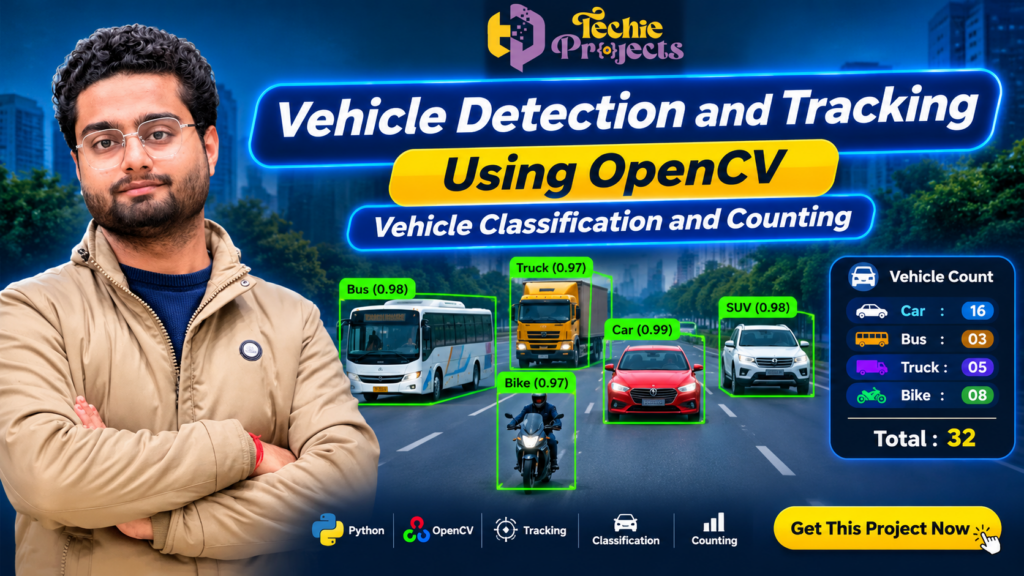
🚗 Looking for a ready-made Vehicle Detection and Tracking Using OpenCV project for your final-year engineering submission? Get this practical computer vision and machine learning project from Techie Projects and explore how Python can detect, classify, track, and count vehicles from video footage.
Stop spending weeks searching for project ideas or developing every component from scratch. Techie Projects offers engineering project solutions to help students explore practical implementations of artificial intelligence, machine learning, and computer vision. Enquire about our Vehicle Detection and Tracking Using OpenCV project to check source code availability, documentation, installation guidance, and technical support.
This project demonstrates how a computer vision application can identify different vehicle categories, track detected vehicles, and calculate the number of vehicles passing through a defined counting region or virtual line. It is a useful academic application for students interested in intelligent transportation systems, traffic monitoring, object detection, and automated vehicle analysis.
🎓 Whether you are pursuing B.Tech, BCA, MCA, M.Tech, or a diploma in computer science or information technology, this project can help you understand how computer vision techniques are applied to real-world transportation problems.
📞 Contact Techie Projects for Project Enquiries
Want to purchase the Vehicle Detection and Tracking Using OpenCV project? Contact our team to discuss the available package, project requirements, source code, documentation, and technical support.
- 📱 WhatsApp: https://wa.me/919460060699
- ☎️ Contact Number: +91 94600 60699
- 🌐 Website: www.techieprojects.com
- 📸 Instagram: https://www.instagram.com/pythonprojects_/
Share your college requirements and preferred features to confirm the available package before purchasing.
🎬 Watch the Vehicle Detection and Tracking Project Demo
Explore the project demonstration to understand how the application processes traffic video footage, identifies vehicles, and displays vehicle classification and counting results.
The demonstration helps you understand the application workflow and visual output before making a purchase decision.
🚘 What Is Vehicle Detection and Tracking Using OpenCV?
Vehicle Detection and Tracking Using OpenCV is a computer vision application designed to identify and monitor vehicles from images or video footage.
Vehicle detection involves locating vehicles in a visual scene, while vehicle tracking involves maintaining information about detected vehicles across successive video frames. Vehicle counting uses the detection or tracking information to estimate how many vehicles pass through a specified area.
For example, a traffic monitoring application may analyze a road video containing cars, buses, trucks, motorcycles, and other vehicles. The system identifies supported vehicle categories and displays detection information on the video frames.
OpenCV is a popular computer vision library that provides tools for image processing and video analysis. Machine learning and object detection models can be integrated to recognize vehicles and identify their locations.
The project combines these concepts to demonstrate an automated vehicle analysis workflow using Python.
Unlike manual observation, computer vision-based vehicle analysis can process video frames and produce visual detection results. The accuracy of the output depends on the selected detection model, training dataset, camera quality, lighting, and implementation.
🎯 Objectives of the Vehicle Detection and Tracking Project
The main objective is to demonstrate how computer vision and machine learning can be used to analyze road traffic videos.
The major objectives include:
- Vehicle Detection: Identify vehicles from supported images or video footage.
- Vehicle Classification: Recognize supported vehicle categories such as cars, buses, trucks, and motorcycles.
- Vehicle Tracking: Follow detected vehicles across consecutive video frames.
- Vehicle Counting: Calculate the number of vehicles passing through a defined counting region.
- Video Processing: Process traffic video frames using OpenCV.
- Visual Representation: Display detection boxes, labels, and counting information.
- Automated Analysis: Reduce dependence on manual vehicle observation for the demonstrated video analysis task.
- Academic Learning: Understand the practical use of Python, machine learning, and computer vision.
These objectives make the project relevant to students interested in intelligent transportation and automated traffic monitoring.
⚙️ How Does Vehicle Detection and Tracking Work?
The application follows a series of image processing, object detection, and tracking operations. The exact workflow depends on the model and implementation included in the selected project package.
1. Video Input
The system receives traffic video footage as an input. The video contains moving vehicles that need to be detected and analyzed.
Depending on the available implementation, the input may be selected from a stored video file or another supported video source.
2. Video Frame Extraction
OpenCV processes the video by reading individual frames.
A video is essentially a sequence of images displayed at a particular frame rate. Processing these frames allows the system to analyze the road scene and identify vehicles.
The application prepares each frame for the detection process.
3. Vehicle Detection
The object detection component identifies vehicle objects in each processed frame.
A configured machine learning or deep learning model analyzes the image and produces detection results. These results may include object locations, predicted categories, and confidence scores.
Bounding boxes can be drawn around detected vehicles to make their positions visible.
4. Vehicle Classification
After detecting vehicles, the application identifies their supported categories.
Depending on the configured model, categories may include:
- Cars
- Buses
- Trucks
- Motorcycles
- Other supported vehicle types
Vehicle classification helps distinguish different road users instead of treating every detected object as the same category.
5. Vehicle Tracking
Tracking helps maintain the identity of detected vehicles across successive frames.
For example, when a car moves from one part of a video frame to another, a tracking component can associate detections across frames.
The exact tracking method depends on the implementation and configured algorithms.
6. Vehicle Counting
The system can count vehicles passing through a predefined region or virtual line.
When a tracked vehicle crosses the configured counting area, the application can update the vehicle count.
This is useful for demonstrating how computer vision can estimate traffic movement from recorded footage.
7. Displaying Results
The final output may display:
- Vehicle bounding boxes.
- Vehicle category labels.
- Tracking information.
- Vehicle count.
- Processed video frames.
These visual results help students understand the complete workflow and demonstrate the project during academic evaluation.
⭐ Key Features of the Vehicle Detection and Tracking Project
The project combines multiple computer vision concepts in one Python-based application.
🚗 1. Vehicle Detection
The system identifies vehicles appearing in supported traffic video footage.
🚙 2. Vehicle Classification
The application can classify detected vehicles into supported categories, helping distinguish cars, buses, trucks, and motorcycles.
🎥 3. Video Processing
OpenCV provides video reading and frame-processing capabilities for analyzing traffic scenes.
🔍 4. Object Localization
Bounding boxes can be used to highlight detected vehicle positions in video frames.
🔄 5. Vehicle Tracking
Tracking techniques help associate vehicle detections across consecutive frames.
🔢 6. Automated Vehicle Counting
The application demonstrates how vehicles can be counted when they cross a configured counting region.
📊 7. Visual Detection Results
The system can display labels and counting information to make the output easier to understand.
🐍 8. Python-Based Development
Python provides access to computer vision libraries and machine learning frameworks that support the project implementation.
Note: The precise model, tracking algorithm, supported vehicle classes, and interface features should be confirmed with Techie Projects before purchase.
🧠 Technologies Used in This Project
Python Programming
Python is the primary programming language used to develop the application. It supports integration with computer vision libraries, machine learning models, and video processing tools.
OpenCV
OpenCV is an open-source computer vision library used to process images and videos.
It supports operations such as:
- Reading video files.
- Extracting video frames.
- Resizing images.
- Drawing bounding boxes.
- Displaying processed frames.
- Performing image processing operations.
Machine Learning
Machine learning techniques help computer systems recognize patterns from data. In vehicle detection applications, trained models can identify visual features associated with different vehicle categories.
Deep Learning and Object Detection
Deep learning-based object detection models can identify objects and estimate their locations within images.
The model selected for the project determines its supported categories and detection performance.
Vehicle Tracking Algorithms
Tracking algorithms help associate detected vehicles across multiple video frames. They can be used to maintain vehicle identities and support counting operations.
Tkinter (If Included in the Selected Implementation)
Tkinter is a Python library for creating graphical user interfaces. If included in the project package, it can provide an interface for selecting video input and displaying application results.
🚦 Applications of Vehicle Detection and Tracking
Vehicle detection and tracking technologies are useful in several transportation and research applications.
1. Traffic Monitoring Systems
Computer vision can analyze traffic videos and identify different vehicle categories. This information can support traffic monitoring research.
2. Vehicle Counting
Automated vehicle counting can help estimate the number of vehicles passing through a particular road section.
3. Smart City Development
Smart city research explores how technology can support urban infrastructure. Vehicle analysis can form one component of broader intelligent transportation systems.
4. Highway Traffic Analysis
Recorded highway videos can be analyzed to understand vehicle movement and traffic patterns.
5. Parking Management Research
Vehicle detection techniques can be explored in parking applications to identify vehicles entering or leaving a parking area.
6. Intelligent Transportation Systems
Vehicle detection and tracking are important research areas in intelligent transportation systems, where computer vision is used to understand road activity.
7. Academic and Research Applications
Students can use the project to explore object detection, tracking, vehicle classification, and automated counting techniques.
🎓 Why Choose This Project for Your Final-Year Engineering Submission?
Selecting a project that demonstrates practical technical knowledge can make your academic work more meaningful.
The Vehicle Detection and Tracking Using OpenCV project combines Python programming, machine learning, and computer vision in one application.
Practical Computer Vision: Understand how software can analyze video footage and detect vehicles.
Machine Learning Knowledge: Explore how trained models recognize different vehicle categories.
Object Tracking Concepts: Learn how detections can be associated across video frames.
Automated Counting: Understand how virtual counting lines can be used to calculate vehicle movement.
Visual Demonstration: Display detection and counting results to explain the application workflow.
Technical Learning: Explore the relationship between video processing, object detection, classification, and tracking.
Project Customization: Additional features may be possible depending on the available source code and technical requirements.
If you want a practical project for your academic submission, contact Techie Projects to discuss the available package and implementation details.
🏗️ Possible Future Enhancements
The basic project concept can be extended with additional features depending on the available implementation and development requirements.
1. Real-Time Vehicle Detection
A compatible camera can be integrated to analyze live traffic footage instead of relying only on recorded videos.
2. Advanced Vehicle Classification
The application can be extended to recognize additional vehicle categories when suitable training data and model support are available.
3. Traffic Density Estimation
Vehicle counts can be used to estimate traffic density over selected time intervals.
4. Number Plate Recognition
A separate number plate recognition component can be integrated to explore vehicle identification using OCR and image processing.
5. Accident Detection Research
Video analysis techniques can be explored to investigate unusual vehicle movement and potential accident scenarios.
6. Traffic Analytics Dashboard
A dashboard can display vehicle counts, category-wise statistics, and traffic analysis results.
7. Database Integration
Vehicle counting results can potentially be stored in a database for later analysis and reporting.
8. Multiple Camera Support
An extended implementation can explore processing video streams from multiple cameras, subject to hardware and software requirements.
These enhancements provide opportunities for further research and development.
💻 Software and Hardware Requirements
The following requirements provide a general starting point for a Python-based vehicle detection application. Actual requirements depend on the selected model and implementation.
Software Requirements
- Programming Language: Python
- Computer Vision Library: OpenCV
- Machine Learning: Compatible detection framework
- Operating System: Windows 10 or Windows 11
- GUI Framework: Tkinter, if included
- Development Environment: VS Code or PyCharm
- Additional Libraries: As required by the project source code
Hardware Requirements
- Processor: Modern Intel or AMD processor
- RAM: 8 GB recommended as a starting point
- Storage: Sufficient space for source code, model weights, and video files
- Input: Keyboard and mouse
- GPU: Optional, depending on model and processing requirements
A compatible GPU can help accelerate supported deep learning workloads. Actual performance depends on the selected model, video resolution, and system configuration.
📦 What Do You Get When You Purchase This Project?
Planning to purchase the Vehicle Detection and Tracking Using OpenCV project from Techie Projects?
Contact our team to confirm the exact deliverables included in the selected package.
Depending on the package, available deliverables may include:
- Python project source code.
- Required project files.
- Model weights or configuration files, where included.
- Installation instructions.
- Execution guidance.
- Project documentation, where included.
- Demonstration or implementation guidance.
- Technical support options, as agreed before purchase.
Before ordering, share your college requirements and expected deliverables. Our team can help you understand the available package and whether it matches your academic needs.
🚗 Benefits of Vehicle Detection and Tracking Using OpenCV
Vehicle Detection and Tracking using OpenCV is a useful computer vision project for students who want to understand how automated traffic monitoring systems work. It demonstrates how video frames can be processed to identify vehicles and track their movement.
Some important benefits of this project include:
- Vehicle identification: Detect vehicles appearing in images or video frames.
- Vehicle tracking: Follow detected vehicles across consecutive frames, depending on the tracking algorithm used.
- Vehicle classification: Categorize vehicles such as cars, buses, trucks and motorcycles when supported by the model.
- Traffic analysis: Use detection and counting results to study vehicle movement.
- Practical learning: Understand Python, OpenCV, image processing and machine learning concepts.
⚙️ Applications of Vehicle Detection and Tracking Using OpenCV
The concepts used in Vehicle Detection and Tracking using OpenCV can be applied to different intelligent transportation and computer vision applications.
- Smart traffic monitoring: Analyze vehicle movement on roads.
- Vehicle counting: Estimate the number of vehicles passing through a selected region.
- Traffic flow analysis: Study traffic density using recorded video footage.
- Parking management: Explore vehicle detection in parking-area monitoring systems.
- Road surveillance: Support academic demonstrations of automated vehicle monitoring.
The actual functionality depends on the model, tracking method and features included in the project package.
💻 Why Choose This OpenCV Vehicle Detection Project?
If you are searching for a practical computer vision project, Vehicle Detection and Tracking using OpenCV provides an opportunity to explore real-world image and video processing concepts.
This project can help engineering students understand object detection, vehicle classification, tracking techniques and vehicle counting. It can also be used as a foundation for further experiments involving traffic analysis and intelligent transportation systems.
🛒 Why Purchase Your Engineering Project from Techie Projects?
Finding a suitable engineering project can take considerable time. Techie Projects helps students explore practical project solutions across multiple technical domains.
We focus on project categories such as:
- Artificial Intelligence Projects
- Machine Learning Projects
- Python Projects
- Computer Vision Projects
- OpenCV Projects
- Deep Learning Projects
- IoT Projects
- Data Analytics Projects
- Web Development Projects
Benefits of Contacting Techie Projects
🎓 Multiple Project Domains: Explore project ideas across different engineering and computer science fields.
💻 Practical Implementations: Enquire about projects that demonstrate real technical concepts.
📁 Source Code Availability: Confirm the source code included in your selected package.
📚 Documentation: Ask about project reports and documentation availability.
🤝 Technical Guidance: Discuss installation, execution, and implementation-related questions.
🧩 Customization Enquiries: Share your requirements to discuss possible modifications.
📞 Direct Communication: Contact our team to discuss project availability, pricing, and deliverables.
Our goal is to help students explore technical implementations and understand the concepts behind their engineering projects.
💰 How to Vehicle Detection and Tracking Project Source Code
Want to develop your final-year project without starting every component from scratch? Contact Techie Projects to enquire about the Vehicle Detection and Tracking using OpenCV project.
You can ask our team about the available source code, project documentation, software requirements, demonstration and technical support options before purchasing.
🚀 Ready to purchase your Vehicle Detection and Tracking Using OpenCV project?
Don’t waste time searching endlessly for a suitable engineering project. Contact Techie Projects today to enquire about source code, documentation, pricing, and available technical support.
📱 WhatsApp: https://wa.me/919460060699
☎️ Call: +91 94600 60699
🌐 Website: www.techieprojects.com
📸 Instagram: https://www.instagram.com/pythonprojects_/
Techie Projects – Your Partner in Engineering Projects.
Interested in purchasing this project? Follow these simple steps:
- Visit the Techie Projects website.
- Contact our team through WhatsApp.
- Mention Vehicle Detection and Tracking Using OpenCV.
- Share your branch, course, semester, and college requirements.
- Confirm source code, documentation, features, and package pricing.
- Discuss customization and technical support, if required.
- Proceed with your order after confirming all deliverables.
❓ Frequently Asked Questions (FAQs)
1. What is Vehicle Detection and Tracking Using OpenCV?
It is a computer vision application that detects vehicles from video footage, identifies supported vehicle categories, tracks vehicle movement, and counts vehicles passing through a defined region.
2. Which programming language is used?
Python is used as the primary programming language.
3. Which library is used for video processing?
OpenCV is used for image and video processing operations.
4. Can the system detect different vehicle types?
The configured detection model can identify supported categories, which may include cars, buses, trucks, and motorcycles.
5. Can the project count vehicles automatically?
Yes, the project demonstrates vehicle counting using a configured counting region or virtual line, depending on the implementation.
6. Is this project suitable for final-year engineering students?
Yes. It can be suitable for students interested in computer vision, machine learning, Python programming, and intelligent transportation systems.
7. Can I get the complete source code?
Contact Techie Projects to confirm source code availability and the exact contents of the selected package.
8. Does the project support real-time video?
Real-time processing depends on the available input method, model configuration, hardware, and implementation. Confirm this requirement before purchasing.
9. Can I customize the project?
Customization may be possible depending on the selected package and technical requirements. Discuss the required changes with our team before ordering.
10. Do I receive project documentation?
Documentation availability depends on the selected package. Contact Techie Projects to confirm the included documents.
11. Can I use this project for a machine learning presentation?
Yes. The project provides concepts that can be explained during an academic presentation, including vehicle detection, classification, tracking, and counting.
12. How can I purchase this project?
Contact Techie Projects through WhatsApp at +91 94600 60699 or visit www.techieprojects.com to enquire about availability and pricing.
💡 Recommended Projects
Explore more related projects from Techie Projects:
- 🚦 Traffic Light Detection Using YOLO – Detect traffic signals and recognize their colors using computer vision.
- 🔢 Automatic Number Plate Recognition Using Python – Identify vehicle registration plates using image processing and OCR.
- 🪖 Helmet Detection Using YOLO – Detect motorcycle riders with and without helmets.
- 🚗 Real-Time Object Detection Using YOLO – Identify multiple objects from images and video.
- 🛣️ Lane Detection Using OpenCV – Identify road lanes using computer vision techniques.
- 🚨 Red Light Violation Detection System – Explore traffic signal monitoring and vehicle movement analysis.
- 🅿️ Smart Parking Management System – Explore vehicle detection and parking-space management.
- 🚘 Car Brand and Model Recognition Using Deep Learning – Classify vehicles using image recognition.
- 🚙 Vehicle Number Plate Detection Using OpenCV – Locate registration plates in vehicle images.
- 📊 Traffic Density Estimation Using Machine Learning – Analyze traffic volume and road activity.
Explore more engineering projects at www.techieprojects.com.
🏆 Conclusion
The Vehicle Detection and Tracking Using OpenCV project demonstrates how Python, computer vision, and machine learning can be combined to analyze traffic videos and identify moving vehicles.
By combining vehicle detection, classification, tracking, and counting concepts, the application provides a practical introduction to intelligent transportation research.
For engineering students, it offers an opportunity to explore how computer vision can solve transportation-related problems through software development.