
Introduction
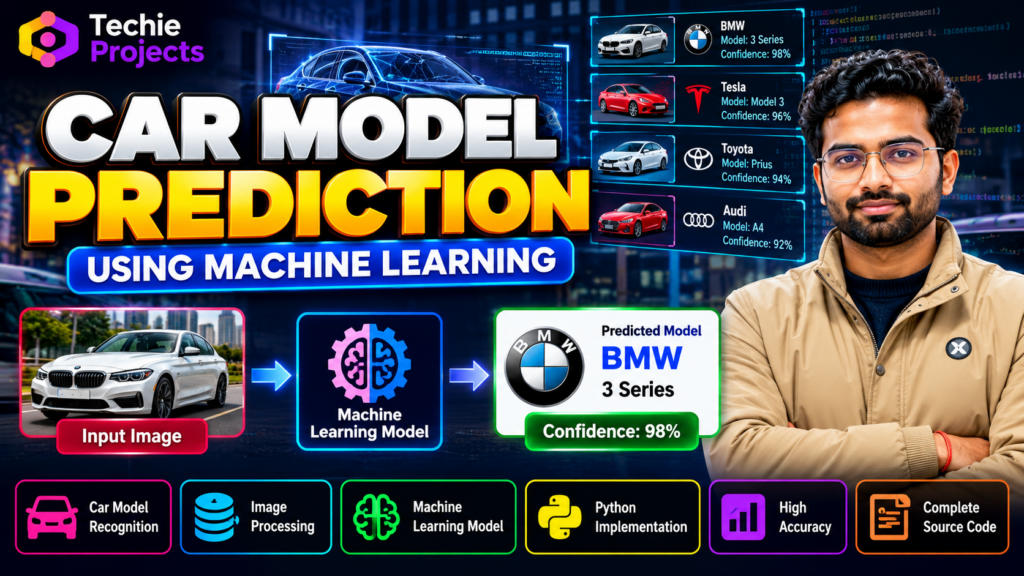
The car model prediction using machine learning project is a Python-based computer vision application designed to identify or classify car models from vehicle images using a trained machine learning or deep learning model. It is a useful project idea for B.Tech, B.E., computer science, artificial intelligence, and machine learning students looking for a practical final-year project.
This project demonstrates how image processing and AI techniques can be applied to vehicle recognition. Students can explore image datasets, preprocessing, model training, prediction, and result visualization while learning how machine learning can solve real-world classification problems.
If you are looking for a car model prediction project with Python source code, Techie Projects can help you explore project implementation, understand the workflow, and enquire about source code availability or customization options.
🎬 Car Model Prediction Using Machine Learning – Project Demo Video
Watch the project demonstration to understand how the car model prediction system works, how vehicle images are processed, and how the application displays its prediction results.
The demo provides a practical overview of the project interface and its machine learning workflow, helping students understand how an AI-based vehicle recognition application can be developed using Python.
🎯 Project Overview
The main objective of the car model prediction system is to demonstrate vehicle image classification using machine learning techniques. Depending on the trained dataset and implemented model, the application can be designed to recognize supported car categories and display a predicted class for an input image.
Project details:
- Project Name: Car Model Prediction Using Machine Learning
- Programming Language: Python
- Domain: Machine Learning and Computer Vision
- Application: Vehicle image classification
- Project Type: Academic and final-year engineering project
- Frameworks and Libraries: Python-based image processing and machine learning libraries, depending on the implementation
🚗 Key Features of the Car Model Prediction Project
1. Car Image Input
The application accepts a vehicle image as input so the implemented model can analyze its visual characteristics.
2. Machine Learning-Based Classification
A trained classification model processes the input image and predicts a car category represented in its training dataset.
3. Image Processing
Image preprocessing prepares input images in the format expected by the model. This may include resizing, normalization, and other transformations.
4. Prediction Results
The application displays the predicted class through its interface. The supported car models depend on the dataset and the trained model.
5. Python Implementation
Python provides a practical environment for developing the application and integrating image processing, model inference, and result visualization.
6. Academic Project Demonstration
The project can help students demonstrate the fundamentals of computer vision, image classification, and machine learning during academic presentations, subject to their institution’s requirements.
⚙️ How Does the Project Work?
The car model prediction using machine learning project follows a typical image-classification workflow.
- Dataset collection: Gather labeled images for the car categories the model is expected to recognize.
- Image preprocessing: Resize and prepare images for model input.
- Dataset preparation: Organize images into appropriate training, validation, and testing sets.
- Model training: Train or configure a suitable classification model using the prepared dataset.
- Image input: Provide a new vehicle image to the application.
- Prediction: The model processes the image and returns a predicted class.
- Result display: Show the prediction in the application interface.
The prediction quality depends on the dataset, image quality, model architecture, training process, and similarity between training images and real-world inputs.
🧠 Machine Learning Algorithms and Technologies
The appropriate model depends on the implementation and available dataset. Potential approaches include:
- Convolutional Neural Networks (CNNs): Commonly used for image classification tasks.
- Transfer Learning: Pretrained image models can be adapted to recognize selected car categories.
- OpenCV: Can support image loading and preprocessing.
- Python: Used to connect the processing pipeline, model, and application interface.
- TensorFlow or PyTorch: Possible frameworks for building or running deep learning models.
These are possible technologies for this type of project; the exact algorithms and libraries included should be confirmed against the supplied implementation.
💻 Software and Hardware Requirements
Software Requirements
- Python
- A compatible Python IDE, such as VS Code or PyCharm
- Required machine learning and image processing libraries
- A compatible operating system
- A labeled car image dataset for training or testing, as required by the implementation
Hardware Requirements
- A computer or laptop capable of running the selected Python environment
- Sufficient RAM and storage for the dataset and model
- A GPU may be useful for training larger deep learning models but is not always required for inference
The exact requirements depend on the model architecture, dataset size, and included project files.
🎓 Applications of Car Model Prediction
A car model prediction system demonstrates concepts that may be useful in several computer vision applications:
- Vehicle image classification
- Automotive image management
- Intelligent transportation research
- Vehicle inventory organization
- Computer vision education
- AI-based vehicle recognition prototypes
This academic project should not be treated as a guaranteed production-ready vehicle identification system without additional validation and testing.
📈 Advantages of the Project
- Provides practical exposure to machine learning and computer vision.
- Helps students understand image preprocessing and classification.
- Combines Python programming with an applied AI problem.
- Can be extended with additional car categories and improved datasets.
- Offers opportunities to explore transfer learning and model evaluation.
🔮 Future Scope
The project can be extended in several ways, depending on the existing implementation:
- Add more car categories to the training dataset.
- Compare different classification models.
- Improve performance through data augmentation and model tuning.
- Develop a web-based interface for image uploads.
- Explore vehicle detection before car model classification.
- Evaluate the model using precision, recall, accuracy, and a confusion matrix.
Future improvements should be evaluated experimentally rather than assuming that a larger dataset or a different model will automatically improve performance.
🛒 Get the Car Model Prediction Project with Python Source Code
Are you looking for a car model prediction using machine learning project for your final-year engineering submission?
Techie Projects offers engineering project assistance for students who want to explore practical Python, machine learning, and computer vision applications.
You can contact us to enquire about the available project package, source code, implementation details, setup requirements, and customization options.
Why enquire with Techie Projects?
- Explore Python and machine learning project options.
- Discuss your project requirements before ordering.
- Ask about available source code and implementation support.
- Enquire about customization based on your academic requirements.
Request project details:
- 📲 Call/WhatsApp: +91-9460060699
- 🌎 Website: www.techieprojects.com
- 📺 Instagram: @pythonprojects_
Contact us to confirm the current package, deliverables, pricing, and support availability before purchasing.
❓ Frequently Asked Questions
1. What is a car model prediction using machine learning project?
It is a computer vision project that uses a trained model to classify vehicle images into supported car categories.
2. Which programming language is used in this project?
Python is suitable for this type of project because it supports image processing, machine learning, and deep learning development.
3. Is this project suitable for B.Tech and B.E. students?
It can be suitable for computer science, AI, data science, and related engineering students, subject to the project requirements and institutional guidelines.
4. Can I customize the car model prediction project?
Customization may be possible depending on the available implementation. Contact Techie Projects to discuss the required car categories, interface, and additional features.
5. Can I purchase the Python source code?
You can contact Techie Projects to confirm source code availability, package contents, pricing, and any included support.
6. Does the model recognize every car model?
No. A model generally recognizes only the categories it was trained and configured to classify. Performance also depends on image quality and the training data.
🎓 Explore Related Projects
Explore these related project ideas to discover more opportunities in Python, machine learning, and computer vision:
- Vehicle Detection and Counting Using Python
- Number Plate Recognition Using Python
- Traffic Sign Recognition Using Deep Learning
- Road Accident Detection Using Machine Learning
- Object Detection Using YOLO and Python
- Image Classification Using Deep Learning
Browse more ideas in our Machine Learning Projects, Deep Learning Projects, and OpenCV Projects collections.
Conclusion
The car model prediction using machine learning project is a practical way to explore image classification, Python programming, and computer vision. It introduces students to a complete workflow, from image preprocessing and model inference to displaying classification results.
If you want to develop your understanding of machine learning or are searching for a project for your final-year engineering work, contact Techie Projects to enquire about the available implementation, source code, and customization options.
Enquire about this project on WhatsApp and discuss your requirements with Techie Projects.