
Introduction
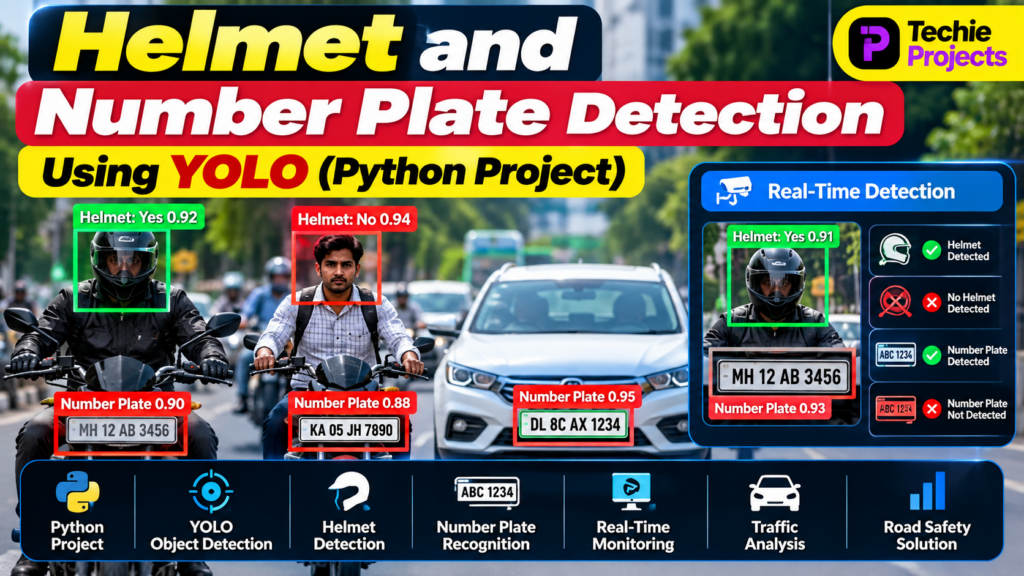
Helmet and number plate detection using YOLO is a computer vision project designed to identify motorcycle riders, detect helmet usage, and locate vehicle number plates from images or video streams. This project combines Python, deep learning, and real-time object detection to demonstrate how AI can support traffic monitoring and road safety applications.
In traditional traffic monitoring, checking helmet usage and recording vehicle numbers manually can be time-consuming. An automated detection system can help identify potential helmet violations and locate number plates for further review.
This project is suitable for B.Tech Computer Science students, final-year engineering projects, and learners interested in Python, artificial intelligence, machine learning, and computer vision.
🎥 Project Working Demo
Watch the project demonstration to understand how helmet detection and number plate recognition work in practice.
Project Demo: Insert your YouTube project demonstration video here.
The demo can show a traffic video being processed, detection boxes around riders and helmets, number plate localization, and the final detection results. Actual performance depends on the trained models, dataset quality, camera conditions, and implementation.
What Is Helmet and Number Plate Detection Using YOLO?
Helmet and number plate detection is an automated vision system that identifies specific objects in traffic images or video frames.
YOLO, which stands for You Only Look Once, is an object detection approach that can locate and classify multiple objects in an image. A trained YOLO model can detect objects such as motorcycles, riders, helmets, and number plates, depending on the classes included in its training dataset.
Number plate recognition may require an additional optical character recognition (OCR) step to read the characters from a detected plate.
Helmet and number plate detection using YOLO with Python combines object detection techniques to identify helmets, riders, motorcycles, and number plates in traffic images or video.
A complete system may combine:
- Vehicle and rider detection
- Helmet and no-helmet classification
- Number plate localization
- Image cropping and preprocessing
- Number plate text recognition
- Detection result display and storage
Important: Detecting a number plate and reading its characters are separate tasks. The accuracy of each stage depends on the models and techniques used.
🎯 Objectives of the Project
The main objectives of this helmet and number plate detection project are:
- Detect motorcycles and riders in traffic images or video.
- Identify helmet usage when supported by the trained model.
- Locate vehicle number plates.
- Extract plate text using an OCR tool when implemented.
- Display detection results with bounding boxes and confidence scores.
- Demonstrate how computer vision can support traffic monitoring.
- Provide a practical learning experience in Python and deep learning.
Key Features of the System
1. Helmet Detection
The system identifies helmets in input images or video frames. Depending on the training data, it may classify riders into helmet and no-helmet categories.
2. Motorcycle and Rider Detection
A trained object detection model can identify motorcycles and riders to help associate helmet detections with the correct vehicle or person.
3. Number Plate Detection
The model locates the number plate region using a bounding box. The cropped region can then be processed separately.
4. Number Plate Recognition
If OCR is included, the cropped plate image can be processed to extract its characters. Recognition quality may be affected by blur, glare, low resolution, unusual fonts, and viewing angles.
5. Video-Based Detection
The project can process recorded traffic footage or a supported camera stream, depending on the implementation and available hardware.
6. Detection Results
The application can display bounding boxes, object labels, confidence scores, and recognized plate text when these features are implemented.
7. Result Logging
An optional database or file-based logging feature can record detection events and timestamps. Store identifiable vehicle information only when there is a legitimate purpose and appropriate authorization.
⚙️ How Does the System Work?
The general workflow of a helmet and number plate detection system includes the following stages.
The helmet and number plate detection using YOLO system processes video frames, identifies the trained object classes, and displays the detected objects with bounding boxes.
Step 1: Input Image or Video
The application receives an image, recorded video, or supported camera stream. OpenCV can be used to read and process video frames.
Step 2: Frame Preprocessing
The system prepares the input for the detection model. Depending on the implementation, preprocessing may include resizing, color conversion, and normalization.
Step 3: Object Detection Using YOLO
The trained YOLO model analyzes the frame and predicts object classes, bounding boxes, and confidence scores.
The model must be trained or configured to detect the required classes. A generic pretrained model will not necessarily identify helmet violations or number plates correctly.
Step 4: Helmet Classification
The application examines the detected rider and helmet-related classes to determine whether the configured model identifies helmet use.
Correctly associating a helmet with the relevant rider is important, especially when multiple motorcycles appear in one frame.
Step 5: Number Plate Localization
The system identifies the plate region and crops it from the original image or video frame.
Step 6: Optical Character Recognition
If number plate reading is included, an OCR engine processes the cropped plate image and attempts to extract its text. Additional preprocessing may improve results, but accurate recognition is not guaranteed in every scene.
Step 7: Display and Store Results
The application displays the processed frame and may save selected detection events, timestamps, and results for authorized review.
Technologies Used
The technologies depend on the project’s actual implementation. Common options include:
- Python: Main programming language.
- YOLO: Object detection model for identifying trained object classes.
- OpenCV: Image processing, video capture, cropping, and visualization.
- PyTorch: Model training or inference when using a PyTorch-based implementation.
- OCR library: For example, EasyOCR or Tesseract, if plate text recognition is required.
- NumPy: Numerical operations and array processing.
- Flask, Streamlit, or Tkinter: Optional interface for presenting results.
Use only the libraries that your implementation actually requires.
Software Requirements
Typical software requirements include:
- Python 3
- OpenCV
- A compatible YOLO implementation and trained model weights
- PyTorch or the framework required by the selected model
- NumPy
- An OCR library, if number plate recognition is included
- Visual Studio Code, PyCharm, or another Python development environment
Install compatible package versions for your selected model and Python environment.
Hardware Requirements
The basic project can run on a modern computer with a compatible CPU. A supported NVIDIA GPU may improve inference speed and model training performance.
Recommended considerations include:
- Computer or laptop
- At least 8 GB RAM for a more comfortable development environment
- Sufficient storage for datasets, model weights, and videos
- Webcam or recorded video for testing
- NVIDIA GPU with compatible software support, if accelerated processing is needed
Actual requirements depend on the YOLO model size, input resolution, and whether training or inference is being performed.
Dataset Requirements
A suitable dataset is essential for reliable detection.
The dataset should contain representative examples of:
- Riders wearing helmets
- Riders without helmets
- Motorcycles and other relevant vehicles
- Number plates from different angles and distances
- Daytime, nighttime, and varied lighting conditions
- Partially obscured and low-resolution objects
Images should be annotated with accurate bounding boxes and class labels. Separate training, validation, and test sets should be used to evaluate how well the model performs on unseen data.
For number plate recognition, ensure that the dataset and any plate text used for training or testing are handled with appropriate permissions and privacy protections.
Sample Python Code for Image-Based YOLO Detection
The following example demonstrates basic object detection using an already trained YOLO model. It does not independently train a helmet detector or perform number plate OCR.
import cv2
from ultralytics import YOLO

# Load a compatible trained YOLO model.
# Replace this path with your model weights.
model = YOLO("best.pt")

image = cv2.imread("traffic.jpg")

if image is None:
    raise FileNotFoundError("Could not load traffic.jpg")

# Run object detection
results = model(image)

# Draw detected objects
annotated_image = results[0].plot()

cv2.imshow("YOLO Detection", annotated_image)
cv2.waitKey(0)
cv2.destroyAllWindows()
Before running the code: Install the required packages, provide a compatible best.pt file trained for your target classes, and place the test image at the specified path. The output depends on the classes and quality of the selected model.
Applications of Helmet and Number Plate Detection
Traffic Monitoring
The system can assist with reviewing traffic footage and identifying frames that may require human inspection.
Road Safety Research
Researchers and students can analyze helmet-use patterns in appropriately collected datasets.
Smart City Projects
The project can serve as a prototype for exploring computer vision in traffic monitoring systems.
Vehicle Access Management
A related system may use authorized number plate recognition for vehicle entry management.
Academic Demonstrations
Students can demonstrate object detection, image processing, OCR, model evaluation, and application development in a final-year project.
These are potential applications, not a guarantee that the prototype is suitable for unattended enforcement or operational deployment.
Advantages of the Project
- Demonstrates practical deep learning and computer vision concepts.
- Can process images and video when supported by the implementation.
- Combines object detection with optional OCR.
- Can be extended with a dashboard or event logging.
- Provides opportunities to evaluate precision, recall, and detection speed.
- Can be adapted for academic research and controlled demonstrations.
Limitations and Challenges
Lighting Conditions
Poor lighting, glare, shadows, and nighttime footage can reduce detection quality.
Motion Blur
Fast-moving vehicles and low-quality cameras can make helmets and number plates difficult to identify.
Occlusion
Other vehicles, passengers, and objects may partially hide a rider or plate.
Small Number Plates
Distant plates may contain too few pixels for reliable detection or text recognition.
Model Accuracy
A model trained on limited or unrepresentative data may produce false detections or miss real objects.
Real-Time Performance
Processing speed depends on the model, hardware, video resolution, and software configuration.
Privacy and Responsible Use
Number plates can be identifying information. Testing and deployment should follow applicable privacy laws, access controls, retention policies, and authorization requirements. Automated detections should be reviewed by a person before consequential decisions are made.
Future Scope
The project can be improved through features such as:
- Training on a larger and more diverse dataset
- Comparing different YOLO model sizes
- Improving number plate preprocessing and OCR
- Adding vehicle tracking across video frames
- Creating a web dashboard for authorized users
- Recording detection timestamps and confidence scores
- Evaluating performance across lighting and weather conditions
- Deploying an optimized model on suitable edge hardware
Any additional feature should be implemented and evaluated before being described as part of the finished project.
Frequently Asked Questions
1. What is helmet and number plate detection using YOLO?
It is a computer vision application that uses a trained object detection model to locate helmet-related objects and vehicle number plates in images or video.
2. Can YOLO detect a rider without a helmet?
Yes, if the selected model has been trained and evaluated for the relevant classes, such as helmet and no-helmet. A generic YOLO model may not provide this capability.
3. Can Python read vehicle number plates?
Yes. Python can combine plate localization with OCR to attempt to read characters from number plate images. Results depend on image quality and the selected model.
4. Which libraries are useful for this project?
Common options include Python, OpenCV, a compatible YOLO implementation, PyTorch, NumPy, and an OCR library if character recognition is required.
5. Is this project suitable for a final-year engineering project?
Yes. It can demonstrate object detection, model evaluation, image processing, and optional OCR. Students should document the dataset, implementation, limitations, and evaluation results.
6. Can the project work in real time?
It may process a live camera stream if the implementation and hardware provide sufficient speed. Real-time performance should be measured on the target device.
7. Does the system automatically issue traffic fines?
Not by itself. Detection is not proof of a violation. Operational enforcement requires appropriate legal authority, reliable validation, privacy safeguards, and human review as applicable.
🎓 Explore Related Python and Computer Vision Projects
Explore more project ideas on Techie Projects:
- Helmet Detection Using Python
- Automatic Number Plate Recognition Using Python
- Vehicle Detection and Counting Using YOLO
- Traffic Sign Recognition Using Deep Learning
- Smart Parking Management System Using Python
- Object Detection Using OpenCV and YOLO
Link each title to its corresponding project page on your website.
Need Help With Your Final-Year Project?
Looking for a Python, Artificial Intelligence, Machine Learning, or Computer Vision project? Techie Projects can help you explore project ideas, implementation options, technical requirements, and project scope.
- 📲 Call/WhatsApp: +91-9460060699
- 🌎 Website: www.techieprojects.com
- 📺 Instagram: @pythonprojects_
Contact us to discuss your project requirements and available support.
Conclusion
Helmet and number plate detection using YOLO with Python is a useful computer vision project for learning how object detection can be applied to traffic monitoring and road safety research. By combining a suitable trained model, OpenCV, and optional OCR, developers can build a prototype that detects relevant objects and attempts to read number plates.
For a strong final-year submission, focus on dataset quality, accurate annotations, evaluation metrics, clear documentation, and responsible handling of vehicle-related information. These elements make the project more informative, measurable, and practical.
This helmet and number plate detection using YOLO project provides practical experience with Python, deep learning, and computer vision for traffic monitoring applications.