
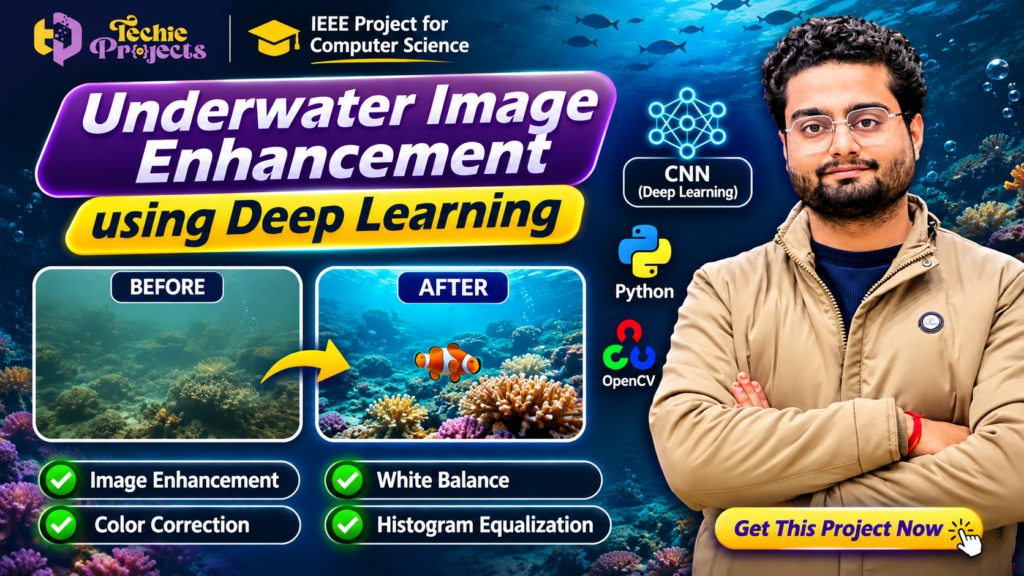
🚀 Looking for an advanced Deep Learning IEEE project for your final-year engineering submission? Purchase the Underwater Image Enhancement using Deep Learning project from Techie Projects and explore how artificial intelligence can improve the quality of underwater images using Convolutional Neural Networks (CNN).
The Underwater Image Enhancement using Deep Learning project demonstrates how artificial intelligence can improve underwater image quality through CNN-based image processing. It provides practical experience with Python, neural networks, and computer vision techniques.
Underwater images often suffer from poor visibility, color distortion, low contrast, and reduced image clarity because light behaves differently when it travels through water. These challenges make underwater image enhancement an interesting research area in Artificial Intelligence, Computer Vision, and Deep Learning.
🎓 If you are a B.Tech, M.Tech, BCA, MCA, or Computer Science Engineering student searching for an innovative final-year project, this project offers an opportunity to explore practical applications of deep learning and digital image processing.
Don’t waste valuable project development time searching for complicated implementations. Connect with Techie Projects to enquire about purchasing the project, Python source code availability, project demonstration, implementation details, and technical support options.
🛒 Get your Underwater Image Enhancement project today and take your final-year engineering project forward with AI technology!
📞 Contact Techie Projects for Project Enquiries
Interested in purchasing this IEEE Deep Learning project? Contact our team for pricing, availability, project demonstrations, and implementation details.
- 📞 Contact / WhatsApp: +91 94600 60699
- 🌐 Website: www.techieprojects.com
- 📸 Instagram: @pythonprojects_
Techie Projects offers practical engineering project solutions across Artificial Intelligence, Machine Learning, Deep Learning, Python, Computer Vision, IoT, and Data Science.
🎬 Watch the Underwater Image Enhancement Project Demo
Explore the project demonstration to understand how deep learning techniques can improve the visual quality of underwater images.
The main purpose of Underwater Image Enhancement using Deep Learning is to improve underwater photographs affected by poor visibility, color distortion, and low contrast. The system processes input images to generate visually enhanced outputs.
The demonstration showcases the image enhancement process, including input underwater images, enhanced output images, color correction, white balance, and image processing techniques.
You can observe how underwater images with poor visibility and color distortion can be processed to produce clearer and more visually appealing results.
🎯 Want to purchase this project? Contact Techie Projects through WhatsApp to enquire about the available source code, demonstration, documentation, and implementation package.
🌊 What Is Underwater Image Enhancement Using Deep Learning?
Underwater Image Enhancement using Deep Learning is an Artificial Intelligence application designed to improve the visual quality of images captured underwater.
When light travels through water, different wavelengths are absorbed and scattered at different rates. This can result in images with unnatural colors, reduced contrast, poor visibility, and blurred details.
Traditional image processing methods can improve some of these problems. However, deep learning provides additional opportunities to learn complex image characteristics and generate enhanced outputs.
In this project, Convolutional Neural Networks (CNN) can be used to learn image features and support underwater image enhancement.
The system processes an underwater image and generates an enhanced version with improved visual characteristics.
For example, an underwater photograph containing a greenish or bluish color cast can be processed to improve its color balance, contrast, and visibility.
The main objective is to explore how deep learning and image processing techniques can help improve underwater visual information.
🎯 Objectives of the Underwater Image Enhancement Project
The primary objective is to develop a deep learning-based system that improves the quality of underwater images.
Developing an Underwater Image Enhancement using Deep Learning application helps students understand how convolutional neural networks learn image features and perform image enhancement tasks.
The major objectives include:
- 🌊 Improve the visual quality of underwater photographs.
- 🧠 Implement CNN-based image enhancement techniques.
- 🎨 Reduce unwanted color distortion in underwater images.
- 💡 Improve image brightness and contrast.
- 🔍 Enhance visibility and preserve important image details.
- 🐠 Process underwater images using Python.
- 📊 Compare original and enhanced images.
- 🤖 Explore the application of Artificial Intelligence in underwater imaging.
⚙️ Technologies Used in Underwater Image Enhancement Using CNN
Python and CNN architectures play an important role in Underwater Image Enhancement using Deep Learning. These technologies help process underwater images, learn visual patterns, and generate enhanced results.
The project combines deep learning and image processing technologies to develop an underwater image enhancement application.
1. 🐍 Python Programming Language
Python is the primary programming language used for implementation. It provides a flexible environment for developing deep learning models and image processing applications.
2. 🧠 Convolutional Neural Network (CNN)
CNN is a deep learning architecture designed to process image data and learn visual features.
In this project, a CNN-based approach can learn patterns from underwater images and support image enhancement.
3. 🔬 Deep Learning
Deep learning techniques help models learn complex visual relationships from image datasets. These techniques can be applied to improve underwater image appearance.
4. 🖼️ Image Processing
Image processing techniques are used to manipulate image characteristics such as brightness, contrast, color balance, and intensity distribution.
5. 📊 NumPy
NumPy supports numerical computations and array operations during image processing and model development.
6. 👁️ OpenCV
OpenCV is a computer vision library used for reading images, resizing, color-space conversion, image manipulation, and displaying results.
7. 📈 Model Evaluation
Image quality evaluation can use suitable metrics such as PSNR and SSIM when reference images are available. Other no-reference quality measures may also be explored for real underwater images.
🔄 How Does the Underwater Image Enhancement System Work?
During Underwater Image Enhancement using Deep Learning, the input image passes through a preprocessing stage before being processed by the trained neural network. The model analyzes image features and generates an enhanced underwater image.
The Underwater Image Enhancement using Deep Learning project follows a series of steps to process underwater images and generate enhanced outputs.
Step 1: Input Image Collection
The system receives underwater images from a dataset or an image uploaded by the user.
These images may contain color distortion, low brightness, poor contrast, and reduced visibility.
Step 2: Image Preprocessing
The input image is prepared for model processing.
Preprocessing operations may include:
- Image resizing.
- Pixel normalization.
- Color-space conversion.
- Dataset preparation.
- Image augmentation.
These steps help prepare image data for deep learning model training or inference.
Step 3: CNN-Based Feature Extraction
The CNN model analyzes the input image and learns visual features such as edges, textures, colors, and image patterns.
These features help the model understand the characteristics of the underwater image.
Step 4: Image Enhancement
The trained deep learning model processes the input image to generate an enhanced output.
Depending on the selected architecture, the model may learn to improve color representation, contrast, brightness, and visual details.
Step 5: Color Correction and Image Restoration
Additional image processing operations can be applied to improve visual appearance.
These may include:
- White balance adjustment.
- Gamma correction.
- Histogram equalization.
- Contrast enhancement.
- Color correction.
The exact enhancement pipeline depends on the project’s implementation.
Step 6: Output Image Generation
The system generates an enhanced underwater image.
The original and processed images can be displayed together to help users compare their visual differences.
Step 7: Result Analysis
The output can be evaluated using visual comparisons and appropriate image quality metrics.
This helps students understand the performance and limitations of their enhancement approach.
⭐ Key Features of Underwater Image Enhancement Project
One of the major capabilities of Underwater Image Enhancement using Deep Learning is improving the visual appearance of underwater images through learned image enhancement techniques.
This project demonstrates several useful capabilities of deep learning and computer vision.
🌈 1. Underwater Image Enhancement
Improves the visual appearance of underwater photographs by processing color, brightness, and contrast.
🧠 2. CNN-Based Deep Learning
Uses convolutional neural network concepts to learn image features and support enhancement.
🎨 3. Color Correction
Explores methods to reduce unwanted color casts and improve underwater image appearance.
💡 4. White Balance Adjustment
Applies white balance techniques to improve color representation.
📊 5. Histogram Equalization
Explores contrast enhancement by redistributing image intensity values.
🔍 6. Image Quality Comparison
Displays original and enhanced images for visual comparison and analysis.
🐠 7. Python-Based Implementation
Uses Python libraries to build and experiment with deep learning and image processing techniques.
🐬 Applications of Underwater Image Enhancement
The Underwater Image Enhancement using Deep Learning technology can be explored in marine research, underwater photography, coral reef monitoring, ocean exploration, and underwater robotics.
Underwater image enhancement technology has several potential applications in marine research, ocean exploration, and underwater computer vision.
1. 🌊 Marine Research
Researchers can use enhanced underwater images to study marine environments and observe underwater ecosystems.
2. 🐠 Marine Life Monitoring
Image enhancement can help improve the visibility of underwater photographs used for observing fish, coral reefs, and other marine organisms.
3. 🤿 Underwater Exploration
Improved image quality can support underwater photography and visual exploration.
4. 🚢 Underwater Robotics
Underwater robots and remotely operated vehicles can use computer vision systems to analyze visual information collected underwater.
5. 🔬 Scientific Research
Enhanced underwater images can support research involving underwater structures, marine habitats, and environmental observations.
6. 🪸 Coral Reef Monitoring
Image enhancement can help researchers analyze underwater photographs of coral reefs and monitor visible changes over time.
7. 🤖 Underwater Object Detection
Improved image quality can support downstream computer vision tasks such as object detection and classification, although enhancement alone does not guarantee better detection performance.
💻 Software Requirements
The following technologies are commonly associated with this project.
| Component | Technology |
|---|---|
| Programming Language | Python |
| Deep Learning | CNN |
| Image Processing | OpenCV |
| Numerical Processing | NumPy |
| Deep Learning Framework | TensorFlow / Keras |
| Operating System | Windows / Linux |
| Development Environment | Python IDE |
| Input | Underwater Images |
| Output | Enhanced Images |
The exact libraries and versions depend on the supplied project implementation.
🖥️ Hardware Requirements
A suitable computer is required to develop, train, and test the deep learning model.
Recommended configuration:
- Processor: Intel Core i5 or equivalent.
- RAM: 8 GB or higher.
- Storage: 256 GB or higher.
- Graphics: NVIDIA GPU recommended for deep learning training.
- GPU Memory: Depends on the model architecture and image resolution.
A dedicated GPU can accelerate model training, although the exact hardware requirement depends on the selected CNN architecture and dataset.
📈 Advantages of Underwater Image Enhancement Using Deep Learning
Implementing Underwater Image Enhancement using Deep Learning provides practical knowledge of CNN models, image restoration, Python programming, and computer vision applications.
There are several advantages to exploring deep learning-based underwater image enhancement.
- Improved Visual Quality: Helps improve the appearance of underwater photographs.
- Color Correction: Explores methods for reducing unwanted color distortions.
- Deep Learning Experience: Provides practical experience with CNN architectures.
- Computer Vision Learning: Introduces students to image processing and visual analysis.
- Research Opportunities: Offers a foundation for further experimentation in underwater imaging.
- Python Development: Combines deep learning and image processing libraries.
- Real-World Applications: Connects AI concepts with marine research and underwater exploration.
🔬 Future Scope of Underwater Image Enhancement Project
The Underwater Image Enhancement using Deep Learning project can be extended with advanced CNN architectures, GAN-based enhancement, real-time image processing, and underwater object detection.
Students can extend the project with advanced technologies and additional capabilities.
1. 🤖 Advanced CNN Architectures
Experiment with deeper CNN architectures and encoder-decoder networks to explore different image enhancement strategies.
2. 🧠 Generative Adversarial Networks (GANs)
Explore GAN-based image enhancement approaches for generating visually improved underwater images.
3. 🌈 Real-Time Underwater Image Enhancement
Develop a system capable of processing underwater camera feeds with suitable hardware and optimized models.
4. 🐠 Underwater Object Detection
Integrate object detection models to identify marine organisms and underwater objects.
5. 📊 Image Quality Evaluation
Add image quality assessment metrics to compare different enhancement algorithms.
6. ☁️ Cloud-Based Image Processing
Develop a cloud-based application where users can upload underwater images and receive enhanced outputs.
7. 📱 Web-Based Image Enhancement Application
Create a web interface using Streamlit or another suitable framework to upload, process, and download underwater images.
These enhancements can provide opportunities for further research in deep learning, image restoration, and underwater computer vision.
🎓 Why Choose This IEEE Deep Learning Project for Your Final Year?
Students selecting Underwater Image Enhancement using Deep Learning can gain practical experience with neural networks, image preprocessing, model training, and image quality evaluation.
Selecting an appropriate final-year engineering project is important for students who want to demonstrate technical knowledge and practical implementation skills.
Underwater Image Enhancement using Deep Learning offers an interesting combination of CNN, Python, image processing, and artificial intelligence.
Computer Science Engineering (CSE): Explore Python programming, deep learning, image processing, and computer vision.
Artificial Intelligence: Understand how neural networks learn visual patterns and process image data.
Machine Learning: Explore training datasets, model evaluation, and neural network optimization.
Information Technology (IT): Learn how AI-based image processing applications can be integrated into software systems.
BCA and MCA: Develop practical experience with Python-based image processing and deep learning applications.
The project can also provide a starting point for students interested in research-oriented IEEE project topics and advanced computer vision applications.
💡 Recommended Projects from Techie Projects
If you are interested in Underwater Image Enhancement using Deep Learning, you can also explore related AI and computer vision projects offered by Techie Projects.
Looking for more interesting AI, Deep Learning, and Computer Vision projects? Explore these related final-year engineering project ideas.
- 🧠 Brain Tumor Detection Using Deep Learning.
- 🩺 Skin Cancer Detection Using Machine Learning.
- 🌿 Plant Leaf Disease Detection Using CNN.
- 🚗 Vehicle Number Plate Detection Using YOLO.
- 👤 Face Recognition Attendance System Using Python.
- 🎥 Real-Time Object Detection Using YOLO.
- 📰 Fake News Detection Using Machine Learning.
- 🔍 DeepFake Detection Using Deep Learning.
- 🐠 Underwater Object Detection Using Deep Learning.
- 🛰️ Satellite Image Classification Using CNN.
🌐 Explore more projects at www.techieprojects.com.
🛒 Get This Underwater Image Enhancement Project Now!
🚀 Looking for an advanced IEEE project? Purchase the Underwater Image Enhancement using Deep Learning project from Techie Projects and enquire about Python source code, project demonstration, documentation, and implementation guidance.
Get in touch with Techie Projects and enquire about the Underwater Image Enhancement using Deep Learning project.
If you are looking for a Python-based project involving CNN, image processing, and artificial intelligence, this project is an excellent option to explore.
Our team can help you understand the available project package and purchasing options before you proceed.
🎁 What Can You Enquire About?
Contact our team to confirm the availability of:
- 💻 Python source code.
- 🎬 Working project demonstration.
- 📚 Project documentation.
- ⚙️ Installation and execution requirements.
- 🧑💻 Implementation guidance.
- 🔧 Customization possibilities.
- 📞 Technical support options.
The exact deliverables, pricing, and support arrangements can be confirmed before purchase.
<mark>🔥 Start your final-year project journey with Techie Projects today!</mark>
📲 Purchase Enquiry – Techie Projects
Interested in purchasing this project? Send us a WhatsApp enquiry.
📞 Contact / WhatsApp: +91 94600 60699
🌐 Website: www.techieprojects.com
📸 Instagram: @pythonprojects_
Techie Projects – Your Destination for Practical Engineering Projects!
❓ Frequently Asked Questions (FAQs)
1. What is Underwater Image Enhancement using Deep Learning?
It is an AI-based application that uses deep learning techniques to improve underwater image quality by addressing issues such as color distortion, low contrast, and poor visibility.
2. Which deep learning model is used in this project?
Convolutional Neural Networks (CNN) can be used for learning underwater image features and supporting image enhancement. The exact model architecture depends on the implementation.
3. Which programming language is used?
Python is used as the primary programming language, with libraries such as TensorFlow, Keras, OpenCV, and NumPy depending on the implementation.
4. What is CNN in image enhancement?
CNN stands for Convolutional Neural Network. It is a deep learning architecture that learns visual features from image data and can be used in image restoration and enhancement applications.
5. What are the applications of underwater image enhancement?
Applications include marine research, coral reef monitoring, underwater photography, ocean exploration, underwater robotics, and marine life observation.
6. Is this project suitable for final-year engineering students?
Yes. It is suitable for CSE, IT, Artificial Intelligence, Machine Learning, BCA, and MCA students interested in deep learning and computer vision.
7. Can this project be extended with object detection?
Yes. A suitable object detection model can be integrated to identify marine organisms and underwater objects in enhanced images.
8. Can I purchase this project from Techie Projects?
Yes. Contact Techie Projects at +91 94600 60699 to enquire about pricing, source code availability, demonstration, and project purchasing options.
9. Can I customize the project?
Customization options can be discussed with our team based on your requirements, selected technologies, and available implementation.
🏁 Conclusion
Underwater Image Enhancement using Deep Learning is an interesting Artificial Intelligence and Computer Vision project that explores how deep learning can improve the visual quality of underwater images.
By combining CNN architectures, Python programming, OpenCV, and image processing techniques, students can understand how AI-based systems address challenges related to underwater visibility, color distortion, and image quality.
This project provides an opportunity to explore practical deep learning applications while developing technical skills in Python, neural networks, and computer vision.
🎓 Planning your final-year engineering project?
Purchase your project from Techie Projects and explore our collection of AI, Machine Learning, Deep Learning, Python, IoT, and Data Science projects.
📞 Contact / WhatsApp: +91 94600 60699
📸 Follow Techie Projects on Instagram
🚀 Techie Projects – Build, Learn, and Innovate!