
Introduction
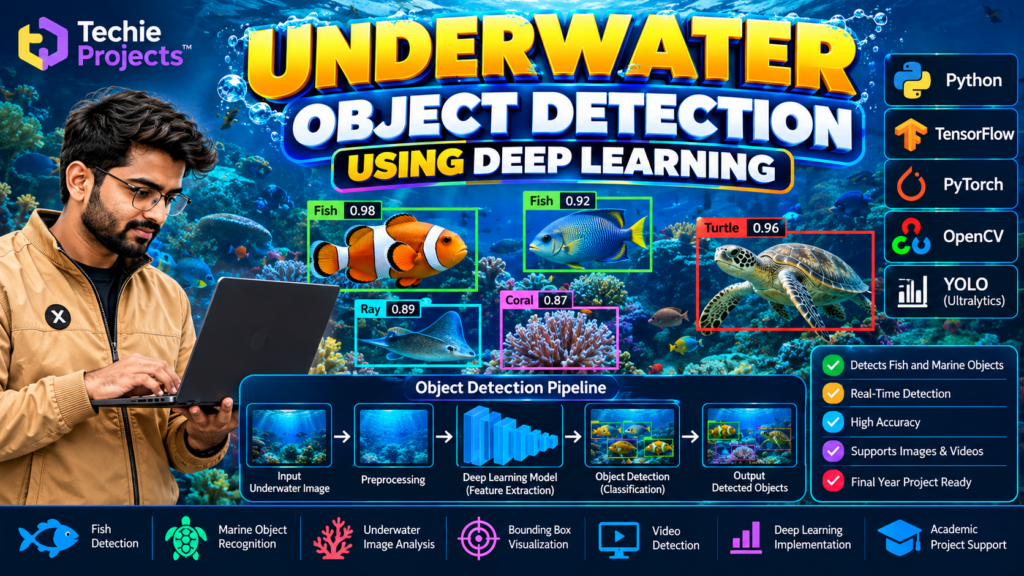
Underwater object detection using deep learning is a computer vision project that explores how artificial intelligence can identify and locate objects in underwater images or videos. This Python-based project demonstrates how a trained deep learning model can detect objects such as fish and other underwater targets, depending on the dataset and model implementation.
For B.Tech, BCA, MCA, and computer science students, this project offers a practical way to explore deep learning, image processing, object detection, and AI-based visual analysis.
🎬 Project Demo
Watch the project demonstration to understand its interface, detection output, and workflow. The demo can help you evaluate whether this project matches your academic requirements.
🎓 Project Objectives
The main objectives of underwater object detection using deep learning are:
- Identify underwater objects in supported images or video frames.
- Explore how deep learning models detect and classify visual objects.
- Understand image preprocessing and object detection workflows.
- Display detection results through a visual output.
- Study practical computer vision applications in underwater environments.
🔍 Key Features of the Project
The exact functionality depends on the supplied implementation and trained model.
1. Underwater Object Detection
The system processes an input image or video frame and uses a trained model to identify objects it has learned to recognize.
2. Visual Detection Output
Detected objects may be displayed with bounding boxes and class labels when supported by the model.
3. Deep Learning Integration
The project demonstrates how a deep learning model can learn visual patterns from training data and apply them to new images.
4. Python-Based Implementation
Python provides the programming environment for image handling, model inference, and application logic.
5. Educational Interface
The project can help students understand the relationship between input images, model predictions, and visual output.
⚙️ How Underwater Object Detection Using Deep Learning Works
The general workflow includes the following stages:
- Input image or video: Provide an underwater image or supported video.
- Image preprocessing: Prepare the input according to the model’s requirements.
- Model inference: Pass the processed image through the trained object detection model.
- Object recognition: The model predicts object classes and their locations.
- Result visualization: Display the predicted objects and detection labels, if implemented.
The quality of the results depends on the model, training dataset, water visibility, lighting, image quality, and the types of objects represented in the training data.
🧰 Technologies Used
The technologies may include the following, depending on the actual project package:
- Programming language: Python
- Deep learning: A trained object detection model
- Image processing: OpenCV
- Model framework: TensorFlow or PyTorch, depending on the implementation
- Development environment: Visual Studio Code, PyCharm, or another compatible Python environment
Confirm the exact libraries and versions before installation.
💻 Software and Hardware Requirements
Software Requirements
- Compatible Windows, Linux, or other supported operating system
- Python version compatible with the project’s dependencies
- Required machine learning and image processing libraries
- Code editor or Python IDE
Hardware Requirements
- Computer or laptop capable of running the selected model
- Adequate RAM and storage for the source code, model, and dataset
- A compatible GPU may improve inference speed but is not always required
The actual requirements depend on the selected model and implementation.
🌊 Applications of Underwater Object Detection
Underwater object detection using deep learning can be explored in several areas:
- Marine research: Studying underwater imagery for research purposes.
- Fish monitoring: Identifying fish in supported underwater images.
- Underwater robotics: Investigating computer vision for remotely operated or autonomous systems.
- Marine biodiversity: Exploring visual analysis of underwater environments.
- Academic research: Learning about object detection, image datasets, and deep learning models.
This educational project should not be treated as a validated marine monitoring system without appropriate testing.
✅ Advantages of the Project
- Provides hands-on experience with computer vision and deep learning.
- Demonstrates a practical AI application using underwater imagery.
- Helps students understand model inference and visual predictions.
- Can be extended with additional datasets or model architectures.
- Offers opportunities for experimentation and academic presentation.
⚠️ Limitations
Underwater images can be difficult to analyze because of low visibility, changing lighting, color distortion, suspended particles, and partially hidden objects. A model may also struggle with object classes that are missing or poorly represented in its training dataset.
Detection accuracy should be measured through appropriate testing rather than assumed. The project should be evaluated on representative images before making claims about real-world performance.
🚀 Future Scope
Possible future improvements include:
- Training with a larger and more diverse underwater dataset.
- Comparing different object detection architectures.
- Exploring video-based detection and object tracking.
- Improving detection under low-light or turbid-water conditions.
- Developing a user-friendly interface for selecting images and reviewing results.
- Evaluating model performance using appropriate metrics.
These are potential extensions and may not be included in the current version.
Benefits of Underwater Object Detection Using Deep Learning
Underwater object detection using deep learning helps students explore AI-based recognition of fish and other underwater objects. The project demonstrates image processing, object localization, and model inference, making it a useful learning exercise in computer vision.
Future Improvements for Underwater Object Detection Using Deep Learning
Underwater object detection using deep learning can be extended by testing additional underwater datasets, comparing different detection models, and evaluating performance in low-light or low-visibility conditions. These improvements can help students investigate the challenges of underwater image analysis.
🎓 Why Choose This Project for Your Final Year?
Underwater object detection combines programming, image processing, artificial intelligence, and practical model evaluation. It can provide a useful demonstration for students interested in computer vision, deep learning, and research-oriented projects.
Techie Projects can help you enquire about project availability, the implementation, and the materials supplied with the selected package.
📦 Get the Underwater Object Detection Project
Looking for an underwater object detection using deep learning project for your academic work? Contact Techie Projects to confirm the available implementation, source code, documentation, installation requirements, demonstration, and pricing before ordering.
Enquire about the project on WhatsApp:
📲 Call/WhatsApp: +91-9460060699
🌎 Website: www.techieprojects.com
📺 Instagram: @pythonprojects_
🔗 Explore Related Projects
You can also explore related topics on Techie Projects:
- Fish Detection Using Deep Learning — a related topic focused on recognizing fish in images.
- Crowd Counting Using YOLO — explore object detection and counting in crowded scenes.
- People Detection and Tracking Using YOLO — learn about detecting and tracking people in video.
- Real-Time Object Detection with Voice Output — explore object recognition with audio feedback.
- Digital Image Forgery Detection Using Deep Learning — study deep learning for image analysis.
Search for these titles on Techie Projects and link each item to the matching published article on your website.
❓ Frequently Asked Questions
1. What is underwater object detection using deep learning?
It is a computer vision approach that uses a trained deep learning model to identify and locate objects in underwater images or video frames.
2. Which programming language is used?
Python is commonly used for the implementation, together with the machine learning and image processing libraries required by the chosen model.
3. Can this project detect fish?
It can detect fish if the model has been trained for relevant fish classes and the implementation supports those predictions. Results depend on the dataset and image conditions.
4. Is a GPU necessary?
Not necessarily. Some models can run on a CPU, although a compatible GPU may improve processing speed.
5. Can I customize the project?
Customization depends on the available source code, model, dataset, and project package. Contact Techie Projects to discuss your requirements before ordering.
6. How can I get the project source code?
Contact Techie Projects through the WhatsApp enquiry link above to confirm package availability, included files, documentation, setup instructions, and pricing.
📝 Conclusion
Underwater object detection using deep learning is a practical educational topic for exploring Python, computer vision, and AI-based object recognition. By studying its workflow, model requirements, limitations, and potential applications, students can build a stronger understanding of how deep learning processes underwater imagery.
If you need the project for your academic work, contact Techie Projects to confirm the available version and included materials before purchasing.