
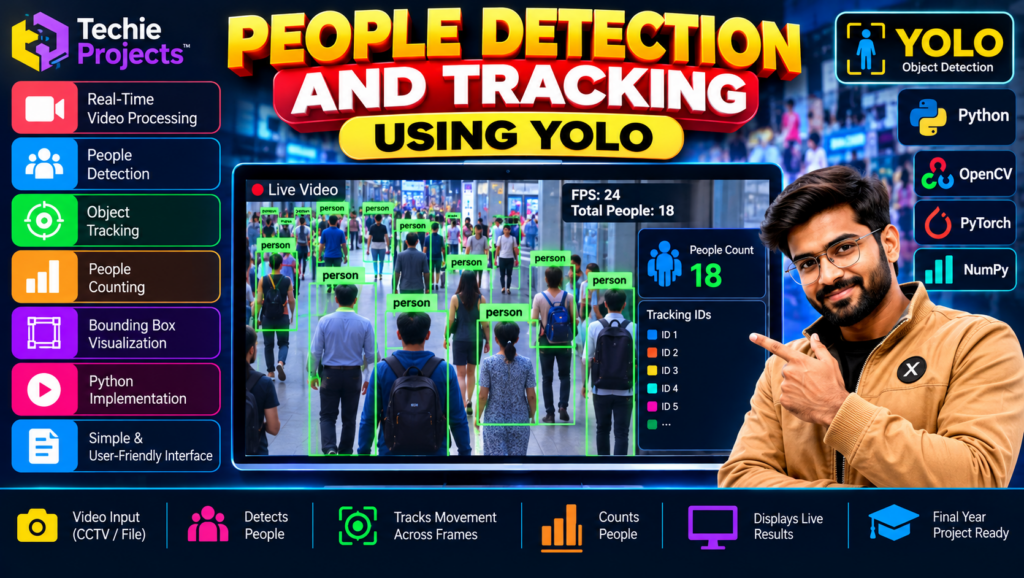
People detection and tracking using YOLO is a computer vision project that demonstrates how artificial intelligence can identify people in video frames and track their movement. Using Python and the YOLO object detection framework, this project introduces students to real-time object detection, bounding boxes, video processing, and people-counting concepts.
This project is suitable for B.Tech, B.E., BCA, MCA, Computer Science, Artificial Intelligence, and Data Science students interested in practical machine learning and computer vision applications.
If you are looking for a final-year project with a practical demonstration, Techie Projects can help you explore the available implementation, source code, documentation, and pricing.
🎬 Project Demo: People Detection and Tracking Using YOLO
Watch the project demonstration to understand how the application processes video frames and identifies people.
The displayed results depend on the implementation, trained model, and input video. Review the demonstration to see which detection, tracking, and counting features are available in the supplied project.
🎯 What Is People Detection and Tracking Using YOLO?
People detection and tracking using YOLO combines object detection with video analysis to locate people in images or video frames. YOLO, short for You Only Look Once, is a family of object detection models designed to predict object locations and classes efficiently.
The detection model can identify people and draw bounding boxes around them. A tracking algorithm can then associate detections across successive frames to estimate movement and maintain track identities.
People detection and tracking are different tasks. Detection identifies people in individual frames, while tracking attempts to follow them across frames. People counting may also be included, but its accuracy depends on the counting method and whether the application handles entries, exits, and repeated detections correctly.
✨ Key Features of the Project
Depending on the supplied version, the project may include the following features:
- Person detection: Identify people in supported images or video frames.
- Bounding-box visualization: Display boxes around detected people.
- Video processing: Analyze video input frame by frame.
- People counting: Display the number of detected people when this feature is implemented.
- Object tracking: Associate detections across frames if a tracking algorithm is included.
- Visual output: Display processed frames and detection results.
- Python implementation: Combine computer vision libraries with a trained detection model.
Confirm the exact features before purchasing. Do not assume that every version supports live CCTV streams, multiple cameras, entry-exit counting, or persistent tracking.
🎓 Objectives of the Project
The main objectives of people detection and tracking using YOLO are:
- Understand the fundamentals of object detection.
- Learn how to process video frames using Python.
- Apply a YOLO model to identify people.
- Visualize detected objects with bounding boxes.
- Explore how object tracking works across video frames.
- Understand basic people-counting methods.
- Evaluate detection results under different video conditions.
⚙️ How Does the System Work?
1. Video or Image Input
The application receives a supported image or video file. Live-camera input is possible only if the implementation includes it.
2. Frame Processing
For video input, the application reads individual frames and prepares them for the detection model. Preprocessing may include resizing and converting image data into the required format.
3. YOLO Model Inference
The trained YOLO model processes each frame and predicts objects, their locations, and class labels. The application can select detections classified as people.
4. Bounding-Box Generation
The system draws bounding boxes around detected people and may display confidence scores or labels, depending on the implementation.
5. Object Tracking
If tracking is included, the system associates detections between frames using a tracking algorithm. Track IDs can help distinguish individuals within the same video sequence.
6. People Counting and Display
If counting is implemented, the application calculates a count using its selected method. Simple per-frame detection counts may count the same person repeatedly across frames, so they should not be confused with unique-person counts.
🧰 Technologies Used
Python
Python provides the main programming environment for video processing and model integration.
YOLO
YOLO performs object detection and predicts the locations and classes of objects in image frames.
OpenCV
OpenCV can read video files, process frames, draw bounding boxes, and display the output.
NumPy
NumPy supports numerical operations and image-array processing.
PyTorch or Another Model Framework
The required framework depends on the YOLO version and the model files supplied with the project. Check the installation requirements before running the application.
💻 Software and Hardware Requirements
Software Requirements
- Python
- OpenCV
- The required YOLO package and model weights
- PyTorch or the framework required by the selected model
- NumPy and other project dependencies
- VS Code, PyCharm, or another compatible editor
Hardware Requirements
- Laptop or desktop computer
- Compatible processor
- Sufficient RAM for video processing
- Storage for source code, model weights, and input videos
A compatible GPU may improve processing speed, but whether one is necessary depends on the model, resolution, and expected performance.
🌟 Advantages of People Detection and Tracking Using YOLO
- Demonstrates practical computer vision concepts.
- Introduces students to deep learning-based object detection.
- Supports experimentation with images and video.
- Helps explain bounding boxes, confidence scores, and tracking.
- Can be extended with counting and visualization features.
- Provides a foundation for further video analytics projects.
🏢 Applications of People Detection and Tracking
People detection and tracking techniques have potential applications in:
- Crowd analysis and monitoring
- Retail footfall analysis
- Pedestrian observation
- Public-space video analytics
- Traffic and transportation research
- Academic computer vision experiments
- Smart-building research prototypes
These are general application areas. The suitability of this particular project depends on its actual capabilities, testing, and deployment environment.
⚠️ Limitations and Considerations
The performance of people detection and tracking can be affected by:
- Low lighting and poor video quality
- Occlusion when people overlap
- Crowded scenes
- Camera movement and changing viewpoints
- Model limitations and unsuitable training data
- Processing speed and hardware capacity
- Tracking errors when people leave and re-enter a scene
Video analytics can also involve privacy considerations. Use authorized footage, follow applicable privacy requirements, and avoid treating automated detections as definitive evidence of an individual’s identity or actions.
🚀 Future Scope
Possible improvements to people detection and tracking using YOLO include:
- Integrating a suitable tracking algorithm.
- Adding line-crossing or entry-exit counting.
- Creating a dashboard for detection statistics.
- Supporting additional video formats.
- Optimizing inference speed.
- Evaluating performance on different scenes.
- Exploring GPU acceleration.
- Adding privacy-conscious video handling and configurable data retention.
These enhancements may require additional development beyond the current version.
🎓 Why Choose This Project for Your Final Year?
This project brings together Python programming, deep learning, and video analysis in a single practical topic. It can help students understand how an object detection model is used within a larger application.
It may be suitable for students working in Computer Science, Artificial Intelligence, Data Science, and related engineering disciplines.
Before selecting it, check your college’s project requirements and confirm which modules, documentation, model files, and demonstrations are included.
📦 What Should You Check Before Purchasing?
Before purchasing the project from Techie Projects, confirm the availability of:
- Python source code
- YOLO model weights and configuration
- Required dependencies and installation instructions
- Sample input videos
- Documentation or project report
- Detection and tracking functionality
- People-counting functionality, if required
- Setup assistance and support terms
Ask whether the package uses detection only or includes a tracking algorithm. This distinction matters if your project title specifically promises tracking.
📲 Purchase the People Detection and Tracking Using YOLO Project
Looking for a people detection and tracking using YOLO project for your final-year submission or practical learning?
Contact Techie Projects to enquire about the available project version, included features, source code, documentation, setup requirements, and pricing before placing your order.
Get Project Details and Pricing on WhatsApp
📲 Call/WhatsApp: +91-9460060699
🌎 Website: www.techieprojects.com
📺 Instagram: @pythonprojects_
Contact us to confirm current availability, deliverables, supported features, and pricing.
🔗 Explore Related Projects
Add links to these relevant project pages on your website:
- Crowd Counting Using YOLO
- Person Detection Using OpenCV and Python
- Vehicle Detection and Counting Using Python
- Abnormal Activity Detection Using Deep Learning
- AI-Based Crowd Monitoring System
Use the published URL of each corresponding article when adding the internal links.
❓ Frequently Asked Questions
1. What is people detection and tracking using YOLO?
It is a computer vision approach that detects people in images or video frames and, when a tracking algorithm is included, follows detections across frames.
2. Which programming language is used?
Python is used for the application’s video-processing workflow and integration with the detection model.
3. Does YOLO track people automatically?
YOLO performs object detection. Tracking generally requires an additional tracking algorithm that associates detections between frames.
4. Can the project count people?
It can if a counting module is implemented. Counting people in each frame is different from counting unique individuals or tracking entries and exits.
5. Can it work with CCTV footage?
CCTV integration depends on whether the project supports the required video stream, camera connection, and processing setup. Confirm this before purchasing.
6. Is the project suitable for final-year engineering students?
It may be suitable for Computer Science, AI, Data Science, and related students, subject to institutional requirements and the features included in the implementation.
7. How can I purchase the project?
Contact Techie Projects on WhatsApp to enquire about availability, deliverables, and pricing.
📝 Conclusion
People detection and tracking using YOLO is a practical educational project for exploring object detection, video processing, and computer vision. It demonstrates how a trained model can identify people and how tracking and counting can be added to support further video analysis.
If you want to use this topic for your final-year project, contact Techie Projects to confirm the available implementation, source code, documentation, and pricing.
👉 Enquire on WhatsApp to get started.