
Introduction
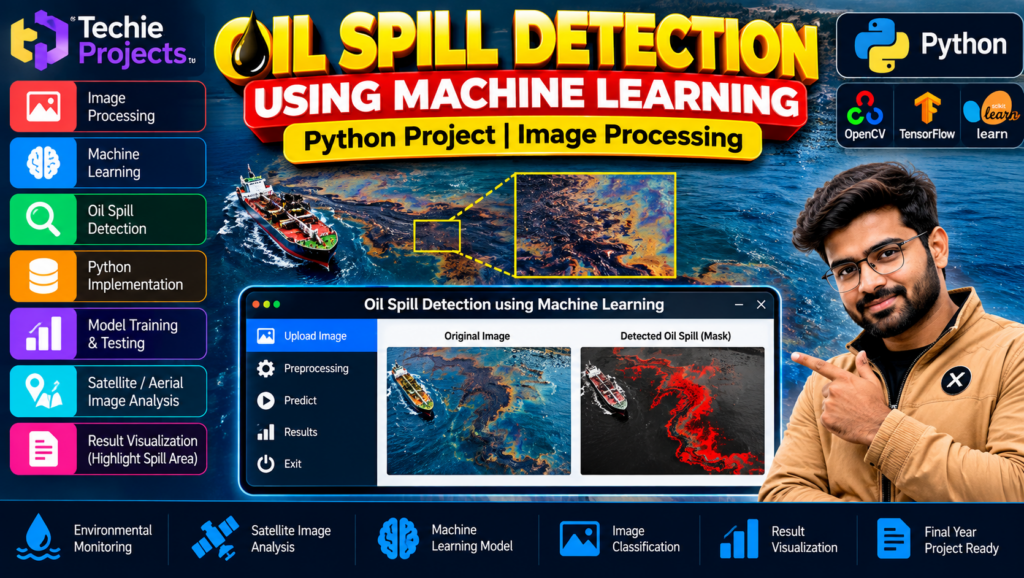
Oil spill detection using machine learning is an environmental monitoring project that demonstrates how image processing and machine learning techniques can be used to identify potential oil spill regions in images. The project combines Python, image analysis, and machine learning concepts to explore how computer vision can support oil spill detection research.
If you are a B.Tech, B.E., BCA, MCA, Computer Science, Artificial Intelligence, or Data Science student looking for a practical final-year project, this topic offers an opportunity to learn about image processing, model-based classification, and environmental applications of AI.
Techie Projects helps students enquire about engineering projects, source code, documentation, and implementation requirements. Contact us to confirm the available features, deliverables, and pricing.
🎬 Project Demo: Oil Spill Detection Using Machine Learning
Watch the project demonstration to understand the interface and workflow. The application may process an input image, analyze visual patterns, and display a predicted oil spill region, depending on the supplied implementation.
Review the actual demo to confirm which image formats, detection methods, and output visualizations are supported.
🎯 What Is Oil Spill Detection Using Machine Learning?
Oil spill detection using machine learning explores how computer systems can analyze images to identify visual patterns associated with oil on water. Oil spills can affect marine ecosystems, wildlife, coastal communities, and water quality, making monitoring an important environmental research area.
In an image-based project, a model may learn patterns from labelled examples of water surfaces and oil-affected regions. Python libraries can prepare the images, extract relevant features, run a trained model, and display the results.
The output depends on the dataset, image quality, lighting, water conditions, and the model used. This educational project should not be treated as a replacement for expert environmental assessment or operational spill-monitoring systems.
✨ Key Features of the Project
The following features may be available depending on the supplied version:
- Image input: Load supported images for analysis.
- Image preprocessing: Prepare images for the selected model.
- Machine learning integration: Use a trained model to classify images or identify possible spill regions.
- Result visualization: Display predictions or highlighted regions if supported.
- Python implementation: Connect image processing and model inference.
- User interface: Provide a convenient way to interact with the application, if included.
- Model evaluation: Explore performance metrics if test data and evaluation code are supplied.
Confirm the actual features before purchasing. Image segmentation, satellite-image processing, live monitoring, and real-time detection should only be claimed if they are implemented.
🎓 Objectives of the Project
The main objectives of oil spill detection using machine learning are:
- Understand image-based environmental monitoring.
- Learn how images can be prepared for machine learning.
- Explore visual features associated with potential oil spill regions.
- Integrate a trained model into a Python application.
- Display and interpret model predictions.
- Evaluate the model using suitable test images.
- Understand the limitations of automated environmental image analysis.
⚙️ How Does the Oil Spill Detection System Work?
1. Image Collection
The process begins with images used to train, test, or demonstrate the model. Depending on the project, these may be ordinary water-surface images, labelled oil spill images, or remote-sensing images.
2. Image Preprocessing
Images may be resized, normalized, or converted into a suitable format for the selected model. Preprocessing helps maintain consistency between training and inference.
3. Feature Extraction
The model analyzes visual patterns such as color, texture, and spatial characteristics. The relevant features depend on the model architecture and training data.
4. Machine Learning Model
A trained model processes the prepared image and predicts whether patterns associated with an oil spill are present. The exact approach may involve image classification, object detection, or segmentation.
5. Prediction and Visualization
The application displays the model’s output. Depending on the implementation, this may be a classification label, confidence score, or highlighted region.
6. Model Evaluation
Performance can be assessed using suitable labelled test data. Metrics may include precision, recall, F1-score, and a confusion matrix. Actual results should be reported from the supplied model rather than assumed.
🧰 Technologies Used
Python
Python connects the image-processing workflow, machine learning model, and application interface.
OpenCV
OpenCV can support image loading, resizing, preprocessing, and visualization.
NumPy
NumPy supports numerical calculations and image-array operations.
Machine Learning or Deep Learning Framework
Depending on the implementation, the model may use a framework such as TensorFlow, Keras, or Scikit-learn. Confirm the actual framework and model architecture in the project requirements.
Matplotlib
Matplotlib may be used to visualize images, model outputs, or evaluation results if included.
💻 Software and Hardware Requirements
Software Requirements
- Python
- Required image-processing libraries
- The machine learning framework used by the project
- Model files and configuration, if applicable
- A compatible operating system
- VS Code, PyCharm, or another suitable code editor
Hardware Requirements
- Laptop or desktop computer
- Compatible processor
- Sufficient RAM for image processing and model inference
- Storage for source code, model files, and datasets
A GPU may be useful for larger models, but requirements depend on the model and implementation. Check the supplied installation instructions before setting up the project.
🌟 Advantages of Oil Spill Detection Using Machine Learning
- Demonstrates a practical environmental application of AI.
- Introduces image processing and model-based classification.
- Helps students understand image datasets and model evaluation.
- Combines Python programming with computer vision concepts.
- Can be extended with additional datasets and visualization methods.
- Provides a foundation for studying automated environmental monitoring.
🌊 Applications of Oil Spill Detection
Oil spill detection research has potential applications in:
- Marine environmental monitoring
- Coastal observation
- Satellite and aerial image analysis
- Environmental research projects
- Pollution monitoring prototypes
- Computer vision and remote-sensing education
These are potential application areas. The capabilities of this particular project depend on its data sources, model, and implementation.
⚠️ Limitations and Considerations
Oil spill detection can be challenging because oil may appear differently under different lighting, weather, and water conditions.
Important limitations include:
- Sunlight reflections may resemble oil on water.
- Waves, clouds, and shadows can affect predictions.
- Training data may not represent every environment.
- A model may perform poorly on unfamiliar images.
- Incorrect predictions require human review.
- A demonstration using ordinary images does not establish operational performance on satellite or aerial data.
For real environmental incidents, predictions should be verified by qualified personnel using appropriate monitoring methods.
🚀 Future Scope
Possible future enhancements include:
- Training on more diverse labelled datasets.
- Comparing different machine learning architectures.
- Exploring image segmentation for region identification.
- Adding satellite or aerial imagery support.
- Improving prediction visualization.
- Evaluating robustness under different environmental conditions.
- Developing a web interface for image uploads.
- Testing performance on independent data.
These improvements may require additional data, training, and development beyond the current project.
🎓 Why Choose This Project for Your Final Year?
Oil spill detection using machine learning is a relevant topic for students interested in Artificial Intelligence, Data Science, Computer Vision, and environmental applications.
This project can help you explore:
- Image preprocessing
- Machine learning model integration
- Visual classification
- Environmental monitoring concepts
- Prediction visualization
- Model testing and evaluation
- Python application development
Before selecting the project, confirm that the implementation meets your college’s requirements and includes the modules you need.
📦 What Should You Confirm Before Purchasing?
Contact Techie Projects to confirm which deliverables are available in the current project package:
- Python source code
- Trained model files, if applicable
- Dataset or dataset access instructions
- Required dependencies
- Installation and execution instructions
- Project documentation or report
- Available technical support
Also ask whether the implementation performs image classification, object detection, or segmentation. These approaches provide different types of output.
📲 Purchase the Oil Spill Detection Using Machine Learning Project
Looking for an oil spill detection using machine learning project for your B.Tech, B.E., BCA, MCA, or final-year submission?
Techie Projects can help you enquire about the available project version, source code, documentation, setup requirements, and pricing before you purchase.
Get Project Details and Pricing on WhatsApp
📲 Call/WhatsApp: +91-9460060699
🌎 Website: www.techieprojects.com
📺 Instagram: @pythonprojects_
Contact us to confirm current availability, included deliverables, implementation details, and pricing.
🔗 Explore Related Projects
Explore these related project topics on Techie Projects:
- Crop Prediction Using Machine Learning
- Garbage Detection Using YOLO
- Wine Quality Prediction Using Machine Learning
- Forest Fire Detection Using Deep Learning
- Satellite Image Classification Using Python
Link each project title to its relevant published article on your website when available.
❓ Frequently Asked Questions
1. What is oil spill detection using machine learning?
It is an image-analysis approach that uses a trained model to identify patterns associated with possible oil spills.
2. Which programming language is used?
Python is commonly used for image preprocessing, model integration, and application development.
3. Does the project use satellite images?
That depends on the implementation and dataset. Confirm whether the supplied version supports satellite imagery, aerial photographs, or ordinary images.
4. Can the system identify the exact spill area?
Only if the implementation includes a suitable detection or segmentation method. An image classifier may return a category without identifying the precise region.
5. Is the project suitable for final-year students?
It may be suitable for students studying Computer Science, Artificial Intelligence, Data Science, or related subjects, subject to their institution’s requirements.
6. Is the prediction always accurate?
No. Model performance depends on training data, image conditions, and the evaluation process. Predictions should be validated, especially for environmental decisions.
7. How can I purchase the project?
Contact Techie Projects on WhatsApp to enquire about availability and pricing.
📝 Conclusion
Oil spill detection using machine learning is an educational project that explores how Python and image analysis can be applied to environmental monitoring.
It introduces students to image preprocessing, model integration, prediction visualization, and the challenges of identifying oil spills in varying conditions.
If you want to purchase this project for academic learning, contact Techie Projects to confirm the available implementation, source code, documentation, and price.
👉 Contact Techie Projects on WhatsApp to get started.