
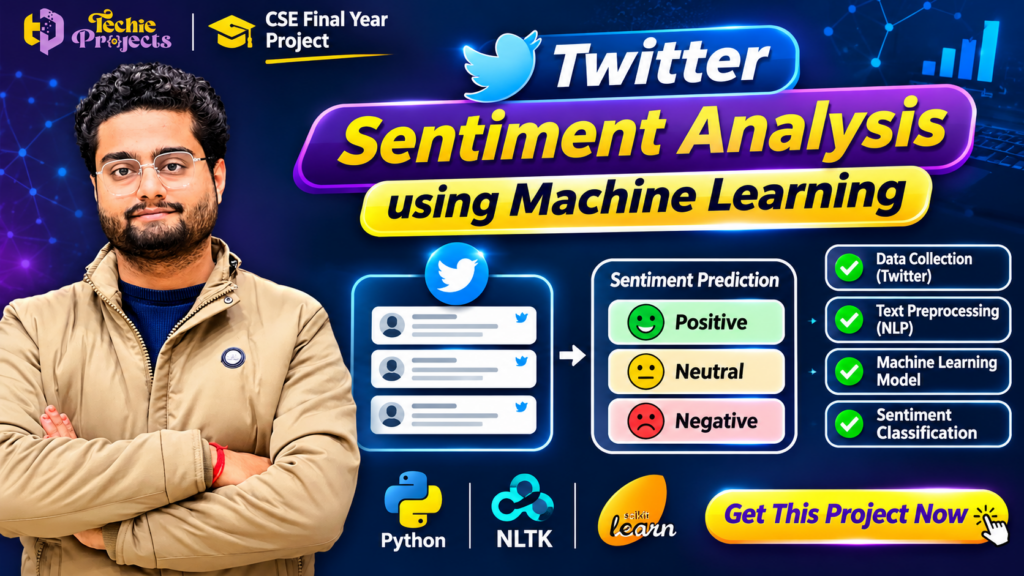
🚀 Looking to purchase an interesting Machine Learning project for your final-year engineering submission? Get the Twitter Sentiment Analysis using Machine Learning project from Techie Projects and explore how Artificial Intelligence can understand people’s opinions, emotions, and reactions through social media text!
The Twitter Sentiment Analysis using Machine Learning project demonstrates how artificial intelligence can analyze social media opinions and automatically identify positive, negative, and neutral sentiments. It provides practical experience with Python, Natural Language Processing, and machine learning algorithms.
Social media platforms generate enormous amounts of text every day. People share opinions about products, companies, movies, political events, technologies, and trending topics. Understanding these opinions manually is difficult because of the massive volume of information.
This is where Twitter Sentiment Analysis using Machine Learning becomes useful. It is an exciting Natural Language Processing (NLP) project that analyzes text data and classifies opinions into positive, negative, and neutral sentiments.
🎓 If you are a B.Tech, M.Tech, BCA, MCA, or Computer Science Engineering student searching for a practical IEEE-style Machine Learning project, this project is an excellent opportunity to explore Python programming, NLP, text preprocessing, and sentiment classification.
Don’t waste your valuable final-year project time searching for complicated implementations. Get in touch with Techie Projects to enquire about purchasing the project, Python source code availability, working demonstration, project documentation, and implementation guidance.
🛒 Get This Project Now! Take the next step towards your final-year engineering project with Techie Projects.
📞 Contact Techie Projects for Project Enquiries
Want to purchase the Twitter Sentiment Analysis project? Contact our team for pricing, availability, project demonstrations, and implementation details.
- 📞 Contact / WhatsApp: +91 94600 60699
- 🌐 Website: www.techieprojects.com
- 📸 Instagram: @pythonprojects_
Techie Projects provides engineering project solutions across Python, Artificial Intelligence, Machine Learning, Deep Learning, Natural Language Processing, Computer Vision, IoT, and Data Science.
🎬 Watch the Twitter Sentiment Analysis Project Demo
Explore the Twitter Sentiment Analysis using Machine Learning project demonstration to understand how social media text is analyzed and classified using Python and NLP techniques.
The demonstration introduces the sentiment analysis workflow, including text processing, sentiment classification, and prediction of positive, negative, and neutral opinions.
You can understand how machine learning techniques transform unstructured text into meaningful sentiment information.
🎯 Interested in purchasing this project? Contact Techie Projects through WhatsApp to enquire about source code availability, project demonstrations, documentation, and implementation support.
🐦 What Is Twitter Sentiment Analysis Using Machine Learning?
Twitter Sentiment Analysis using Machine Learning is an NLP-based application that identifies the emotional tone or opinion expressed in text messages and classifies them into different sentiment categories.
The main purpose of Twitter Sentiment Analysis using Machine Learning is to understand public opinions by processing large amounts of social media text. The system analyzes words and expressions to predict the sentiment associated with each message.
It uses Natural Language Processing techniques to understand textual information and machine learning algorithms to predict sentiment.
For example, consider these three social media posts:
- 😊 Positive: “This new smartphone has an amazing camera. I love it!”
- 😐 Neutral: “The smartphone was launched today.”
- 😡 Negative: “The battery performance of this smartphone is disappointing.”
A sentiment analysis system processes these messages and predicts whether the expressed opinion is positive, neutral, or negative.
The application can help analyze large collections of text data more efficiently than manually reading individual posts.
In this project, Python libraries and machine learning algorithms are used to process text, extract useful features, train classification models, and predict sentiment categories.
🎯 Objectives of Twitter Sentiment Analysis Project
Developing a Twitter Sentiment Analysis using Machine Learning application helps students understand how computers process human language and classify opinions using supervised learning techniques.
The primary objective is to develop an automated sentiment classification system that analyzes social media text using machine learning and NLP techniques.
The main objectives include:
- 🐦 Collect or load social media text data for analysis.
- 📝 Preprocess textual information using NLP techniques.
- 🔍 Remove unnecessary characters, symbols, and unwanted text.
- 🧠 Extract meaningful features from text data.
- 🤖 Train machine learning models for sentiment classification.
- 😊 Identify positive, negative, and neutral opinions.
- 📊 Analyze sentiment distribution and classification results.
- 📈 Evaluate model performance using suitable evaluation metrics.
- ⚡ Automate sentiment prediction for new text inputs.
⚙️ Technologies Used in Twitter Sentiment Analysis Using Python
Python, NLTK, Pandas, and Scikit-learn are important technologies used in Twitter Sentiment Analysis using Machine Learning. These tools support text preprocessing, feature extraction, model training, and sentiment prediction.
The project combines multiple Python libraries and machine learning techniques to develop an automated sentiment classification application.
1. 🐍 Python Programming
Python is the primary programming language used to implement the project. It provides a flexible environment for data processing, machine learning, NLP, and visualization.
2. 📝 Natural Language Processing (NLP)
NLP helps computers process and analyze human language. In this project, NLP techniques are used to clean text, tokenize sentences, remove stop words, and prepare text for machine learning.
3. 🔢 NumPy
NumPy supports numerical computations and array operations required during data processing and model development.
4. 📊 Pandas
Pandas is used to load, organize, clean, and manipulate datasets. It helps manage social media text and sentiment labels efficiently.
5. 📚 NLTK
Natural Language Toolkit (NLTK) provides useful NLP functions such as tokenization, stop-word removal, stemming, and text preprocessing.
6. 🧠 Scikit-learn
Scikit-learn provides machine learning algorithms and tools for feature extraction, model training, prediction, and performance evaluation.
Algorithms that can be explored include:
- Logistic Regression.
- Naive Bayes.
- Support Vector Machine (SVM).
- Decision Tree.
- Random Forest.
The actual algorithms depend on the selected implementation.
7. 📈 Matplotlib and Seaborn
These libraries help visualize sentiment distribution, model performance, confusion matrices, and other analytical results.
🔄 How Does the Twitter Sentiment Analysis System Work?
The Twitter Sentiment Analysis using Machine Learning project follows a sequence of steps to transform raw text into meaningful sentiment predictions.
During Twitter Sentiment Analysis using Machine Learning, raw social media text is cleaned and converted into numerical features. The trained classification model then analyzes these features and predicts the sentiment category.
Step 1: Data Collection
The system receives textual data from a dataset or an authorized data source.
The dataset may contain social media posts, comments, text messages, and their corresponding sentiment labels.
Depending on the implementation, data can be loaded from CSV files or collected through an authorized API.
Step 2: Data Preprocessing
Raw social media text often contains unnecessary information such as URLs, hashtags, punctuation, special characters, and repeated spaces.
Text preprocessing prepares the data for machine learning.
Common preprocessing operations include:
- Removing URLs.
- Removing unwanted special characters.
- Converting text into lowercase.
- Removing unnecessary punctuation.
- Tokenization.
- Stop-word removal.
- Stemming or lemmatization.
These operations help standardize text before feature extraction.
Step 3: Text Tokenization
Tokenization divides sentences into smaller units called tokens.
For example:
Original sentence: “Machine learning is very interesting.”
Tokens: Machine, learning, is, very, interesting.
Tokenization helps the system process individual words and understand the structure of text.
Step 4: Feature Extraction
Machine learning algorithms require numerical input rather than raw text.
Feature extraction converts text into numerical representations.
Common techniques include:
Bag of Words (BoW): Represents text using word occurrence information.
TF-IDF: Assigns importance to words based on their frequency and distribution across documents.
Word Embeddings: Represent words as numerical vectors that capture semantic relationships.
The selected technique depends on the model and implementation.
Step 5: Machine Learning Model Training
The processed dataset is divided into training and testing sets.
The machine learning algorithm learns patterns from the training data and develops a classification model.
Algorithms such as Logistic Regression, Naive Bayes, and Support Vector Machine can be used for sentiment classification.
Step 6: Sentiment Prediction
After training, the model receives new text and predicts its sentiment category.
The output may include:
- 😊 Positive Sentiment.
- 😐 Neutral Sentiment.
- 😡 Negative Sentiment.
Step 7: Result Visualization
The system can display prediction results and sentiment distribution through charts, graphs, and classification reports.
This makes the results easier to understand and analyze.
⭐ Key Features of Twitter Sentiment Analysis Project
One of the major capabilities of Twitter Sentiment Analysis using Machine Learning is automated opinion classification. The application can identify positive, negative, and neutral opinions from processed text data.
The project demonstrates several important capabilities of machine learning and natural language processing.
🐦 1. Social Media Text Analysis
Processes text data to identify opinions and understand the overall sentiment expressed in social media content.
📝 2. Text Preprocessing
Cleans raw textual information using NLP techniques such as tokenization, stop-word removal, and text normalization.
😊 3. Positive Sentiment Classification
Identifies text containing positive opinions, satisfaction, appreciation, and favorable expressions.
😐 4. Neutral Sentiment Classification
Identifies text that expresses factual or relatively neutral information without strong positive or negative opinions.
😡 5. Negative Sentiment Classification
Identifies text containing complaints, dissatisfaction, criticism, or unfavorable opinions.
🤖 6. Machine Learning Prediction
Uses trained classification algorithms to predict sentiment categories for new textual inputs.
📊 7. Data Visualization
Displays sentiment distribution and model performance through graphical representations.
⚡ 8. Automated Sentiment Analysis
Reduces the need to manually analyze every individual social media message.
📊 Types of Sentiment Classification
Sentiment classification is an important component of Natural Language Processing.
The project primarily focuses on three sentiment categories.
1. 😊 Positive Sentiment
Positive sentiment indicates satisfaction, happiness, appreciation, or favorable opinions.
Example:
“I really enjoyed using this application. It works perfectly!”
Predicted result: Positive.
2. 😐 Neutral Sentiment
Neutral sentiment represents statements that do not express a strong positive or negative opinion.
Example:
“The company announced its new product today.”
Predicted result: Neutral.
3. 😡 Negative Sentiment
Negative sentiment represents dissatisfaction, complaints, criticism, or unfavorable opinions.
Example:
“This application crashes frequently and needs improvement.”
Predicted result: Negative.
These classifications help convert large amounts of textual information into understandable analytical results.
🌍 Applications of Twitter Sentiment Analysis
The Twitter Sentiment Analysis using Machine Learning technology can be explored in brand monitoring, customer feedback analysis, product review analysis, marketing research, and social media analytics. Twitter sentiment analysis has several potential applications across business, marketing, research, and customer experience management.
1. 🏢 Brand Reputation Monitoring
Companies can analyze public opinions about their brands and identify customer satisfaction or dissatisfaction.
2. 📱 Product Review Analysis
Businesses can understand customer reactions to products and identify common complaints or positive feedback.
3. 📢 Marketing Campaign Analysis
Marketing teams can study public reactions to advertising campaigns, promotional activities, and product launches.
4. 🎬 Movie and Entertainment Reviews
Sentiment analysis can help analyze audience opinions about movies, television programs, and entertainment content.
5. 🛍️ Customer Feedback Analysis
Organizations can process large collections of customer feedback and identify recurring satisfaction issues.
6. 📈 Market Research
Researchers can study public discussions about products, services, and market trends.
7. 🏦 Financial Opinion Analysis
Sentiment classification can be explored for analyzing public discussions about companies, products, and financial topics. However, social media sentiment should not be treated as a standalone investment signal.
8. 📰 Public Opinion Analysis
Researchers can examine public reactions to events, announcements, and trending topics.
💻 Software Requirements
The following technologies are commonly associated with this project.
| Component | Technology |
|---|---|
| Programming Language | Python |
| Machine Learning | Scikit-learn |
| NLP Library | NLTK |
| Data Processing | Pandas |
| Numerical Computing | NumPy |
| Visualization | Matplotlib / Seaborn |
| Feature Extraction | TF-IDF / Bag of Words |
| Operating System | Windows / Linux |
| Input | Social Media Text Dataset |
| Output | Sentiment Classification |
The exact dependencies and versions depend on the supplied implementation.
🖥️ Hardware Requirements
A standard computer can be used to develop and execute this Python-based machine learning project.
Recommended configuration:
- Processor: Intel Core i5 or equivalent.
- RAM: 8 GB or higher.
- Storage: 256 GB or higher.
- Operating System: Windows 10/11 or Linux.
- Graphics: Integrated graphics are generally sufficient for traditional machine learning models.
A dedicated GPU is not normally required for basic TF-IDF-based sentiment classification.
📈 Advantages of Twitter Sentiment Analysis Using Machine Learning
Implementing Twitter Sentiment Analysis using Machine Learning provides practical knowledge of Python programming, NLP, text classification, data preprocessing, and machine learning model evaluation.
There are several advantages to developing an automated sentiment analysis application.
- Automation: Processes large amounts of textual information efficiently.
- Time Saving: Reduces the need for manual opinion classification.
- Business Insights: Helps organizations understand customer opinions.
- NLP Learning: Provides practical knowledge of text processing techniques.
- Machine Learning Experience: Introduces students to classification algorithms.
- Visualization: Makes sentiment distribution easier to understand.
- Scalability: Can be extended to process larger text datasets.
- Practical Applications: Connects AI concepts with real-world business problems.
🔬 Future Scope of Twitter Sentiment Analysis Project
The Twitter Sentiment Analysis using Machine Learning project can be extended with BERT, LSTM, multilingual sentiment classification, real-time analytics, and interactive business intelligence dashboards.
Students can extend the project by integrating advanced machine learning and NLP technologies.
1. 🧠 BERT-Based Sentiment Analysis
Integrate transformer-based models such as BERT to explore contextual text representations and potentially improve sentiment classification.
2. 🤖 Deep Learning-Based Sentiment Classification
Explore LSTM, GRU, and other neural network architectures for analyzing sequential text data.
3. 📊 Real-Time Sentiment Monitoring
Develop a dashboard that processes authorized live data streams and displays changing sentiment trends.
4. 🌐 Multilingual Sentiment Analysis
Extend the system to analyze text written in multiple languages.
5. 📈 Advanced Data Visualization
Create interactive dashboards using Streamlit, Plotly, or other visualization frameworks.
6. 🏢 Business Intelligence Integration
Integrate sentiment analysis results into business dashboards to help organizations understand customer feedback.
7. 💬 Aspect-Based Sentiment Analysis
Identify sentiment associated with specific product features, such as price, quality, battery life, and customer service.
8. 🔍 Emotion Detection
Extend basic sentiment classification to identify emotions such as happiness, anger, sadness, and excitement.
These improvements can transform a basic academic implementation into a more advanced NLP and business analytics application.
🎓 Why Choose This Machine Learning NLP Project for Your Final Year?
Students selecting Twitter Sentiment Analysis using Machine Learning can develop practical skills in artificial intelligence, natural language processing, feature extraction, and predictive modelling.
Twitter Sentiment Analysis using Machine Learning combines Python programming, data analysis, NLP, and classification algorithms in one practical application.
Computer Science Engineering (CSE): Learn Python, NLP, machine learning, text processing, and classification.
Information Technology (IT): Understand how AI-based applications process and analyze large amounts of textual data.
Artificial Intelligence: Explore how computers identify sentiment patterns from human language.
Machine Learning: Gain experience with model training, feature extraction, and performance evaluation.
BCA and MCA: Develop practical knowledge of Python-based text analysis applications.
This project is also useful for students interested in Data Science, Natural Language Processing, and AI-based business applications.
💡 Recommended Projects from Techie Projects
If you are interested in Twitter Sentiment Analysis using Machine Learning, you can also explore related Python NLP and Artificial Intelligence projects available at Techie Projects.
Looking for more exciting Artificial Intelligence, Python, Machine Learning, and NLP projects? Explore these related project ideas for your final-year engineering submission.
- 📰 Fake News Detection Using Machine Learning – Identify potentially misleading news articles using NLP and classification algorithms.
- 💬 Chatbot Using Natural Language Processing – Develop an intelligent chatbot that understands and responds to user messages.
- 📧 Spam Email Detection Using Python – Classify emails into spam and legitimate categories.
- 🎬 Movie Review Sentiment Analysis – Analyze movie reviews and classify audience opinions.
- 🧠 Emotion Detection Using Deep Learning – Identify emotions from textual or visual inputs.
- 📚 Text Summarization Using NLP – Generate concise summaries from lengthy documents.
- 🔍 Text Classification Using Machine Learning – Automatically categorize text into predefined classes.
- 📰 News Classification Using Python – Categorize news articles into different topics.
- 🤖 Fake Review Detection Using Machine Learning – Identify suspicious or potentially misleading product reviews.
- 📊 Customer Feedback Analysis Using NLP – Analyze customer opinions to generate useful business insights.
🌐 Explore more final-year projects at www.techieprojects.com.
🛒 Get This Twitter Sentiment Analysis Project Now!
🚀 Looking for a practical final-year NLP project? Purchase the Twitter Sentiment Analysis using Machine Learning project from Techie Projects and enquire about Python source code, project demonstration, documentation, and implementation guidance.
Get in touch with Techie Projects and enquire about the Twitter Sentiment Analysis using Machine Learning project.
If you are searching for a practical Python NLP project that combines text preprocessing, machine learning algorithms, and sentiment classification, this project is an excellent option to explore.
Our team can help you understand the available project package, pricing, and purchasing options before you proceed.
🎁 What Can You Enquire About?
Contact our team to confirm the availability of:
- 💻 Python project source code.
- 🎬 Working project demonstration.
- 📚 Project documentation.
- ⚙️ Installation and execution requirements.
- 🧑💻 Implementation guidance.
- 🔧 Customization possibilities.
- 📞 Technical support options.
The exact deliverables, pricing, and support arrangements will be confirmed before purchase.
<mark>🔥 Don’t wait until your final-year submission deadline approaches. Choose your project and start preparing today!</mark>
📲 Purchase Enquiry – Techie Projects
Interested in purchasing this project? Send us a WhatsApp message.
📞 Contact / WhatsApp: +91 94600 60699
🌐 Website: www.techieprojects.com
📸 Instagram: @pythonprojects_
Techie Projects – Your Destination for Practical Engineering Projects!
❓ Frequently Asked Questions (FAQs)
1. What is Twitter Sentiment Analysis using Machine Learning?
It is an NLP-based application that analyzes social media text and classifies opinions into positive, negative, and neutral sentiment categories using machine learning algorithms.
2. Which programming language is used in this project?
Python is the primary programming language. Libraries such as Pandas, NumPy, NLTK, and Scikit-learn can be used.
3. Which machine learning algorithms are used?
Algorithms such as Naive Bayes, Logistic Regression, Support Vector Machine, Decision Tree, and Random Forest can be explored.
4. What is the role of NLP in sentiment analysis?
NLP helps computers process human language through tokenization, text cleaning, stop-word removal, and feature extraction.
5. Can the system identify positive, negative, and neutral sentiments?
Yes. A three-class sentiment classification model can predict positive, negative, and neutral categories when trained with appropriately labelled data.
6. Is this project suitable for final-year engineering students?
Yes. It is suitable for CSE, IT, AI, Machine Learning, BCA, and MCA students interested in Python and NLP.
7. Can this project use real-time Twitter or X data?
Real-time data collection can be explored through authorized API access, subject to the platform’s current access policies and applicable usage limits. The project can also work with prepared datasets.
8. Can I purchase this project from Techie Projects?
Yes. Contact Techie Projects at +91 94600 60699 to enquire about pricing, source code availability, project demonstration, and purchasing options.
9. Can this project be extended using deep learning?
Yes. You can explore BERT, LSTM, GRU, and other deep learning models to develop more advanced sentiment analysis applications.
🏁 Conclusion
Twitter Sentiment Analysis using Machine Learning is an interesting Natural Language Processing project that demonstrates how artificial intelligence can understand opinions and classify sentiments from social media text.
By combining Python programming, NLP, text preprocessing, feature extraction, and machine learning algorithms, students can develop an application that identifies positive, negative, and neutral opinions.
The project provides practical knowledge of text analytics and demonstrates how sentiment analysis can support business intelligence, customer feedback analysis, brand monitoring, and market research.
🎓 Planning your final-year engineering project?
Purchase your project from Techie Projects and explore our collection of Python, Artificial Intelligence, Machine Learning, Deep Learning, NLP, IoT, and Data Science projects.
📞 Contact / WhatsApp: +91 94600 60699
📸 Follow Techie Projects on Instagram
🚀 Techie Projects – Build, Learn, and Innovate!