
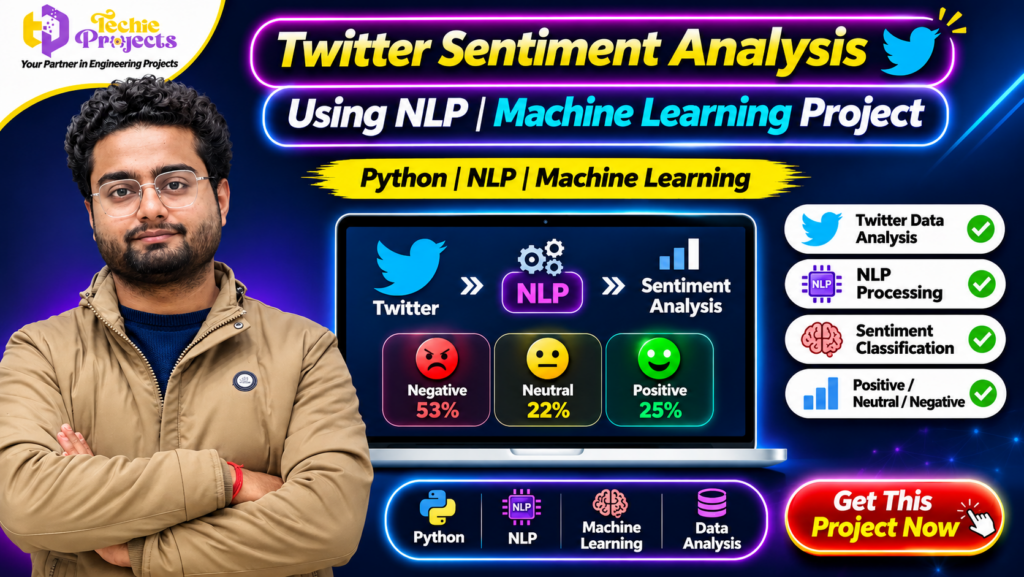
🚀 Get Your Twitter Sentiment Analysis Project from Techie Projects
Looking for a practical machine learning project that demonstrates the real-world application of Natural Language Processing? Twitter Sentiment Analysis Using NLP is an excellent project for final-year engineering students, computer science students, and learners interested in Artificial Intelligence, Python, and Machine Learning.
Instead of spending weeks developing an entire project from scratch, you can enquire about the ready-to-use project package from Techie Projects. Get project-related resources such as source code, documentation, implementation guidance, and available technical support options. Whether you need a project for your final-year submission, academic demonstration, or practical learning, this project can help you understand how machine learning techniques are applied to analyse text and identify sentiment.
The project focuses on analysing text data and classifying opinions into categories such as positive, negative, and neutral. It demonstrates how NLP techniques and machine learning algorithms can convert unstructured text into meaningful sentiment information.
📞 Contact Techie Projects for Project Enquiries
Interested in purchasing the Twitter Sentiment Analysis Using NLP project? Contact us to enquire about package availability, pricing, source code, documentation, installation guidance, and technical support options.
💬 WhatsApp Enquiry: Chat with Techie Projects
📱 Contact Number: +91 94600 60699
🌐 Official Website: www.techieprojects.com
📸 Instagram: Follow Techie Projects
🎓 Project Categories: Python, Artificial Intelligence, Machine Learning, Natural Language Processing, and Data Analytics.
✅ Request Project Details: Share your engineering branch, preferred features, and technical requirements to enquire about the most suitable available package.
🚀 Ready to get started? Click here to enquire on WhatsApp and mention Twitter Sentiment Analysis Using NLP.
Package contents, prices, included features, and support options should be confirmed before purchase.
🎬 Watch the Twitter Sentiment Analysis Using NLP Project Demo
Explore the project demonstration to understand its interface, text analysis workflow, and sentiment classification results. The demo can help you understand how the application processes text and presents sentiment categories.
📌 Introduction to Twitter Sentiment Analysis Using NLP
Social media platforms generate a huge amount of text every day. People share opinions, feedback, experiences, product reviews, and reactions to different topics. Analysing these opinions manually can be difficult because of the volume of content.
Twitter Sentiment Analysis Using NLP applies Natural Language Processing and machine learning techniques to identify the sentiment expressed in text. The system analyses textual input and predicts whether the expressed opinion is positive, negative, or neutral, depending on the model and implementation.
This project combines Python programming, text preprocessing, feature extraction, and machine learning concepts. It provides students with practical exposure to an important application of Artificial Intelligence.
For students searching for a Python-based final-year project, this topic offers an opportunity to explore text classification, data processing, and model evaluation in one application.
🎯 Objectives of the Project
The main objective is to develop a system that can analyse textual opinions and classify them into meaningful sentiment categories.
The important objectives include:
- Collecting or accepting text data for analysis.
- Cleaning and preprocessing textual information.
- Removing unnecessary characters and handling common text variations.
- Converting text into numerical features suitable for machine learning.
- Applying a machine learning model for sentiment classification.
- Identifying positive, negative, and neutral opinions.
- Displaying the classification results in an understandable format.
- Demonstrating how NLP can support opinion analysis.
These objectives help students understand the complete workflow of a basic text classification application.
🔍 What Is Sentiment Analysis?
Sentiment analysis is a Natural Language Processing technique used to identify opinions, emotions, or attitudes expressed in text. It is commonly used to understand customer feedback, online discussions, product reviews, and public responses.
For example, consider these sentences:
- Positive: “This product is excellent. I really like it.”
- Negative: “The service was disappointing and slow.”
- Neutral: “The product was delivered yesterday.”
A sentiment analysis model processes these sentences and predicts an appropriate sentiment category.
The accuracy of the prediction depends on the dataset, preprocessing method, model selection, and training quality. Sarcasm, slang, spelling mistakes, and context can make sentiment classification challenging.
🧠 How Twitter Sentiment Analysis Using NLP Works
The project follows a series of steps to convert text into sentiment predictions.
1. Text Data Collection
The first step is obtaining textual data. Depending on the project implementation, data may come from a prepared dataset, uploaded file, or supported data source.
For academic demonstrations, a sample dataset can be used to understand the complete analysis process.
2. Text Preprocessing
Raw text often contains punctuation, URLs, special characters, repeated spaces, and other elements that may affect model performance.
Preprocessing prepares the text for analysis. Common operations include:
- Converting text into lowercase.
- Removing unnecessary punctuation.
- Handling URLs and special characters.
- Tokenizing sentences into individual words.
- Removing selected stop words.
- Applying stemming or lemmatization when required.
The exact preprocessing pipeline depends on the selected NLP implementation.
3. Feature Extraction
Machine learning algorithms generally require numerical input. Therefore, the cleaned text must be transformed into numerical features.
Common feature extraction approaches include:
- Bag of Words.
- Count Vectorization.
- TF-IDF Vectorization.
- Word embeddings.
TF-IDF is a popular approach because it represents words according to their importance within documents and the overall dataset.
4. Model Training
After feature extraction, the processed dataset can be used to train a machine learning classifier.
Depending on the implementation, algorithms may include:
- Naive Bayes.
- Logistic Regression.
- Support Vector Machine.
- Decision Tree.
- Random Forest.
The selected model learns patterns from labelled examples and uses those patterns to predict sentiment for new text.
5. Sentiment Prediction
After training, the model can analyse input text and generate a predicted sentiment category.
For example, a sentence expressing satisfaction may be classified as positive, while a complaint may be classified as negative.
6. Result Display
The final step presents the prediction to the user. Results may be displayed through a graphical interface, web application, or other output format depending on the project package.
⚙️ Key Features of Twitter Sentiment Analysis Using NLP
The project demonstrates several important features of Natural Language Processing and machine learning.
📝 Text Preprocessing
Text preprocessing prepares raw textual information for machine learning. It helps remove unnecessary elements and creates a more consistent input format.
📊 Sentiment Classification
The system can classify text into positive, negative, and neutral categories when these classes are supported by the trained model.
🤖 Machine Learning Integration
The project demonstrates how a trained machine learning model can identify patterns in text and generate predictions.
🧹 Data Cleaning
Data cleaning helps prepare textual information for further processing and reduces inconsistencies in the input data.
📈 Result Analysis
The classification output can be used to understand the distribution of sentiment categories in the analysed dataset.
🐍 Python-Based Development
Python provides libraries and tools for data processing, machine learning, and NLP development, making it suitable for this academic project.
Note: The exact interface, algorithms, datasets, and features depend on the available project implementation and selected package.
🛠️ Technologies Used in the Project
The following technologies are commonly used to develop a Python-based sentiment analysis application.
| Technology | Purpose |
|---|---|
| Python | Main programming language |
| NLP | Text processing and language analysis |
| Machine Learning | Sentiment classification |
| Pandas | Dataset handling and processing |
| NumPy | Numerical operations |
| Scikit-learn | Feature extraction and model training |
| NLTK | Text preprocessing and NLP operations |
| Matplotlib | Data visualization, if included |
The actual libraries and versions should be checked against the project source code before installation.
💻 Software and Hardware Requirements
Software Requirements
- Programming Language: Python
- Operating System: Windows 10/11 or a compatible environment
- Development Environment: Python IDE or code editor
- Machine Learning Libraries: As required by the implementation
- NLP Libraries: As required by the implementation
Hardware Requirements
- Processor: Intel or compatible processor
- RAM: 4 GB minimum recommended
- Storage: Sufficient free space for Python, libraries, and datasets
- Input Devices: Keyboard and mouse
The recommended configuration may vary according to the dataset size and selected machine learning model.
🌍 Real-World Applications of Sentiment Analysis
Sentiment analysis has applications across several industries. It helps organisations understand opinions expressed in online content and customer feedback.
1. Customer Feedback Analysis
Businesses can analyse customer comments to identify common positive and negative experiences.
2. Product Review Analysis
Online retailers can use sentiment analysis to understand customer reactions to products and services.
3. Brand Monitoring
Companies can study public discussions to understand how people respond to their products, campaigns, and announcements.
4. Marketing Research
Marketing teams can use sentiment information as one input when studying customer preferences and campaign responses.
5. Public Opinion Research
Researchers can analyse text datasets to explore opinions about selected topics and events.
6. Customer Support
Sentiment classification can help organise feedback and identify messages that may require additional attention.
These are broader applications of sentiment analysis. This academic project demonstrates the underlying concepts and should not be presented as a complete commercial monitoring platform unless those capabilities are implemented.
🎓 Why Choose This Project for Final-Year Engineering?
A final-year engineering project should demonstrate technical understanding, practical implementation, and the ability to explain a complete system.
Twitter Sentiment Analysis Using NLP brings together several useful concepts:
- Python programming.
- Natural Language Processing.
- Machine learning algorithms.
- Text preprocessing.
- Dataset handling.
- Feature extraction.
- Model evaluation.
- Application development.
Students can use this topic to understand how unstructured text is converted into structured information. It can also provide a foundation for exploring more advanced NLP applications.
The project is relevant to Computer Science Engineering, Information Technology, Artificial Intelligence, and Data Science students.
📚 What Can You Learn from This Project?
Working with a sentiment analysis application can help students understand the relationship between data preprocessing and machine learning predictions.
Some important learning areas include:
- How text data is represented in Python.
- Why preprocessing is important in NLP.
- How numerical features are extracted from text.
- How classification algorithms learn from labelled datasets.
- How model predictions are generated.
- How classification results can be evaluated.
- How a machine learning model can be integrated into an application.
Students can also explore improvements such as better preprocessing, additional training data, model comparisons, and visualizations.
🚀 Future Enhancements
The project can be extended with additional features depending on the available source code and development requirements.
1. Multiple Machine Learning Models
Students can compare different classifiers to understand their performance on the same dataset.
2. Interactive Dashboard
A dashboard can display sentiment distribution, charts, and analysis summaries.
3. Larger Dataset Support
The application can be extended to handle larger text datasets with suitable preprocessing and memory management.
4. Multilingual Sentiment Analysis
Additional language-processing techniques and datasets can be explored to support languages beyond English.
5. Deep Learning Integration
Advanced models such as LSTM or transformer-based architectures can be explored for more sophisticated text analysis.
6. Real-Time Data Integration
A supported and authorised data source or API can be integrated to analyse newly available text. API access, platform restrictions, and data availability must be considered before implementing this feature.
📊 Benefits of Twitter Sentiment Analysis Using NLP
Twitter Sentiment Analysis Using NLP helps students understand how machine learning can be applied to real-world text analysis. By processing textual opinions, the application demonstrates how unstructured data can be converted into meaningful sentiment categories.
Some important benefits include:
- Understanding practical Natural Language Processing techniques.
- Learning how text preprocessing improves data quality.
- Exploring machine learning-based sentiment classification.
- Analysing positive, negative, and neutral opinions.
- Understanding how Python supports text analytics applications.
This makes the project a useful learning resource for students interested in Artificial Intelligence and data-driven applications.
🧪 Development Scope of Twitter Sentiment Analysis Using NLP
Developing Twitter Sentiment Analysis Using NLP provides opportunities to explore several stages of a machine learning workflow. Students can work with labelled datasets, clean textual information, extract numerical features, train classification models, and evaluate prediction results.
The project can also be extended by comparing different algorithms, improving text preprocessing, and introducing visual reports. These enhancements help students understand how changes in datasets and model selection can influence classification performance.
🎓 Who Should Choose Twitter Sentiment Analysis Using NLP?
Twitter Sentiment Analysis Using NLP is suitable for students pursuing Computer Science Engineering, Information Technology, Artificial Intelligence, and Data Science.
It is particularly relevant to students who want practical exposure to Python programming, NLP, text classification, and machine learning. The project also provides a useful starting point for exploring advanced applications such as customer feedback analysis and product review classification.
🛒 Enquire About Twitter Sentiment Analysis Using NLP from Techie Projects
Looking for a project package for your academic requirements? Choose Twitter Sentiment Analysis Using NLP and contact Techie Projects to confirm source code availability, documentation, pricing, implementation details, and technical support options.
Developing a machine learning project involves several stages, including selecting a dataset, preparing the environment, implementing algorithms, testing the application, and preparing project documentation.
If you want to save development time and get a structured starting point, you can enquire about the Twitter Sentiment Analysis Using NLP project from Techie Projects.
We help students explore project options across Python, Artificial Intelligence, Machine Learning, Data Science, Computer Vision, IoT, and other engineering domains.
Before purchasing, you can contact our team to confirm the available package contents and technical requirements.
Benefits of Enquiring with Techie Projects
- Project options across multiple engineering domains.
- Source code availability, subject to the selected package.
- Documentation availability, subject to the selected package.
- Information about software and installation requirements.
- Guidance options for understanding project implementation.
- Enquiry support through WhatsApp and the official website.
Our aim is to help students identify suitable academic project resources and understand the technology behind their selected projects.
💰 How to Purchase Twitter Sentiment Analysis Using NLP
Interested in getting this Python machine learning project? Follow these simple steps:
Step 1: Contact Techie Projects through WhatsApp.
Step 2: Mention the project name: Twitter Sentiment Analysis Using NLP.
Step 3: Share your engineering branch, academic requirements, and preferred features.
Step 4: Confirm the available source code, documentation, package contents, pricing, and support options.
Step 5: Proceed with the purchase after reviewing and confirming the package details.
Visit www.techieprojects.com to explore more engineering projects.
❓ Frequently Asked Questions
1. What is Twitter Sentiment Analysis Using NLP?
It is a Python-based Natural Language Processing and machine learning project that analyses textual opinions and classifies them into sentiment categories such as positive, negative, and neutral.
2. Which programming language is used?
Python is commonly used for this project because it provides libraries for text processing, data analysis, and machine learning.
3. Which algorithms can be used?
Depending on the implementation, algorithms such as Naive Bayes, Logistic Regression, Support Vector Machine, Decision Tree, and Random Forest can be explored.
4. Is this project suitable for final-year students?
Yes. It is a relevant academic topic for students interested in Python, Artificial Intelligence, Machine Learning, and Natural Language Processing.
5. Can I get the source code?
You can contact Techie Projects to confirm source code availability and the contents of the current project package.
6. Does the project support real-time Twitter data?
Real-time data analysis requires a supported data source or API integration. Confirm whether this functionality is included in the selected implementation before purchasing.
7. How can I purchase this project?
Contact Techie Projects through WhatsApp at +91 94600 60699 or visit www.techieprojects.com to enquire about pricing and package availability.
💡 Recommended Projects
If you are exploring more projects related to Artificial Intelligence, Machine Learning, NLP, and Python, check out these project topics:
- YouTube Comment Sentiment Analysis – Analyse positive, negative, and neutral opinions in YouTube comments.
- Fake News Detection Using Machine Learning – Classify news content using machine learning techniques.
- News Classification Using NLP – Categorise news articles into different topics.
- Movie Review Sentiment Analysis – Identify sentiment in movie reviews using text classification.
- Spam Email Detection Using Machine Learning – Classify messages as spam or legitimate.
- Text Summarization Using NLP – Generate concise summaries from longer text.
- Chatbot Using Artificial Intelligence – Develop a chatbot for automated user interaction.
- Emotion Detection from Text – Explore emotion classification using Natural Language Processing.
- Product Review Analysis Using Python – Analyse customer reviews and sentiment patterns.
- Customer Feedback Analysis Using Machine Learning – Extract useful insights from customer feedback.
Explore more project ideas at www.techieprojects.com.
📞 Contact Techie Projects Today!
Ready to work on your machine learning project? Enquire about the Twitter Sentiment Analysis Using NLP project from Techie Projects and confirm the available source code, documentation, package details, and technical support options.
🎓 Suitable for students exploring Python, NLP, Machine Learning, Artificial Intelligence, and Data Science.
💬 WhatsApp: https://wa.me/919460060699
📱 Phone: +91 94600 60699
🌐 Website: www.techieprojects.com
📸 Instagram: @pythonprojects_
🚀 Don’t wait until your project deadline is close. Enquire today and take the next step towards your engineering project!
Techie Projects – Your Partner in Engineering Projects.