
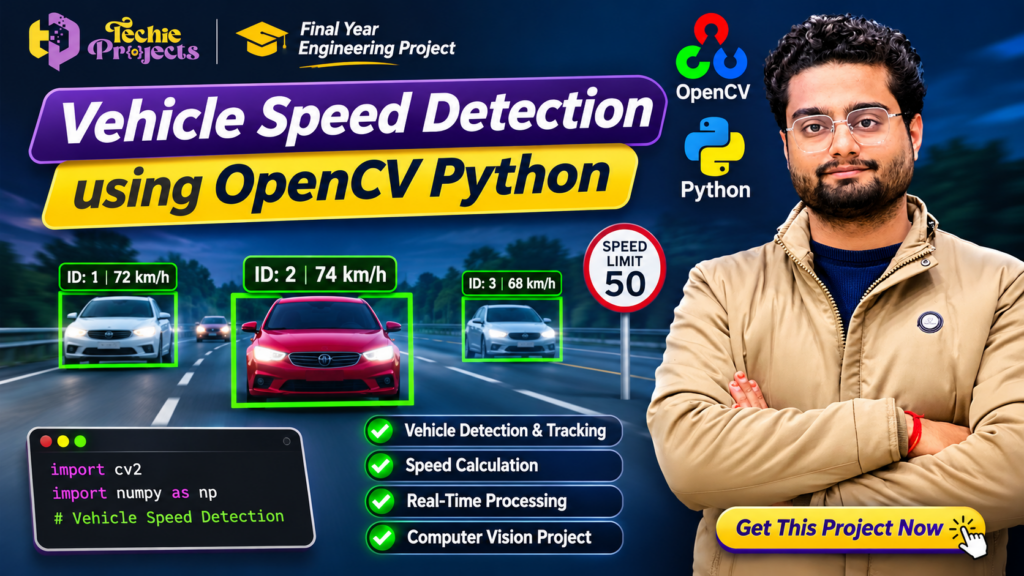
🚀 Want to purchase an AI-based Vehicle Speed Detection project for your final-year engineering submission? Get the Vehicle Speed Detection using OpenCV project from Techie Projects and explore how computer vision and Python can automatically detect vehicles, track their movement, and estimate their speed from video footage.
The Vehicle Speed Detection using OpenCV project is designed for students who want to explore practical applications of Python, image processing, and artificial intelligence. It demonstrates how computer vision can detect moving vehicles and estimate their speed from video footage.
Looking for an interesting final-year project in Artificial Intelligence, Machine Learning, Python, or Computer Vision? This project is an excellent opportunity to explore real-world applications of image processing and intelligent transportation systems.
🎓 Instead of spending weeks searching for project ideas and struggling with implementation, connect with Techie Projects to enquire about the project source code, demonstration, implementation details, and available technical support.
Whether you are a B.Tech, M.Tech, BCA, MCA, or Computer Science Engineering student, this project can help you understand practical computer vision concepts while developing an application related to road safety and traffic monitoring.
🛒 Interested in purchasing this project? Contact our team today and get started with your next engineering project!
📞 Contact Techie Projects for Project Enquiries
Want to purchase the Vehicle Speed Detection project? Contact us for pricing, source code availability, project demonstrations, and implementation details.
- 📞 Contact / WhatsApp: +91 94600 60699
- 🌐 Website: www.techieprojects.com
- 📸 Instagram: @pythonprojects_
Techie Projects provides engineering project solutions across Python, Artificial Intelligence, Machine Learning, Deep Learning, IoT, Data Science, and other technical domains.
🎬 Watch the Vehicle Speed Detection Project Demo
Explore the Vehicle Speed Detection using OpenCV Python project demonstration to understand how vehicles are detected and tracked in video footage.
The demonstration helps you understand the project’s working process, including vehicle detection, tracking, speed estimation, and displaying the calculated speed.
🎯 Want to implement this project for your final year? Contact Techie Projects to enquire about purchasing the project and available implementation resources.
📌 What Is Vehicle Speed Detection Using OpenCV?
Vehicle Speed Detection using OpenCV is a computer vision application designed to identify vehicles in video footage, track their movement, and estimate their speed using image-processing techniques.
The main purpose of Vehicle Speed Detection using OpenCV is to automate vehicle movement analysis through video processing. The system identifies vehicles, tracks their positions, and estimates their speed using distance and time information.
OpenCV (Open Source Computer Vision Library) is widely used for image processing, video analysis, object tracking, and computer vision applications.
In this project, Python and OpenCV are used to process video frames and analyze vehicle movement. By tracking a vehicle across consecutive frames and applying suitable calibration and timing information, the system can estimate its speed.
For example, when a car moves along a road, the system can detect its position in different video frames, track its movement, and calculate an estimated speed based on the configured measurement parameters.
The main purpose of this application is to demonstrate how computer vision can support automated vehicle monitoring and traffic analysis.
🎯 Objectives of the Vehicle Speed Detection Project0
Developing a Vehicle Speed Detection using OpenCV application helps students understand how automated traffic monitoring systems work. It combines vehicle identification, object tracking, and mathematical calculations to estimate vehicle speed.
The primary objective is to develop an automated system that detects vehicles and estimates their speed using Python and computer vision.
The main objectives include:
- 🚗 Detect vehicles from road traffic videos.
- 🎥 Process video frames using OpenCV.
- 🎯 Track vehicle movement across consecutive frames.
- 📏 Estimate vehicle speed using position and time information.
- 📊 Display vehicle tracking and speed information.
- 🤖 Explore computer vision techniques for intelligent traffic monitoring.
- ⚡ Reduce the need for manual vehicle speed observation.
- 🛣️ Understand the application of AI and image processing in transportation systems.
⚙️ Technologies Used in Vehicle Speed Detection Using Python
Python and OpenCV play an important role in Vehicle Speed Detection using OpenCV. These technologies help process video frames, identify vehicle movements, and display speed estimation results. The project combines multiple Python technologies and computer vision concepts to develop an automated vehicle speed monitoring application.
1. 🐍 Python Programming
Python is the primary programming language used to implement the project. It provides a flexible environment for video processing, image analysis, object tracking, and mathematical calculations.
2. 👁️ OpenCV
OpenCV is the main computer vision library used for processing video frames, reading video files, resizing images, drawing bounding boxes, and displaying detection results.
3. 🔢 NumPy
NumPy supports numerical calculations and array operations. It is useful for processing image data and performing mathematical operations related to vehicle movement.
4. 🚘 Vehicle Detection
Vehicle detection identifies vehicles within video frames. Depending on the implementation, this can be performed using a trained object detection model or another suitable computer vision method.
5. 🎯 Object Tracking
Object tracking helps maintain the identity of detected vehicles across consecutive video frames.
This allows the system to analyze the movement of individual vehicles rather than treating every frame as a separate image.
6. 📐 Speed Calculation Algorithm
The speed estimation component calculates the movement of a vehicle over a specified time interval.
The calculation requires suitable distance calibration, frame timing, and camera configuration to produce meaningful speed estimates.
🔄 How Does the Vehicle Speed Detection System Work?
During Vehicle Speed Detection using OpenCV, the application processes consecutive video frames to identify vehicle positions. By tracking movement over a known time interval and applying suitable distance calibration, the system estimates vehicle speed. The Vehicle Speed Detection using OpenCV project follows a series of steps to detect vehicles, track their movement, and estimate their speed.
Step 1: Video Input
The system receives a video containing vehicles moving along a road.
The input can be a recorded traffic video or a suitable camera stream, depending on the implementation.
Step 2: Video Frame Processing
OpenCV reads the video and extracts individual frames for processing.
Each frame is analyzed to identify vehicles and determine their positions.
Step 3: Vehicle Detection
The detection component identifies vehicles in the video frames.
Detected vehicles can be highlighted using rectangular bounding boxes to make their positions visible.
Step 4: Vehicle Tracking
After detection, the system tracks vehicle movement across consecutive frames.
Tracking helps identify whether a vehicle has moved from one position to another and maintains its identity during the observation period.
Step 5: Distance Calculation
The system estimates the distance travelled by a vehicle using its movement between frames.
For meaningful speed estimation, the image coordinates must be calibrated against real-world distances.
Step 6: Speed Calculation
Vehicle speed is estimated using the distance travelled and the elapsed time.
The commonly used relationship is:
Speed = Distance / Time
The result can be converted into kilometres per hour (km/h).
Step 7: Display Results
Finally, the system displays the processed video with vehicle detection boxes, tracking information, and estimated speed values.
This makes the output easier to understand and demonstrates how automated vehicle monitoring works.
⭐ Key Features of the Vehicle Speed Detection Project
One of the major advantages of Vehicle Speed Detection using OpenCV is its ability to analyze vehicle movement automatically. The application can display detected vehicles, tracking information, and estimated speed values on processed video frames. The project demonstrates important capabilities of computer vision and automated traffic analysis.
🚗 1. Automatic Vehicle Detection
The system identifies vehicles from input video footage using its configured detection method.
🎯 2. Vehicle Tracking
Detected vehicles can be tracked across consecutive frames to analyze their movement.
📊 3. Speed Estimation
The application estimates vehicle speed using movement and time information, subject to appropriate calibration.
🎥 4. Video Processing
OpenCV enables the processing of recorded traffic videos and supported camera streams.
🖥️ 5. Visual Detection Output
Bounding boxes and speed labels can be displayed on the video to show the detection and tracking results.
⚡ 6. Automated Monitoring
The project demonstrates how computer vision can reduce dependence on manual observation for basic vehicle monitoring tasks.
🐍 7. Python-Based Development
Students can explore Python programming, image processing, tracking algorithms, and mathematical calculations in one practical application.
🛣️ Applications of Vehicle Speed Detection System
The Vehicle Speed Detection using OpenCV technology can be explored in highway monitoring, traffic analysis, smart city applications, and intelligent transportation systems. Vehicle speed detection technology has several potential applications in traffic management, transportation analysis, and road safety.
1. 🚦 Traffic Monitoring
Traffic authorities can explore computer vision-based systems to analyze vehicle movement and monitor traffic conditions.
2. 🛣️ Highway Speed Monitoring
Speed estimation technology can be used as part of larger highway monitoring solutions to analyze vehicle movement.
3. 🏙️ Smart City Projects
Intelligent transportation systems can use computer vision to collect traffic information and support urban traffic management.
4. 🚔 Road Safety Applications
Automated vehicle monitoring can support road safety research and help identify traffic patterns that require attention.
5. 🅿️ Parking and Campus Monitoring
Vehicle tracking can be explored in campus areas, parking facilities, and controlled vehicle movement zones.
6. 📹 CCTV-Based Traffic Analysis
Video surveillance systems can be extended with computer vision applications to analyze vehicles and traffic movement.
7. 🤖 Intelligent Transportation Systems
Vehicle speed estimation can be integrated into broader intelligent transportation applications that combine video analytics, traffic data, and monitoring systems.
Note: Academic speed estimates should not be treated as certified enforcement measurements without validated calibration, accuracy testing, and compliance with applicable regulations.
💻 Software Requirements
The following software components are commonly associated with this project.
| Component | Technology |
|---|---|
| Programming Language | Python |
| Computer Vision | OpenCV |
| Numerical Processing | NumPy |
| Vehicle Detection | Compatible detection method |
| Vehicle Tracking | Object Tracking Algorithm |
| Operating System | Windows / Linux |
| Development Environment | Python IDE |
| Input | Video File / Camera |
The exact software versions and dependencies depend on the supplied implementation.
🖥️ Hardware Requirements
A standard computer can be used to develop and test the project, depending on the complexity of the vehicle detection and tracking implementation.
Recommended configuration:
- Processor: Intel Core i5 or equivalent.
- RAM: 8 GB or higher.
- Storage: 256 GB or higher.
- Graphics: Dedicated GPU recommended for computationally intensive detection models.
- Camera: Optional, for live video input.
📈 Advantages of Vehicle Speed Detection Using OpenCV
Implementing Vehicle Speed Detection using OpenCV provides practical experience with computer vision, Python programming, video processing, and object tracking. It also helps students understand the technical foundations of automated traffic monitoring. There are several advantages to developing a computer vision-based vehicle speed estimation application.
- Automation: Demonstrates automated vehicle detection and speed estimation.
- Cost-effective experimentation: Allows students to explore video-based analysis using accessible software libraries.
- Real-world application: Introduces practical traffic monitoring and transportation use cases.
- Computer Vision Learning: Provides experience with image processing and video analysis.
- Vehicle Tracking: Helps students understand how objects can be tracked across multiple frames.
- Python Integration: Combines multiple Python programming concepts in one application.
- Future Development: Can be extended with advanced object detection, dashboards, and database integration.
🔬 Future Scope of Vehicle Speed Detection Project
Students can extend the project by integrating additional technologies and developing more advanced traffic monitoring features.
1. 🤖 YOLO-Based Vehicle Detection
Integrate a suitable YOLO model to detect multiple vehicle categories, such as cars, buses, motorcycles, and trucks.
2. 📹 Live CCTV Camera Integration
Connect the application to a compatible CCTV camera or webcam to process live video streams.
3. 📊 Traffic Monitoring Dashboard
Develop a dashboard to display vehicle counts, estimated speeds, traffic statistics, and monitoring information.
4. 🗄️ Database Integration
Store vehicle detection records, timestamps, and estimated speed information in a database for further analysis.
5. 🚨 Speed Alert System
Explore a configurable notification system that identifies vehicles exceeding a specified speed threshold in a monitored environment.
6. ☁️ Cloud-Based Monitoring
Integrate cloud infrastructure to store traffic analysis results and access monitoring information remotely.
7. 🧠 Advanced Object Tracking
Experiment with advanced tracking algorithms to improve vehicle identification across consecutive video frames.
These enhancements can turn a basic academic implementation into a more comprehensive intelligent transportation system.
💡 Recommended Projects from Techie Projects
Looking for more exciting Artificial Intelligence, Python, and Computer Vision projects for your final-year engineering submission? Explore these related project ideas.
- 🚗 Vehicle Number Plate Detection Using YOLO – Detect vehicle registration plates using deep learning and OCR.
- 🚦 Vehicle Detection and Counting Using YOLO – Detect, track, and count vehicles from traffic videos.
- 🪖 Helmet Detection Using YOLO – Identify riders wearing or not wearing helmets.
- 🚥 Traffic Signal Violation Detection System – Detect vehicles crossing traffic signals.
- 🛣️ Lane Detection Using OpenCV – Identify road lanes for intelligent driving applications.
- 🚘 Vehicle Tracking System Using DeepSORT – Track multiple vehicles with unique identification IDs.
- 🚨 Overspeeding Vehicle Detection System – Identify vehicles exceeding configured speed limits.
- 🎥 Real-Time Object Detection Using YOLO – Detect multiple objects from live video streams.
- 🚗 AI-Based Traffic Monitoring System – Analyze traffic density, vehicle movement, and congestion.
- 🔍 Automatic Number Plate Recognition System – Extract vehicle registration numbers using OCR.
🎓 Why Choose This Project for Your Final-Year Engineering Submission?
Choosing a final-year engineering project is an important decision for students. The selected project should demonstrate practical technical skills and provide opportunities to understand real-world applications.
Students selecting Vehicle Speed Detection using OpenCV can develop practical skills in image processing and intelligent video analysis. This makes it an interesting project option for Computer Science, Information Technology, and Artificial Intelligence students.
Vehicle Speed Detection using OpenCV is a useful project concept for students interested in:
Computer Science Engineering (CSE): Explore Python programming, computer vision, image processing, and object tracking.
Artificial Intelligence: Understand automated object detection and intelligent video analysis.
Information Technology (IT): Learn how video processing applications can be integrated into software systems.
Machine Learning: Explore detection models, tracking methods, and data analysis.
BCA and MCA: Develop practical knowledge of Python-based computer vision applications.
Students can also use the project as a foundation for learning advanced AI technologies and developing additional features.
🛒 Get This Vehicle Speed Detection Project Now!
🚀 Ready to purchase your final-year engineering project?
Looking for a practical AI and Python project? Vehicle Speed Detection using OpenCV is an excellent option to explore for your final-year engineering submission. Contact Techie Projects to enquire about source code, project demonstrations, implementation guidance, and purchasing options.
Get in touch with Techie Projects and enquire about the Vehicle Speed Detection using OpenCV Python project.
If you are looking for a practical computer vision project that combines vehicle detection, object tracking, and speed estimation, this project is worth exploring.
Our team can help you understand the available project package and purchasing options before you proceed.
🎁 What Can You Enquire About?
Contact our team to confirm the availability of:
- 💻 Python project source code.
- 🎬 Working project demonstration.
- 📚 Project documentation.
- ⚙️ Installation and execution requirements.
- 🧑💻 Implementation guidance.
- 🔧 Customization possibilities.
- 📞 Technical support options.
The exact deliverables, pricing, and support arrangements will be confirmed before purchase.
<mark>🔥 Don’t wait until your final-year submission deadline approaches. Start planning your engineering project today!</mark>
📲 Purchase Enquiry – Techie Projects
Interested in purchasing this project? Send us a WhatsApp message.
📞 Contact / WhatsApp: +91 94600 60699
🌐 Website: www.techieprojects.com
📸 Instagram: @pythonprojects_
Techie Projects – Your Destination for Practical Engineering Projects!
❓ Frequently Asked Questions (FAQs)
1. What is Vehicle Speed Detection using OpenCV?
It is a computer vision application that uses Python and OpenCV to analyze vehicle movement in video footage and estimate vehicle speed.
2. Which programming language is used in this project?
Python is the primary programming language. OpenCV and NumPy are commonly used for video processing and numerical operations.
3. How is vehicle speed calculated?
The system estimates the distance travelled by a vehicle and divides it by the elapsed time. Accurate real-world speed estimation requires proper camera calibration and distance measurement.
4. Is this project suitable for final-year engineering students?
Yes. It is suitable for CSE, IT, AI, Machine Learning, BCA, and MCA students interested in computer vision and Python development.
5. Can the project detect multiple vehicles?
The project can be extended to detect and track multiple vehicles, depending on the selected detection and tracking implementation.
6. Can I use a CCTV camera for vehicle speed detection?
Yes. A compatible CCTV camera or video stream can be integrated into the application if the implementation supports live video input.
7. Can YOLO be integrated into this project?
Yes. A suitable YOLO model can be integrated to improve vehicle detection and identify multiple vehicle categories.
8. Can I purchase this project from Techie Projects?
Yes. Contact Techie Projects through WhatsApp at +91 94600 60699 to enquire about project pricing, source code availability, demonstration, and purchasing options.
9. Can I customize the project?
Customization options can be discussed with our team based on your requirements, project scope, and available implementation.
🏁 Conclusion
Vehicle Speed Detection using OpenCV is an interesting Python-based computer vision project that demonstrates how automated systems can analyze vehicle movement and estimate speed from video footage.
By combining OpenCV, Python, object detection, tracking algorithms, and speed calculation techniques, students can explore practical applications of intelligent transportation and traffic monitoring.
The project provides an opportunity to develop programming skills, understand computer vision concepts, and explore AI-based applications for real-world problems.
🎓 Planning your final-year engineering project?
Get in touch with Techie Projects to enquire about purchasing the Vehicle Speed Detection project and explore our collection of Python, AI, Machine Learning, Deep Learning, and IoT projects.
📞 Contact / WhatsApp: +91 94600 60699
📸 Follow Techie Projects on Instagram
🚀 Techie Projects – Build, Learn, and Innovate!