
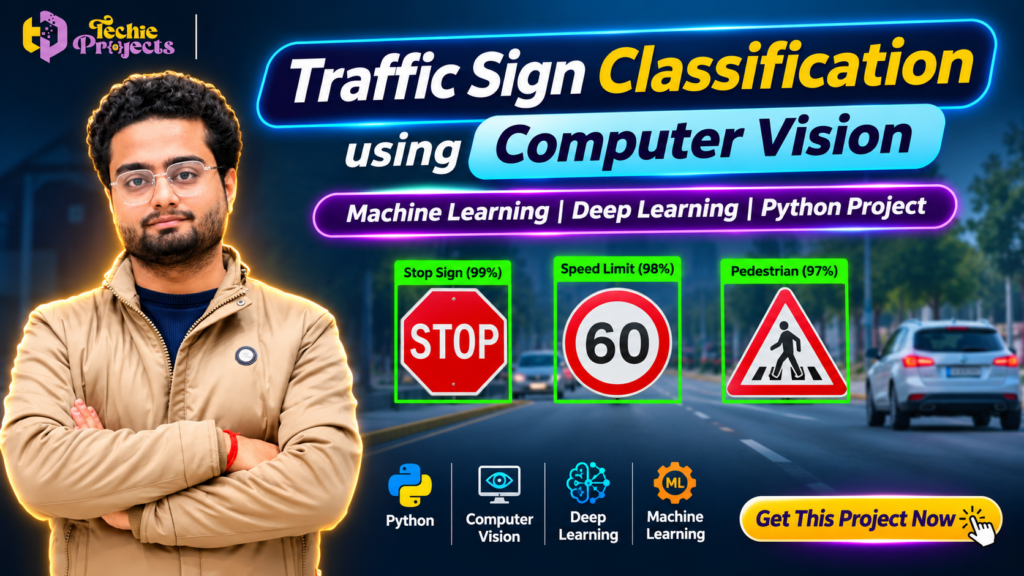
The Traffic Sign Classification using Computer Vision project is designed for students who want to explore practical applications of artificial intelligence. It demonstrates how computer vision techniques can analyze road sign images and identify different traffic sign categories through automated image classification.
🚀 Looking to purchase a ready-to-demonstrate Traffic Sign Classification project for your final-year engineering submission? Techie Projects offers a practical computer vision project designed to help students explore intelligent traffic sign recognition using Python, machine learning, deep learning, and image processing.
The Traffic Sign Classification using Computer Vision project demonstrates how an intelligent system can identify and classify different road signs from images. It is an excellent project idea for Computer Science Engineering (CSE), Artificial Intelligence, Data Science, and Information Technology students who want to understand real-world applications of computer vision.
Instead of spending weeks developing an entire project from scratch, students can enquire about our project package, explore the demonstration, and get assistance with the implementation and customization requirements.
🎓 Whether you are preparing a final-year project, academic demonstration, mini-project, or major project, Techie Projects can help you explore this AI-based solution.
📞 Contact / WhatsApp: +91 94600 60699
🌐 Website: www.techieprojects.com
🎬 Watch the Traffic Sign Classification Project Demo
Watch the project demonstration to understand how traffic signs can be identified and classified using computer vision techniques.
Project Demo: Traffic Sign Classification using Computer Vision
The demonstration can help students understand the project workflow, user interface, input images, recognition process, and classification output.
If you want the complete project, contact Techie Projects to enquire about availability, source code, documentation, and customization.
🚦 What Is Traffic Sign Classification Using Computer Vision?
Traffic sign recognition is an important application of artificial intelligence and computer vision. It involves identifying different traffic signs from images and assigning them to their corresponding categories.
The Traffic Sign Classification using Computer Vision system processes input images and analyzes their visual characteristics to recognize road signs.
Traffic signs communicate important road information, including:
- Stop signs.
- Speed limit signs.
- No-entry signs.
- Pedestrian crossing signs.
- Warning signs.
- Direction indicators.
- Mandatory instruction signs.
Traditionally, drivers identify these signs visually. However, computer vision systems can automate the recognition process and provide useful information for intelligent transportation research.
This project demonstrates how Python-based image processing and machine learning techniques can be applied to traffic sign classification.
🎯 Objectives of the Project
An important advantage of Traffic Sign Classification using Computer Vision is that students can understand the complete workflow of an AI-based image recognition system, from collecting image datasets to processing images and generating classification predictions.
The main objective is to develop an intelligent system that can recognize different traffic signs from image inputs.
The major objectives include:
- To understand the fundamentals of computer vision.
- To process traffic sign images using Python.
- To identify important visual characteristics of traffic signs.
- To classify traffic signs into predefined categories.
- To explore machine learning and deep learning techniques.
- To develop an interactive project demonstration.
- To understand practical applications of AI in transportation.
The project provides an opportunity to explore how artificial intelligence can support automated road sign recognition.
⚙️ How Does the Project Work?
The Traffic Sign Classification using Computer Vision project follows a structured image-processing and classification workflow.
1. Input Image Collection
The first step involves collecting traffic sign images. These images can be obtained from an appropriate dataset or supplied directly by the user.
Different categories of road signs are required to train and evaluate a classification model.
2. Image Preprocessing
Images may have different sizes, lighting conditions, and visual characteristics.
Preprocessing helps prepare images for the classification process.
Common operations include:
- Image resizing.
- Image normalization.
- Noise reduction.
- Color processing.
- Dataset organization.
These operations help create consistent input data for the model.
3. Feature Extraction
The system analyzes important characteristics of traffic sign images.
These characteristics may include:
- Shape.
- Color.
- Edges.
- Patterns.
- Visual structures.
Feature extraction helps the classification model distinguish between different traffic sign categories.
4. Model Training
Machine learning or deep learning techniques can be used to develop the recognition model.
Depending on the implementation, convolutional neural networks (CNNs) can learn visual patterns directly from training images.
The model learns relationships between input images and their corresponding traffic sign labels.
5. Traffic Sign Classification
After training, the model can process an input image and predict its corresponding traffic sign category.
For example, when a stop sign image is supplied, the system attempts to identify it as a stop sign.
6. Display Classification Results
Finally, the predicted category is displayed through the project interface or output screen.
This allows students to understand the complete image classification workflow.
⭐ Key Features of the Project
The Traffic Sign Classification using Computer Vision implementation also provides an opportunity to experiment with different image preprocessing techniques and classification models. Students can explore how changes in training data and model architecture influence recognition performance.
The Traffic Sign Classification project offers several useful features for academic learning and demonstration.
🚘 Traffic Sign Recognition
The system demonstrates automated identification of road sign images using computer vision techniques.
🧠 AI-Based Classification
Machine learning and deep learning concepts can be explored to understand how visual information is converted into classification results.
🖼️ Image Processing
Students can understand how image preprocessing helps prepare input images for model prediction.
🐍 Python Implementation
Python provides a flexible environment for developing computer vision and machine learning applications.
📊 Classification Output
The system presents the predicted traffic sign category, helping users understand the recognition process.
🎓 Academic Demonstration
The project can be used as a learning and demonstration resource for engineering students studying artificial intelligence and computer vision.
🛠️ Technologies Used
Python makes Traffic Sign Classification using Computer Vision easier to develop because it provides access to powerful libraries for image processing, machine learning, and deep learning. These technologies help students build an understanding of modern computer vision applications.
The following technologies are relevant to developing and understanding this project.
Programming Language
Python: Python is widely used in artificial intelligence, image processing, machine learning, and computer vision applications.
Computer Vision
Computer vision techniques help analyze and interpret traffic sign images.
Machine Learning
Machine learning algorithms can identify patterns from training data and support automated classification.
Deep Learning
Deep learning models, including CNN architectures where implemented, can learn visual features from image datasets.
Image Processing
Image preprocessing techniques help prepare input images for classification.
Development Environment
The project can be developed using suitable Python environments and supporting libraries according to the implementation.
💻 Software and Hardware Requirements
The following is a general development setup. Exact requirements may vary depending on the supplied implementation.
Software Requirements
- Programming Language: Python.
- Operating System: Windows 10 / Windows 11.
- Development Environment: Visual Studio Code, PyCharm, or Jupyter Notebook.
- Image Processing: OpenCV.
- Machine Learning: Scikit-learn.
- Deep Learning: TensorFlow or another supported framework, depending on implementation.
Hardware Requirements
- Processor: Intel Core i3 or higher recommended.
- RAM: 4 GB minimum; 8 GB recommended.
- Storage: Sufficient space for datasets and project files.
- Display: Standard computer monitor.
- Input Devices: Keyboard and mouse.
A GPU may be useful for larger deep learning experiments but is not necessarily required for every implementation.
📌 Applications of Traffic Sign Classification
Traffic Sign Classification using Computer Vision can be explored in intelligent transportation research, autonomous vehicle development, road safety applications, and advanced driver assistance systems. It provides a practical introduction to AI-powered transportation solutions.
Traffic sign recognition has several applications in intelligent transportation and automotive research.
1. Advanced Driver Assistance Systems
Traffic sign classification can support research into driver assistance technologies by identifying road signs and communicating relevant information.
2. Autonomous Vehicle Research
Self-driving vehicle research requires systems that can understand their surrounding environment.
Traffic sign recognition is one component of this broader perception process.
3. Intelligent Transportation Systems
Traffic sign recognition can be integrated into research involving intelligent transportation and automated road monitoring.
4. Road Safety Research
Researchers can explore how automated road sign recognition may support awareness of road instructions and restrictions.
5. Smart City Projects
Computer vision can be investigated as part of smart city transportation and infrastructure monitoring solutions.
6. Academic Research
Students can use this project as a starting point for studying artificial intelligence, image classification, and deep learning.
🎓 Why Choose This Project for Your Final Year?
Choosing the right engineering project is important because it provides an opportunity to demonstrate practical technical knowledge.
The Traffic Sign Classification using Computer Vision project combines several important areas of computer science.
Practical AI Learning: Understand how computer vision models analyze real-world images.
Python Programming: Explore Python libraries and their applications in image processing.
Deep Learning Concepts: Learn how neural networks can identify patterns in image datasets.
Project Demonstration: Present an interactive example of an AI-based classification system.
Research Opportunities: Explore possible improvements involving larger datasets, different model architectures, and image augmentation.
This project is suitable for students interested in AI, machine learning, computer vision, and intelligent transportation systems.
🏆 Benefits of Purchasing the Project from Techie Projects
Developing a complete academic project can involve several stages, including programming, debugging, testing, documentation, and demonstration preparation.
Techie Projects helps students explore project solutions across multiple technical domains.
When enquiring about the Traffic Sign Classification project, you can discuss the following requirements:
- Complete Python project source code.
- Project execution and setup assistance.
- Project demonstration.
- Technical explanation.
- Documentation availability.
- Installation guidance.
- Customization requirements.
- Support for understanding the implementation.
The exact deliverables and support included should be confirmed before placing your order.
Our objective is to help students understand project implementation and prepare for their academic demonstrations.
💡 Recommended Computer Vision and AI Projects
If you are interested in the Traffic Sign Classification project, explore these related project ideas from Techie Projects:
- Vehicle Detection and Counting System – Detect and count vehicles using computer vision.
- Automatic Number Plate Recognition – Identify vehicle registration numbers from images.
- Helmet Detection System – Explore helmet detection using deep learning.
- Pothole Detection System – Identify road potholes using image processing.
- Face Recognition Attendance System – Automate attendance using facial recognition.
- Object Detection Using YOLO – Detect multiple objects in images and videos.
- Pedestrian Detection System – Identify pedestrians using computer vision.
- Lane Detection System – Detect road lanes for intelligent transportation applications.
- Vehicle Classification System – Classify different vehicle categories.
- Road Damage Detection – Analyze road images to identify damaged surfaces.
Visit Techie Projects to explore more final-year engineering projects.
📈 Future Scope of Traffic Sign Classification
Students interested in advanced artificial intelligence can extend Traffic Sign Classification using Computer Vision by experimenting with real-time camera input, video processing, object detection, and improved deep learning architectures.
The project can be extended in several directions to explore more advanced computer vision applications.
Real-Time Traffic Sign Detection
The classification model can be extended to process live camera input instead of individual images.
Video-Based Recognition
Video processing can help analyze traffic signs across consecutive frames.
Object Detection Integration
Object detection algorithms can be explored to locate traffic signs within larger road images before classification.
Improved Model Performance
Students can experiment with different architectures, training configurations, and image augmentation techniques.
Mobile Application Integration
A mobile application could be developed to provide a user-friendly interface for image-based traffic sign recognition.
Intelligent Transportation Integration
The system can be explored as one component of a larger intelligent transportation research solution.
These extensions provide opportunities for students to improve their understanding of artificial intelligence and computer vision.
🛒 Purchase Traffic Sign Classification Project from Techie Projects
If you want to purchase Traffic Sign Classification using Computer Vision for your final-year engineering project, contact Techie Projects. Enquire about Python source code, project demonstrations, documentation, installation assistance, and customization options.
Are you ready to work on your final-year computer vision project?
Get in touch with Techie Projects to enquire about purchasing the Traffic Sign Classification using Computer Vision project.
We can discuss the project package, source code availability, demonstration, documentation, installation requirements, and customization options.
Whether you are a B.Tech CSE student, IT student, AI and ML student, or engineering researcher, our team can help you understand the available project solution.
🎯 Get This Project Now!
Techie Projects – Your Project Development Partner
📞 Contact / WhatsApp: +91 94600 60699
🌐 Website: www.techieprojects.com
📸 Instagram: @pythonprojects_
Send us a WhatsApp enquiry with the message:
“I am interested in purchasing the Traffic Sign Classification using Computer Vision project. Please share the project details, demonstration, price, and available deliverables.”
❓ Frequently Asked Questions (FAQs)
1. What is Traffic Sign Classification using Computer Vision?
It is an artificial intelligence application that analyzes traffic sign images and classifies them into predefined categories using image processing and machine learning techniques.
2. Which programming language is used?
Python is a suitable programming language for implementing this project because of its extensive computer vision and machine learning ecosystem.
3. Is this project suitable for final-year engineering students?
Yes. It is a relevant project topic for Computer Science, Information Technology, Artificial Intelligence, and Data Science students.
4. Does this project use deep learning?
Deep learning techniques such as CNNs can be used for traffic sign image classification, depending on the selected implementation.
5. Can the project recognize different traffic signs?
The system can classify the traffic sign categories represented in its training dataset and supported by its trained model.
6. Can I customize the project?
Customization options can be discussed with Techie Projects based on your academic requirements and the available implementation.
7. How can I purchase this project?
You can contact Techie Projects through WhatsApp at +91 94600 60699 or visit www.techieprojects.com to enquire about availability, pricing, and deliverables.
8. Is a GPU required?
A GPU can help accelerate deep learning training, but many image classification demonstrations can run on a compatible CPU.
🎓 Conclusion
The Traffic Sign Classification using Computer Vision project demonstrates how artificial intelligence, Python programming, image processing, and machine learning can be combined to solve a practical image classification problem.
It provides an interesting learning opportunity for engineering students who want to explore computer vision and its applications in intelligent transportation systems.
From image preprocessing and model training to traffic sign classification and result visualization, the project introduces several important concepts used in modern AI applications.
If you are planning your final-year engineering project and want to explore this solution, contact Techie Projects today.
🚀 Don’t just choose a project idea – explore a practical implementation and understand how it works!
📞 Contact / WhatsApp: +91 94600 60699
Techie Projects – AI, Machine Learning, Python, Computer Vision and Final Year Engineering Projects.