
Introduction
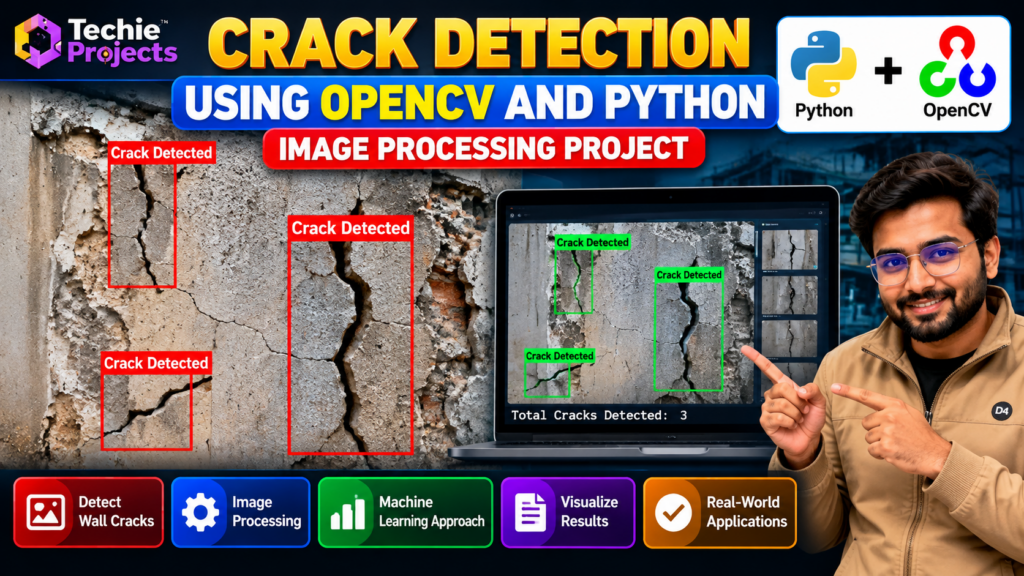
Crack detection using OpenCV and Python is a computer vision project that helps identify visible cracks in walls, concrete surfaces, and other structural materials using image processing techniques. This project demonstrates how Python can be used to analyze images, highlight potential cracks, and display detection results.
For B.Tech, B.E., BCA, MCA, and computer science students, this project offers a practical way to explore image processing, computer vision, and automated defect detection. It can also serve as a foundation for more advanced infrastructure inspection systems.
If you are looking for a practical final-year project with implementation support, Techie Projects can help you explore a suitable project package for your academic requirements.
The crack detection using OpenCV and Python project demonstrates how computer vision techniques can help identify visible cracks in concrete and wall images. It provides students with practical experience in image preprocessing, crack visualization, and automated defect identification.
🎬 Project Demo
Watch the project demonstration to understand how crack detection works, how images are processed, and how detection results can be visualized.
🎯 Project Objectives
The main objectives of this project are:
- Detect visible cracks in wall and concrete images.
- Explore image preprocessing and image enhancement techniques.
- Apply OpenCV functions to analyze image features.
- Highlight potential crack regions for easier inspection.
- Display detection results through a visual interface or processed output.
- Understand how computer vision can support infrastructure inspection.
The exact detection performance depends on the implementation, image quality, lighting conditions, and the techniques used.
🚀 Key Features
1. Image-Based Crack Detection
Analyze images of walls, concrete surfaces, or similar materials to identify visible crack patterns.
2. Image Preprocessing
Apply suitable image processing techniques, such as grayscale conversion, noise reduction, thresholding, or edge detection, depending on the implementation.
3. Crack Visualization
Highlight detected regions so users can inspect the output more easily.
4. Python and OpenCV Integration
Use Python and OpenCV to develop the image analysis workflow.
5. Detection Result Display
Display processed images and detection results for demonstration and evaluation.
6. Scope for Further Development
Extend the project with a graphical interface, image upload functionality, batch processing, or a trained machine learning model.
Note: Features such as trained-model detection, live camera processing, and automatic crack measurement should be included only if they are supported by your actual implementation.
⚙️ How the Crack Detection Project Works
The general workflow for crack detection using OpenCV and Python involves the following stages:
Step 1: Input Image
Provide an image containing a wall, concrete surface, or other material that may contain visible cracks.
Step 2: Image Preprocessing
Prepare the image for analysis. Depending on the method, preprocessing may include resizing, grayscale conversion, noise reduction, or contrast enhancement.
Step 3: Crack Feature Analysis
Apply the selected image processing or machine learning method to identify patterns that may indicate cracks.
Step 4: Crack Region Identification
Mark or extract the regions classified as potential cracks by the chosen detection method.
Step 5: Output Visualization
Display the processed image and detection results for review.
🛠️ Technologies Used
The project may use the following technologies, depending on its implementation:
- Programming Language: Python
- Computer Vision Library: OpenCV
- Image Processing: NumPy and related image processing techniques
- Optional Machine Learning: A trained model or classification algorithm, if implemented
- Optional Interface: Tkinter or another supported user interface framework
💻 Software Requirements
- Python 3.x, compatible with the selected libraries
- OpenCV
- NumPy
- A code editor such as VS Code or PyCharm
- Windows, Linux, or another compatible operating system
🖥️ Hardware Requirements
- Computer or laptop
- Minimum 4 GB RAM recommended for a basic demonstration
- Adequate storage for source code, libraries, and image datasets
- A webcam only if the project includes live image capture
Actual requirements depend on the selected algorithm and whether model training is included.
📚 Applications of Crack Detection
Crack detection using OpenCV and Python can be explored in several areas:
- Building and concrete surface inspection
- Infrastructure maintenance research
- Image processing and computer vision education
- Preliminary defect identification
- Civil engineering inspection prototypes
- Automated visual inspection research
This project is an educational prototype. Its output should not replace professional structural inspections or engineering safety assessments.
🎓 Advantages of This Project
- Provides practical experience with Python and OpenCV.
- Demonstrates a real-world computer vision application.
- Helps students understand image preprocessing and feature analysis.
- Offers opportunities for further development using machine learning.
- Can be adapted into a final-year engineering demonstration.
🔮 Future Scope
Further development of crack detection using OpenCV and Python could include deep learning integration, crack measurement, real-time camera processing, and automated inspection reports, depending on the selected implementation.
The project can be extended in several ways:
- Deep Learning Integration: Train and evaluate a suitable model on a labeled crack dataset.
- Real-Time Detection: Add camera-based processing if the hardware and algorithm support it.
- Crack Measurement: Estimate crack length or width using appropriate calibration and validation.
- Web-Based Interface: Allow users to upload images and view results through a web application.
- Report Generation: Export detection results and analyzed images into a report.
- Dataset Evaluation: Measure precision, recall, and other suitable metrics against labeled test images.
🎓 Who Can Choose This Project?
This project may be suitable for students pursuing:
- B.Tech and B.E. in Computer Science Engineering
- B.Tech in Artificial Intelligence and Data Science
- MCA and M.Sc. Computer Science
- Computer vision and image processing coursework
- Final-year engineering and mini-project assignments
Students should select a version that matches their syllabus, available time, and implementation requirements.
🛒 Get the Crack Detection Project from Techie Projects
Looking for a crack detection project in Python for your mini project or final-year submission?
Techie Projects provides project-related assistance for students exploring Python, OpenCV, image processing, and machine learning applications.
Before choosing a package, enquire about the exact implementation and available deliverables.
Depending on the selected package, you can ask about:
- Python source code availability
- Project setup and execution instructions
- Software and library requirements
- Project documentation and report availability
- Demonstration and implementation guidance
- Customization options for your academic requirements
📲 Interested in this project?
Tell us your course, project requirements, and preferred features so we can help you identify a suitable option.
🎓 Recommended Projects
Explore these related project topics on Techie Projects. Link each title to its corresponding published page on your website.
- Real-Time Object Measurement Using Python OpenCV
- Garbage Detection Using Python
- Object Detection Using OpenCV and Python
- Sign Language Recognition Using Machine Learning
- Dental Caries Detection Using Deep Learning
- Intrusion Detection System Using Machine Learning
These related topics can help you explore other computer vision, image processing, and machine learning applications.
Frequently Asked Questions
1. What is crack detection using OpenCV and Python?
It is a computer vision project that analyzes images to identify visible crack patterns using OpenCV and Python-based image processing or machine learning methods.
2. Is this project suitable for final-year students?
Yes. It can be suitable for computer science and related engineering students when the implementation, documentation, and evaluation match their academic requirements.
3. Does crack detection require machine learning?
Not always. Basic crack identification can use traditional image processing. A machine learning or deep learning approach requires a suitable model and, typically, labeled training data.
4. Can this project detect cracks in real time?
Real-time detection is possible with an appropriate camera input and implementation, but it should not be claimed unless that functionality is actually included and tested.
5. How can I get the project source code?
Contact Techie Projects through WhatsApp to enquire about source code availability, documentation, setup instructions, and support.
Conclusion
Crack detection using OpenCV and Python is a useful educational project for understanding computer vision, image processing, and automated visual inspection. It gives students a foundation for exploring how image analysis techniques can identify potential defects in concrete and other surfaces.
If you want to develop this project for your academic work, contact Techie Projects to discuss the available implementation, deliverables, and support options.
Ready to explore this project?
📲 Call/WhatsApp: +91-9460060699
🌎 Website: www.techieprojects.com
📺 Instagram: @pythonprojects_