
Introduction
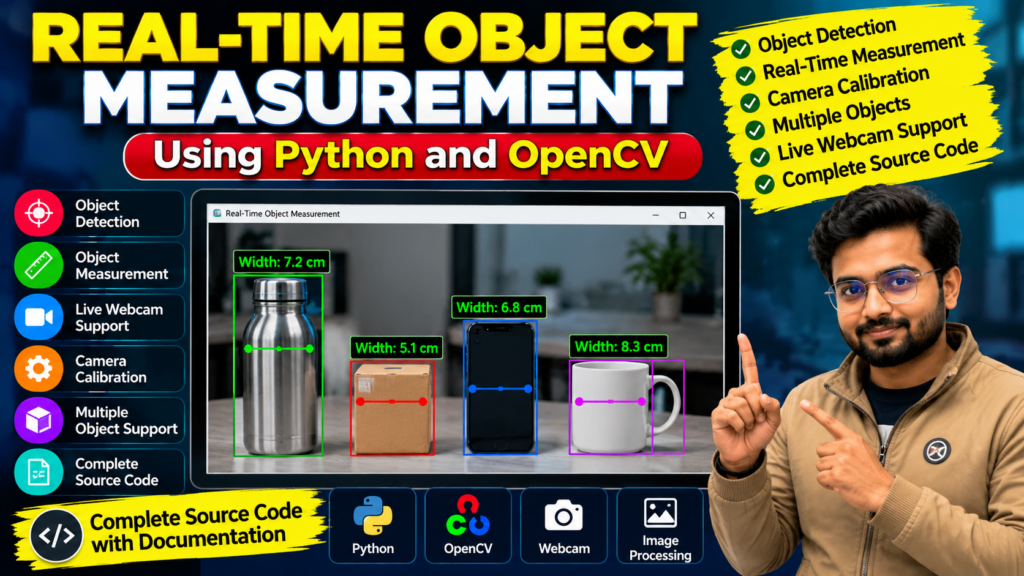
The Real-Time Object Measurement Using Python OpenCV project demonstrates how computer vision and image processing can be used to detect objects and estimate their dimensions through a camera. This project is useful for students who want to explore practical applications of Python, OpenCV, object detection, and real-time image analysis.
By processing camera frames and identifying object boundaries, the system can display estimated measurements on the screen. With suitable camera calibration and a known reference object, the project can demonstrate how object dimensions may be calculated in real-world units.
This project is suitable for B.Tech, BCA, MCA, and computer science students looking for a practical computer vision or image processing project.
🎬 Project Working Demo
Watch the project demonstration to explore real-time object detection, measurement overlays, and the working interface.
What Is Real-Time Object Measurement Using Python OpenCV?
Real-time object measurement is a computer vision technique that analyzes images or video frames to estimate the dimensions of objects. OpenCV provides image processing tools that help identify object contours, edges, boundaries, and reference points.
In this project, a camera captures the scene, Python processes the incoming frames, and the application displays estimated object measurements. The accuracy depends on camera positioning, calibration, object visibility, and the measurement algorithm used.
🎯 Objectives of the Project
The main objectives of this project are to:
- Detect objects from a live camera feed.
- Identify object boundaries using image processing.
- Estimate object dimensions using a reference measurement.
- Display measurement values on video frames.
- Understand camera calibration and pixel-to-unit conversion.
- Explore real-time computer vision using Python and OpenCV.
⭐ Key Features
1. Real-Time Object Detection
Capture live video frames and process them to identify objects suitable for measurement.
2. Object Dimension Estimation
Estimate object width and height using detected boundaries and a suitable reference scale.
3. Live Webcam Support
Use a compatible webcam to capture objects and display processed video frames.
4. Measurement Visualization
Draw bounding boxes, measurement lines, and dimension labels over detected objects.
5. Multiple Object Support
Depending on the implementation, the system can process multiple visible objects in the same frame.
6. Image Processing
Apply techniques such as thresholding, contour detection, edge detection, and image filtering where appropriate.
7. Camera Calibration
Use a known reference object or calibration method to estimate the relationship between image pixels and real-world measurements.
🛠️ Technologies Used
- Python: Main programming language.
- OpenCV: Image processing and computer vision.
- NumPy: Numerical operations and array processing.
- Webcam: Live image acquisition.
- Python IDE: Visual Studio Code, PyCharm, or another compatible editor.
Additional libraries may be required depending on the supplied implementation.
⚙️ How Does the Project Work?
The general workflow of a real-time object measurement system involves these steps:
- Capture the image: Obtain a frame from a webcam or camera.
- Preprocess the frame: Apply suitable image processing to improve object detection.
- Detect object boundaries: Identify contours, edges, or other features that represent the object.
- Calculate dimensions: Estimate the object’s width and height in pixels.
- Apply calibration: Convert pixel measurements into real-world units using a known reference.
- Display results: Show bounding boxes and estimated dimensions on the video frame.
The exact workflow depends on the algorithm and features included in the project version.
📐 How Is Object Measurement Calculated?
A basic measurement system can estimate an object’s dimensions using a known reference object.
For example, if a reference object has a known width, its width in pixels can help establish a pixel-to-unit ratio. The same ratio may then be used to estimate the dimensions of other objects at a similar distance from the camera.
However, accurate measurement requires appropriate calibration. Perspective distortion, camera angle, object depth, lighting, and incorrect reference measurements can affect the results. A simple webcam-based system should therefore be treated as an educational measurement demonstration rather than a precision measuring instrument.
💻 Software Requirements
Typical software requirements include:
- Python 3
- OpenCV
- NumPy
- A compatible operating system
- A Python IDE or code editor
- A working webcam, if using live video
Install only the libraries required by the supplied project code.
🖥️ Hardware Requirements
The project can generally run on a standard laptop or desktop computer with:
- A dual-core processor or better
- At least 4 GB RAM
- Sufficient free storage
- A webcam or compatible camera
- Keyboard and mouse
Actual requirements may vary depending on the camera resolution and processing method.
🎓 Applications of Object Measurement Using OpenCV
Computer vision-based measurement can be explored in several areas:
- Educational computer vision demonstrations
- Basic industrial inspection prototypes
- Object dimension estimation
- Packaging and sorting demonstrations
- Image processing research
- Automated visual inspection experiments
Real-world industrial applications require suitable calibration, testing, and accuracy validation.
✅ Advantages of the Project
- Demonstrates practical Python programming.
- Introduces real-time image processing.
- Helps students understand contours and object boundaries.
- Shows how camera calibration affects measurement.
- Can be extended with additional computer vision features.
- Provides a useful foundation for more advanced image analysis projects.
⚠️ Limitations
- Measurement accuracy depends on camera calibration.
- Objects may be difficult to detect under poor lighting.
- Overlapping objects can affect boundary detection.
- Perspective distortion can introduce measurement errors.
- A reference object may be necessary for real-world measurements.
- Performance depends on camera resolution and computer hardware.
🚀 Future Scope
The project can be enhanced by adding:
- YOLO-based object detection
- Automatic reference-object detection
- Improved camera calibration
- Measurement history and report generation
- A graphical user interface
- Support for additional measurement units
- Improved handling of overlapping objects
These enhancements depend on the selected algorithms and development requirements.
❓ Frequently Asked Questions
1. What is the Real-Time Object Measurement Using Python OpenCV project?
It is a computer vision project that processes camera images to detect object boundaries and estimate their dimensions.
2. Which libraries are used?
Python and OpenCV are the primary technologies. NumPy may also be used for numerical operations.
3. Can this project measure multiple objects?
Yes, if the implementation includes suitable object detection and measurement logic for multiple objects.
4. Is the project suitable for final-year engineering students?
It can be suitable for B.Tech, BCA, MCA, and computer science students interested in computer vision and image processing, subject to their academic requirements.
5. Can the project be customized?
Possible customizations include additional object detection methods, improved calibration, a GUI, and report generation. The available options depend on the project implementation.
🎓 Recommended Projects
- Object Detection and Counting Using Python
- Satellite Image Classification using Machine Learning
- Face Recognition Attendance System
- Pothole Detection Using Computer Vision
- Brain Tumor Detection using Machine Learning
📩 Get the Project from Techie Projects
Looking for a Real-Time Object Measurement Using Python OpenCV project with source code for your academic work?
Techie Projects can help you enquire about project availability, source code, documentation, installation guidance, and customization options.
Contact us before purchasing to confirm the included features and deliverables.
📲 Call/WhatsApp: +91-9460060699
🌎 Website: www.techieprojects.com
📺 Instagram: @pythonprojects_
Conclusion
The Real-Time Object Measurement Using Python OpenCV project provides a practical introduction to camera-based object analysis, image processing, and dimension estimation. By combining Python with OpenCV, students can explore how computer vision systems detect objects and display estimated measurements in real time.
Contact Techie Projects to enquire about the available project package and determine whether it meets your implementation and academic requirements.