
Introduction
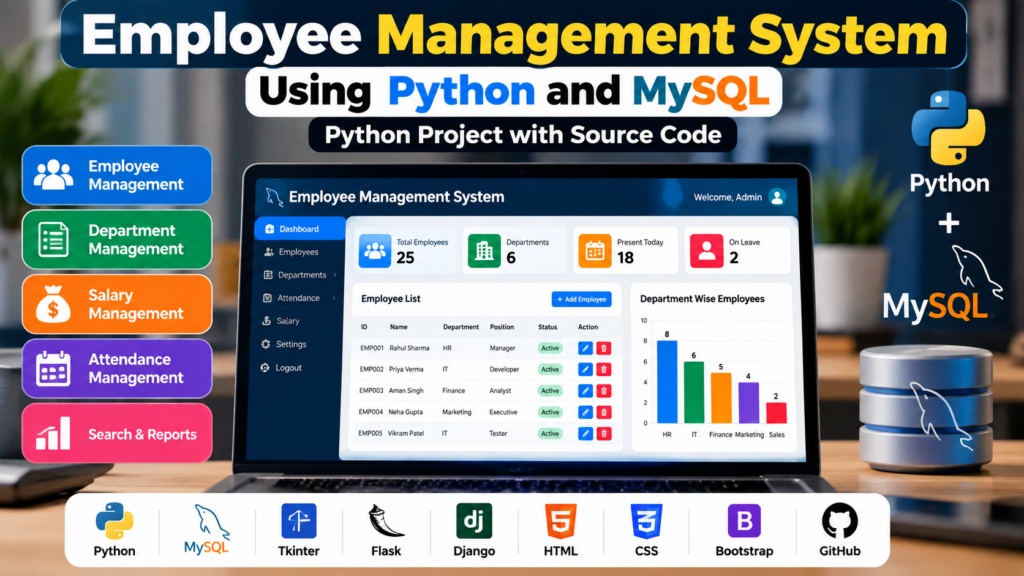
An Employee Management System Project in Python with MySQL is a software application designed to manage employee information digitally. Instead of maintaining employee records manually in registers or spreadsheets, the system stores important information in a structured database and allows authorized users to add, view, update, search, and manage employee records efficiently.
This project is suitable for students looking for a practical Python project with MySQL for academic or final-year project development. It demonstrates Python programming, database connectivity, CRUD operations, and basic software development concepts.
The system can be designed for small businesses, offices, educational organizations, startups, and other workplaces that need a simple way to manage employee information.
Employee Management System Project Overview
The main purpose of an employee management system is to maintain employee records in an organized and accessible format.
A typical system can manage:
- Employee registration
- Employee personal information
- Employee ID and department
- Job designation
- Contact information
- Joining date
- Salary information
- Attendance records
- Employee status
- Search and filtering
- Updating employee information
- Deleting employee records
- Database storage and retrieval
The application can use Python for the application logic and MySQL for storing employee data.
Objectives of the Employee Management System
The major objectives of this project are:
- To maintain employee records digitally.
- To reduce manual record keeping.
- To provide quick access to employee information.
- To perform CRUD operations using Python and MySQL.
- To organize employees according to departments and roles.
- To provide search and update functionality.
- To improve the accuracy of employee data management.
- To provide a practical database management project for students.
Key Features
1. Employee Registration
The administrator can add new employees to the system by entering information such as:
- Employee ID
- Employee name
- Gender
- Contact number
- Address
- Department
- Designation
- Joining date
- Salary
The information is stored in the MySQL database.
2. View Employee Records
The system can display all registered employees in a structured table.
Administrators can view important information such as employee ID, name, department, designation, and employment status.
3. Search Employee
A search feature allows users to find an employee using information such as:
- Employee ID
- Employee name
- Department
- Designation
- Contact number
This makes it easier to find records when the database contains many employees.
4. Update Employee Information
Employee information can change over time. The system can allow authorized users to update details such as:
- Contact number
- Address
- Department
- Designation
- Salary
- Employment status
5. Delete Employee Records
Authorized administrators can remove employee records when they are no longer required.
A confirmation step should be included before deleting records to prevent accidental deletion.
6. Department Management
Employees can be organized into different departments, such as:
- Human Resources
- Information Technology
- Finance
- Marketing
- Sales
- Administration
Department-based organization makes employee management easier.
7. Salary Management
The project can include basic salary information for each employee.
Depending on the implementation, salary management can include:
- Basic salary
- Allowances
- Deductions
- Net salary
- Salary history
Advanced payroll functionality can be added as a future enhancement.
8. Attendance Management
An attendance module can be integrated into the system to record employee attendance.
For example, the system can store:
- Employee ID
- Date
- Present/Absent status
- Working hours
- Leave status
This feature can be expanded into a complete employee attendance system.
Employee Management System Workflow
The basic workflow of the project is:
Admin Login → Employee Registration → Database Storage → View/Search Records → Update Records → Attendance/Salary Management → Reports
When an administrator enters employee information, Python processes the request and communicates with the MySQL database.
The database stores the information and returns the requested records to the application.
Technologies Used
The technologies used can vary depending on the implementation.
Programming Language
Python
Python is used to develop the application logic and implement database operations.
Database
MySQL
MySQL is used to store employee information in structured tables.
Database Connector
A Python MySQL connector can be used to establish communication between the Python application and MySQL database.
User Interface
Depending on the project implementation, the interface can be developed using:
- Tkinter
- HTML
- CSS
- Bootstrap
- Flask
- Django
For a desktop application, Tkinter can be used to create forms, buttons, tables, and other interface elements.
Database Design
A basic employee management database can contain an employees table.
Example fields may include:
| Field | Description |
|---|---|
| employee_id | Unique employee identifier |
| name | Employee name |
| gender | Employee gender |
| Employee email | |
| phone | Contact number |
| address | Employee address |
| department | Department name |
| designation | Job position |
| joining_date | Date of joining |
| salary | Employee salary |
| status | Current employment status |
Additional tables can be created for departments, attendance, salary records, and user accounts.
CRUD Operations
One of the most important concepts demonstrated by this project is CRUD.
CRUD stands for:
- Create – Add a new employee
- Read – View employee information
- Update – Modify employee information
- Delete – Remove an employee record
Python can execute these operations by sending SQL queries to the MySQL database.
Software Requirements
The basic software requirements may include:
- Python 3.x
- MySQL Server
- MySQL Workbench
- Python MySQL Connector
- VS Code, PyCharm, or another Python IDE
- Windows, Linux, or macOS
- Required Python libraries depending on the implementation
Hardware Requirements
A basic computer is sufficient for developing and running this project.
Recommended requirements:
- Processor: Intel Core i3 or equivalent
- RAM: 4 GB or more
- Storage: 500 GB or more
- Keyboard and mouse
- Monitor
- Internet connection for installing software and dependencies
Advantages
An Employee Management System provides several advantages:
- Reduces manual paperwork
- Provides centralized employee records
- Makes searching information faster
- Reduces duplicate records
- Makes updating information easier
- Provides better organization of employee data
- Demonstrates database management concepts
- Can be customized according to organizational requirements
Applications
An employee management system can be used in:
- Small businesses
- Offices
- Startups
- Educational institutions
- IT companies
- Retail businesses
- Manufacturing organizations
- Service companies
- Non-profit organizations
The project can also be extended for larger organizations by adding authentication, role-based access, payroll, attendance, and reporting modules.
Limitations
A basic employee management system may have some limitations:
- It may not include advanced payroll functionality.
- Security depends on how authentication and database access are implemented.
- A basic version may not support multiple branches or locations.
- Advanced reporting may require additional development.
- Database backup functionality may need to be implemented separately.
- Role-based access may not be available in a simple version.
Future Scope
The project can be enhanced with several advanced features.
1. Employee Login
Employees can receive individual accounts to access their personal information.
2. Admin and Employee Roles
Role-based access can restrict sensitive operations to authorized users.
3. Payroll Management
A complete payroll module can calculate salary, deductions, allowances, bonuses, and net salary.
4. Attendance System
Attendance can be integrated with the employee database for automated attendance reports.
5. Leave Management
Employees can submit leave requests while administrators can approve or reject them.
6. Email Notifications
The system can send notifications related to attendance, leave, salary, or important announcements.
7. Reports and Analytics
Interactive dashboards can display:
- Total employees
- Department-wise employees
- Attendance statistics
- Salary statistics
- Employee joining trends
8. Web-Based Application
The desktop application can be converted into a web application using Flask or Django.
9. Cloud Database
The system can be connected to a cloud-based database for remote access and centralized management.
Why This Is a Good Python Project
The Employee Management System is a useful Python project because it combines programming and database concepts in a practical application.
Students can learn:
- Python programming
- MySQL database management
- SQL queries
- CRUD operations
- Database connectivity
- Form validation
- User interface development
- Software project workflow
It can also be expanded according to the requirements of an academic project.
FAQs
What is an Employee Management System Project in Python?
An Employee Management System Project in Python is an application that allows organizations to store, manage, search, update, and organize employee information digitally.
Which database is used in this project?
MySQL can be used as the database to store employee records and related information.
Can this project be developed using Tkinter?
Yes. Tkinter can be used to create a desktop-based employee management application using Python.
Can Flask or Django be used?
Yes. Flask or Django can be used to develop a web-based employee management system.
What concepts are covered in this project?
The project can cover Python programming, MySQL, SQL queries, CRUD operations, database connectivity, forms, validation, and application development.
Can attendance and payroll be added?
Yes. Attendance, leave management, payroll, employee login, reports, and other modules can be added to create a more advanced system.
Conclusion
The Employee Management System Project in Python with MySQL is a practical application for managing employee information digitally. It demonstrates how Python can communicate with a MySQL database to perform operations such as employee registration, record management, searching, updating, and deleting data.
The project is suitable for students who want to understand Python database connectivity and build a practical Python and MySQL project. With additional modules such as attendance, payroll, leave management, authentication, reporting, and web deployment, the system can be developed into a more comprehensive employee management solution.
This Employee Management System Project in Python demonstrates how employee records can be managed efficiently using Python and MySQL.
Explore Related Projects
If you are interested in similar Python and database projects, you can also explore:
- Attendance Management System Project in Python
- Restaurant Management System Project in Python
- College Management System Project in Python
- Hotel Management System Project in Python
- Inventory Management System Project in Python
- Online Voting System Project in Python
- Library Management System Project in Python
- Student Management System Project in Python
These projects can help students explore different applications of Python, MySQL, database management, and software development.
☎️ Contact Us For More Queries:-
📲 Call/WhatsApp: +91-9460060699
🌎 Website: www.techieprojects.com
📺 Instagram: @pythonprojects_