
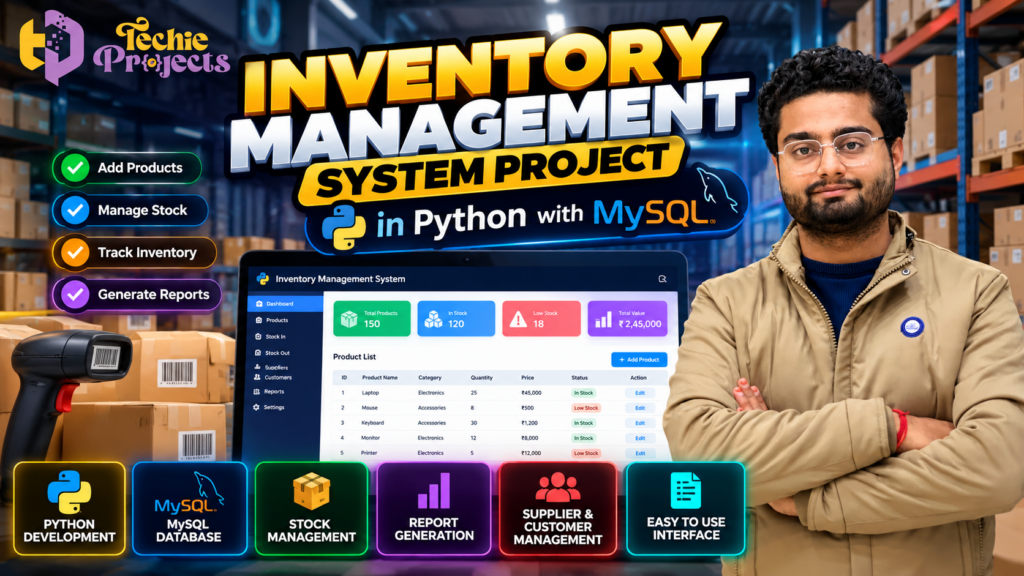
🚀 Looking for an Inventory Management System Project in Python for your final-year engineering submission? Choose a practical software project that demonstrates how businesses can manage products, track stock, organize inventory records, and work with a database. The Inventory Management System Project in Python with MySQL is a useful option for students who want to explore Python programming, database connectivity, and business application development in one project.
Instead of spending weeks planning the entire application, writing database queries, and resolving configuration issues from scratch, explore the available project package from Techie Projects. It can provide a starting point for understanding inventory management workflows and developing practical software skills.
🎓 Whether you are pursuing Computer Science Engineering, Information Technology, or another related discipline, this project can help you study how programming and database management work together in a business application.
Want to purchase this project? Contact Techie Projects to confirm the current price, source code availability, installation instructions, documentation, supported features, and other deliverables before ordering.
- 📲 Call/WhatsApp: +91-9460060699
- 🌎 Website: www.techieprojects.com
- 📺 Instagram: @pythonprojects_
🎬 Watch the Inventory Management System Project Demo
Explore the project demonstration to understand the application’s interface, inventory workflow, and available functionality.
The demonstration can help you evaluate whether the project matches your academic requirements and technical interests before making a purchase.
🧠 What Is an Inventory Management System Project in Python?
An inventory management system is a software application designed to organize product information and maintain stock records. Businesses use inventory systems to understand which products are available, how much stock remains, and when items may need replenishment.
The Inventory Management System Project in Python with MySQL explores how these operations can be implemented using Python programming and a relational database.
Python can handle application logic, user interactions, and business rules, while MySQL can store structured information such as product names, quantities, prices, categories, and supplier details.
Depending on the implementation, the application may support adding products, updating stock quantities, searching records, and generating inventory reports. The exact features should be confirmed against the supplied project.
For students, this project provides an opportunity to understand how a database-backed application is structured and how software can help organize routine business operations.
🎯 Objectives of the Project
The main objective is to develop or study an application that manages inventory records in a structured and efficient manner.
Key objectives may include:
- Maintaining product information in a database.
- Adding new inventory items and updating existing records.
- Recording stock quantities and product prices.
- Retrieving product information through database queries.
- Exploring stock-in and stock-out operations, if implemented.
- Learning Python-to-MySQL database connectivity.
- Understanding basic data validation and error handling.
- Developing practical knowledge of business software design.
These objectives can help students connect programming fundamentals with a real-world inventory management use case.
⚙️ How Does the Inventory Management System Work?
The workflow depends on the supplied implementation, but a typical inventory application follows several stages.
1. Product Registration
The application allows authorized users to enter product details, such as a product name, category, quantity, and price.
The system validates the supplied information before saving it. Appropriate validation can help reduce missing or incorrectly formatted records.
2. Database Storage Using MySQL
MySQL stores product information in structured tables. Python communicates with the database through a compatible database connector.
Typical database operations include inserting new records, retrieving product information, updating quantities, and deleting records when permitted.
3. Stock Management
Inventory records must be updated when stock is received or items are removed. A system may provide stock-in and stock-out operations to record these changes.
Accurate stock tracking depends on the application’s business rules and how consistently transactions are recorded.
4. Searching and Updating Products
A user may need to find a product by its name, identifier, or category. Database queries can retrieve matching records and display them in the application.
Updating an existing product allows the user to correct details or revise quantities without manually rebuilding the record.
5. Inventory Reports
Some inventory applications provide summaries of available products, quantities, or stock values. These reports can help users review stored information.
Report generation, low-stock alerts, and dashboard statistics should be considered available only if they are included in the actual project.
6. Testing and Validation
The application should be tested with different product records and inventory operations. Testing may cover invalid inputs, missing fields, duplicate entries, database connection failures, and incorrect quantity updates.
For an academic submission, explaining these tests can demonstrate an understanding of software quality and database reliability.
📦 Benefits of the Inventory Management System Project in Python with MySQL
The Inventory Management System Project in Python with MySQL helps students understand how a database-driven application can organize product information and inventory records. It combines Python programming, SQL queries, and database connectivity in a practical business software scenario.
Key benefits include:
- Product record management: Learn how product information can be stored and retrieved.
- Stock tracking: Understand how inventory quantities can be updated through supported operations.
- Database connectivity: Explore how Python communicates with a MySQL database.
- Data organization: Study how relational tables help manage structured inventory records.
- Practical programming: Understand how application logic and database operations work together.
- Academic learning: Build knowledge that can help you explain the project workflow during your presentation or viva.
For students interested in Python and database development, this project provides a useful opportunity to explore a common business application.
⚙️ How the Inventory Management System Project in Python with MySQL Works
The workflow typically begins when a user enters product information through the application’s supported interface. Python processes the input and communicates with MySQL to store, retrieve, or update the relevant records.
For example, when a new product is registered, the application may validate the product details and insert a record into the database. When stock quantities change, the system can update the corresponding inventory entry if that functionality is implemented.
The Inventory Management System Project in Python with MySQL may also support searching product records and viewing inventory summaries, depending on its available features.
Understanding this workflow helps students explain the relationship between the user interface, Python application logic, SQL queries, and database storage.
🎓 Who Should Choose the Inventory Management System Project in Python with MySQL?
The Inventory Management System Project in Python with MySQL may be suitable for students pursuing Computer Science Engineering, Information Technology, and related disciplines.
It is particularly relevant for learners interested in:
- Python application development.
- MySQL and relational databases.
- SQL queries and database operations.
- Business management software.
- Final-year engineering project demonstrations.
Before choosing this project, review your institution’s requirements and confirm the actual features, source code, documentation, and installation instructions available in the package.
🌟 Key Features to Explore
The following are common features of inventory management applications. Confirm which are included in the Techie Projects package before purchasing.
- Product management: Add, view, edit, or delete product records where supported.
- Stock tracking: Maintain product quantities through supported inventory operations.
- MySQL database integration: Store and retrieve structured inventory information.
- Product search: Find records using available search fields.
- Inventory reports: Review stock details and summaries if reporting is implemented.
- User interface: Interact with the application through its supported interface.
- Data validation: Apply checks to reduce invalid or incomplete entries.
- Python implementation: Explore application logic, database queries, and software structure.
Not every implementation includes every feature listed above. Review the demonstration and confirm the actual deliverables rather than assuming that advanced features are available.
💻 Technologies Used
A project of this type may use the following technologies.
| Technology | Purpose |
|---|---|
| Python | Application logic and business rules |
| MySQL | Relational database storage |
| MySQL Connector/Python or another connector | Python-to-database communication |
| Tkinter, Flask, or another interface framework | User interface, depending on implementation |
| SQL | Inserting, retrieving, updating, and deleting records |
| Visual Studio Code or PyCharm | Code editing and development |
The exact technology stack depends on the project. For example, a desktop application may use Tkinter, while a web application may use Flask. Confirm which framework is used before purchasing.
🖥️ Software and Hardware Requirements
Software Requirements
A typical setup may require:
- A compatible Windows or Linux operating system.
- A supported Python version.
- MySQL Server and the appropriate database tools.
- Required Python libraries and database connectors.
- A code editor or IDE, such as Visual Studio Code or PyCharm.
Hardware Requirements
- A computer with sufficient RAM and storage.
- A compatible CPU for running Python and MySQL.
- An internet connection for downloading dependencies when required.
The actual requirements depend on the application architecture and package configuration. Confirm the supported Python and MySQL versions, database setup procedure, and installation instructions before purchase.
🎓 Why Choose This Python Project for Final-Year Engineering?
For Computer Science and IT Students
The project offers an opportunity to explore Python functions, application logic, database connectivity, SQL queries, and data validation in a business-oriented application.
For Students Learning Database Management
You can study how structured data is stored in tables, how records are retrieved, and how updates are applied through SQL operations.
For Final-Year Project Demonstrations
An inventory application provides a familiar business scenario that can be explained through its problem statement, system architecture, database design, workflow, testing, and limitations.
For Building Practical Programming Skills
Working with a database-backed application can help students understand how different software components communicate and how user actions translate into database operations.
Use the project in accordance with your institution’s academic integrity policy, and make sure you understand the code and can explain the implementation during your viva.
🏪 Real-World Applications of Inventory Management
Inventory management is relevant to many organizations that maintain physical products or stock records.
- Retail shops: Organize product information and stock quantities.
- Warehouses: Maintain records of stored goods.
- Small businesses: Track inventory changes and product details.
- Electronics stores: Organize products by category, model, and quantity.
- Educational demonstrations: Show how database applications can support business workflows.
These are general applications of inventory management software. The suitability of this particular project for any business depends on its features, security, scalability, and reliability.
⚠️ Challenges and Limitations
Understanding limitations is an important part of project development.
- Data accuracy: Incorrect entries can lead to unreliable stock records.
- Database connectivity: Incorrect credentials or server settings can prevent connections.
- Concurrent updates: Multiple users may create inconsistent records if transactions are not handled correctly.
- Security: User authentication and access controls are important if sensitive business data is stored.
- Backup and recovery: Inventory data should be backed up to reduce the risk of data loss.
- Scalability: A student project may not be suitable for a large commercial operation without further development and testing.
Discussing these limitations helps demonstrate a realistic understanding of database-backed software systems.
🚀 Future Scope
The project can be extended, depending on its architecture and your academic objectives.
Possible enhancements include barcode-based product entry, supplier management, sales and purchase records, low-stock notifications, role-based access, dashboard visualizations, and automated report generation.
You could also explore exporting reports to CSV or Excel, adding database backups, and improving transaction handling.
These are potential extensions, not guaranteed features of the current package. Any additional development should be tested to ensure that inventory records remain consistent and secure.
🛒 Buy the Inventory Management System Project in Python with MySQL
Looking for an Inventory Management System Project in Python with MySQL for your final-year engineering submission? Contact Techie Projects to enquire about the available package, pricing, source code, installation requirements, and documentation.
Confirm the deliverables before purchasing so you know exactly what is included and whether the project fits your academic requirements.
Before placing your order, ask about:
- Source code availability and supported technologies.
- MySQL database structure and setup instructions.
- Installation steps and software dependencies.
- Project report and documentation availability.
- Demonstration video or user interface availability.
- Included features and customization options.
- Pricing, delivery time, and support arrangements.
The exact package contents and services depend on what is confirmed at the time of enquiry.
📲 Contact Techie Projects
- 🌐 Website: https://techieprojects.com/
- 📱 WhatsApp: Enquire About This Project
- 📸 Instagram: https://www.instagram.com/pythonprojects_/
Share your course, project requirements, and expected submission timeline to help clarify which available package may suit your needs.
🔗 Explore Related Python Projects
Looking for more ideas for your engineering portfolio? Visit Techie Projects to explore available software and programming projects.
Related topics include:
- Machine Learning Projects
- Database Management System Projects
- Artificial Intelligence Projects
- Cyber Security Projects
- Web Development Projects
- Final-Year Engineering Projects
Browse related project pages and contact Techie Projects to confirm availability, features, and pricing for any project you are considering.
❓ Frequently Asked Questions
1. What is an Inventory Management System Project in Python?
It is a Python-based application that organizes product information and inventory records. When integrated with MySQL, the application can store and retrieve structured data through database operations.
2. Why is MySQL used in an inventory management project?
MySQL is a relational database management system that can store product details, quantities, categories, and other structured records. Python communicates with MySQL through a suitable connector.
3. Is this project suitable for final-year engineering students?
It may be suitable for Computer Science, IT, and related engineering students, depending on their institution’s project requirements and the scope of the implementation.
4. Does the project include source code and documentation?
The availability of source code, documentation, installation instructions, and other materials depends on the package. Contact Techie Projects to confirm the deliverables before purchasing.
5. Can this inventory project be customized?
Customization depends on the project’s architecture and the services available. Ask Techie Projects whether the specific changes you need can be supported and whether additional charges apply.
6. What software is required to run the project?
A typical implementation may require Python, MySQL, a compatible database connector, and any libraries or interface frameworks used by the application. Confirm the exact versions and setup requirements.
7. How can I purchase the project?
Visit Techie Projects or contact us on WhatsApp to enquire about the current price, package contents, and installation requirements.
✅ Conclusion
The Inventory Management System Project in Python with MySQL is a practical academic topic for exploring Python programming, SQL, database connectivity, and business application development. It can help students understand how software organizes product records and supports routine inventory operations.
If you are searching for an inventory management project for your engineering portfolio or final-year submission, contact Techie Projects to review the available package and confirm its suitability before purchasing.
🚀 Ready to get started? Enquire on WhatsApp or visit Techie Projects for more information.