
Introduction
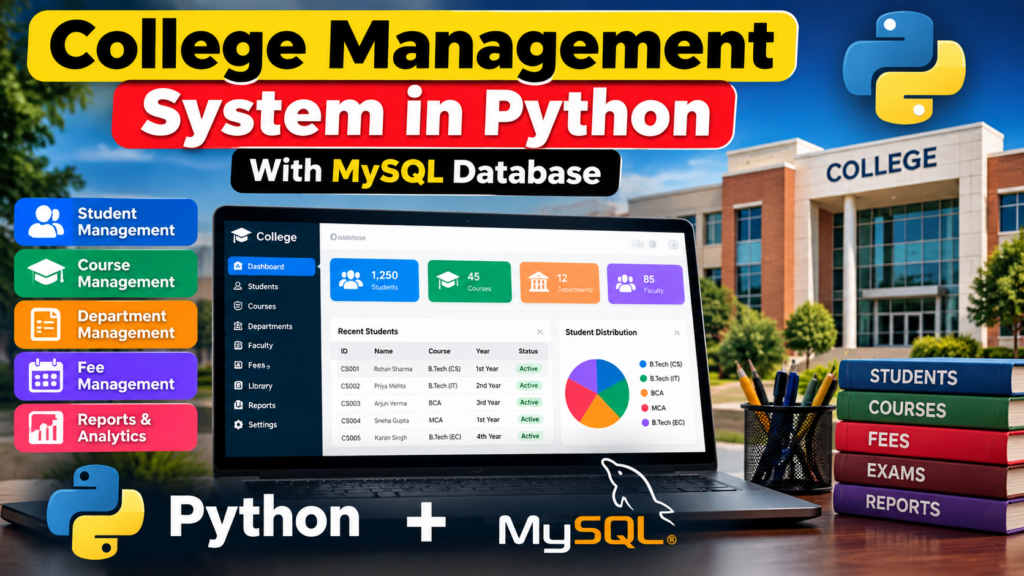
A College Management System Project in Python is a software application designed to simplify and organize the management of college-related information. The system can help manage student records, courses, departments, faculty details, fees, attendance, examinations, and other academic information from a centralized application.
Traditional college management often involves maintaining records manually using registers or spreadsheets. This can make searching, updating, and managing large amounts of information time-consuming. A computerized college management system can make these tasks faster, more organized, and easier to maintain.
This project is suitable for students looking for a practical Python project with MySQL for academic or final-year project development. It demonstrates Python programming, database connectivity, CRUD operations, and basic software development concepts.
Objectives of the College Management System
The main objectives of this college management system project are:
- Manage student information digitally.
- Store and retrieve college records efficiently.
- Manage courses and departments.
- Maintain faculty information.
- Manage student fee records.
- Provide an organized database for college information.
- Reduce manual paperwork.
- Make searching and updating records easier.
- Demonstrate Python and MySQL database connectivity.
- Provide a practical project for students and academic institutions.
Key Features
A College Management System Project in Python can include several useful features.
1. Student Management
The student management module allows administrators to add, update, search, and delete student records.
Typical information may include:
- Student ID
- Student name
- Date of birth
- Gender
- Contact number
- Address
- Course
- Department
- Admission year
2. Course Management
The course module manages information about different courses offered by the college.
Examples include:
- B.Tech
- BCA
- MCA
- BBA
- MBA
- M.Tech
- Diploma courses
The administrator can add new courses, update course information, and remove outdated records.
3. Department Management
The system can maintain information about departments such as:
- Computer Science and Engineering
- Information Technology
- Electronics and Communication
- Mechanical Engineering
- Civil Engineering
- Electrical Engineering
- Management
Each department can be associated with students, courses, and faculty members.
4. Faculty Management
The faculty management module can store information about teaching staff.
It may include:
- Faculty ID
- Faculty name
- Department
- Qualification
- Designation
- Contact number
- Joining date
5. Fee Management
The fee management module can be used to maintain student fee information.
It can store:
- Student ID
- Course
- Semester
- Total fee
- Paid amount
- Remaining amount
- Payment date
- Payment status
This makes it easier to track pending and completed payments.
6. Attendance Management
An advanced version of the project can include an attendance module.
The system can maintain:
- Student ID
- Student name
- Course
- Subject
- Date
- Attendance status
Attendance percentages can also be calculated automatically.
7. Examination Management
The examination module can store information about:
- Subjects
- Examination dates
- Marks
- Grades
- Semester
- Student results
This can help administrators and faculty members manage academic results.
8. Search and Update Records
The system can provide search functionality to quickly find student, faculty, course, or fee information.
Authorized users can also update existing records whenever information changes.
Technologies Used
The project can be developed using the following technologies:
- Programming Language: Python
- Database: MySQL
- Database Connector: MySQL Connector/Python
- GUI: Tkinter, if a desktop application is used
- Development Environment: VS Code, PyCharm, or IDLE
- Operating System: Windows/Linux
Python and MySQL Integration
Python handles the application logic while MySQL stores the project data.
The Python application can connect to the MySQL database using a database connector. SQL queries can then be used to insert, retrieve, update, and delete records.
The basic workflow is:
Python Application → MySQL Connector → MySQL Database
This architecture allows the application to work with structured college information stored in database tables.
Database Design
A MySQL database for the project can contain multiple tables.
Student Table
Possible fields:
- student_id
- student_name
- gender
- date_of_birth
- phone
- address
- course_id
- department_id
Course Table
Possible fields:
- course_id
- course_name
- duration
- department_id
Department Table
Possible fields:
- department_id
- department_name
- department_head
Faculty Table
Possible fields:
- faculty_id
- faculty_name
- department_id
- designation
- qualification
Fees Table
Possible fields:
- fee_id
- student_id
- semester
- total_fee
- paid_amount
- pending_amount
- payment_date
Results Table
Possible fields:
- result_id
- student_id
- subject
- marks
- grade
- semester
CRUD Operations
One of the important concepts demonstrated by this project is CRUD.
CRUD stands for:
- Create – Add new records.
- Read – Display existing records.
- Update – Modify existing records.
- Delete – Remove records.
For example, an administrator can add a new student to the database, search for the student’s information, update the student’s contact details, or delete the record when necessary.
Project Workflow
The basic workflow of the College Management System is:
- User opens the application.
- User logs into the system.
- The application connects to the MySQL database.
- The dashboard displays available modules.
- User selects a module such as Students, Courses, Faculty, Fees, or Results.
- The application performs the requested operation.
- Data is stored or retrieved from MySQL.
- Results are displayed to the user.
- The user can update or search records whenever required.
Software Requirements
The following software can be used:
- Python 3.x
- MySQL Server
- MySQL Connector/Python
- VS Code or PyCharm
- Tkinter, if required
- Windows 10/11 or Linux
Hardware Requirements
Recommended hardware requirements include:
- Processor: Intel Core i3 or above
- RAM: 4 GB or above
- Storage: 500 GB or above
- Keyboard and mouse
- Monitor
- Internet connection for installation and updates
Advantages
A College Management System provides several advantages:
- Reduces manual paperwork.
- Makes record management easier.
- Provides faster access to information.
- Reduces duplicate data entry.
- Improves data organization.
- Makes student searching easier.
- Provides centralized data management.
- Supports database-driven application development.
- Helps students understand real-world software development.
Applications
The project can be adapted for:
- Colleges
- Universities
- Educational institutions
- Training institutes
- Coaching centers
- Academic departments
- Student management applications
Limitations
A basic college management system may have some limitations:
- It may require proper database configuration.
- User authentication may be basic.
- Data security depends on implementation.
- The system may not support multiple institutions by default.
- Advanced reporting may require additional development.
- Online deployment requires server and database configuration.
Future Scope
The project can be enhanced with advanced features such as:
- Online student registration
- Student and faculty login
- Role-based access control
- Online fee payment
- Attendance tracking
- Automated report generation
- Email notifications
- SMS notifications
- Mobile application integration
- Cloud database integration
- Admin dashboard
- Data analytics
- AI-based student performance analysis
The system can also be converted into a web application using frameworks such as Django or Flask.
Security Considerations
Since a college management system can contain sensitive academic and personal information, security should be considered during development.
Recommended practices include:
- Use secure passwords.
- Apply authentication and authorization.
- Validate user input.
- Use parameterized SQL queries.
- Restrict database access.
- Maintain regular database backups.
- Avoid storing passwords in plain text.
- Give users only the permissions they require.
Why Choose This Python Project?
The College Management System is a useful project for students because it combines several important programming concepts in one application.
Students can learn:
- Python programming
- Object-oriented programming
- MySQL database
- SQL queries
- CRUD operations
- Database connectivity
- GUI development
- Form validation
- Application workflow
- Software development concepts
It can also be expanded with additional modules depending on project requirements.
Explore Related Python Projects
If you are looking for more Python projects, you can explore these related projects:
- Student Management System Project in Python
- Attendance Management System Project in Python
- Employee Management System Project in Python
- Library Management System Project in Python
- College Enquiry Chatbot Project in Python
These projects can help students explore different areas of Python programming, database management, automation, and application development.
Frequently Asked Questions
What is a College Management System Project in Python?
A College Management System Project in Python is a software application used to manage college information such as students, courses, departments, faculty, fees, attendance, and examination records.
Which database can be used for this project?
MySQL can be used as the database for storing student, faculty, course, fee, and other college records.
Is this project suitable for final-year students?
Yes. The project can be used as an academic or final-year project and can be extended with additional modules and features.
Can Python connect to MySQL?
Yes. Python can connect to MySQL using MySQL Connector/Python or other compatible database libraries.
Can this project be converted into a web application?
Yes. The project can be developed or migrated to a web-based application using frameworks such as Django or Flask.
Can attendance and fees be added to the system?
Yes. Attendance management and fee management can be implemented as separate modules connected to the main college database.
Conclusion
The College Management System Project in Python is a practical database-driven application that demonstrates how Python and MySQL can be used together to manage college information.
The project can manage students, courses, departments, faculty, fees, attendance, and examination records while reducing manual data management. With additional features such as authentication, online payments, cloud integration, analytics, and mobile support, the system can be developed into a more advanced educational management platform.
For students, this project provides practical experience with Python, MySQL, SQL, CRUD operations, database connectivity, and real-world software development concepts.
☎️ Contact Us For More Queries:-
📲 Call/WhatsApp: +91-9460060699
🌎 Website: www.techieprojects.com
📺 Instagram: @pythonprojects_