
Introduction 🎯
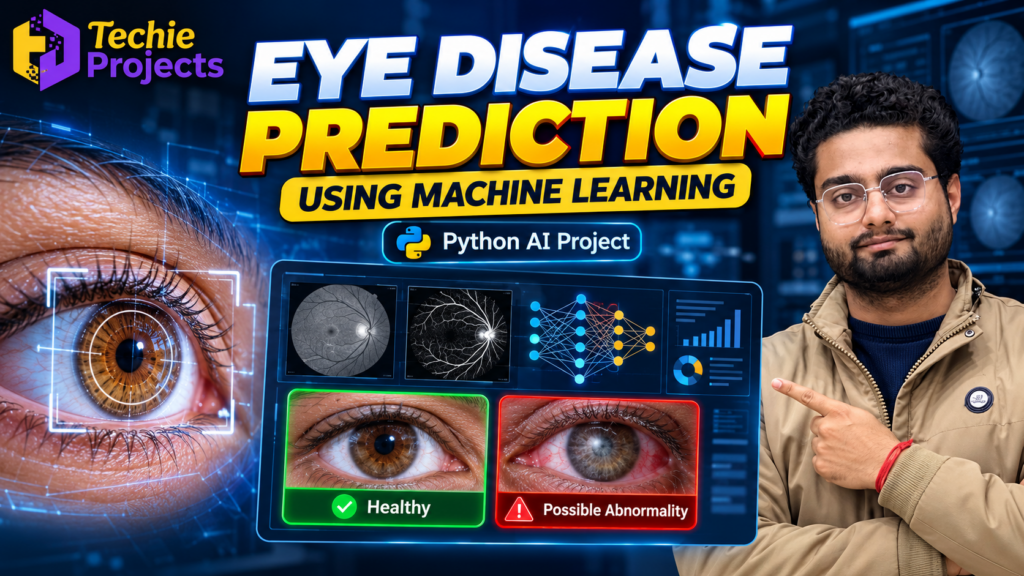
The Eye Disease Prediction Using Machine Learning project is an AI-based application that demonstrates how machine learning and image processing techniques can be used to classify eye images. This Python project is suitable for students interested in artificial intelligence, medical image analysis, computer vision, and final-year engineering projects.
Eye-related image classification is an important research area in computer vision. By processing images and applying a trained machine learning or deep learning model, an application can generate predictions based on the patterns learned from its training dataset.
If you are looking for an Eye Disease Prediction Using Machine Learning project with Python source code, Techie Projects can help you explore project availability, implementation details, pricing, and customization options.
The Eye Disease Prediction Using Machine Learning project demonstrates how Python-based image processing and trained classification models can analyze eye images and generate predictions for educational purposes.
This project is designed as an educational prototype for students who want to understand how AI-based image classification applications work. In this blog, we explain the project workflow, objectives, features, technologies, requirements, applications, and opportunities for future development.
🎬 Eye Disease Prediction Using Machine Learning – Project Demo
Explore the project demonstration to understand how the application processes eye images and displays classification results. The demo provides an overview of the interface and the general workflow of this Python-based AI project.
Students can use the demonstration to understand the expected application flow and decide whether the project matches their academic interests and requirements.
👁️ What Is an Eye Disease Prediction Project?
An eye disease prediction project uses image processing and a trained classification model to analyze eye-related images and predict categories defined by the dataset.
Depending on the implementation, the system may work with eye photographs, retinal images, or another supported image format. The model’s predictions depend on its architecture, training data, preprocessing steps, and evaluation results.
The Eye Disease Prediction Using Machine Learning project demonstrates the integration of image input, preprocessing, model inference, and result visualization in a Python application.
For example, a model trained on two image categories may predict whether an input belongs to one category or another. The actual categories supported by your project depend on the supplied dataset and trained model.
It is important to understand that an educational image classifier is not a substitute for a professional eye examination. Its predictions should not be used to diagnose a medical condition or make treatment decisions.
🎯 Objectives of the Project
The primary objective is to demonstrate how machine learning and image processing can be integrated into an application that classifies eye images.
The main objectives include:
- 📷 Load eye images from a supported input source.
- 🖼️ Preprocess images according to the model’s requirements.
- 🧠 Apply a trained classification model.
- 📊 Display the predicted category in the application.
- 💻 Develop a user-friendly interface, if included in the implementation.
- ⚙️ Understand the connection between image processing and machine learning.
- 📈 Explore classification performance using appropriate evaluation metrics.
- 🚀 Identify opportunities to improve model performance and usability.
These objectives make the project useful for students who want practical exposure to AI-based image classification.
⚙️ How Does the Project Work?
The application generally follows an image-processing and classification workflow. The exact steps depend on the implementation and model supplied with the project.
1. 📥 Image Input
The user selects or uploads an eye image in a supported format. The application receives the image for processing.
2. 🖼️ Image Preprocessing
The image is prepared for the model. Common preprocessing operations may include resizing, normalization, and conversion into the expected input format.
3. 🧠 Model Loading
The application loads the trained machine learning or deep learning model. The model must be compatible with the input dimensions and preprocessing method used by the application.
4. 🔍 Image Classification
The processed image is passed to the model. The model generates a prediction based on the classes it was trained to recognize.
5. 📊 Prediction Display
The application displays the predicted class and may show a confidence score if this functionality is supported.
6. 🧪 Model Evaluation
During development, students can evaluate the model using suitable test data and metrics such as accuracy, precision, recall, and a confusion matrix. These measurements help explain the model’s strengths and limitations.
🌟 Key Features of the Eye Disease Prediction Project
👁️ 1. Eye Image Classification
The project demonstrates how an image classification model can process eye-related images and predict supported categories.
🧠 2. Machine Learning Integration
Students can learn how a trained model is connected to a Python application and used to generate predictions.
🖼️ 3. Image Processing Workflow
The system can demonstrate preprocessing operations required to prepare image data for model inference.
💻 4. User Interface
If included, a graphical interface allows users to provide image input and view the results without manually executing each processing step.
⚡ 5. Automated Prediction
The application automates the classification process after the user provides a valid image.
📊 6. Result Visualization
The interface can display the predicted category and any additional output supported by the implementation.
🧪 7. Model Evaluation Opportunities
Students can experiment with test datasets and appropriate evaluation metrics to understand classification performance.
🐍 8. Python-Based Implementation
Python provides a practical environment for combining image-processing libraries, machine learning frameworks, and application components.
🛠️ Technologies Used
The exact technologies depend on the supplied source code. Common options for this type of project include:
- 🐍 Python: Main programming language.
- 👁️ OpenCV: Image processing, if used.
- 📊 NumPy: Numerical operations and array processing, if required.
- 🧠 Scikit-learn: Machine learning utilities, if used.
- 🔥 TensorFlow or Keras: Deep learning model integration, if used.
- 📚 Pillow: Image loading and manipulation, if included.
- 💻 Tkinter or another GUI framework: Application interface, if implemented.
Not every project uses all these libraries. Confirm the actual framework, model type, and dependency versions against the available source code before installation.
💻 Software and Hardware Requirements
💿 Software Requirements
The project may require:
- Windows or another compatible operating system.
- A compatible Python version.
- Required Python libraries.
- Trained model and configuration files.
- A Python IDE or code editor.
- A supported image dataset for testing, where required.
🖥️ Hardware Requirements
A typical development setup may include:
- Laptop or desktop computer.
- Adequate RAM for the selected model.
- Sufficient storage for the source code and dataset.
- CPU resources for image processing and inference.
A dedicated GPU may improve the speed of some deep learning workloads, but it is not necessary for every implementation.
🌟 Benefits of the Eye Disease Prediction Using Machine Learning Project
The Eye Disease Prediction Using Machine Learning project helps students explore image classification, preprocessing, model integration, and prediction visualization. It provides practical experience with Python and AI while offering opportunities to evaluate model performance and investigate future improvements.
🎓 Advantages of the Project
The Eye Disease Prediction Using Machine Learning project offers several educational benefits.
- 🧠 Practical AI experience: Understand how trained models generate image classifications.
- 👁️ Computer vision knowledge: Explore image preprocessing and visual data.
- 🐍 Python programming: Learn how libraries and model components work together.
- 📊 Performance evaluation: Investigate how classification models should be tested.
- 💻 Application development: Understand how predictions can be displayed through a user interface.
- 🎓 Academic learning: Explore an AI project topic relevant to computer science and information technology.
- 🚀 Scope for improvement: Experiment with different models, datasets, and preprocessing techniques.
Students should understand the implementation rather than relying only on the final prediction screen. This makes it easier to explain the workflow, methodology, and limitations during an academic presentation.
🌍 Applications of Eye Image Classification
🎓 AI and Machine Learning Education
The project can help students understand image classification, model inference, and performance evaluation.
🔬 Medical Image Research
Researchers can explore image classification techniques using appropriately prepared datasets and suitable validation methods.
🖼️ Computer Vision Experiments
Students can investigate image preprocessing, model inputs, and classification outputs.
📊 Dataset Analysis
The project can be extended to compare model performance across supported image classes and test conditions.
🧪 AI Prototype Development
Developers can use the project as an educational starting point for exploring improved image classification workflows.
Medical safety note: This project should be treated as an educational prototype unless it has undergone appropriate independent clinical validation and regulatory review. Predictions from an unvalidated model cannot confirm or rule out an eye disease.
⚠️ Limitations of the Project
Like other machine learning applications, this project has limitations that students should understand.
- 📚 Dataset quality: Limited or unrepresentative training data can reduce reliability.
- 🖼️ Image quality: Blurry, poorly lit, or incorrectly formatted images may affect predictions.
- 🧠 Model limitations: The model may perform poorly on images unlike those used during training.
- 📊 Evaluation requirements: High training accuracy alone does not establish reliable performance on new data.
- 🔄 Generalization: Performance can change across different cameras, populations, and image sources.
- 🩺 Clinical limitations: An educational model cannot replace examination by a qualified eye-care professional.
These limitations should be included in the project report to demonstrate responsible understanding of AI technology.
🚀 Future Scope of the Project
The project can be extended in several ways, depending on the available implementation.
- 🧠 Model comparison: Compare suitable classification architectures.
- 📚 Dataset expansion: Explore additional representative and properly labeled images.
- 📊 Performance analysis: Evaluate precision, recall, sensitivity, specificity, and other relevant metrics where appropriate.
- 🖼️ Image preprocessing improvements: Test suitable resizing and normalization strategies.
- 💻 Interface enhancement: Improve image upload, result display, and error handling.
- 🌐 Deployment exploration: Investigate a web application or another deployment option.
- 🔒 Privacy protection: Handle sensitive image data securely and obtain appropriate consent.
- 🧪 Independent validation: Investigate whether performance generalizes to separate datasets and real-world conditions.
These improvements can give students additional opportunities to study machine learning, software development, and responsible AI.
🎓 Who Can Choose This Project?
This project may be suitable for:
- B.Tech Computer Science Engineering students.
- B.E. Information Technology students.
- Final-year engineering students.
- Students interested in artificial intelligence.
- Learners exploring Python and machine learning.
- Students studying image processing and computer vision.
Before choosing the project, check your institution’s requirements for source code, implementation, documentation, demonstrations, and individual academic contribution.
🛒 Purchase the Eye Disease Prediction Project from Techie Projects
Looking for an Eye Disease Prediction Using Machine Learning project with source code? Contact Techie Projects to enquire about available Python source code, implementation details, documentation, pricing, and customization options for your final-year engineering project.
Techie Projects helps students explore engineering project options and discuss their implementation requirements. Contact us to confirm the project’s availability, package details, pricing, and customization possibilities.
Depending on the available package, you can enquire about:
- 🐍 Python source code.
- ⚙️ Installation and setup guidance.
- 🧠 Model and implementation details.
- 🖼️ Supported image inputs and classification categories.
- 📄 Available project documentation.
- 💻 Demonstration and supported application features.
- 🛠️ Customization options.
- 💬 Pricing and delivery details.
The actual package contents and support arrangements should be confirmed before ordering. Students should understand and test the code and follow their institution’s academic integrity rules.
💬 Contact Techie Projects for Pricing and Source Code
Ready to explore the Eye Disease Prediction Using Machine Learning project?
Send your course details and project requirements to discuss source code availability, current pricing, implementation features, and customization options.
📲 Call/WhatsApp: +91-9460060699
🌎 Website: www.techieprojects.com
📺 Instagram: @pythonprojects_
Contact us to learn more about this project and find out whether the available implementation matches your academic requirements.
🎓 Explore Related Projects
Explore these related project topics in artificial intelligence and computer vision:
- Skin Cancer Detection Using Machine Learning
- Plant Leaf Disease Detection Using Deep Learning
- Brain Tumor Detection Using Image Processing
- Face Recognition Attendance System
- Sign Language Detection Using Python
- Image Classification Using Deep Learning
❓ Frequently Asked Questions
1. What is an Eye Disease Prediction Using Machine Learning project?
It is an educational application that demonstrates how a trained model can classify eye-related images into predefined categories.
2. Which programming language is used?
Python is commonly used. The exact libraries and framework depend on the supplied implementation.
3. Can this project diagnose eye diseases?
No. An educational prototype should not be used to diagnose or rule out a medical condition. Medical diagnosis requires appropriate professional assessment.
4. Can I get the Python source code?
Contact Techie Projects to confirm source code availability, package contents, and current pricing.
5. Is this project suitable for final-year students?
It may be suitable for B.Tech, B.E., CSE, and IT students, subject to institutional guidelines and the student’s ability to understand and explain the implementation.
6. Can the project be customized?
Customization may be possible depending on the available source code and your requirements. Contact Techie Projects to discuss the requested changes.
7. Does the project require a GPU?
Not necessarily. Hardware requirements depend on the model, dataset, and expected processing speed.
8. How can I evaluate the model?
Use suitable test data and relevant classification metrics. Evaluation results should be reported honestly and should not be presented as evidence of clinical effectiveness without appropriate validation.
🏁 Conclusion
The Eye Disease Prediction Using Machine Learning project demonstrates how Python, image processing, and a trained classification model can be combined to create an educational AI application. It gives engineering students an opportunity to explore image preprocessing, model inference, prediction visualization, and machine learning evaluation.
Choose the Eye Disease Prediction Using Machine Learning project to explore an educational AI application and understand the practical workflow of image classification using Python.
With further testing and responsible development, students can use this project to investigate improvements in image classification and application usability.
If you are interested in obtaining the project for your academic work, contact Techie Projects to discuss source code availability, package contents, pricing, and customization options.
📱 Contact Techie Projects on WhatsApp to enquire today.