
Introduction
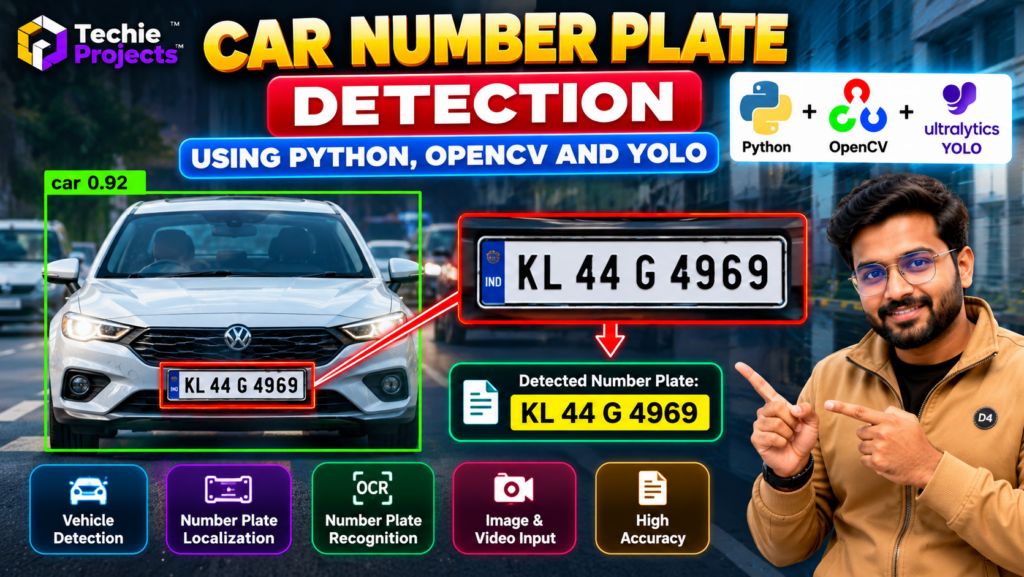
Car number plate detection using Python is a computer vision project that demonstrates how vehicle license plates can be located in images or video footage using image processing and object detection techniques. By combining Python with OpenCV and YOLO, students can explore how a system identifies vehicle number plate regions and prepares them for further processing.
Automatic number plate detection is useful in applications such as smart parking, traffic monitoring, vehicle access management, and intelligent transportation systems. This project offers students a practical opportunity to understand computer vision workflows and develop a real-world-inspired application.
If you are looking for a car number plate detection project in Python with source code, Techie Projects can help you enquire about available project packages, implementation details, and documentation.
Car number plate detection using Python demonstrates how computer vision can locate license plates in vehicle images and video footage. By combining OpenCV with a suitable detection model, students can explore the process of identifying plate regions for further analysis.
🎬 Project Demo: Car Number Plate Detection Using Python
Explore the project demonstration to see how the application processes vehicle images, locates number plate regions, and displays detection results. The demonstration introduces the workflow and interface of this Python computer vision project.
🎯 Objectives of the Project
The main objectives of the car number plate detection using Python project are:
- Detect vehicle number plate regions in images or video.
- Explore object detection using YOLO, if included in the implementation.
- Use OpenCV for image loading, processing, and result visualization.
- Understand the stages of a license plate detection workflow.
- Explore how detected plate regions can be prepared for character recognition.
- Investigate applications in traffic monitoring and vehicle management.
🚘 Key Features of Car Number Plate Detection Using Python
1. Vehicle Image Processing
The application accepts vehicle images or video frames and processes them for number plate detection.
2. Number Plate Localization
An object detection model or another implemented detection method identifies the region containing the vehicle’s number plate.
3. YOLO-Based Detection
If YOLO is used in the project, the model predicts the locations of number plates and returns bounding boxes with associated confidence scores.
4. OpenCV Integration
OpenCV supports image loading, frame processing, drawing detection boxes, and displaying the results.
5. Detection Result Visualization
The application can highlight detected number plates so users can inspect the system’s output.
6. OCR Integration for Character Recognition
An additional optical character recognition (OCR) component can read characters from a detected plate region. Plate detection and character recognition are separate tasks, so OCR should only be described as an implemented feature when it is included in the project.
⚙️ How Does the Project Work?
In car number plate detection using Python, the detection model identifies the plate region and returns its location in the image. If character recognition is required, an OCR component can process the cropped region separately.
Step 1: Input Vehicle Image or Video
The system receives a vehicle image, recorded footage, or a video stream supported by the implementation.
Step 2: Preprocess the Input
OpenCV can be used to load and prepare the image or video frames for analysis.
Step 3: Detect the Number Plate
The trained detection model or selected image-processing method identifies the number plate region.
Step 4: Extract the Detected Region
The application can crop the detected plate area for closer inspection or additional processing.
Step 5: Recognize Plate Characters
If OCR is implemented, the cropped plate image is processed to extract its alphanumeric characters.
Step 6: Display the Results
The system displays the detection box and, where supported, the recognized number plate text.
Step 7: Test the Detection System
Test the application with different vehicle images, camera angles, lighting conditions, plate sizes, and image resolutions to evaluate its performance.
🛠️ Technologies Used
The exact technology stack depends on the project implementation. Common technologies include:
- Python: Main programming language.
- OpenCV: Image processing and video handling.
- YOLO: Object detection for locating number plates, if used.
- NumPy: Numerical operations on image data.
- OCR library: Optional character recognition from detected plates.
- Python IDE: Visual Studio Code, PyCharm, or another compatible editor.
💻 Software Requirements
Typical requirements may include:
- Python 3.x
- OpenCV
- NumPy
- YOLO model files and dependencies, if applicable
- OCR libraries, if character recognition is implemented
- Visual Studio Code or another Python IDE
- Sample vehicle images or video footage
Check the package instructions for the exact library versions and installation procedure.
🖥️ Hardware Requirements
A standard laptop or desktop computer is generally sufficient for a basic implementation.
- Processor: Modern dual-core processor or better
- RAM: 4 GB or more recommended
- Storage: Sufficient space for source code, model files, and test images
- Keyboard, mouse, and display
- Camera, if live video input is supported
A GPU may improve inference speed for some models, but whether one is needed depends on the selected model and performance requirements.
🌐 Applications of Number Plate Detection
Smart Parking Systems
Detected number plates can support vehicle entry and exit workflows when integrated with a suitable parking management application.
Traffic Monitoring
Computer vision systems can use plate localization as one stage of a broader traffic analysis pipeline.
Vehicle Access Management
A number plate detection system can help locate plates at controlled entry points. Additional recognition and authorization logic is required to make access decisions.
Intelligent Transportation Systems
Number plate detection can form part of larger systems for vehicle monitoring and traffic management.
Academic Research
Students can experiment with detection models, image quality, model evaluation, and the difference between localization and text recognition.
✅ Advantages of the Project
- Provides hands-on experience with Python and computer vision.
- Demonstrates vehicle number plate localization.
- Introduces object detection and image processing.
- Can be extended with OCR if required.
- Offers opportunities to evaluate model performance.
- Provides a foundation for exploring intelligent transportation applications.
⚠️ Limitations
- Poor lighting may reduce detection performance.
- Motion blur and low-resolution images can make plates difficult to locate.
- Unusual camera angles may affect accuracy.
- Dirty, damaged, or partially obscured plates can be challenging.
- A detection model may need suitable training data for different plate styles.
- Character recognition requires a separate OCR stage unless the selected solution already includes it.
🔮 Future Scope
Car number plate detection using Python can be extended with live camera input, OCR-based character recognition, and database integration, depending on the project requirements.
Car number plate detection using Python can be extended in several ways:
- Live Camera Support: Process a live video feed when compatible camera integration is available.
- OCR-Based Recognition: Extract alphanumeric plate text from detected regions.
- Database Integration: Store recognized plate records for authorized applications.
- Parking Management Integration: Connect plate detection with an appropriate parking workflow.
- Web Dashboard: Display detection results through a web interface.
- Model Evaluation: Compare detection performance across different image conditions.
- Improved Detection: Explore updated models and suitable training datasets.
These features may require additional development beyond the current project.
🎓 Why Choose This Project for Your Final Year?
This project combines Python programming, image processing, and object detection in a practical application. It is suitable for students interested in computer vision, artificial intelligence, and intelligent transportation systems.
It can help students demonstrate their understanding of:
- Image and video processing
- Object detection concepts
- Bounding boxes and confidence scores
- Model testing and evaluation
- Optional OCR integration
- Application workflow and result visualization
🛒 Get the Car Number Plate Detection Project
Looking for a car number plate detection project in Python with source code for your B.Tech, B.E., BCA, MCA, M.Tech, or final-year engineering submission?
Techie Projects helps students explore engineering project options and enquire about available implementations.
Before purchasing, ask us to confirm whether the package includes:
- Python source code
- Required model files and dependencies
- Installation and execution instructions
- Sample images or video inputs
- Project report or documentation, if available
- OCR functionality, if required
- Customization options, if available
The included features, documentation, pricing, and support options should be confirmed before placing an order.
📲 Enquire About the Project on WhatsApp
Share your course, submission deadline, and required features to discuss the available project package.
👉 Enquire About Car Number Plate Detection on WhatsApp
📲 Call/WhatsApp: +91-9460060699
🌎 Website: www.techieprojects.com
📺 Instagram: @pythonprojects_
Visit Techie Projects to explore more Python, AI, and computer vision projects.
🎓 Recommended Projects
Explore these related project topics on Techie Projects. Link each title to its corresponding published article.
- Parking Slot Detection Using OpenCV — identify available and occupied parking spaces.
- Vehicle Detection and Counting Using Python — analyze vehicle presence and traffic flow.
- Smart Traffic Management System Using Artificial Intelligence — explore intelligent traffic monitoring.
- Car Crash Detection Using Python — investigate accident detection approaches.
- Computer Vision Projects Using Python — discover more image processing and object detection ideas.
❓ Frequently Asked Questions
1. What is car number plate detection using Python?
It is a computer vision application that locates vehicle license plate regions in images or video using image processing or object detection techniques.
2. Which technologies are used?
Python and OpenCV are common choices. YOLO may be used for plate localization, while an OCR library can be added for character recognition.
3. Does number plate detection automatically read the plate?
Not necessarily. Detection locates the plate region; reading the characters requires OCR or another recognition method.
4. Is this project suitable for final-year students?
It can be suitable for computer science and information technology students, depending on their institution’s requirements and the implementation scope.
5. Can I purchase the source code?
Contact Techie Projects to confirm current source code availability, package contents, documentation, and pricing.
6. Can additional features be added?
Additional features may be possible depending on the implementation and development requirements. Confirm the scope before purchasing.
Conclusion
Car number plate detection using Python demonstrates how computer vision can locate vehicle license plates and support applications in parking, traffic monitoring, and vehicle management. Combining OpenCV with an appropriate detection model provides a practical way to explore image processing and object detection.
If you are interested in this project for your academic submission, contact Techie Projects to discuss the available implementation, included deliverables, and pricing.
📲 Contact Techie Projects on WhatsApp