
Introduction
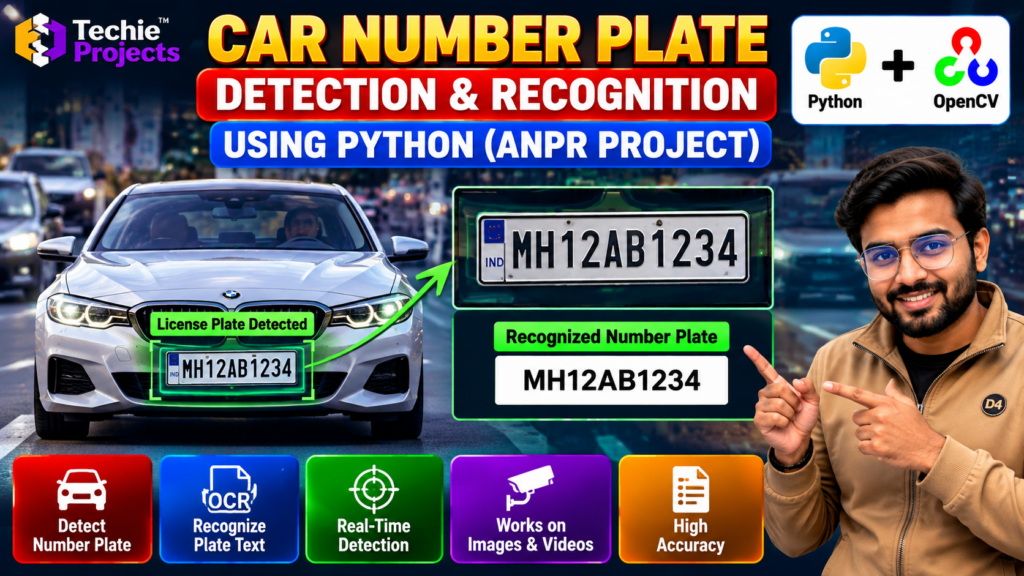
Car Number Plate Detection Using Python is a computer vision project that demonstrates how vehicles’ license plates can be detected and their characters recognized using image processing and optical character recognition (OCR). This project explores how Python and OpenCV can be used to build an Automatic Number Plate Recognition (ANPR) system for educational and research purposes.
Automatic number plate recognition is useful in applications such as parking management, vehicle monitoring, access control, and intelligent transportation systems. By developing this project, students can understand vehicle image processing, number plate localization, text extraction, and the fundamentals of computer vision.
The car number plate detection using Python project combines image processing and license plate recognition to demonstrate how vehicle registration text can be extracted from images. Using OpenCV and an appropriate detection or OCR method, students can explore the steps involved in building an Automatic Number Plate Recognition (ANPR) application.
If you are pursuing B.Tech, B.E., BCA, MCA, or another computer science program, this project can help you explore practical applications of Python and AI.
🎬 Project Demo
Explore the project demonstration to see how vehicle number plates can be detected and recognized, and how the system displays the extracted plate text.
🎯 Objectives of the Project
The main objectives of this project are:
- Detect license plates in supported vehicle images or video frames.
- Explore image processing techniques using Python and OpenCV.
- Extract number plate characters using an OCR method, if included in the implementation.
- Display detection results in a visual interface.
- Understand the workflow of an Automatic Number Plate Recognition system.
- Explore potential applications of computer vision in vehicle monitoring.
🚘 Key Features of Car Number Plate Detection Using Python
1. License Plate Detection
The system identifies the potential number plate region in a vehicle image or video frame using the implemented image processing or object detection method.
2. Number Plate Recognition
An OCR component can extract text from the detected plate region. Recognition quality depends on image resolution, lighting, plate orientation, and the OCR method used.
3. Image Processing Using OpenCV
OpenCV can support image resizing, grayscale conversion, noise reduction, thresholding, and other preprocessing operations that may improve plate localization or text extraction.
4. Image and Video Input
Depending on the implementation, the system may process saved vehicle images, recorded video, or a live camera stream.
5. Visual Detection Results
The application can display a detected plate region and extracted characters for review.
6. Scope for Further Development
The project can be extended with vehicle records, timestamp logging, a database, or a graphical user interface if these features are required.
⚙️ How Does the Project Work?
The typical workflow of a number plate recognition application includes the following steps.
Step 1: Input Vehicle Image
The application receives an image or video frame containing a vehicle.
Step 2: Image Preprocessing
Python and OpenCV can prepare the image using techniques such as grayscale conversion, noise reduction, and thresholding.
Step 3: License Plate Localization
The selected detection method identifies the region that may contain the vehicle’s number plate.
Step 4: Character Extraction
The detected plate region is cropped and prepared for text recognition.
Step 5: OCR-Based Recognition
If OCR is part of the implementation, the system attempts to extract the characters from the cropped plate.
Step 6: Display the Result
The application presents the detected plate region and recognized text for inspection.
🛠️ Technologies Used
The technologies depend on the version of the project being developed. Common options include:
- Python: Main programming language.
- OpenCV: Image processing and video analysis.
- OCR Library: EasyOCR or Tesseract, if used for character recognition.
- NumPy: Numerical and image-array operations.
- YOLO or another detection model: Optional, if used to locate number plates.
- Tkinter: Optional graphical user interface.
Check the actual project implementation before installing libraries or describing a particular model as included.
💻 Software Requirements
Typical requirements include:
- Python 3.x compatible with the selected libraries
- Visual Studio Code, PyCharm, or another Python IDE
- OpenCV
- NumPy
- The selected OCR library, if applicable
- Compatible image or video input files
🖥️ Hardware Requirements
- Laptop or desktop computer
- Minimum 4 GB RAM for a basic development environment
- Sufficient storage for images, videos, and dependencies
- Webcam or camera if live input is supported
More memory or GPU resources may be necessary for deep learning-based detection models.
🌍 Applications of Automatic Number Plate Recognition
Parking Management
A number plate recognition system can be explored for vehicle entry and exit monitoring in parking facilities.
Vehicle Access Control
The project can be extended to compare recognized plate text against an authorized vehicle list. Any real access-control system requires suitable security and validation.
Intelligent Transportation
Number plate recognition is one possible component of broader intelligent transportation applications.
Vehicle Monitoring
The project can demonstrate how vehicle images are processed to extract identifying plate text.
Academic Research
Students can evaluate different preprocessing techniques, detection models, and OCR methods to understand their effect on recognition results.
✅ Advantages of the Project
- Provides hands-on experience with Python and OpenCV.
- Demonstrates image processing and OCR concepts.
- Offers visual results for project demonstrations.
- Can be extended with databases and user interfaces.
- Introduces an application of computer vision to vehicle monitoring.
- Provides opportunities to evaluate recognition accuracy and limitations.
⚠️ Limitations
- Blurry or low-resolution images may reduce recognition accuracy.
- Poor lighting, reflections, and unusual viewing angles can affect results.
- Incorrect plate localization can lead to incorrect text extraction.
- Different plate formats may require additional preprocessing.
- A demonstration project is not automatically suitable for production or law-enforcement use.
🔮 Future Scope
The car number plate detection using Python system can be extended with vehicle entry logging, database integration, and improved OCR techniques. These enhancements can help students explore more advanced vehicle monitoring applications and evaluate recognition performance under different image conditions.
The project can be extended in several ways:
- Real-Time Recognition: Add camera input if the current version supports only images.
- Database Integration: Store recognized plate text and timestamps.
- Vehicle Entry and Exit Logging: Explore a parking-management workflow.
- Improved OCR: Compare OCR methods using a representative dataset.
- Deep Learning Detection: Evaluate a suitable object detection model.
- Graphical User Interface: Add a user-friendly interface for selecting images and viewing results.
- Performance Evaluation: Measure detection performance and character recognition accuracy.
These extensions may require additional coding and testing beyond the existing implementation.
🎓 Why Choose This as a Final-Year Project?
Car Number Plate Detection Using Python is a suitable topic to explore if you are interested in computer vision, image processing, OCR, and AI applications.
It can help you demonstrate:
- Python programming skills
- Image preprocessing and analysis
- Number plate localization
- OCR concepts
- Testing and performance evaluation
- Project documentation and presentation
Before choosing the project, confirm that its features and deliverables match your college’s requirements.
🛒 Get the Car Number Plate Detection Project
Looking for a Car Number Plate Detection Using Python project for your B.Tech, B.E., BCA, MCA, or final-year engineering submission?
Techie Projects helps students explore engineering project options and enquire about available implementations.
You can contact us to discuss:
- Python source code availability
- Installation and execution instructions
- Software requirements and dependencies
- Project documentation and report availability
- Number plate detection and OCR functionality
- Customization and demonstration options
The exact deliverables depend on the selected project package, so please confirm availability and pricing before purchasing.
📲 Interested in Purchasing This Project?
Enquire About the ANPR Project on WhatsApp
📲 Call/WhatsApp: +91-9460060699
🌎 Website: www.techieprojects.com
📺 Instagram: @pythonprojects_
Tell us your course, submission deadline, and required features so we can discuss the available options.
🎓 Recommended Projects
Explore these related project topics on Techie Projects. Link each title to its relevant published article.
- Vehicle Detection and Counting Using Python — explore vehicle detection and traffic analysis.
- Smart Traffic Management System Using Artificial Intelligence — investigate traffic monitoring with computer vision.
- Helmet Detection Using Python — explore road-safety monitoring.
- Car Crash Detection Using Python — investigate accident detection concepts.
- Real-Time Object Detection Using Python — learn about object detection in images and videos.
- Vehicle Detection Using YOLO — explore deep learning-based vehicle detection, if available on your website.
Visit Techie Projects to explore more Python, AI, and computer vision projects.
❓ Frequently Asked Questions
1. What is car number plate detection using Python?
It is a computer vision application that identifies a vehicle’s license plate region and may extract its characters using OCR.
2. Which libraries can be used?
Python, OpenCV, NumPy, and an OCR library such as EasyOCR or Tesseract are common options. The actual requirements depend on the implementation.
3. Can the project recognize plates from videos?
Yes, if video processing is implemented. Real-time camera support may require additional configuration.
4. Is this project suitable for final-year engineering students?
It can be suitable for computer science and related engineering students, subject to their academic requirements and project scope.
5. How can I purchase the project?
Contact Techie Projects on WhatsApp to enquire about the available implementation, source code, documentation, features, and pricing.
Conclusion
Car Number Plate Detection Using Python demonstrates how computer vision and OCR can be combined to identify license plate regions and extract text from vehicle images. The project offers students a practical introduction to image processing, recognition techniques, and vehicle-monitoring applications.
If you want to explore this project for your mini-project or final-year submission, contact Techie Projects to discuss the available implementation and deliverables.
Ready to discuss your project?