
Introduction
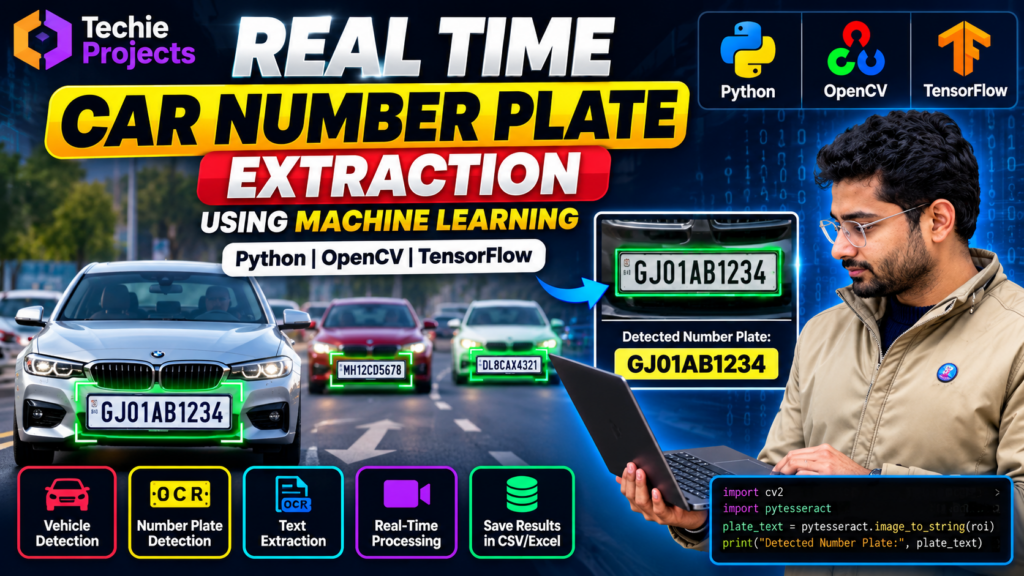
Real time car number plate extraction using machine learning is a computer vision project that detects vehicle number plates from images or video streams and extracts the plate text using image processing and Optical Character Recognition (OCR). This Python-based project demonstrates how technologies such as OpenCV, machine learning techniques, and OCR can be combined to develop an automatic number plate recognition system.
The real time car number plate extraction using machine learning project combines Python-based image processing and OCR to demonstrate how vehicle registration numbers can be detected and converted into readable text.
The Real Time Car Number Plate Extraction Using Machine Learning project is suitable for final-year B.Tech, B.E., computer science, information technology, and AI/ML students who want practical experience building an intelligent vehicle recognition application.
If you are looking for a ready-to-run project with source code, implementation guidance, and customization options, Techie Projects can help you explore a solution suited to your academic requirements.
🎬 Real Time Car Number Plate Extraction – Project Demo Video
Watch the project demonstration to understand how the system processes vehicle images, identifies number plates, and extracts text from the detected plate. The demo also introduces the Python-based workflow and the technologies used to build the application.
The demonstration can help students understand the project’s interface, processing pipeline, and potential applications before choosing it for a final-year project.
What Is a Car Number Plate Recognition System?
A car number plate recognition system is an application that identifies a vehicle’s registration plate and converts the characters into machine-readable text. Depending on the implementation, it can process still images, recorded videos, or live camera footage.
A typical system includes these stages:
- Vehicle image capture: Obtain an image or video frame containing a vehicle.
- Image preprocessing: Improve the image and prepare it for detection.
- Number plate detection: Locate the likely plate region using computer vision or a trained detection model.
- Character recognition: Apply OCR to extract the letters and numbers.
- Result display: Display the extracted text and optionally save results for later review.
The accuracy of the output depends on lighting, camera quality, vehicle speed, plate condition, viewing angle, and the models used.
Key Features of the Project
The real time car number plate extraction project can demonstrate the following features, depending on the supplied implementation:
- Vehicle number plate detection: Locate a plate within a supported image or video frame.
- OCR-based text extraction: Convert visible registration characters into text.
- Video processing: Process frames from a supported video source.
- Visual output: Display the detected plate region and recognized text.
- Python implementation: Explore the use of Python libraries for computer vision.
- Result storage: Extend the application to save recognized plate text and timestamps in a CSV or Excel file.
- Customization opportunities: Adapt the project for different datasets, camera inputs, and academic requirements.
Features such as live camera processing, automatic record storage, and multiple-vehicle tracking should be confirmed against the actual project version before purchase.
Technologies Used
The project may use the following technologies, depending on the implementation:
- Python: Main programming language.
- OpenCV: Image processing, video frame handling, and computer vision operations.
- OCR library: Text extraction from detected number plate regions.
- Machine learning or deep learning: Optional trained models for plate detection.
- TensorFlow: Used when the selected model or implementation requires it.
Not every implementation requires TensorFlow. The final technology stack depends on the detection and recognition approach included in the project.
How Does the System Work?
The real time car number plate extraction using machine learning workflow connects image preprocessing, plate localization, and character recognition in a single application. Students can explore each stage to understand how computer vision systems process vehicle images.
1. Image or Video Input
The application receives an image, recorded video, or supported live camera feed containing one or more vehicles.
2. Image Preprocessing
OpenCV can be used to resize frames, adjust image properties, reduce noise, and prepare the input for detection.
3. Number Plate Localization
The system identifies the region that is likely to contain the vehicle’s registration plate. This can be implemented using image processing, a trained object detection model, or a combination of techniques.
4. Text Recognition Using OCR
After locating the plate, the system extracts the plate region and sends it to an OCR engine. The OCR engine attempts to recognize the registration characters.
5. Display and Save Results
The application displays the recognized plate text. With suitable implementation, the output can also include timestamps, confidence information, and a record of recognized vehicles.
Project Objectives
The main objectives of this project are to:
- Understand practical computer vision concepts using Python.
- Detect vehicle number plates in supported images or video.
- Explore OCR techniques for extracting alphanumeric text.
- Learn how image preprocessing affects recognition results.
- Develop an extensible application for vehicle-related automation.
- Demonstrate a practical AI or machine learning project during an academic presentation.
Software and Hardware Requirements
Software Requirements
- Programming language: Python
- Operating system: Windows or another supported Python environment
- Libraries: OpenCV and the OCR or machine learning dependencies used by the implementation
- Development environment: VS Code, PyCharm, or a compatible Python IDE
Hardware Requirements
- Computer or laptop capable of running Python
- Keyboard and mouse
- Webcam or video input if live processing is supported
- Additional computing resources if a deep learning model requires them
Exact package versions and system requirements should be checked against the project’s setup instructions.
Applications of Automatic Number Plate Recognition
Parking Management
A suitable implementation can assist with vehicle entry and exit recording at parking facilities.
Toll and Traffic Systems
Number plate recognition technology can support vehicle identification workflows in tolling and traffic-management environments.
Campus Vehicle Monitoring
Educational institutions can explore number plate recognition for controlled campus entry and vehicle logging prototypes.
Access Control
Organizations can investigate integrating plate recognition with an authorized vehicle database and access-control workflow.
Research and Academic Projects
Students can use the project to study image processing, OCR, object detection, and the challenges of real-world computer vision systems.
These are potential applications of the technology, not a guarantee that a student prototype is suitable for operational deployment.
Advantages of the Project
- Combines Python programming with practical computer vision.
- Demonstrates an end-to-end detection and text recognition workflow.
- Provides opportunities to experiment with image preprocessing and OCR.
- Can be extended with databases, reporting, or a graphical user interface.
- Offers useful learning experience for AI, machine learning, and image processing coursework.
Limitations and Future Scope
Number plate recognition can fail when images are blurred, plates are obscured, lighting is poor, or characters are difficult to distinguish. Different plate formats and languages may also require additional training or preprocessing.
Possible future improvements include:
- Integrating a trained number plate detection model.
- Improving OCR through plate-specific preprocessing.
- Adding timestamps and CSV or database storage.
- Building a dashboard to search and review recognition records.
- Evaluating performance on a diverse, legally obtained dataset.
- Adding safeguards for personal data and limiting access to vehicle records.
Any real-world deployment should comply with applicable privacy, data-protection, and vehicle-record regulations.
Why Choose Techie Projects for Your Final-Year Project?
Techie Projects helps students explore practical Python, machine learning, deep learning, and computer vision project options. If you need a project for your final-year submission, you can enquire about the available implementation and whether it can be customized for your requirements.
If you need a real time car number plate extraction using machine learning project for your final-year submission, contact Techie Projects to enquire about source code availability, implementation details, and customization options.
Before purchasing, ask about the included source code, setup instructions, supported features, software dependencies, demonstration, and available customization. Confirm the deliverables and compatibility with your college’s project requirements.
What You Can Enquire About
- Project source code and implementation details
- Installation and execution guidance
- Explanation of the workflow and technologies
- Customization based on your academic requirements
- Demonstration of the available implementation
Looking for a car number plate recognition project in Python? Contact Techie Projects to check availability, pricing, and customization options.
WhatsApp: https://wa.me/919460060699
Website: https://techieprojects.com/
Instagram: https://www.instagram.com/pythonprojects_/
Frequently Asked Questions
1. What is real time car number plate extraction using machine learning?
It is a computer vision application that locates vehicle registration plates in supported images or video and uses OCR to convert visible plate characters into text.
2. Which programming language is used for this project?
Python is commonly used, with OpenCV for image processing and an OCR library for character recognition. A machine learning model may also be used for plate detection.
3. Can the project process live video?
That depends on the implementation. A version configured for webcam or camera input can process live frames, while other versions may support only images or recorded videos.
4. Is this project suitable for final-year engineering students?
Yes, it can be a useful educational project for computer science, information technology, AI, and machine learning students, subject to their institution’s project guidelines.
5. Can I customize the project?
Customization may be possible for features such as result storage, user interfaces, datasets, and detection models. Contact Techie Projects to confirm the available options.
6. How can I purchase this project?
Contact Techie Projects through WhatsApp to ask about the available version, price, source code, setup guidance, and customization options.
7. Does the system always recognize number plates correctly?
No. Recognition depends on image quality, lighting, plate visibility, OCR performance, and the detection method. The system should be tested on representative data before any practical deployment.
🎓 Explore Related Projects
Explore these related project topics on Techie Projects to find an option that matches your interests:
- Vehicle Detection and Counting Using Python
- Vehicle Speed Detection Using OpenCV
- Automatic Number Plate Recognition Using Deep Learning
- Traffic Sign Recognition Using Machine Learning
- Road Accident Detection Using Computer Vision
- Smart Parking Management System Using Python
Browse the Machine Learning Projects, Deep Learning Projects, and OpenCV Projects categories for more ideas.
Conclusion
Real time car number plate extraction using machine learning is a practical way to explore vehicle detection, image processing, and OCR using Python. It introduces students to a complete computer vision workflow and offers opportunities to extend the system with video processing, structured result storage, and improved recognition models.
If you want to explore this project for your final-year submission, contact Techie Projects to confirm the available source code, features, pricing, and customization options.
Start your project enquiry today: Contact Techie Projects on WhatsApp
Academic note: Use this project to support learning and demonstrate your own understanding. Follow your institution’s rules on project assistance, attribution, and submission. This prototype should not be treated as a guaranteed or fully validated vehicle surveillance system.
📲 Call/WhatsApp: +91-9460060699
🌎 Website: www.techieprojects.com
📺 Instagram: @pythonprojects_