
Introduction
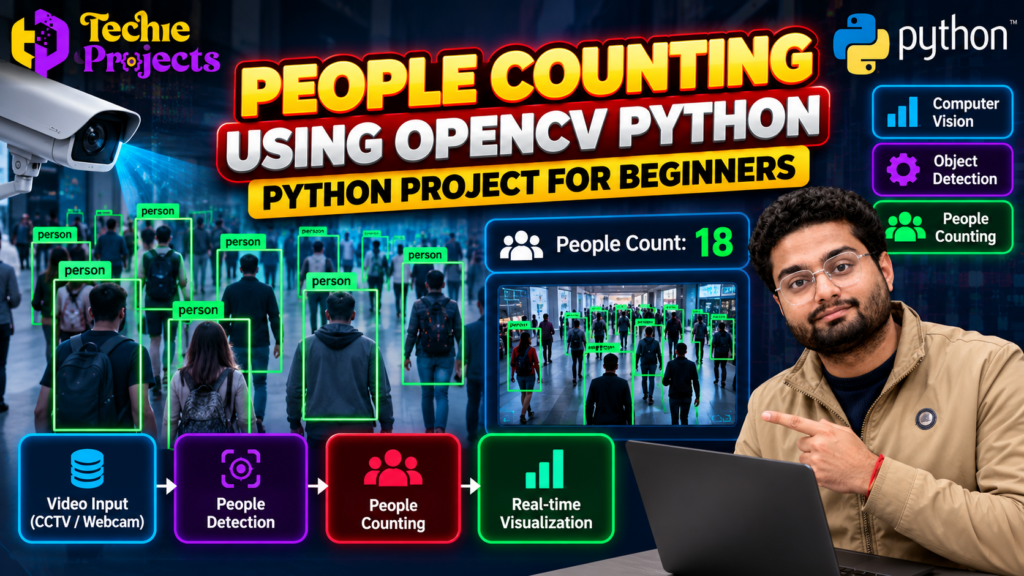
People counting using OpenCV Python is a computer vision project that detects and counts people in images or video streams using image processing and object detection techniques. This project is useful for students who want to explore artificial intelligence, video analytics, automation, and real-time computer vision applications.
In public places such as shopping malls, educational institutions, railway stations, offices, and event venues, understanding the number of people present can help with space management, crowd monitoring, and resource planning. A people counting system can analyze video frames, identify people, and display an estimated count on the screen.
The People Counting Using OpenCV Python project is suitable for B.Tech, B.E., computer science, information technology, artificial intelligence, and data science students. It offers practical experience with Python programming, OpenCV, image processing, object detection, and video analysis.
At Techie Projects, students can explore this project for academic learning, demonstrations, and final-year project development. Contact us for project availability, source code details, implementation guidance, and customization options based on your requirements.
🎬 People Counting Using OpenCV Python – Project Demo Video
Watch the project demonstration to understand how the people counting system processes video frames and identifies people using computer vision techniques.
The demo can help you understand the application’s interface, detection process, counting output, and overall workflow before deciding whether this project suits your academic requirements.
🎯 Project Overview
The primary objective of people counting using OpenCV Python is to develop a system that identifies people in a visual scene and calculates their number using computer vision methods.
The system can process video from a stored file or, if supported by the implementation, a live camera feed. Each frame is analyzed to identify people, and the detected results are displayed visually.
Depending on the selected detection and tracking approach, the system may count people visible in a frame or track individuals moving through a defined region. These are different counting methods: frame-based counting estimates how many people are visible at a particular moment, while line-crossing or region-based counting can estimate how many people enter or leave an area.
This distinction is important when selecting the project configuration for your requirements.
Key objectives
- Detect people in video frames.
- Display detection results using visual bounding boxes.
- Calculate the number of detected people.
- Demonstrate computer vision concepts with Python.
- Explore video processing and object detection.
- Build a foundation for advanced crowd analytics applications.
💡 Why Choose a People Counting Project?
People counting is a practical example of how computer vision can convert visual information into useful data. Instead of manually observing and counting individuals, an automated system can analyze video frames and present detection results.
For engineering students, this project connects programming concepts with a real-world application. It can also provide a starting point for learning about object detection, tracking algorithms, video analytics, and intelligent monitoring systems.
The project can be extended with features such as entry and exit counting, occupancy estimation, graphical reports, and dashboard integration, depending on the chosen implementation.
⚙️ How Does the People Counting System Work?
The workflow of people counting using OpenCV Python generally includes the following stages.
1. Video input
The application receives video from a webcam, CCTV-compatible video source, or prerecorded video file, depending on the implementation. The video is divided into individual frames for analysis.
2. Frame preprocessing
OpenCV helps read, process, resize, and display video frames. Preprocessing may be applied to improve processing efficiency or prepare frames for the selected detection model.
3. Person detection
A detection algorithm identifies regions in the frame that may contain people. Depending on the implementation, this may use a traditional computer vision technique or a trained deep learning object detection model.
4. Detection visualization
The application can draw bounding boxes around detected people and display labels or confidence scores. These visual indicators help users understand which objects the model has identified.
5. People counting
The system calculates the number of valid person detections in the processed frame. If tracking or line-crossing logic is implemented, it may also estimate how many people cross a selected boundary.
6. Displaying the result
The processed video is shown with the detection output and count. Additional features, such as saved results or graphical reports, can be added if required.
🚀 Main Features of the Project
The following are common features that can be implemented in a people counting application. The exact features available depend on the project version and selected detection model.
👥 Person detection
Identifies people in video frames and highlights the detected regions. Detection performance depends on lighting, camera angle, crowd density, image quality, and the model used.
🔢 Automatic counting
Calculates the number of detected people and displays the result. Frame-based counting and entry-exit counting should be configured according to the intended use.
🎥 Video processing
Processes recorded videos and can support live camera input when the application is configured for it.
🖥️ Visual output
Displays bounding boxes, detection labels, and the current count to make results easier to interpret.
🐍 Python implementation
Uses Python as the main programming language, with OpenCV providing video processing and image manipulation functionality.
🔧 Customization opportunities
The project can be extended with additional modules such as people tracking, occupancy thresholds, entry-exit monitoring, data logging, and report generation.
🛠️ Technologies Used
People counting using OpenCV Python can be developed with a combination of the following technologies.
- Python: Main programming language for application logic.
- OpenCV: Video capture, frame processing, drawing, and display.
- Object detection model: Identifies people in images or video frames, if included in the implementation.
- NumPy: Supports numerical operations and image-array processing.
- Tracking algorithm: Can maintain object identities across frames when tracking functionality is required.
- Matplotlib or a dashboard library: Optional tools for visualizing saved results or building reports.
The exact libraries and model requirements depend on the source code and selected implementation. Not every version requires every technology listed above.
💻 Software and Hardware Requirements
Software requirements
- Operating system: Windows or Linux, depending on compatibility.
- Programming language: Python.
- IDE: Visual Studio Code, PyCharm, or another compatible Python editor.
- Libraries: OpenCV and NumPy, plus any dependencies required by the selected detection model.
- Input: Compatible video file or camera source, depending on the configuration.
Hardware requirements
- Computer or laptop capable of running Python.
- Webcam or prerecorded video for testing.
- Adequate RAM and storage for the selected model and video resolution.
- A compatible GPU may improve performance for some deep learning models, but it is not necessarily required for every implementation.
Always verify the specific Python version and library dependencies before installation.
📍 Applications of People Counting Using OpenCV Python
🛍️ Shopping malls and retail stores
People counting can help estimate customer traffic and understand busy periods. Aggregated counts may support staffing and store-layout decisions.
🏫 Colleges and educational institutions
A people counting prototype can demonstrate occupancy estimation in classrooms, laboratories, libraries, and campus facilities.
🚉 Railway stations and transport facilities
Video-based counting can help estimate the number of visible people in selected areas and support crowd-management research.
🏢 Offices and commercial buildings
Organizations can explore occupancy estimation to support space planning and facility management.
🎤 Events and exhibitions
The system can be used as a prototype for estimating attendance in a defined camera view.
🏟️ Public venues
Crowd analytics can provide useful information for capacity planning when deployed with appropriate validation and operational safeguards.
These are potential applications, not a guarantee that a student prototype is suitable for safety-critical or production deployment.
📊 Advantages of the Project
- Demonstrates practical computer vision concepts.
- Helps students learn Python and OpenCV.
- Can automate counting within a defined visual scene.
- Supports experimentation with video files and compatible camera feeds.
- Can be extended with object tracking and reporting.
- Provides an engaging demonstration for project presentations.
- Offers a foundation for advanced AI and video analytics projects.
⚠️ Limitations and Challenges
Although people counting using OpenCV Python is useful for learning, several factors can affect its performance.
Overlapping people: Individuals standing close together may be missed or counted incorrectly.
Lighting conditions: Poor lighting, shadows, and glare can reduce detection quality.
Camera position: An unsuitable angle may hide people or make detections less reliable.
Crowded scenes: Dense crowds can create occlusion and detection challenges.
Processing speed: High-resolution video and complex detection models may require additional computing resources.
Repeated counting: A system that counts every detection in every frame may count the same individual repeatedly. Tracking or line-crossing logic is needed for more reliable entry-exit totals.
These limitations should be evaluated when testing the application with different videos and environments.
🔬 Future Scope and Project Enhancements
Students can extend the basic people counting system in several ways.
Real-time occupancy monitoring
Add an occupancy indicator that compares the estimated number of people with a configured threshold.
Entry and exit counting
Use tracking and virtual lines to estimate how many people enter or leave a monitored region.
Crowd density estimation
Divide the scene into regions and analyze the distribution of detected people.
Data storage and reports
Save timestamped counts and generate daily or weekly summaries using a database or CSV files.
Web dashboard integration
Connect the detection system to a dashboard that displays counts and historical trends.
Advanced object detection
Experiment with suitable deep learning models to compare detection performance, inference speed, and resource requirements.
Privacy-conscious deployment
Use appropriate permissions, access controls, data minimization, and retention policies when working with real camera footage. Avoid collecting or storing personally identifiable information unless there is a legitimate, authorized need.
🎓 Why Choose Techie Projects for Your Academic Project?
Techie Projects helps students explore programming-based engineering projects and understand their implementation requirements.
If you are interested in purchasing the People Counting Using OpenCV Python project, contact us to discuss the available implementation and the support options offered for your requirements.
Depending on availability and the selected package, you can ask about:
- Project source code and setup requirements.
- Installation and execution guidance.
- Explanation of the workflow and important modules.
- Customization based on your project objectives.
- Demonstration and presentation preparation.
- Help understanding the implementation for your viva.
Before purchasing, confirm the exact deliverables, supported Python version, included features, documentation, and any additional charges for customization.
📩 Get the People Counting Project
Are you looking for a computer vision project for your final-year engineering submission? The People Counting Using OpenCV Python project is a useful option to explore if you want to learn video processing, object detection, and automated counting.
Contact Techie Projects to check availability, pricing, source code options, and customization support.
📲 Call/WhatsApp: +91-9460060699
🌎 Website: www.techieprojects.com
📺 Instagram: @pythonprojects_
Send your course, project requirements, and preferred features so the available implementation can be discussed with you.
🎓 Explore Related Projects
Explore these related project topics to discover more ideas in computer vision, Python, and artificial intelligence:
- Object Detection Using Python
- Vehicle Detection and Counting System
- Face Recognition Attendance System
- Crowd Monitoring Using Computer Vision
- Real-Time Object Detection Using Deep Learning
- Intrusion Detection System Using Machine Learning
Visit the Computer Vision and OpenCV project resources and Deep Learning Projects sections on Techie Projects to explore related topics. Confirm individual project availability before requesting a purchase.
❓ Frequently Asked Questions
1. What is people counting using OpenCV Python?
It is a computer vision application that analyzes video frames to detect people and calculate their number. Depending on the implementation, it may also track people or estimate entry and exit counts.
2. Which programming language is used in this project?
Python is the primary programming language, while OpenCV is commonly used for video processing and image manipulation.
3. Can this project count people in real time?
Real-time counting is possible when the selected implementation supports a live camera source and the computer can process frames at an appropriate speed.
4. Does the project require a GPU?
Not always. Basic OpenCV processing and some lightweight detection models can run on a CPU. More computationally intensive models may benefit from a compatible GPU.
5. Can I customize the people counting project?
Potential customizations include entry-exit counting, tracking, occupancy thresholds, data logging, and dashboards. Confirm which modifications are supported before purchasing.
6. Is this project suitable for final-year engineering students?
It can be suitable for computer science, information technology, AI, and data science students, depending on their course requirements and the complexity expected by their institution.
7. How can I purchase the project?
Contact Techie Projects through WhatsApp to ask about availability, pricing, deliverables, and customization options.
📝 Conclusion
People counting using OpenCV Python demonstrates how computer vision can analyze video footage, identify people, and produce useful counting results. It combines Python programming, video processing, and object detection in a practical application that students can explore and extend.
From occupancy estimation to crowd analytics, this project offers several opportunities for experimentation and further development. Its actual performance depends on the detection method, video conditions, and counting logic used.
If you want to explore this project for your academic work, contact Techie Projects to discuss source code availability, implementation details, and customization options.
Build your computer vision skills with a project that connects Python programming to a real-world application.