
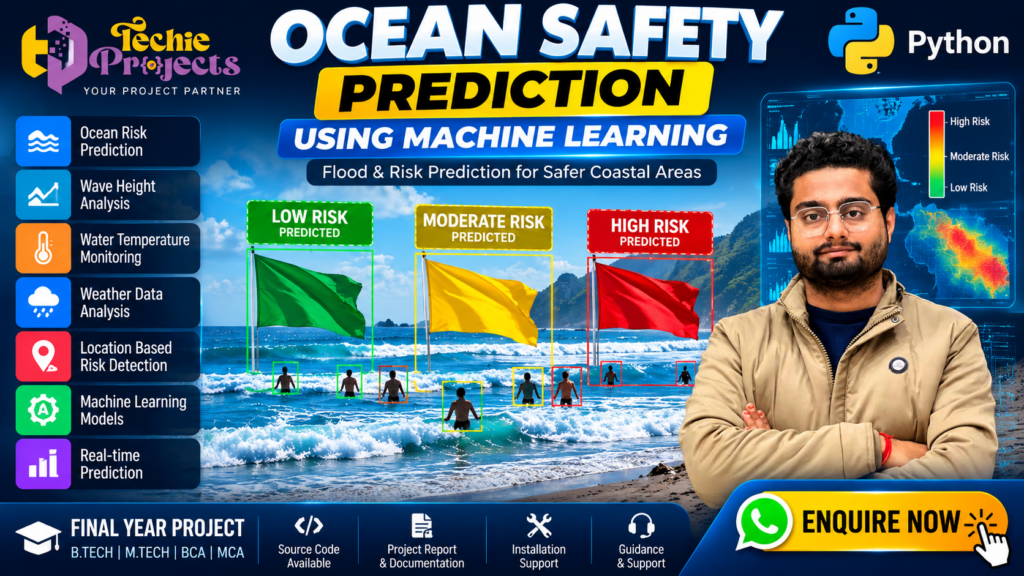
🌊 Are you looking for an impressive machine learning project that combines Python, environmental data analysis, and ocean risk prediction? The Ocean Safety Prediction Using Machine Learning project is an excellent topic for students who want to explore how artificial intelligence can help analyse ocean conditions and classify potential safety risks.
Instead of spending weeks searching for datasets, selecting algorithms, planning the interface, and assembling project documentation, you can enquire about the available project package from Techie Projects. Discuss your requirements before purchasing to confirm the available source code, implementation details, project report, installation guidance, and technical support options.
This project explores how environmental information, such as wave conditions, water temperature, weather measurements, and other relevant inputs, may be used to classify ocean conditions into risk categories. It offers a practical way to study machine learning workflows while developing a project that can be explained and demonstrated during an academic presentation.
🎬 Ocean Safety Prediction Using Machine Learning – Project Demo
Watch the project demonstration to understand the proposed workflow, the user interface, and how the system presents different ocean risk categories.
The demonstration can help you evaluate the project’s presentation and understand its intended functionality before enquiring about the available package. Review the displayed inputs, prediction output, and implementation details carefully to ensure they match your academic requirements.
📞 Contact Techie Projects for Project Enquiries
Interested in purchasing the Ocean Safety Prediction Using Machine Learning project? Contact Techie Projects to enquire about package availability, pricing, source code, documentation, installation guidance, and technical support options.
💬 WhatsApp Enquiry: Chat with Techie Projects
📱 Contact Number: +91 94600 60699
🌐 Official Website: https://techieprojects.com/
📸 Instagram: Follow Techie Projects
🎓 Project Categories: Machine Learning, Python, Artificial Intelligence, Environmental Data Analysis, and Prediction Systems.
✅ Request Project Details: Share your degree, engineering branch, preferred features, and technical requirements so the team can discuss a suitable available package.
🚀 Ready to get started? Enquire on WhatsApp and mention Ocean Safety Prediction Using Machine Learning.
🌊 What Is Ocean Safety Prediction Using Machine Learning?
Ocean safety prediction is an application area in which environmental observations and relevant data are analysed to understand conditions that may affect people near the sea. Machine learning can help identify patterns in historical data and use those patterns to generate classifications or predictions.
In this academic project, the system can be designed to accept relevant environmental inputs and return a risk category, such as low, moderate, or high. The exact inputs and prediction capabilities depend on the dataset, trained model, and implementation used in the selected project package.
For example, a model trained on suitable historical measurements may classify a set of conditions as a particular risk level. A user interface can then display the result in a clear format, making the output easier to understand during a demonstration.
It is important to distinguish an academic prediction model from a certified coastal warning system. A student project should not be treated as a substitute for official weather forecasts, lifeguard instructions, or emergency alerts.
🎯 Objectives of the Project
The main objective of the Ocean Safety Prediction Using Machine Learning project is to demonstrate how data-driven techniques can be applied to environmental risk classification.
Key learning objectives include:
- Understanding the role of machine learning in environmental analysis.
- Preparing and cleaning a dataset for model training.
- Selecting suitable input features for a prediction task.
- Training and evaluating a classification model.
- Displaying model output through a simple interface.
- Understanding the relationship between environmental data and predicted risk categories.
- Explaining model limitations and evaluation results during a project presentation.
These objectives make the project relevant to students studying computer science, artificial intelligence, data science, and related disciplines.
⚙️ Key Features of the Project
The final features depend on the actual implementation and the package selected. Possible features include the following.
1. 🌊 Ocean Risk Classification
The system can classify environmental conditions into categories such as low, moderate, and high risk when those categories are supported by the trained model and dataset.
The classification output should be presented clearly so users can understand the model’s result. The categories must be documented accurately rather than presented as guaranteed safety assessments.
2. 🌦️ Environmental Data Analysis
Environmental data can be examined to identify patterns and relationships among relevant measurements. Depending on the dataset, features might include wave height, water temperature, wind speed, or weather-related observations.
Only variables available in the actual dataset should be included in the implementation.
3. 🤖 Machine Learning Model
A supervised classification algorithm may be trained using labelled historical observations. The choice of algorithm depends on dataset size, feature types, model performance, and project requirements.
Possible algorithms include decision trees, random forests, logistic regression, or other appropriate classifiers. These are options to evaluate, not a claim that every algorithm is implemented in the project.
4. 📊 Prediction Results
The application may present its output using labels, visual indicators, tables, or charts. A clear interface helps students explain the input data, prediction process, and resulting classification.
5. 💻 User-Friendly Interface
A simple interface can allow users to enter supported values and view the model’s result without directly interacting with the Python code.
The interface framework should be confirmed before purchasing. Python projects may use tools such as Streamlit, Flask, Tkinter, or another suitable framework depending on the implementation.
6. 📈 Model Evaluation
A reliable academic project should evaluate its model on data that was not used for training. Depending on the task, evaluation may include accuracy, precision, recall, F1-score, and a confusion matrix.
These metrics help explain how often the model predicts the correct class and which categories may be difficult to distinguish.
🌊 Applications of Ocean Safety Prediction Using Machine Learning
The Ocean Safety Prediction Using Machine Learning project demonstrates how environmental data can be analysed to classify ocean conditions into different risk categories. This approach provides a practical learning opportunity for students interested in artificial intelligence, environmental monitoring, and predictive analytics.
Potential academic applications include studying historical ocean observations, analysing environmental patterns, developing risk classification dashboards, and exploring how machine learning models interpret different input variables. The actual applications depend on the available dataset and the model’s demonstrated capabilities.
🧠 Technologies Used in the Project
The technology stack depends on the actual source code supplied with the project. A possible implementation may use:
- Python: Main programming language for data processing and model development.
- Pandas: Data loading, cleaning, and manipulation.
- NumPy: Numerical operations and data preparation.
- Scikit-learn: Model training, evaluation, and preprocessing.
- Matplotlib or Seaborn: Visualising data and model results.
- Streamlit, Flask, or Tkinter: Optional interface development, depending on the implementation.
- Jupyter Notebook or VS Code: Development, testing, and code exploration.
Before purchasing, request confirmation of the installed libraries, Python version, operating-system requirements, and any additional dependencies.
📂 Dataset and Data Preprocessing
Data quality is an important part of any machine learning application. Environmental datasets may contain missing values, inconsistent units, duplicated rows, or measurements recorded under different conditions.
A typical workflow may include the following steps:
- Load the available dataset into Python.
- Inspect column names, data types, and missing values.
- Remove duplicate or unsuitable records where appropriate.
- Select relevant features and the target variable.
- Encode categorical values if required.
- Split the data into training and testing subsets.
- Train the model using the training data.
- Evaluate the results on unseen test data.
The selected dataset should be relevant to the intended prediction task. A model trained on limited or unrepresentative data may not perform reliably under different environmental conditions.
🔄 How the System Works
A typical implementation follows a structured machine learning pipeline.
Step 1: Data collection
The project starts with an available dataset containing environmental measurements and, where required, labelled risk categories.
Step 2: Data preprocessing
The data is checked, cleaned, and transformed into a format suitable for the chosen algorithm.
Step 3: Model training
A classification model learns patterns from the training examples.
Step 4: Model testing
The trained model is evaluated using a separate test dataset to estimate how well it handles previously unseen examples.
Step 5: User input
The application accepts the input variables supported by the implementation.
Step 6: Risk classification
The model processes the input and returns a predicted category.
Step 7: Result presentation
The interface displays the prediction and, where available, supporting information such as charts or model evaluation results.
This workflow provides a useful demonstration of how a machine learning application moves from raw data to a visible output.
🎓 Benefits for Engineering and Computer Science Students
The Ocean Safety Prediction Using Machine Learning project can help students connect theoretical concepts with practical implementation.
Practical Python Experience
Students can explore data structures, preprocessing, functions, model training, and evaluation within a single application.
Understanding Machine Learning
The project offers opportunities to study labelled datasets, classification algorithms, model validation, and prediction outputs.
Project Presentation Preparation
A well-documented implementation gives students a structured way to explain the problem statement, methodology, technology stack, workflow, and limitations.
Portfolio Development
After understanding and adapting the code, students can document their contribution and showcase the project as part of a technical portfolio where permitted by their institution.
Scope for Further Development
Students can explore additional datasets, compare algorithms, improve the interface, or evaluate different feature combinations as part of their own learning.
📊 Advantages of Ocean Safety Prediction Using Machine Learning
One important advantage of the Ocean Safety Prediction Using Machine Learning approach is that it connects Python programming with a real-world environmental problem. Students can explore data preprocessing, feature selection, classification algorithms, and model evaluation within a single project.
Other potential benefits include:
- 🌐 Understanding environmental data analysis.
- 🤖 Learning practical machine learning workflows.
- 📈 Comparing classification results using evaluation metrics.
- 💻 Developing a simple interface for presenting predictions.
- 🎓 Preparing a structured academic demonstration.
- 🔍 Identifying model limitations and opportunities for improvement.
These benefits make the topic useful for students who want to develop practical skills while studying data-driven prediction systems.
🛒 Why Enquire About This Project from Techie Projects?
Choosing a suitable project package can save time during planning and help students understand the scope of the implementation before committing to it.
Techie Projects provides an enquiry channel for students looking for software and engineering project options. Before ordering, discuss the deliverables and confirm exactly what is included.
What to Confirm Before Purchasing
- Source code: Confirm whether the complete source code is included.
- Project documentation: Ask whether a project report or technical documentation is available.
- Installation guidance: Confirm the Python version, dependencies, and setup process.
- Demonstration: Ask to review the available project demo and interface.
- Technical support: Confirm the scope and availability of installation or troubleshooting assistance.
- Customisation: Discuss whether modifications are possible and whether additional charges apply.
- Delivery and pricing: Request the current package price, delivery timeline, and payment terms.
Package contents may vary, so obtain confirmation before placing an order.
🧪 Testing and Evaluation
Testing is essential for understanding whether the project behaves as expected. A useful evaluation plan can include:
- Checking that supported input values are accepted.
- Verifying that missing or invalid values are handled appropriately.
- Confirming that the model produces an output for valid inputs.
- Evaluating classification performance on unseen test data.
- Reviewing a confusion matrix to identify common classification errors.
- Testing the interface and documenting any limitations.
A strong academic report should explain the actual evaluation procedure and results. Avoid claiming a particular accuracy percentage unless it has been measured and can be supported by the implementation.
🧪 Model Evaluation in Ocean Safety Prediction Using Machine Learning
Evaluating the model is an essential part of the Ocean Safety Prediction Using Machine Learning project. Students should test the trained model using data that was not used during training and report the results accurately.
Depending on the classification task, evaluation may include accuracy, precision, recall, F1-score, and a confusion matrix. These measurements help explain how well the model identifies the categories represented in the dataset.
A responsible evaluation should also discuss missing data, dataset limitations, possible classification errors, and the difference between an academic prediction and a verified operational ocean warning system.
🚀 Future Scope of Ocean Safety Prediction
There are several possible extensions for students who want to explore this subject further.
Integration of More Environmental Features
Additional relevant measurements may improve the model if reliable data is available and the features are appropriate for the prediction task.
Comparison of Machine Learning Algorithms
Different classification algorithms can be evaluated using the same data split and metrics to understand their strengths and weaknesses.
Visual Analytics Dashboard
A dashboard could display dataset trends, model performance, and prediction categories in a more accessible format.
Time-Series Analysis
Where suitable historical measurements are available, students could explore temporal patterns and time-series forecasting methods.
Integration with Live Data
An advanced prototype could investigate the use of verified weather or ocean data feeds. Such integration requires compatible data sources, appropriate validation, and careful handling of missing or delayed observations.
These extensions are potential research directions, not guaranteed features of the existing project package.
⚠️ Limitations and Safety Considerations
Machine learning predictions depend on the quality, coverage, and relevance of the training data. A model may perform poorly when environmental conditions differ significantly from those represented in its dataset.
A low-risk classification should not be interpreted as a guarantee that swimming or other ocean activities are safe. Real-world coastal safety depends on multiple factors, and operational warning systems require appropriate validation, current data, and expert oversight.
For an academic demonstration, clearly state the model’s assumptions, dataset source, evaluation results, and limitations. Follow official local safety instructions when making real-world decisions near the ocean.
❓ Frequently Asked Questions
1. What is the Ocean Safety Prediction Using Machine Learning project?
It is an academic project concept that uses environmental data and machine learning to classify or analyse potential ocean risk conditions.
2. Which programming language is used?
Python is a suitable choice for data processing, model development, and evaluation. Confirm the language and framework used in the available package before purchasing.
3. Is the project suitable for final-year students?
It can be suitable for computer science, AI, machine learning, and data science students, depending on their syllabus, project scope, and institutional requirements.
4. Does the project include source code?
Source code availability depends on the selected package. Contact Techie Projects to confirm the deliverables before ordering.
5. Can the project include a user interface?
A user interface can be developed using a suitable framework. Confirm whether an interface is included in the available implementation.
6. Does the model provide real-time ocean warnings?
Not necessarily. Real-time warnings require current, reliable environmental data, suitable model validation, and appropriate deployment. An academic model should not be assumed to provide operational safety alerts.
7. How can I enquire about pricing?
Contact Techie Projects through WhatsApp and mention the project name. Share your requirements to request details about pricing, documentation, installation, and support.
8. Can I customise the project?
Possible modifications depend on the available source code, data, and package terms. Discuss the required changes before purchasing.
🎓 Explore Related Python Projects
If you are exploring machine learning and data-driven applications, you may also be interested in these project topics:
- Crop Yield Prediction Using Machine Learning
- Heart Disease Prediction Using Machine Learning
- Autism Prediction System Using Machine Learning
- Nail Disease Detection using Machine Learning
- Remote Controlled River Cleaning Boat Project
- Forest Fire Prediction Using Machine Learning
- Disease Prediction Using Machine Learning
- IoT-Based Smart Home Automation System Project
Choose a project that matches your academic objectives, available datasets, and preferred technology stack. You can explore more topics at Techie Projects.
🛒 Get the Ocean Safety Prediction Using Machine Learning Project
Looking for a project package for your academic work? Contact Techie Projects to discuss the Ocean Safety Prediction Using Machine Learning project and confirm the available source code, documentation, installation requirements, demonstration, and technical support options.
💬 WhatsApp: Enquire about the project
🌐 Website: Techie Projects
Share your course, branch, and required features to receive details about package availability and pricing before purchasing.
📞 Get Started with Techie Projects
The Ocean Safety Prediction Using Machine Learning project offers a practical way to explore Python programming, environmental data analysis, classification algorithms, and model evaluation.
If you want to review the available project package, discuss source code and documentation, or ask about installation support, contact Techie Projects before purchasing. Confirm the deliverables, project requirements, and price so you can make an informed decision.
Build your understanding of machine learning through a project you can explain, evaluate, and develop further as part of your academic learning.