
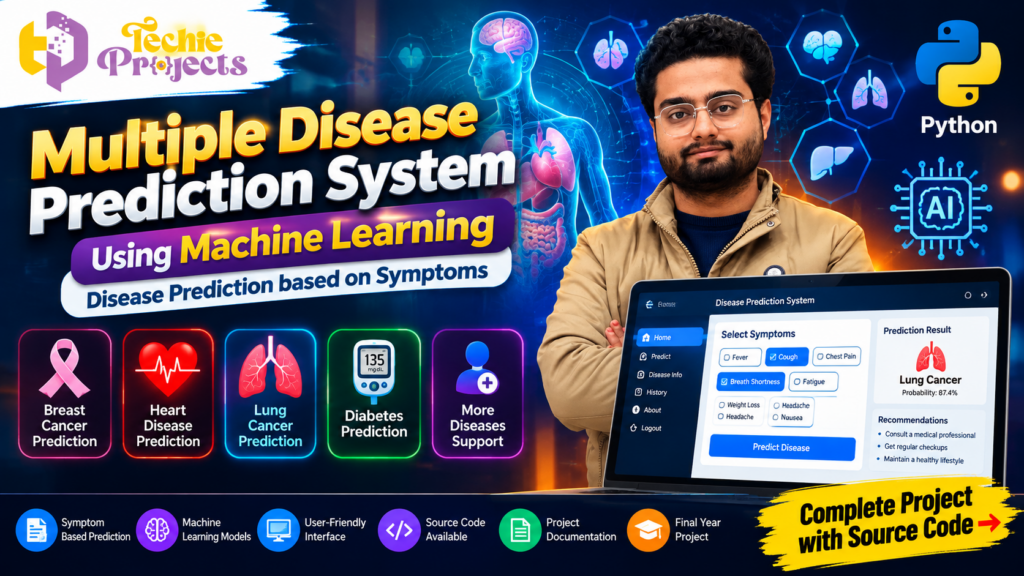
🚀 Looking for a complete Multiple Disease Prediction Using Machine Learning project for your final-year submission? Explore this Python-based healthcare project from Techie Projects and learn how machine learning can be used to analyze health-related inputs and generate prediction results through a user-friendly application.
If you are a B.Tech, M.Tech, BCA, MCA, or computer science student, this project can help you understand practical applications of Python, machine learning algorithms, data preprocessing, and healthcare data analysis. Instead of spending your entire project timeline building every component from scratch, you can enquire about the available project package from Techie Projects, including source code, documentation, installation guidance, and technical support options.
The Multiple Disease Prediction Using Machine Learning project demonstrates how a software application can use health-related input data or selected symptoms to generate predictions for supported disease categories. Depending on the implemented version, the system may include modules related to heart disease, diabetes, breast cancer, lung cancer, and other supported conditions.
Get in touch with Techie Projects to check the available package, understand its features, and select the project resources that match your academic requirements.
📞 Contact Techie Projects for Project Enquiries
Want to purchase the Multiple Disease Prediction Using Machine Learning project? Contact Techie Projects to discuss source code availability, documentation, project installation, and technical assistance.
- 📱 WhatsApp: Enquire Now
- 🌐 Website: https://techieprojects.com/
- 📸 Instagram: Techie Projects
- ☎️ Contact Number: +91 94600 60699
Share your course, project requirements, and expected submission date to help the team understand your needs. Confirm the package contents and support terms before placing your order.
🎬 Multiple Disease Prediction Using Machine Learning – Project Overview
The Multiple Disease Prediction Using Machine Learning project is a Python-based application designed to demonstrate how machine learning techniques can be applied to healthcare-related datasets.
The system can accept selected health parameters or symptoms and process the information using the prediction logic implemented in the project. The application then displays a result through its graphical user interface.
A multiple disease prediction system can bring different prediction modules together in one application. Instead of developing a separate interface for every prediction task, developers can organize multiple models or prediction workflows within a single software platform.
For an academic project, this provides an opportunity to understand how datasets, machine learning models, input forms, and graphical interfaces work together.
The main purpose of this project is educational. Its prediction results should not be used to diagnose medical conditions, make treatment decisions, or replace consultation with qualified healthcare professionals.
🧠 What Is Multiple Disease Prediction Using Machine Learning?
Multiple disease prediction is an application of machine learning in which a software system uses relevant input features to estimate the possibility of different health conditions.
Machine learning algorithms identify patterns from training datasets. After training, a model can process new input data and generate a prediction based on the patterns it has learned.
For example, a heart disease prediction model may use features such as age, cholesterol level, blood pressure, and other dataset-specific attributes. A diabetes prediction model may use features such as glucose level, BMI, age, and other relevant parameters.
Different diseases require different datasets, input features, and model configurations. Therefore, each prediction module must be trained and evaluated using suitable data.
The Multiple Disease Prediction Using Machine Learning project brings these concepts together in a common software application. It helps students explore the relationship between data science, healthcare analytics, and intelligent software development.
✨ Key Features of the Multiple Disease Prediction System
The project can include the following features, depending on the actual source-code version and supported prediction modules.
❤️ 1. Heart Disease Prediction
The heart disease module demonstrates how machine learning can analyze selected health-related parameters from a dataset to generate a prediction.
Students can explore data preprocessing, feature selection, model training, and prediction output. The model’s performance should be evaluated using appropriate test data.
🩺 2. Diabetes Prediction
The diabetes prediction module can use relevant health attributes, such as glucose level, BMI, age, and other available dataset features.
The application processes the entered values and displays the output generated by its trained model. Students can study how classification algorithms work with structured healthcare datasets.
🎗️ 3. Breast Cancer Prediction
A breast cancer prediction module can demonstrate classification using numerical features from an appropriate breast cancer dataset.
Students can understand how a model learns patterns from labeled data and predicts a class for new input records. The prediction should be treated as an academic demonstration rather than a clinical result.
🫁 4. Lung Cancer Prediction
If included in the selected version, the lung cancer module can demonstrate how machine learning processes relevant dataset attributes to generate a classification result.
The features and prediction logic must match the actual dataset and model used in the implementation.
🧩 5. Multiple Prediction Modules
One of the key ideas behind this project is combining multiple prediction tasks within one application.
A common interface can allow users to select a prediction category and enter the corresponding input values. Each module can then use its own trained model or prediction logic.
🖥️ 6. Graphical User Interface
A graphical user interface makes the application easier to operate and demonstrate. Students can explore how input fields, buttons, navigation options, and result screens are connected to the Python backend.
📊 7. Prediction Results
After processing the submitted values, the application displays the result generated by the relevant model. Students can study how the backend connects model predictions with the interface.
⚙️ Technologies Used in the Project
The Multiple Disease Prediction Using Machine Learning project uses Python as its primary programming language. Additional technologies depend on the selected implementation.
| Technology | Purpose |
|---|---|
| Python | Main programming language |
| Pandas | Dataset handling and data analysis |
| NumPy | Numerical operations |
| Scikit-learn | Machine learning algorithms and model evaluation |
| Matplotlib | Data visualization, if included |
| Seaborn | Statistical visualization, if included |
| Tkinter | Desktop graphical user interface, if used |
| Pickle or Joblib | Saving and loading trained models, if used |
| VS Code or PyCharm | Development environment |
The exact libraries and versions should be confirmed against the delivered source code. Students should install compatible dependencies before running the application.
🔄 How Multiple Disease Prediction Using Machine Learning Works
The general workflow of the application can be understood through the following stages.
Step 1: Collecting the Dataset
Machine learning requires relevant data for training and evaluation. Each disease prediction module needs an appropriate dataset containing the features and labels required for that task.
For example, a diabetes dataset and a heart disease dataset contain different attributes. They should not be treated as interchangeable.
Step 2: Data Preprocessing
Raw datasets may contain missing values, inconsistent formats, duplicate records, or features that require transformation.
Data preprocessing prepares the dataset for machine learning. Depending on the dataset, this stage may include:
- Handling missing values.
- Removing duplicate records.
- Converting categorical variables.
- Scaling numerical features.
- Separating input features and target labels.
- Splitting data into training and testing sets.
Step 3: Model Training
After preprocessing, the selected algorithm is trained using the training dataset.
Common classification algorithms that students may explore include:
- Logistic Regression.
- Decision Tree.
- Random Forest.
- Support Vector Machine.
- K-Nearest Neighbors.
- Naive Bayes.
The best algorithm depends on the dataset and evaluation results. Different prediction modules may require different models.
Step 4: Model Evaluation
The trained model should be evaluated using data that was not used during training.
Common evaluation metrics include accuracy, precision, recall, F1-score, and a confusion matrix. For healthcare-related classification, it is particularly important to understand false positives and false negatives rather than relying only on accuracy.
Step 5: Connecting Models with the Application
The trained models can be saved and loaded into the Python application. The interface collects the required input values and passes them to the appropriate prediction module.
Step 6: Generating Prediction Results
The selected model processes the input and generates its output. The application then displays the result to the user.
The output should clearly communicate that it is a model-generated estimate and not a confirmed medical diagnosis.
📂 Project Modules and Application Structure
A well-organized Multiple Disease Prediction Using Machine Learning project can be divided into different modules.
1. Home Module
The home screen provides navigation to the available prediction options and other application pages.
2. Disease Selection Module
Users select the prediction category they want to explore. The system opens the relevant input form.
3. Input Data Module
The application collects the required values for the selected model. Input validation helps prevent empty, invalid, or incorrectly formatted values.
4. Prediction Module
The backend loads the relevant trained model and processes the submitted input.
5. Result Module
The result screen displays the model output in a clear format.
6. About and Information Module
An information page can explain the project’s educational purpose, technologies, limitations, and development details.
🎓 Benefits for Final-Year Engineering Students
The Multiple Disease Prediction Using Machine Learning project can be a useful academic learning experience for students interested in artificial intelligence and data science.
Practical Machine Learning Experience
Students can understand how a machine learning workflow moves from dataset collection and preprocessing to model training and prediction.
Python Programming Skills
The project helps students work with Python functions, libraries, data structures, file handling, and application development.
Understanding Healthcare Analytics
Students can explore how structured healthcare datasets are used in academic machine learning experiments.
Project Demonstration
The graphical interface provides a way to demonstrate the application workflow during a project presentation or viva.
Customization Opportunities
Students can explore additional datasets, compare classification algorithms, improve interface design, and add evaluation reports, subject to the project’s structure and available data.
Better Technical Understanding
Working through the source code can help students explain the model, dataset, input features, prediction workflow, and limitations during academic evaluation.
🛒 Why Purchase the Project from Techie Projects?
Developing a complete machine learning application requires several steps, including dataset preparation, coding, model training, testing, interface development, and documentation.
If you need a project reference or a ready-to-study implementation, Techie Projects provides an opportunity to enquire about available academic project packages.
Before purchasing, discuss the following details with the team:
- Availability of complete Python source code.
- Supported disease prediction modules.
- Dataset details and model information.
- Installation instructions.
- Python and library version requirements.
- Project documentation or report availability.
- Project synopsis and presentation availability.
- Code explanation and technical support options.
- Customization possibilities.
Package contents and support availability may vary. Confirm all deliverables, pricing, and terms before making payment.
💰 Enquire About the Project Package
Looking for the Multiple Disease Prediction Using Machine Learning source code?
Contact Techie Projects to discuss the available version and package options.
You can also visit Techie Projects to explore other Python, artificial intelligence, machine learning, and final-year engineering projects.
💻 System Requirements
The system requirements depend on the model, datasets, Python version, and graphical interface included in the project.
Typical requirements may include:
- Windows 10 or Windows 11, or another supported operating system.
- Python 3.x compatible with the project’s dependencies.
- Minimum 4 GB RAM, with 8 GB or more recommended for smoother development.
- Adequate disk space for source code, datasets, and model files.
- VS Code, PyCharm, or another Python IDE.
- Required Python packages installed in a compatible environment.
A GPU is generally not necessary for basic tabular machine learning models. However, resource requirements may differ if additional deep learning components are included.
🧪 Testing and Model Evaluation
Testing is essential to understand whether the application behaves correctly.
Students should test each prediction module separately and verify that the correct model is being used.
Some useful testing activities include:
- Entering valid sample inputs.
- Checking how the system handles empty fields.
- Testing invalid numerical values.
- Verifying that each disease module opens correctly.
- Checking whether the correct model loads.
- Comparing prediction output with the expected application behavior.
- Testing the interface on different screen sizes, where applicable.
- Evaluating the machine learning model using suitable test data.
Students should document the evaluation results accurately. Do not claim that the system provides clinically reliable predictions based only on a successful software demonstration.
🚀 Future Scope of Multiple Disease Prediction Using Machine Learning
The project can be extended in several ways to explore more advanced machine learning and healthcare analytics concepts.
1. Additional Disease Prediction Models
Developers can explore adding new prediction modules using suitable datasets, features, and independently evaluated models.
2. Improved Model Performance
Students can compare algorithms, tune hyperparameters, improve preprocessing, and evaluate performance on separate test datasets.
3. Web-Based Application
The desktop interface could be extended into a web application using a suitable Python framework such as Flask or Streamlit.
4. Data Visualization Dashboard
Charts and graphs could help display dataset distributions, model comparisons, and evaluation metrics.
5. Improved User Experience
A better interface, clearer instructions, input validation, and accessible design can make the application easier to use.
6. Privacy and Security
Future versions should consider secure data handling, limited data collection, transparent privacy notices, and access controls wherever user information is stored.
These enhancements are possible development directions and should not be considered existing features unless they are implemented in the selected project version.
🛡️ Important Disclaimer: Educational Use Only
The Multiple Disease Prediction Using Machine Learning project is intended for academic learning, programming practice, and machine learning demonstration.
Its output is not a medical diagnosis, and the system should not be used to make decisions about treatment, medication, or healthcare. Machine learning predictions can be inaccurate because of dataset limitations, bias, incomplete input, and model performance issues.
Anyone concerned about their health should consult a qualified medical professional. The project should clearly communicate its limitations to users.
❓ Frequently Asked Questions
1. What is the Multiple Disease Prediction Using Machine Learning project?
It is a Python-based educational application that demonstrates how machine learning models can process health-related data and generate predictions for supported disease categories.
2. Which programming language is used?
Python is the primary programming language. Libraries such as Pandas, NumPy, and Scikit-learn may be used depending on the implementation.
3. Which diseases can the system predict?
The available categories depend on the implemented models. The project shown demonstrates examples such as heart disease, diabetes, breast cancer, and lung cancer. Confirm the exact supported modules before purchasing.
4. Is this project suitable for B.Tech and MCA students?
It may be suitable for computer science, information technology, and related academic programs, subject to the requirements of the student’s institution.
5. Can I purchase the source code?
You can contact Techie Projects to check source code availability, pricing, included resources, and applicable usage terms.
6. Does the project include a project report?
Report and documentation availability depends on the selected package. Confirm the deliverables with Techie Projects before ordering.
7. Can I modify the project?
Customization may be possible depending on the source code, dataset, and selected package. Discuss your required changes before purchasing.
8. Does the application provide accurate medical diagnoses?
No. It is an educational machine learning demonstration and should not be used as a clinical diagnostic system.
9. Do I need a GPU to run this project?
Basic tabular machine learning models generally run on a regular computer without a dedicated GPU. Requirements depend on the selected implementation.
10. How can I contact Techie Projects?
Visit techieprojects.com or contact the team directly through WhatsApp.
🔗 Explore Related Machine Learning Projects
Interested in exploring more academic projects? Visit Techie Projects for related topics:
- Heart Disease Prediction Using Machine Learning
- Diabetes Prediction Using Machine Learning
- Breast Cancer Prediction Using Machine Learning
- Lung Cancer Prediction Using Machine Learning
- Brain Tumor Detection Using Deep Learning
- Skin Cancer Detection Using Machine Learning
- Brain Stroke Classification Using CT and MRI Images
- Eye Disease Prediction using Machine Learning
Explore more topics through the Techie Projects website.
📞 Purchase Multiple Disease Prediction Using Machine Learning Project
Ready to explore this project for your final-year academic work?
Contact Techie Projects to enquire about the Multiple Disease Prediction Using Machine Learning project package. Discuss the source code, documentation, supported modules, installation requirements, and technical support options before placing your order.
Get started with your project enquiry today!
- 📲 Call/WhatsApp: +91-9460060699
- 🌎 Website: www.techieprojects.com
- 📺 Instagram: @pythonprojects_
- ☎️ Contact: +91 94600 60699
🎯 Conclusion
The Multiple Disease Prediction Using Machine Learning project demonstrates how Python and machine learning can be combined to develop a healthcare-related prediction application. By bringing different prediction modules into one interface, the project gives students an opportunity to explore data preprocessing, classification algorithms, model evaluation, and graphical user interface development.
For students looking for a project reference or implementation resources, Techie Projects offers a place to enquire about available source code, documentation, installation guidance, and technical support options.
Contact Techie Projects today to discuss the available package and take the next step in your machine learning project journey.