
🎓 Introduction
Diabetes is a common chronic health condition that requires proper monitoring and timely medical attention. With the growth of Machine Learning and Artificial Intelligence, healthcare data can be analyzed to identify patterns that may help predict whether a person is at risk of diabetes.
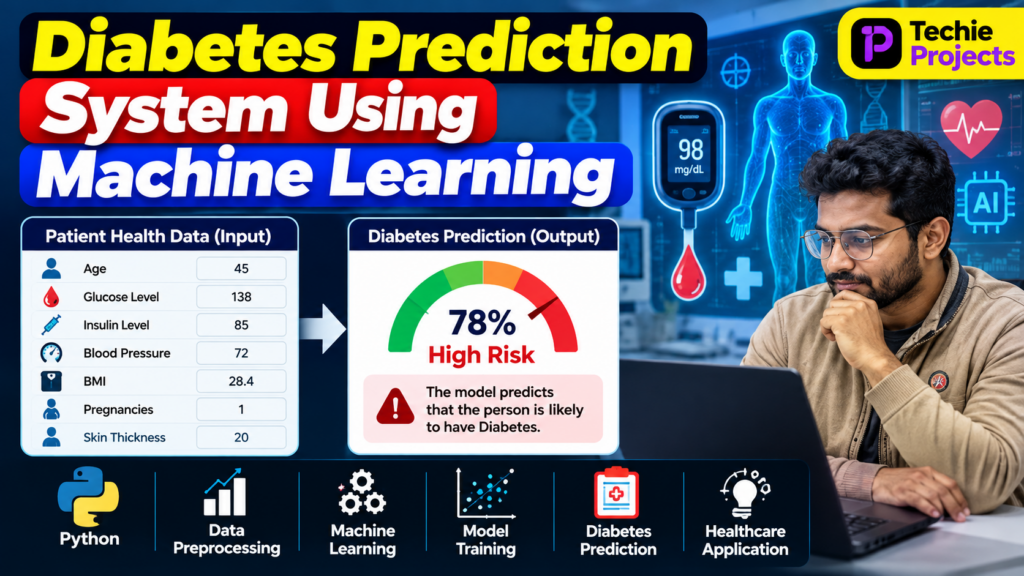
A Diabetes Prediction System Using Machine Learning is a Python-based project that analyzes patient health information and uses a trained machine learning model to generate a prediction. The project can be used by students to understand how healthcare datasets, data preprocessing, machine learning algorithms, and prediction systems work together.
This project is suitable for B.Tech, BCA, MCA, Computer Science, Information Technology, Artificial Intelligence, and final-year engineering students.
Medical Disclaimer: This project is intended for educational and research purposes only. A machine learning prediction should not be considered a medical diagnosis. Real healthcare decisions should always be made by qualified medical professionals.
🔍 What Is a Diabetes Prediction System?
A diabetes prediction system is a machine learning application that analyzes selected health-related attributes and predicts whether a person may belong to a diabetes-risk category based on patterns learned from historical data.
The system generally follows this process:
Patient Data → Data Preprocessing → Machine Learning Model → Prediction → Result
The input may contain attributes such as:
- Age
- Glucose level
- Blood pressure
- Insulin level
- BMI
- Skin thickness
- Number of pregnancies
- Diabetes pedigree information
The exact features depend on the dataset used for training the model.
🎯 Objectives of the Project
The main objectives of the Diabetes Prediction System Using Machine Learning are:
- Analyze a diabetes-related dataset.
- Perform data preprocessing and cleaning.
- Identify important features associated with prediction.
- Train a machine learning classification model.
- Evaluate the trained model using suitable performance metrics.
- Accept patient-related input from the user.
- Generate a machine learning-based prediction.
- Provide an easy-to-understand interface for demonstrating the prediction process.
- Help students understand the application of machine learning in healthcare analytics.
📊 Dataset Used for Diabetes Prediction
A diabetes prediction project requires a structured dataset containing health-related attributes and a target label.
A commonly used educational dataset contains variables such as:
| Feature | Description |
|---|---|
| Pregnancies | Number of pregnancies |
| Glucose | Blood glucose measurement |
| Blood Pressure | Blood pressure measurement |
| Skin Thickness | Skin fold thickness |
| Insulin | Insulin measurement |
| BMI | Body Mass Index |
| Diabetes Pedigree Function | Family-history-related statistical feature |
| Age | Patient age |
| Outcome | Target prediction label |
The dataset is divided into input features and a target variable before model training.
For an academic project, students should clearly mention the dataset source, preprocessing steps, and limitations of the dataset.
🧠 Machine Learning in Diabetes Prediction
Machine learning allows computers to learn patterns from historical data and use those patterns to make predictions on new data.
For diabetes prediction, the problem is commonly treated as a classification task.
Depending on the project requirements, students can experiment with algorithms such as:
- Logistic Regression
- Decision Tree
- Random Forest
- Support Vector Machine
- K-Nearest Neighbors
- Naive Bayes
- Gradient Boosting
Different algorithms may produce different results depending on the dataset, preprocessing, feature selection, and evaluation method.
⚙️ How the Diabetes Prediction System Works
The complete workflow can be divided into several stages.
Step 1: Collect the Dataset
The first step is to obtain a suitable diabetes dataset containing patient-related features and the target outcome.
The dataset should be inspected to understand:
- Number of records
- Number of features
- Missing values
- Data types
- Target distribution
- Possible outliers
Step 2: Data Preprocessing
Raw healthcare datasets may require preprocessing before they can be used for machine learning.
Common preprocessing operations include:
- Handling missing or invalid values
- Removing duplicate records
- Checking outliers
- Scaling numerical features
- Encoding categorical values when necessary
- Separating input and output variables
Good preprocessing can improve the reliability of the machine learning workflow.
Step 3: Exploratory Data Analysis
Exploratory Data Analysis helps students understand relationships between different features.
Charts can be used to examine:
- Glucose distribution
- Age distribution
- BMI distribution
- Blood pressure
- Outcome distribution
- Feature relationships
Libraries such as Pandas, NumPy, Matplotlib, and Seaborn can be used for data analysis and visualization.
Step 4: Split the Dataset
The dataset can be divided into training and testing subsets.
For example:
Training Data → Model Learning
Testing Data → Model Evaluation
A common approach is to use a larger portion of the dataset for training and the remaining portion for testing, although the exact split should depend on the dataset and experimental methodology.
Step 5: Train the Machine Learning Model
After preprocessing, the training data is supplied to the selected machine learning algorithm.
For example, a classification model can learn relationships between:
Input Features → Diabetes Outcome
The model attempts to learn patterns from the training examples.
Step 6: Evaluate the Model
After training, the model should be evaluated using data that was not used during training.
Common evaluation metrics include:
- Accuracy
- Precision
- Recall
- F1-score
- Confusion Matrix
- ROC-AUC
For healthcare-related classification, accuracy alone should not be treated as sufficient. Other metrics such as recall and precision can provide additional information about model performance.
Step 7: User Input
A user interface can be created where the user enters the required input values.
For example:
- Age
- Glucose
- Blood Pressure
- BMI
- Insulin
- Pregnancies
The input values are passed to the trained model after applying the same preprocessing used during training.
Step 8: Generate Prediction
The trained model processes the input and produces a prediction according to the classes defined by the dataset.
The application can display a result such as:
Prediction Result: Positive / Negative
The wording and interpretation should match the actual target variable used in the dataset.
🖥️ Technologies Used
A typical implementation can use:
- Python
- Pandas
- NumPy
- Scikit-learn
- Matplotlib
- Seaborn
- Jupyter Notebook
- Streamlit or Tkinter for the user interface
The exact technologies depend on the implementation selected for the project.
💻 Software Requirements
Programming Language
- Python 3.x
Python Libraries
- Pandas
- NumPy
- Scikit-learn
- Matplotlib
- Seaborn
Optional Interface
- Streamlit
- Tkinter
Development Tools
The project can be developed using:
- VS Code
- PyCharm
- Jupyter Notebook
- Anaconda
Operating System
- Windows 10/11
- Linux
- macOS
🖥️ Hardware Requirements
The basic version of the project does not require high-end hardware.
Recommended configuration:
- Intel Core i3/i5 or equivalent processor
- 4 GB RAM minimum
- 8 GB RAM recommended
- 5 GB or more available storage
- Keyboard and mouse
- Standard monitor
A dedicated GPU is generally not necessary for traditional machine learning algorithms used in this type of educational project.
📈 Important Features
A complete Diabetes Prediction System Using Machine Learning can include the following features.
👤 Patient Data Input
The application can provide fields for entering the required patient-related attributes.
🧹 Data Preprocessing
Input data can be cleaned and transformed before being passed to the machine learning model.
🤖 Machine Learning Prediction
The trained classification model generates a prediction based on the supplied input.
📊 Data Visualization
Charts can help demonstrate the distribution and relationships within the dataset.
📋 Model Evaluation
The system can display evaluation metrics such as accuracy, precision, recall, F1-score, and confusion matrix.
🖥️ User-Friendly Interface
A simple Streamlit or Tkinter interface can make the project easier to demonstrate.
📁 Dataset Management
The project can include functionality for loading and processing a CSV dataset.
🔄 Project Workflow
The overall workflow of the project can be represented as:
Diabetes Dataset
↓
Data Cleaning
↓
Exploratory Data Analysis
↓
Feature Selection
↓
Data Scaling
↓
Train-Test Split
↓
Machine Learning Model Training
↓
Model Evaluation
↓
User Input
↓
Diabetes Prediction
↓
Display Result
This workflow demonstrates the complete machine learning development process from raw data to prediction.
🧪 Model Training and Comparison
Students can improve the project by comparing multiple machine learning algorithms.
For example:
| Algorithm | Purpose |
|---|---|
| Logistic Regression | Classification baseline |
| Decision Tree | Rule-based classification |
| Random Forest | Ensemble classification |
| SVM | Classification using decision boundaries |
| KNN | Similarity-based classification |
| Naive Bayes | Probabilistic classification |
Instead of selecting a model only because it produces the highest accuracy, students should compare multiple evaluation metrics and explain why a particular model was selected.
📊 Confusion Matrix
A confusion matrix can be used to understand classification results.
It generally contains:
- True Positive
- True Negative
- False Positive
- False Negative
This helps students understand where the model is making correct and incorrect predictions.
For a healthcare-related educational project, examining false negatives and false positives can be especially important when interpreting model performance.
🎥 Project Working Demo
Before selecting or purchasing the project, students can watch the Diabetes Prediction System Using Machine Learning working demo to understand the interface, patient input process, machine learning prediction workflow, and overall project functionality.
The working demonstration can provide a practical understanding of how the application operates beyond the theoretical explanation.
🚀 Applications
A diabetes prediction project can be used for educational and research applications such as:
- Machine learning research
- Healthcare data analysis
- Academic demonstrations
- Classification model comparison
- Predictive analytics learning
- Data science projects
- Artificial intelligence projects
- Final-year engineering projects
The system should not be presented as a replacement for professional medical diagnosis.
⚠️ Limitations
A machine learning-based diabetes prediction system has several limitations.
Dataset Dependency
Model performance depends heavily on the quality, size, representativeness, and labeling of the dataset.
Prediction Is Not Diagnosis
A model prediction does not confirm that an individual has diabetes.
Data Quality
Incorrect, incomplete, biased, or outdated data can negatively affect model performance.
Generalization
A model trained on one dataset may not perform equally well on different populations or healthcare environments.
Feature Limitations
The model only considers the variables provided to it. Important medical information may not be represented in the dataset.
Healthcare Validation
A student project should not be deployed for real clinical decision-making without appropriate validation, regulatory review, privacy safeguards, and professional oversight.
🔐 Privacy and Ethical Considerations
Healthcare information can be sensitive. If real patient data is used, appropriate privacy, security, consent, and data-protection requirements must be followed.
For student demonstrations, publicly available or properly anonymized datasets should be preferred.
The project should be presented as an educational machine learning system, not as a clinical diagnostic tool.
🔮 Future Scope
The project can be enhanced in several ways.
Advanced Machine Learning Models
Students can experiment with ensemble methods and advanced classification techniques.
Explainable AI
Explainable AI methods can help show which input features contributed to a model’s prediction.
Web Application
The machine learning model can be integrated into a web-based application using Streamlit or another suitable framework.
Cloud Deployment
An educational version can be deployed to a cloud platform for demonstration purposes, subject to appropriate security and privacy controls.
Model Comparison Dashboard
A dashboard can compare different machine learning algorithms using multiple evaluation metrics.
Improved Dataset
The project can be tested with larger, diverse, and properly validated datasets.
Model Monitoring
Future implementations could monitor model performance over time and identify potential changes in data distribution.
🎓 Why This Is a Good Final-Year Project
The Diabetes Prediction System Using Machine Learning combines several important concepts in computer science and artificial intelligence.
Students can learn:
- Python programming
- Data preprocessing
- Exploratory data analysis
- Feature engineering
- Machine learning
- Classification algorithms
- Model evaluation
- Data visualization
- User interface development
- Predictive analytics
It can therefore be developed as a practical B.Tech, BCA, MCA, AI, Machine Learning, or Data Science final-year project.
❓ Frequently Asked Questions
What is a Diabetes Prediction System?
It is a machine learning application that analyzes selected health-related input features and generates a prediction based on patterns learned from a diabetes dataset.
Which programming language is used?
Python is commonly used because it provides powerful libraries for data analysis and machine learning.
Which machine learning algorithms can be used?
Algorithms such as Logistic Regression, Decision Tree, Random Forest, SVM, KNN, and Naive Bayes can be evaluated depending on the dataset and project requirements.
Is this project suitable for final-year students?
Yes. It is suitable for students studying Computer Science, IT, Artificial Intelligence, Machine Learning, Data Science, BCA, MCA, and related engineering programs.
Can the project have a graphical interface?
Yes. A user interface can be developed using Streamlit, Tkinter, or another suitable framework.
Can the prediction be considered a medical diagnosis?
No. A machine learning prediction from an academic project should not be considered a medical diagnosis. Medical decisions should be made by qualified healthcare professionals.
Can the project be customized?
Yes. Students can customize the dataset, algorithms, interface, visualization, model comparison, and reporting modules according to their academic requirements.
🔗 Explore Related Machine Learning Projects
Students interested in similar projects can also explore:
- Skin Cancer Detection Using Machine Learning
- Malware Detection Using Machine Learning
- Intrusion Detection System Using Machine Learning
- Dental Caries Detection Using Deep Learning
- Human Activity Recognition Using Deep Learning
🎓 Need Help With Your Final-Year Project?
Looking for a Python, AI, Machine Learning, Data Science, or final-year engineering project?
Techie Projects can help you discuss your project idea, required features, source-code requirements, documentation, and project scope before development.
📲 Call/WhatsApp: +91-9460060699
🌎 Website: www.techieprojects.com
📺 Instagram: @pythonprojects_
🏁 Conclusion
The Diabetes Prediction System Using Machine Learning is a practical Python project that demonstrates how healthcare-related datasets can be processed and analyzed using machine learning techniques.
From data preprocessing and exploratory analysis to model training, evaluation, and prediction, the project provides students with hands-on experience in the complete machine learning workflow.
With additional features such as model comparison, visualization, explainable AI, and a user-friendly web interface, the project can be expanded into a comprehensive academic machine learning and healthcare analytics project.
The system should always be treated as an educational or research tool, and its predictions should not replace professional medical evaluation or diagnosis.
📲 Call/WhatsApp: +91-9460060699
🌎 Website: www.techieprojects.com
📺 Instagram: @pythonprojects_