
Introduction
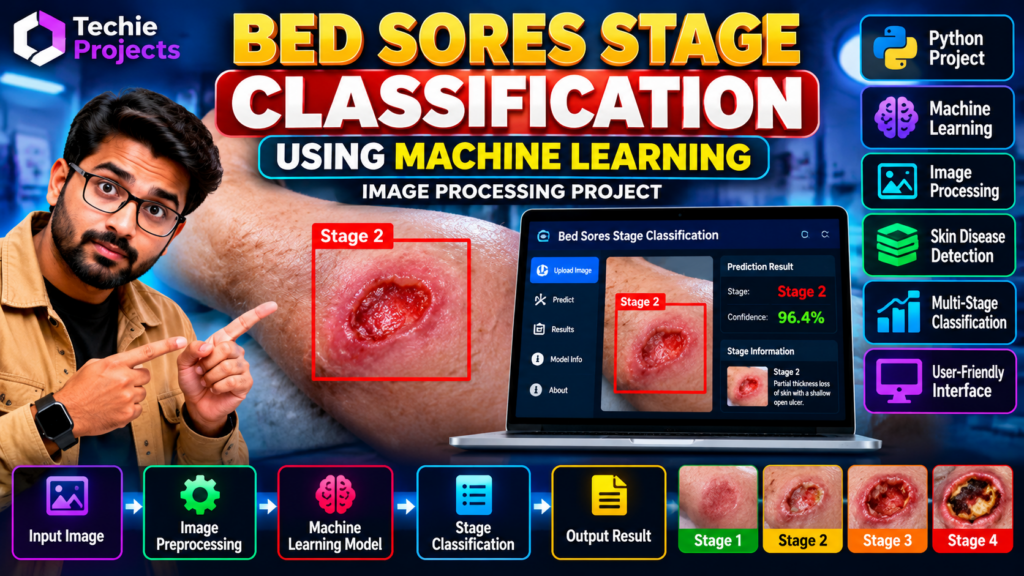
Bed sores stage classification using machine learning is an image processing and artificial intelligence project that explores how computer vision techniques can classify pressure ulcer images into different stages. Also known as pressure ulcers or decubitus ulcers, bed sores can develop when prolonged pressure damages the skin and underlying tissues.
This project demonstrates how Python, image processing, and machine learning can be combined to analyze wound images and predict a possible classification based on a trained model. It is suitable as an educational project for computer science, artificial intelligence, machine learning, and image processing students.
If you are looking for a practical final-year project, this system provides an opportunity to explore image preprocessing, dataset preparation, model training, and prediction using a graphical interface.
Important: This is an educational prototype, not a clinically validated diagnostic system. Its predictions must not be used to diagnose or determine treatment for a patient.
🎬 Project Demo: Bed Sores Stage Classification Using Machine Learning
Watch the Bed Sores Stage Classification Using Machine Learning project demo to explore the application’s interface, wound image upload process, image preprocessing, and model-based classification workflow. The demonstration helps students understand how the project operates and displays prediction results.
This project is designed for educational purposes, allowing students to explore Python, image processing, and machine learning techniques through a practical application.
Interested in this project? Contact Techie Projects on WhatsApp for source code availability, project details, and pricing.
Note: This is an educational prototype and is not a clinically validated diagnostic tool.
🎓 What Is a Bed Sores Stage Classification Project?
A bed sores stage classification project uses image processing and a trained machine learning or deep learning model to analyze images of pressure ulcers. Depending on the dataset and the model implemented, the system may classify images into predefined categories representing different wound stages.
The project can help students understand how image-based classification systems work, from uploading an image to displaying a model-generated result.
🎯 Project Objectives
The main objectives of this project are:
- To develop an educational image classification application using Python.
- To prepare and preprocess wound image datasets.
- To explore machine learning and deep learning classification techniques.
- To classify images into categories represented in the training dataset.
- To display prediction results through a user-friendly interface.
- To evaluate the model using suitable performance metrics.
- To understand the limitations of AI-based image analysis in healthcare.
⚙️ Key Features
The following features can be included, depending on the actual implementation:
1. Image Upload
Allow users to select a wound image from their computer for analysis.
2. Image Preprocessing
Resize images and apply appropriate preprocessing to prepare them for the trained model.
3. Machine Learning Classification
Use a trained classification model to predict the image category based on patterns learned from the dataset.
4. Stage Classification Results
Display the predicted category and, if supported by the model, a confidence score.
5. User-Friendly Interface
Provide a simple interface for uploading images and viewing results.
6. Model Evaluation
Evaluate performance using metrics such as precision, recall, F1-score, and a confusion matrix where appropriate.
🔄 How Does the System Work?
The general workflow for this project consists of the following steps:
- Dataset collection: Obtain a suitable, properly licensed dataset of wound images with reliable labels.
- Image preprocessing: Resize images and normalize pixel values as required by the model.
- Dataset splitting: Divide the dataset into training, validation, and testing sets while preventing data leakage.
- Model selection: Choose a suitable image classification approach, such as a convolutional neural network (CNN).
- Model training: Train the model using the training dataset and tune it with validation data.
- Model evaluation: Measure performance on previously unseen test images.
- Image prediction: Pass an uploaded image through the trained model.
- Result display: Show the predicted dataset category in the application interface.
The quality of the results depends on the dataset, labeling quality, training procedure, and model design.
💻 Technologies Used
The technology stack may include:
- Programming language: Python
- Image processing: OpenCV and Pillow
- Deep learning: TensorFlow/Keras or PyTorch
- Numerical processing: NumPy
- Data analysis: Pandas and Matplotlib
- Interface: Tkinter or another framework supported by the implementation
- Development environment: Visual Studio Code, PyCharm, or Jupyter Notebook
Confirm the exact libraries and framework versions with the project package before installation.
🖥️ Software and Hardware Requirements
Software Requirements
- Python installed on the computer
- Required machine learning and image processing libraries
- A compatible development environment
- A supported operating system such as Windows or Linux
Hardware Requirements
- A computer with a modern processor
- Sufficient RAM for image processing and model inference
- Storage for the dataset, trained model, and source files
- A compatible GPU if required for model training
The actual requirements depend on the model architecture, dataset size, and whether training or only prediction will be performed.
📊 Applications of the Project
The project can be used for academic demonstrations and experimentation in:
- Medical image classification research
- Computer vision and deep learning education
- Image preprocessing and dataset analysis
- Healthcare AI prototype development
- Final-year computer science engineering projects
- Comparative evaluation of image classification models
The system should not replace professional wound assessment. Pressure ulcer staging requires clinical evaluation, and an image-only model may miss important information.
✅ Advantages
- Demonstrates a real-world image classification problem.
- Provides practical experience with Python and deep learning.
- Helps students understand dataset preparation and model evaluation.
- Can be extended with additional classification experiments.
- Offers an opportunity to build an image-based graphical application.
- Supports academic presentations and project demonstrations.
⚠️ Limitations
- Model performance depends on the quality and diversity of training images.
- Lighting, image angle, skin tone, and image quality can affect predictions.
- Incorrect dataset labels can lead to unreliable results.
- An image alone may not provide enough information for clinical staging.
- Predictions require careful evaluation and must not be treated as medical diagnoses.
🚀 Future Scope
Students can extend the project by exploring:
- CNN architecture comparisons
- Transfer learning with suitable pretrained models
- Data augmentation to improve training diversity
- Explainability techniques for model predictions
- Performance evaluation across different image groups
- A web-based interface for academic demonstrations
- Secure dataset management and experiment tracking
Any extension should be evaluated carefully before its results are presented as reliable.
Bed Sores Stage Classification Using Machine Learning Workflow
The bed sores stage classification using machine learning workflow includes dataset preparation, image preprocessing, model training, and prediction. Python libraries support image analysis and classification based on the categories represented in the training dataset.
Features of the Project
This bed sores stage classification using machine learning project demonstrates image uploads, preprocessing, model-based predictions, and result visualization. The available features depend on the implemented model and application.
Get the Project for Your Final Year
Interested in the bed sores stage classification using machine learning project? Contact Techie Projects to enquire about source code availability, setup instructions, documentation, customization, and pricing.
🎓 Why Choose This Project for Your Final Year?
The bed sores stage classification project combines programming, image processing, and machine learning in a practical academic application. It is suitable for students who want to demonstrate their understanding of computer vision and explore an AI-based healthcare use case.
Before selecting the project, review the available implementation, dataset, requirements, and features to ensure they meet your university’s project guidelines.
🛒 Get the Bed Sores Stage Classification Project
Looking for a bed sores stage classification using machine learning project for your final-year submission?
Techie Projects can help you enquire about project availability, source code, setup requirements, documentation, and customization options.
Contact us for project details and pricing:
- 📲 Call/WhatsApp: +91-9460060699
- 🌎 Website: www.techieprojects.com
- 📺 Instagram: @pythonprojects_
Please confirm the deliverables, supported features, and documentation included before purchasing.
🔗 Explore Related Projects
Students interested in related topics can explore:
❓ Frequently Asked Questions
1. What is a bed sores stage classification project?
It is an educational image classification project that explores using a trained machine learning model to categorize pressure ulcer images into predefined classes.
2. Which programming language is used?
Python is commonly used with image processing and machine learning libraries. The exact technology stack depends on the implementation.
3. Can this project be used for a final-year engineering submission?
It can be considered for an academic project, subject to your institution’s requirements, implementation quality, and supervisor approval.
4. Does the system provide medically reliable diagnoses?
No. An educational prototype is not a substitute for clinical assessment and should not be used to diagnose or stage pressure ulcers in real patients.
5. Can I enquire about the source code and project price?
Yes. Contact Techie Projects through the WhatsApp link above to confirm availability, pricing, deliverables, and customization options.
Conclusion
Bed sores stage classification using machine learning is a useful educational topic for students exploring Python, computer vision, and deep learning. By working through dataset preparation, image preprocessing, model training, and evaluation, students can gain practical experience in building an image classification application.
If you want to explore this project for your final-year engineering work, contact Techie Projects to discuss the available implementation and purchasing options.