
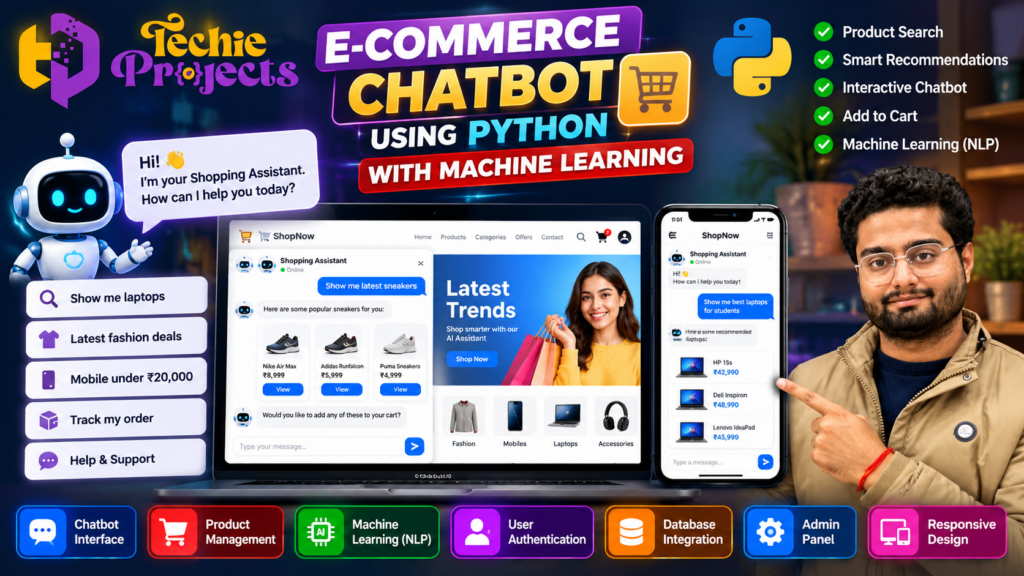
Ecommerce Chatbot using Machine Learning
The E-Commerce Chatbot Using Python with Machine Learning is a practical project that combines online shopping functionality, chatbot interaction, and intelligent product assistance. It demonstrates how a chatbot can help customers explore products, find relevant items, ask shopping-related questions, and improve their online shopping experience. This project is suitable for computer science engineering students, IT students, and learners interested in Python, machine learning, natural language processing (NLP), and web development.
At Techie Projects, students can explore project ideas designed to support practical learning and academic demonstrations. If you are looking for an e-commerce chatbot project for your final-year submission, this topic provides an opportunity to study the connection between conversational interfaces and online shopping applications.
🎬 Project Demo
Watch the project demonstration to understand the interface, chatbot interaction, and shopping workflow. The demo can help you explore how a conversational shopping assistant may guide users through product discovery and related activities.
🎓 What Is an E-Commerce Chatbot Using Python with Machine Learning?
An e-commerce chatbot is a software application that communicates with users through a chat interface and assists them with shopping-related tasks. Depending on its implementation, it may answer predefined questions, identify user requests, recommend products, or retrieve product information from a database.
An E-Commerce Chatbot Using Python with Machine Learning can use Python-based processing and machine learning techniques to interpret user messages and identify their intent. For example, a customer might ask to find laptops, explore fashion products, compare available items, or learn about an order.
The chatbot processes the user’s message and generates an appropriate response based on its programmed logic, available product information, and supported features. The exact capabilities depend on the model, dataset, backend, and modules included in the project.
This project is useful for understanding how conversational AI can be integrated into an online shopping environment.
An E-Commerce Chatbot Using Python with Machine Learning combines conversational interaction with intelligent product discovery. The system can process shopping-related queries, identify user intent, and display relevant product information based on its available data. This project helps students understand how Python, machine learning, and natural language processing can work together in an e-commerce application.
🎯 Objectives of the Project
The main objective is to develop a conversational shopping assistant that makes it easier for users to interact with an e-commerce application.
Key objectives include:
- Develop a chatbot interface for shopping-related conversations.
- Use Python to implement application logic and data processing.
- Explore machine learning techniques for understanding user requests.
- Organise product information for searching and displaying items.
- Provide relevant responses to supported customer queries.
- Understand how a chatbot can integrate with an online shopping workflow.
- Demonstrate the practical application of NLP and machine learning.
The final feature set depends on the specific implementation and project package selected.
⚙️ Technologies Used
Developing an E-Commerce Chatbot Using Python with Machine Learning involves connecting the chatbot interface with application logic and product data. Python can handle backend processing, while machine learning techniques can support intent classification when included in the implementation. Students can also explore text preprocessing, database integration, and response generation to understand the complete workflow.
1. Python
Python is commonly used to implement the backend logic, process user messages, connect application modules, and manage data. Its readable syntax and extensive ecosystem make it suitable for student projects.
2. Machine Learning
Machine learning methods can be used to classify user intents or identify patterns in text. The algorithm and training process depend on the available dataset and implementation.
3. Natural Language Processing (NLP)
NLP techniques help a system process text input. Depending on the design, these techniques may include text cleaning, tokenisation, feature extraction, intent classification, or other language-processing methods.
4. Web Interface
A web interface allows users to interact with the chatbot and view product information. The frontend technology depends on the project implementation and may involve HTML, CSS, JavaScript, or a Python-based interface framework.
5. Database
A database or structured data file can store product names, categories, prices, descriptions, and other relevant information. The selected storage method depends on the application’s requirements.
Important: Confirm the exact programming languages, libraries, framework, database, and machine learning algorithm included in the package before purchasing.
🔄 How Does the E-Commerce Chatbot Work?
A typical e-commerce chatbot follows a sequence of steps to process shopping-related requests.
Step 1: User Enters a Message
The user types a request into the chatbot interface. For example, the user might ask to find laptops, browse mobile phones, or explore products in a particular category.
Step 2: Text Processing
The application processes the input according to its design. Text preprocessing may help standardise the message before further analysis.
Step 3: Intent Identification
If the implementation uses machine learning for intent classification, the model analyses the processed text and predicts the category of the user’s request.
Step 4: Product Information Retrieval
The application retrieves matching information from its available product catalogue, database, or predefined responses.
Step 5: Chatbot Response
The chatbot displays a response based on the identified intent and retrieved information. Depending on the implemented features, the response may contain product names, descriptions, prices, or other details.
Step 6: Continued Interaction
The user can enter another query and continue interacting with the chatbot. Additional functions, such as product recommendations or cart management, require corresponding modules to be implemented.
✨ Key Features of the Project
An e-commerce chatbot project can demonstrate several features that are useful for academic learning.
Interactive Chat Interface
The chat interface allows users to enter questions and receive responses. It provides a straightforward way to demonstrate conversational interaction.
Product Search
A product search module can help users find items by name, category, or other supported attributes.
Product Recommendations
Depending on the implementation, recommendation logic can suggest products based on user input, product attributes, preferences, or predefined rules.
Machine Learning Integration
The project can demonstrate how a trained model identifies supported user intents or processes text-based requests.
Product Catalogue
A product catalogue organises information such as product names, categories, prices, and descriptions for retrieval and display.
User-Friendly Shopping Experience
A conversational interface can provide an alternative to navigating multiple pages or menus when searching for products.
Extendable Architecture
Students may extend the project with additional functions, such as order tracking, FAQs, user authentication, or administrative product management, if these are not already included.
🧩 Main Modules of the E-Commerce Chatbot Project
The project can be understood through the following modules:
1. User Interface Module: Provides the interface through which users communicate with the chatbot.
2. Chatbot Processing Module: Receives user input and manages the conversation flow.
3. NLP Module: Processes text and supports intent identification where implemented.
4. Machine Learning Module: Uses a trained model for supported classification or prediction tasks.
5. Product Management Module: Organises product details and makes them available to the application.
6. Response Generation Module: Produces responses based on user input and available information.
7. Data Storage Module: Stores or retrieves relevant application and product data.
8. Administration Module: If included, enables authorised users to manage products or related application information.
Before ordering, ask which of these modules are included in the actual deliverables and which would require additional development.
🎓 Why Choose This Project for Your Final Year?
The E-Commerce Chatbot Using Python with Machine Learning is a useful academic project for students interested in artificial intelligence and web development. It offers opportunities to study conversational interfaces, product search, text processing, and machine learning concepts through a practical application. Students can use the project to develop their technical understanding and prepare a demonstration based on the features actually implemented.
An e-commerce chatbot is a relevant topic for students who want to explore the relationship between artificial intelligence and web applications.
The project can help students:
- Understand Python-based application development.
- Learn the fundamentals of chatbot architecture.
- Explore machine learning and NLP concepts.
- Practise working with structured product data.
- Understand the connection between frontend and backend components.
- Prepare a project demonstration and technical explanation.
- Identify opportunities for future improvements.
It can also provide a starting point for learning about conversational commerce, intelligent search, and customer-support automation.
💡 Applications of an E-Commerce Chatbot
Online Shopping Websites
A chatbot can help customers search for products and access relevant catalogue information.
Customer Support
A chatbot can respond to supported frequently asked questions and provide basic guidance.
Product Discovery
Conversational search can help users explore product categories through natural-language queries.
Retail Applications
Retailers may use chat interfaces to make product information easier to access.
Academic Research
Students can experiment with intent classification, recommendation methods, conversational interfaces, and system evaluation.
These are potential applications. Actual performance and suitability depend on the implementation and testing.
🚀 Future Enhancements
Students can explore several improvements after understanding the basic system.
- Advanced NLP: Experiment with more capable language-processing models.
- Improved Recommendations: Develop recommendation methods using product attributes or user preferences.
- Voice Interaction: Add speech recognition and text-to-speech functionality.
- Order Tracking: Connect the chatbot to a suitable order-management module.
- Multilingual Support: Explore support for additional languages.
- Analytics Dashboard: Display information about common queries and chatbot usage.
- Secure Authentication: Add appropriate login and access-control functionality.
- Mobile-Friendly Interface: Improve the experience across different screen sizes.
These enhancements can make the project more technically challenging and provide further opportunities for experimentation.
💻 System Requirements
The exact requirements depend on the libraries and frameworks used in the selected version.
A typical Python-based implementation may require:
- A laptop or desktop computer.
- A supported version of Python.
- A code editor such as Visual Studio Code.
- The required Python libraries.
- Project files and any required datasets.
- A compatible web browser if the application uses a web interface.
Check the project’s documented software versions and installation instructions before setting up the application. Machine learning requirements may differ depending on the selected model.
📦 What Should You Check Before Purchasing?
Before purchasing an E-Commerce Chatbot Using Python with Machine Learning project, confirm the following details with the provider:
- Whether the complete source code is included.
- Whether a dataset or sample product catalogue is provided.
- Which machine learning algorithm and NLP methods are used.
- Whether installation instructions are included.
- Whether project documentation is available.
- Whether the application has been tested in the stated environment.
- Whether a demo video and explanation of the code are available.
- What technical assistance, if any, is included with the purchase.
These checks help you understand the deliverables and avoid confusion after ordering. Availability of source code, documentation, installation support, and other services should be confirmed before payment.
Looking to purchase an E-Commerce Chatbot Using Python with Machine Learning for your engineering project? Techie Projects can help you enquire about project availability, source code, documentation, installation requirements, and included features. Contact us before ordering to confirm the current package, pricing, and available technical assistance.
🛒 Purchase the E-Commerce Chatbot Project from Techie Projects
Looking for an E-Commerce Chatbot Using Python with Machine Learning for your engineering project or academic demonstration? Techie Projects helps students explore practical software project options across Python, machine learning, artificial intelligence, web development, and related areas.
Before placing an order, contact us to confirm the current project version, included files, technical requirements, documentation, pricing, and available support options. You can also ask questions about the installation process and the technologies used in the implementation.
Contact Techie Projects:
- 📲 Call/WhatsApp: +91-9460060699
- 🌎 Website: www.techieprojects.com
- 📺 Instagram: @pythonprojects_
Choose a project that matches your academic requirements, understand how it works, and use it as an opportunity to strengthen your practical skills. Make sure your final submission follows your institution’s rules and that you can explain the implementation yourself.
🔗 Explore Related Python Projects
If you are interested in this topic, you can also explore related project areas on Techie Projects:
- Machine Learning Projects
- Artificial Intelligence Projects
- Python Projects
- Natural Language Processing Projects
- Web Development Projects
- Data Analytics Projects
- Database Management Projects
These categories can help you compare project ideas and select a topic aligned with your course, interests, and technical level.
❓ Frequently Asked Questions
1. What is an e-commerce chatbot project?
It is a software project that uses a conversational interface to help users access shopping-related information, such as products and categories.
2. Which programming language is used?
Python is commonly used for the backend and machine learning components. The complete technology stack depends on the specific implementation.
3. Does this project use machine learning?
A machine-learning-based version may use a trained model for tasks such as identifying user intent. Confirm the exact algorithm and training data in the project documentation.
4. Can beginners understand this project?
Students with basic Python knowledge can begin learning from a chatbot project. Understanding machine learning, NLP, and database integration may require additional study.
5. Is the project suitable for a final-year submission?
It may be suitable for a final-year software or computer science project, depending on your institution’s requirements, the implemented features, and your ability to explain and demonstrate the work.
6. Can the project be customised?
Customisation may be possible depending on the code structure and available modules. Confirm the scope and cost of any requested changes before purchasing.
7. How can I purchase the project?
Visit https://techieprojects.com/ or contact Techie Projects on WhatsApp at https://wa.me/919460060699 to enquire about availability, price, deliverables, and technical requirements.
Conclusion
The E-Commerce Chatbot Using Python with Machine Learning project introduces students to conversational interfaces, product discovery, Python development, and machine learning concepts. It provides a practical way to study how a chatbot can connect user messages with product information in an online shopping environment.
If you are considering this topic for your academic project, review the demonstration, confirm the included modules and documentation, and make sure the project aligns with your institution’s requirements. Contact Techie Projects to enquire about the available version and purchasing options.