
Introduction
A Parking Management System Using Machine Learning with Python is a computer science project designed to simplify vehicle parking management by detecting occupied and vacant parking spaces. As the number of vehicles increases, finding available parking spaces has become a common challenge in shopping malls, offices, universities, hospitals, and commercial buildings.
Traditional parking systems often require manual monitoring, which can be time-consuming and inefficient. A smart parking management system can use Python, computer vision, and machine learning techniques to analyze parking areas and help identify available spaces.
This project demonstrates how automated vehicle detection and parking space monitoring can support efficient parking operations. It is suitable for B.Tech students, computer science engineering students, and learners interested in Python, machine learning, and computer vision.
🎬 Project Working Demo
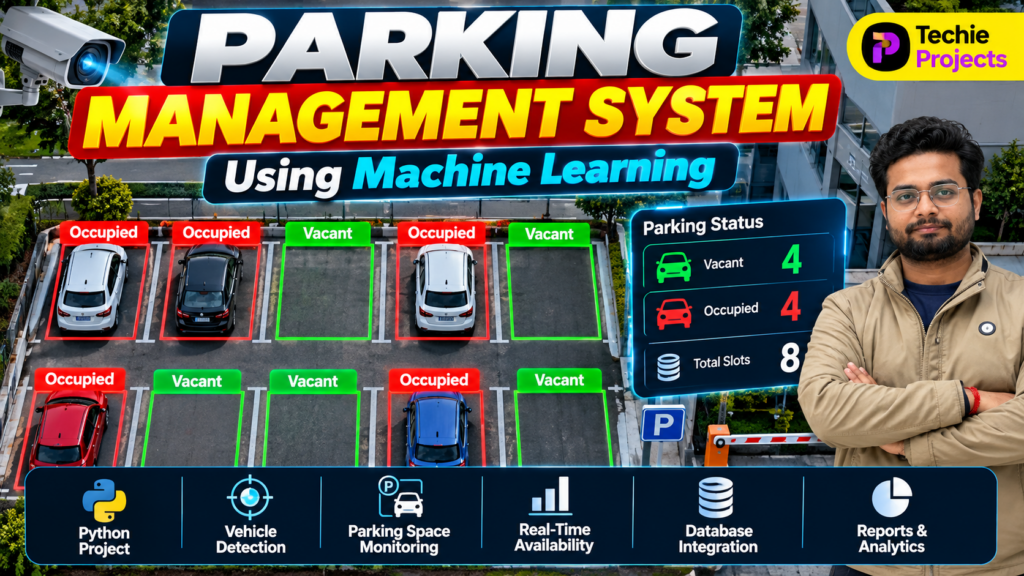
Watch the project demonstration to understand how the parking management system identifies occupied and vacant parking spaces.
The demonstration may show a parking lot image or video, vehicle detection, parking space status, and a dashboard displaying available and occupied spaces. Include only features that are supported by your actual implementation.
What Is a Smart Parking Management System?
A smart parking management system is an application that helps monitor parking spaces and determine their availability. Depending on its design, the system can use images, video feeds, sensors, or computer vision models to identify parking occupancy.
When computer vision is used, the application processes parking lot images or video frames to detect vehicles or classify individual parking spaces as occupied or vacant.
The system can display the results through a graphical interface or dashboard, allowing users to understand parking availability more easily.
🎯 Objectives of the Project
The main objectives of this parking management system project are:
- Develop a Python-based parking monitoring application.
- Identify occupied and vacant parking spaces.
- Explore vehicle detection using computer vision.
- Display parking availability in a user-friendly interface.
- Reduce the need for manual parking space monitoring.
- Store parking information if database integration is implemented.
- Demonstrate practical applications of machine learning and image processing.
⭐ Key Features of the Parking Management System
1. Parking Space Detection
The system analyzes a parking lot image or video to identify parking spaces. Depending on the implementation, predefined parking regions or a trained computer vision model may be used.
2. Occupied and Vacant Space Classification
The application determines whether a parking space is occupied or vacant based on the selected detection method. Results depend on camera quality, lighting, vehicle position, and model performance.
3. Vehicle Detection
A computer vision model can identify vehicles in images or video frames. Detected vehicles can then be used to help determine parking occupancy.
4. Real-Time Parking Monitoring
If connected to a live camera feed, the system can update parking status as new frames are processed. The actual update speed depends on hardware and software performance.
5. Parking Availability Dashboard
A dashboard can display the total number of parking spaces, occupied spaces, vacant spaces, and current parking status.
6. Parking Data Management
If database integration is included, the application can store parking records, occupancy information, and relevant timestamps for later analysis.
7. Parking Reports and Analytics
An extended version can generate reports showing parking occupancy over selected periods. This may help administrators understand usage patterns and manage parking resources.
⚙️ Technologies Used
The technologies depend on the implementation of the project.
- Python: Main programming language.
- OpenCV: Image processing, video capture, and computer vision operations.
- NumPy: Numerical calculations and image-array manipulation.
- Machine Learning or Deep Learning: Optional models for vehicle detection or occupancy classification.
- YOLO: An optional object detection model for identifying vehicles.
- Flask, Streamlit, or Tkinter: Optional tools for developing a user interface.
- SQLite or MySQL: Optional database for storing parking records.
Use only the libraries and frameworks that are actually included in your project.
How Does the Parking Management System Work?
The general workflow of a computer vision-based parking management system includes the following steps.
Step 1: Capture the Parking Lot Image or Video
The system receives an image, recorded video, or live camera feed containing the parking area.
Step 2: Preprocess the Input
Python and OpenCV can be used to resize frames, adjust image properties, or prepare images for further processing.
Step 3: Identify Parking Spaces
The application identifies the relevant parking regions. These regions may be manually configured or detected using a suitable computer vision model.
Step 4: Detect Vehicles or Analyze Occupancy
The system processes the selected regions to determine whether vehicles are present. The approach depends on the algorithm and available training data.
Step 5: Classify Parking Status
Each parking space is classified as occupied or vacant according to the detection results and configured decision rules.
Step 6: Display the Results
The application displays parking spaces and their status through an image overlay, interface, or dashboard.
Step 7: Store or Report the Results
If database and reporting features are implemented, the system can save occupancy records and generate summaries for analysis.
Software Requirements
The typical software requirements may include:
- Python 3
- OpenCV
- NumPy
- A suitable vehicle detection model, if required
- Visual Studio Code, PyCharm, or another Python IDE
- Windows or Linux operating system
- Optional database and dashboard libraries
Install compatible package versions according to your project’s code and model requirements.
Hardware Requirements
The basic hardware requirements may include:
- Desktop computer or laptop
- Keyboard and mouse
- Sufficient RAM for image and video processing
- A camera or parking lot video dataset
- Adequate CPU processing capability
A compatible GPU may improve performance when using computationally demanding deep learning models. It is not necessarily required for every version of the project.
Applications of Smart Parking Management
A parking management system can be adapted for various environments.
1. Shopping Malls
Help monitor parking space availability in large parking areas.
2. Colleges and Universities
Support parking management for students, faculty, staff, and visitors.
3. Office Buildings
Help administrators understand parking occupancy during working hours.
4. Hospitals
Support the monitoring of parking spaces for visitors and employees.
5. Residential Complexes
Assist in monitoring designated parking areas in apartments and housing communities.
6. Commercial Parking Facilities
Provide occupancy information that can support parking operations and resource planning.
Advantages of the Project
The main advantages of a smart parking management system include:
- Reduces reliance on manual occupancy checks.
- Makes parking availability easier to monitor.
- Demonstrates practical Python programming skills.
- Provides experience with image processing and computer vision.
- Can be extended with dashboards and database integration.
- Supports analysis of parking occupancy patterns.
Challenges and Limitations
Although automated parking systems offer several benefits, some challenges should be considered.
- Poor lighting may reduce detection accuracy.
- Camera angles and occluded vehicles can affect results.
- Shadows and weather conditions may cause classification errors.
- Processing live video can require significant computing resources.
- Different parking layouts may require configuration or additional training data.
- Incorrect occupancy predictions may occur and should be evaluated during testing.
Testing the system with representative parking images and videos is important for understanding its accuracy and limitations.
Future Scope
The project can be enhanced with additional capabilities, such as:
- Live camera integration.
- Improved vehicle detection models.
- Automatic parking space counting.
- A web-based parking dashboard.
- Database integration for occupancy records.
- Parking availability notifications.
- Historical occupancy reports.
- Integration with a reservation or parking payment system.
- Mobile-friendly access to parking status.
These features can be added according to project requirements, available resources, and implementation complexity.
🎓 Why Is This a Good Final-Year Engineering Project?
A parking management system using Python is a useful final-year project because it combines programming, image processing, computer vision, and practical problem-solving.
Students can demonstrate how parking occupancy is analyzed and displayed through a working application. The project can be kept simple for beginners or extended with object detection, databases, dashboards, and reporting features for more advanced implementations.
It also provides opportunities to evaluate detection accuracy, compare algorithms, and document the limitations of automated parking monitoring.
Frequently Asked Questions
1. What is a parking management system using Python?
It is a Python application designed to monitor parking spaces and display whether they are occupied or vacant.
2. Is machine learning necessary for a parking management system?
Not always. A basic system may use predefined parking regions and image-processing techniques. Machine learning can be used for more advanced vehicle detection or occupancy classification.
3. Which Python library is commonly used?
OpenCV is commonly used for image processing and video capture. NumPy and optional machine learning frameworks may also be used.
4. Can this system detect vacant parking spaces?
Yes, if the implementation includes a method for classifying parking spaces as occupied or vacant.
5. Can the project work in real time?
A version connected to a live camera can process frames continuously. Actual performance depends on the detection method, hardware, camera setup, and software optimization.
6. Is this project suitable for B.Tech students?
Yes. It is suitable for students interested in Python programming, machine learning, computer vision, and smart systems.
🔗 Explore Related Python and Computer Vision Projects
Explore related project topics on Techie Projects:
- Vehicle Detection and Counting Using Python
- Number Plate Detection Using YOLO
- Object Detection Using OpenCV
- Image Processing Projects Using Python
- Machine Learning Projects for Final-Year Students
Add internal links to the corresponding pages on your website.
🚀 Need Help With Your Final-Year Project?
Looking for project ideas, implementation guidance, documentation, or source-code information?
Techie Projects helps students explore Python, Artificial Intelligence, Machine Learning, and Computer Vision projects.
- 📲 Call/WhatsApp: +91-9460060699
- 🌎 Website: www.techieprojects.com
- 📺 Instagram: @pythonprojects_
Conclusion
A parking management system using machine learning with Python demonstrates how computer vision can help identify occupied and vacant parking spaces. By processing parking lot images or video, the application can present parking information in a more organized and accessible format.
With suitable testing and further development, the project can be extended with live monitoring, database integration, dashboards, and parking analytics. It is a practical learning opportunity for students who want to explore Python programming and intelligent parking applications.