
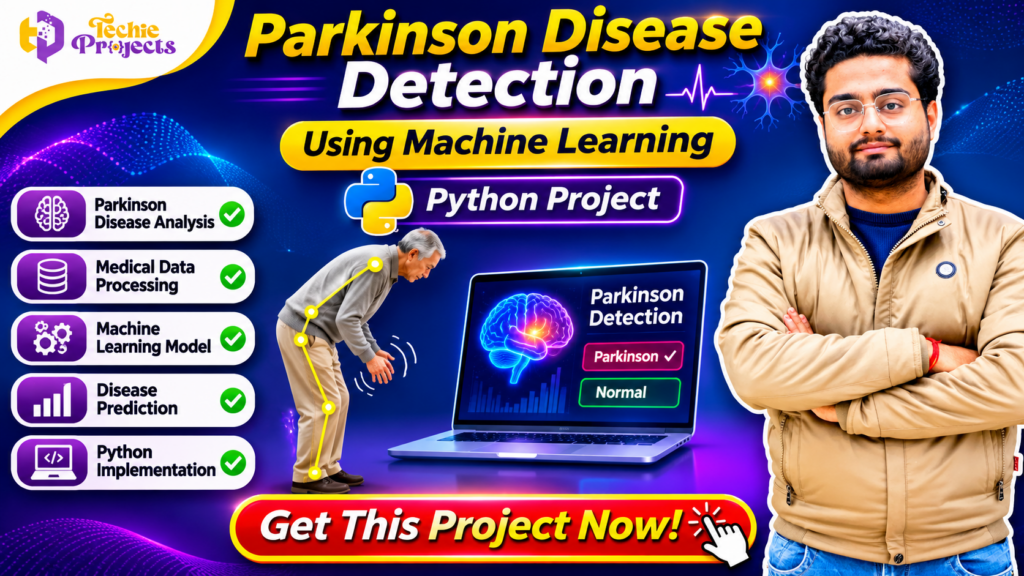
🚀 Get Your Parkinson Disease Detection Project with Source Code
Looking for an innovative Parkinson Disease Detection Using Machine Learning project for your final-year engineering submission? Techie Projects offers a Python-based academic project designed to help students understand how machine learning can be applied to healthcare-related data analysis and disease prediction.
Instead of spending weeks building a project from scratch, you can explore our ready-developed project package and get a practical starting point for your academic work. Whether you are pursuing B.Tech, BCA, MCA, M.Tech, or another computer science course, this project can help you understand machine learning workflows, data preprocessing, model development, and prediction systems.
Get the Parkinson Disease Detection Using Machine Learning project from Techie Projects and explore its implementation, source code, project demonstration, and available documentation. Contact our team to confirm the package details, supported features, and technical assistance before purchasing.
📞 Contact Techie Projects for Project Enquiries
Interested in purchasing this project? Contact Techie Projects directly for pricing, availability, source code details, and project support.
- 📲 Call/WhatsApp: +91-9460060699
- 🌎 Website: www.techieprojects.com
- 📺 Instagram: @pythonprojects_
🎬 Watch the Parkinson Disease Detection Using Machine Learning Project Demo
Explore the project demonstration to understand its interface, workflow, and implementation approach.
Watch the project demo displayed on this page to see the available functionality.
🧠 What Is Parkinson Disease Detection Using Machine Learning?
Parkinson’s disease is a neurological condition that can affect movement, coordination, and other aspects of daily life. Some commonly associated symptoms include tremors, muscle stiffness, slowed movement, and balance difficulties.
Machine learning is a branch of artificial intelligence that enables computer systems to identify patterns in data and generate predictions based on learned relationships.
Parkinson Disease Detection Using Machine Learning is an academic project that demonstrates how machine learning techniques can be explored for analyzing relevant datasets and identifying patterns associated with Parkinson’s disease.
The project provides students with an opportunity to understand the relationship between healthcare data and predictive modelling. It also demonstrates how Python libraries can be used to prepare data, train a machine learning model, and generate prediction results.
This project is intended for educational and research demonstration purposes. It is not a clinically validated diagnostic system and must not be used to diagnose Parkinson’s disease or make medical decisions.
🎯 Objectives of the Project
The main objective is to demonstrate the application of machine learning techniques in healthcare-related data analysis.
Key objectives may include:
- Understanding Parkinson’s disease-related datasets.
- Learning data preprocessing and preparation techniques.
- Applying machine learning algorithms to structured data.
- Training and evaluating a prediction model.
- Understanding how input features influence model predictions.
- Developing a Python-based application interface.
- Exploring the practical applications of artificial intelligence in healthcare research.
By working with this project, students can gain practical exposure to the complete machine learning development process.
⚙️ How Does the Project Work?
The project follows a typical machine learning workflow. The exact implementation depends on the dataset, algorithm, and application interface included in the selected project package.
1. 📊 Dataset Collection
The first step involves obtaining a suitable dataset containing relevant features for Parkinson’s disease research.
A dataset may contain numerical measurements associated with voice recordings or other research parameters. These values are used as input features during the machine learning process.
Students can learn how datasets are structured and why data quality is important for predictive modelling.
2. 🧹 Data Preprocessing
Raw datasets may contain missing values, inconsistent formats, or features that require transformation.
Data preprocessing prepares the dataset for machine learning. Depending on the implementation, this stage may include:
- Checking missing or invalid values.
- Removing unnecessary columns.
- Selecting relevant input features.
- Encoding categorical information when required.
- Scaling numerical values.
- Dividing data into training and testing sets.
Proper preprocessing helps create a consistent input format for model development.
3. 🤖 Machine Learning Model Training
After preparing the dataset, the next step is training a machine learning algorithm.
The selected algorithm learns patterns from the training data. Depending on the project implementation, classification algorithms such as Support Vector Machine, Logistic Regression, Random Forest, or other suitable methods may be explored.
The trained model can then be used to generate predictions for new input data.
4. 📈 Model Evaluation
Model evaluation helps students understand how well a machine learning model performs on test data.
Common evaluation techniques include:
- Accuracy score.
- Precision.
- Recall.
- F1-score.
- Confusion matrix.
These measurements provide different perspectives on model performance. Accuracy alone should not be treated as proof of clinical reliability.
5. 💻 Prediction and Result Display
Once the model has been trained, the application can accept input values and process them through the prediction pipeline.
The application may display a predicted class or result through its user interface, depending on the implemented features.
This stage demonstrates how a trained machine learning model can be connected to a Python application.
⭐ Key Features of the Parkinson Disease Detection Project
The following are common educational components that may be included in a machine learning project of this type. Confirm the exact features available in the package before purchasing.
📌 1. Dataset Processing
The system demonstrates how structured healthcare-related data can be loaded and prepared for analysis.
📌 2. Machine Learning Implementation
Students can explore how a machine learning algorithm learns patterns from a training dataset.
📌 3. Prediction Functionality
A trained model can process supported input features and generate a prediction result.
📌 4. Python-Based Development
Python provides a practical environment for implementing data analysis and machine learning applications.
📌 5. Model Evaluation
The project can demonstrate evaluation methods used to understand the performance of a trained model.
📌 6. User Interface
Depending on the selected implementation, a graphical interface can help users enter data and view the output.
📌 7. Academic Learning
The project provides a practical opportunity to study artificial intelligence, data science, and machine learning concepts.
🛠️ Technologies Used in the Project
The development environment may include the following technologies, depending on the project package.
| Technology | Purpose |
|---|---|
| Python | Main programming language |
| NumPy | Numerical operations |
| Pandas | Dataset handling and processing |
| Scikit-learn | Machine learning algorithms and evaluation |
| Matplotlib | Data visualization |
| Seaborn | Statistical data visualization |
| Tkinter | Graphical user interface, if included |
These tools are widely used in Python-based data science and machine learning applications.
💡 Why Choose This Project for Your Final Year?
Selecting a suitable final-year project is an important part of an engineering or computer application course. A good project should provide practical learning opportunities and allow students to explain the implementation clearly.
Parkinson Disease Detection Using Machine Learning is a useful academic topic because it combines programming, data analysis, and artificial intelligence.
🎓 1. Practical Machine Learning Experience
Students can understand how a machine learning workflow operates, from dataset preparation to model evaluation.
🎓 2. Healthcare and Artificial Intelligence
The topic introduces students to an important application area of artificial intelligence: healthcare-related research and data analysis.
🎓 3. Python Programming Skills
Working with Python libraries can help students become familiar with practical programming techniques used in data science.
🎓 4. Project Demonstration
A working application can help students demonstrate the relationship between input data, model processing, and prediction output.
🎓 5. Academic Presentation
The project provides opportunities to explain the dataset, algorithm, preprocessing steps, evaluation methods, and limitations during a project presentation.
🔍 Applications of Machine Learning in Parkinson’s Disease Research
Machine learning is increasingly studied in healthcare research because it can help researchers investigate patterns in complex datasets.
Some areas of research include:
- Voice Data Analysis: Studying measurable characteristics of voice recordings.
- Movement Analysis: Exploring movement-related patterns in collected research data.
- Data Classification: Investigating differences between labelled data groups.
- Predictive Modelling: Developing models that estimate outcomes from selected input features.
- Research Data Analysis: Supporting the exploration of large datasets.
These are broader research applications. The capabilities of this particular academic project depend on the dataset and model actually implemented.
🧪 Understanding the Machine Learning Workflow
A major learning benefit of this project is understanding how different stages of machine learning work together.
The general workflow can be represented as:
- Collect the dataset.
- Load the data using Python.
- Explore and understand the dataset.
- Clean and preprocess the data.
- Select suitable features.
- Split the dataset into training and testing sets.
- Train the machine learning algorithm.
- Evaluate the model.
- Connect the trained model to the application.
- Display the prediction output.
This workflow gives students a practical understanding of how machine learning applications are developed.
📚 What Can Students Learn from This Project?
Students working with this project can explore several important concepts.
Data handling: Learn how to load, inspect, filter, and prepare datasets using Pandas.
Feature selection: Understand why selecting meaningful input features is important for machine learning.
Classification algorithms: Explore how classification models learn from labelled training data.
Model evaluation: Understand the difference between accuracy, precision, recall, and F1-score.
Python application development: Learn how to connect machine learning code with a user-facing application.
Problem-solving: Understand how to break a larger software development task into smaller implementation stages.
These concepts are useful for students interested in machine learning, data science, artificial intelligence, and Python development.
🏆 Benefits of Purchasing the Project from Techie Projects
Developing a complete academic project requires time, technical knowledge, testing, and documentation. Techie Projects helps students explore project options and obtain development resources for their academic requirements.
✅ 1. Ready Project Package
Get access to the available project package instead of beginning the entire development process without a starting point.
✅ 2. Source Code Availability
Enquire about the Python source code included with the selected package.
✅ 3. Project Demonstration
Use the available demonstration to understand the application’s workflow and presentation.
✅ 4. Documentation Details
Ask about the documentation supplied with the project, including the report and implementation details where available.
✅ 5. Technical Assistance
Contact Techie Projects to confirm the technical support available for installation, execution, and project-related queries.
✅ 6. Academic Project Options
Explore other Python, artificial intelligence, machine learning, and final-year engineering projects through our website.
💰 Why Purchase Your Parkinson Disease Detection Project from Techie Projects?
If you are searching for a Python-based machine learning project, Techie Projects provides an option to explore a project package that can support your academic learning and development.
When purchasing, you should confirm the following details:
- Project source code availability.
- Supported Python version.
- Required libraries and dependencies.
- Dataset details and usage permissions.
- Installation and execution instructions.
- Documentation and report availability.
- Demonstration and technical support options.
- Any additional customization requirements.
We recommend discussing your college requirements with our team before placing an order. This helps you understand what is included and whether the package matches your academic expectations.
🧑💻 Who Can Purchase This Project?
This project may be relevant to students pursuing courses such as:
- B.Tech Computer Science Engineering.
- B.Tech Information Technology.
- BCA.
- MCA.
- M.Tech Computer Science.
- Diploma in Computer Engineering.
- Artificial Intelligence and Data Science courses.
It can also be useful for learners who want to explore Python programming and machine learning concepts through an academic example.
🚀 How to Purchase the Project from Techie Projects
Getting started is simple.
Step 1: Explore the Project
Read the project details and watch the available demonstration to understand the topic and its workflow.
Step 2: Contact Our Team
Send your enquiry through WhatsApp or the Techie Projects website.
Step 3: Confirm Project Requirements
Discuss your course, submission deadline, required technologies, documentation needs, and any customization requirements.
Step 4: Confirm Package Details
Check the source code, dataset, documentation, installation instructions, and support included in the package.
Step 5: Complete Your Purchase
Once the details are confirmed, follow the purchasing instructions provided by our team.
Step 6: Study and Customize
Review the implementation, understand the machine learning workflow, and prepare to explain the project as part of your academic submission.
❓ Frequently Asked Questions
1. What is Parkinson Disease Detection Using Machine Learning?
It is an academic machine learning project that demonstrates how Python-based models can analyze relevant datasets and identify patterns associated with Parkinson’s disease.
2. Which programming language is used?
Python is the primary programming language for the project.
3. Is this project suitable for final-year engineering students?
It can be a suitable academic topic for students studying computer science, information technology, artificial intelligence, and data science, subject to their institution’s project requirements.
4. Can I get the source code?
Contact Techie Projects to confirm source code availability and the contents of the current project package.
5. Which machine learning algorithm is used?
The algorithm depends on the actual implementation. Common classification approaches include Support Vector Machine, Logistic Regression, and Random Forest.
6. Does the project provide medical diagnosis?
No. This is an educational project, not a clinically validated diagnostic tool. It must not be used for medical diagnosis, treatment decisions, or patient care.
7. Can I request customization?
You can contact Techie Projects to discuss your requirements and confirm whether customization is available.
8. Does the package include project documentation?
Please confirm the availability and format of the documentation with our team before purchasing.
🔗 Explore Related Python and Machine Learning Projects
Looking for more academic project ideas? Explore additional project categories from Techie Projects:
- Python Projects
- Machine Learning Projects
- Artificial Intelligence Projects
- Deep Learning Projects
- Data Science Projects
- Computer Vision Projects
- Healthcare Projects
- Final Year Engineering Projects
Visit https://techieprojects.com/ to explore more project ideas and available packages.
🚀 Get Parkinson Disease Detection Using Machine Learning Project with Python Source Code
Are you searching for a practical Parkinson Disease Detection Using Machine Learning project for your final-year submission? Techie Projects provides project solutions for students interested in Python programming, artificial intelligence, and machine learning.
This Parkinson Disease Detection Using Machine Learning project demonstrates how a trained classification model can process relevant dataset features and generate prediction results. It offers an opportunity to understand the complete workflow, including data preparation, feature selection, model training, and evaluation.
Students can explore the implementation and learn how Python libraries are used to develop a machine learning application. Contact Techie Projects to enquire about source code, project documentation, installation guidance, and available technical support.
🔬 Development Scope of Parkinson Disease Detection Using Machine Learning
The development of Parkinson Disease Detection Using Machine Learning involves multiple stages of data analysis and model implementation.
Some important development areas include:
- Dataset analysis: Understanding the structure and features of the available dataset.
- Data preprocessing: Preparing input values for machine learning algorithms.
- Feature selection: Identifying relevant variables for model training.
- Model development: Applying a suitable classification algorithm.
- Performance evaluation: Reviewing model performance using appropriate evaluation metrics.
- Application integration: Connecting the trained model with a Python-based interface, if included.
By studying these stages, students can understand how Parkinson Disease Detection Using Machine Learning connects programming concepts with real-world research topics.
🎓 Why Choose Parkinson Disease Detection Using Machine Learning for Your Academic Project?
Choosing Parkinson Disease Detection Using Machine Learning gives students an opportunity to work on a healthcare-related artificial intelligence topic while developing practical programming knowledge.
The project can help students understand machine learning classification, Python libraries, dataset processing, and predictive modelling. It can also provide useful discussion points for project demonstrations, viva examinations, and technical presentations.
If you want to purchase this project, Techie Projects can help you explore the available package and confirm its contents before ordering.
💻 Purchase Parkinson Disease Detection Using Machine Learning from Techie Projects
Looking for a Parkinson Disease Detection Using Machine Learning project with implementation resources? Contact Techie Projects to discuss your academic requirements and check the current package details.
Before purchasing, confirm the availability of source code, dataset, documentation, supported libraries, and installation instructions.
📲 Enquire now:
- WhatsApp: https://wa.me/919460060699
- Phone: +91 94600 60699
- Website: https://techieprojects.com/
Get the project details and make an informed decision for your final-year engineering submission.
🎯 Conclusion
Parkinson Disease Detection Using Machine Learning is an interesting academic project for students who want to explore the practical applications of Python, artificial intelligence, and predictive modelling in healthcare-related research. It introduces important concepts such as dataset processing, feature selection, machine learning algorithms, model evaluation, and prediction workflows.
If you are planning a final-year project and want a practical starting point, explore the Parkinson Disease Detection project package from Techie Projects. Review the demonstration, confirm the available source code and documentation, and discuss your academic requirements with our team before purchasing.
Don’t spend your entire project preparation time searching for disconnected resources. Get the project details, understand the implementation, and move forward with a structured learning experience.