
Introduction
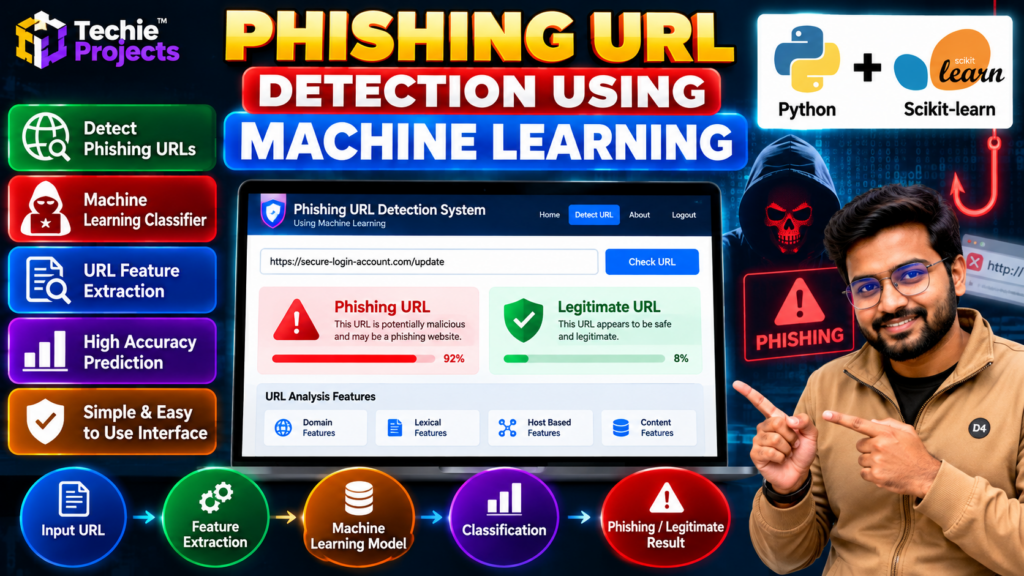
Phishing URL Detection Using Machine Learning is a Python-based cyber security project that demonstrates how machine learning techniques can help classify URLs as potentially phishing or legitimate. The project explores URL feature extraction, data preprocessing, model training, and prediction to help students understand how automated phishing detection systems work.
Phishing attacks often use deceptive website links to trick users into sharing passwords, banking information, and other sensitive data. A machine learning-based phishing URL detection system can analyze selected URL characteristics and use a trained classification model to identify suspicious patterns.
This project is suitable for B.Tech, B.E., BCA, MCA, M.Tech, and final-year computer science students interested in Python programming, machine learning, and cyber security.
Phishing URL detection using machine learning helps students explore how suspicious website links can be classified through data analysis and predictive models. This Python project demonstrates URL feature extraction, dataset preparation, and classification techniques used to identify potentially malicious links.
🎬 Project Demo
Explore the project demonstration to see how the phishing URL detection application works, how a URL is submitted for analysis, and how the system displays its classification result.
🎯 Objectives of the Project
The main objectives of phishing URL detection using machine learning are:
- Understand phishing URLs and common suspicious patterns.
- Extract relevant features from URL data.
- Prepare and process a dataset for classification.
- Train and evaluate a machine learning model.
- Predict whether a URL is potentially phishing or legitimate.
- Explore practical applications of Python in cyber security.
🔍 Key Features of the Phishing URL Detection System
An important component of phishing URL detection using machine learning is URL feature analysis. The system can examine selected characteristics, such as URL length, special characters, subdomains, and HTTPS usage, before passing the extracted features to the trained classification model.
1. URL Input and Analysis
The application accepts a URL and processes it according to the implemented detection workflow.
2. URL Feature Extraction
The system can analyze features such as URL length, number of dots, special characters, subdomains, HTTPS usage, and other relevant characteristics, depending on the implementation.
3. Machine Learning Classification
A trained model uses the selected features to classify URLs according to patterns learned from the training dataset.
4. Prediction Results
The application displays the predicted classification, helping users understand the output of the phishing detection model.
5. User-Friendly Interface
A graphical or web-based interface can make the project easier to demonstrate and test.
6. Model Evaluation
The project can be evaluated using metrics such as accuracy, precision, recall, F1-score, and a confusion matrix.
⚙️ How Does Phishing URL Detection Using Machine Learning Work?
Step 1: Collect the Dataset
Obtain a suitable dataset containing labeled phishing and legitimate URLs. Review the dataset source, labels, and limitations before training the model.
Step 2: Preprocess the Data
Clean the dataset, handle missing values where necessary, and prepare the URL information for feature extraction.
Step 3: Extract URL Features
Convert URLs into numerical or categorical features that the selected machine learning algorithm can process.
Step 4: Split the Dataset
Separate the dataset into training and testing sets to evaluate performance on data not used to fit the model.
Step 5: Train the Model
Use an appropriate classification algorithm, such as Random Forest, Decision Tree, or Logistic Regression, if supported by the implementation.
Step 6: Predict URL Classification
Process a new URL using the same feature extraction procedure and pass its features to the trained model.
Step 7: Display the Result
Show the predicted class and evaluate the model’s performance using appropriate metrics.
🛠️ Technologies Used
The technologies depend on the actual project implementation. Common options include:
- Python: Main programming language.
- Pandas: Dataset processing.
- NumPy: Numerical operations.
- Scikit-learn: Machine learning and model evaluation.
- Matplotlib or Seaborn: Optional performance visualizations.
- Flask, Streamlit, or Tkinter: Optional user interface.
Only include libraries and algorithms that are actually used in your project.
💻 Software Requirements
Typical software requirements include:
- Python 3.x
- Visual Studio Code, PyCharm, or another Python IDE
- Pandas and NumPy, if required
- Scikit-learn, if machine learning is implemented
- The project dataset and required dependencies
🖥️ Hardware Requirements
- Laptop or desktop computer
- At least 4 GB RAM for a basic implementation
- Sufficient storage for the dataset, source code, and model files
- Keyboard, mouse, and display
The actual requirements depend on the dataset size and selected model.
📊 Applications of Phishing URL Detection
Cyber Security Education
Students can learn how machine learning is applied to URL classification and security-related data analysis.
Suspicious URL Classification
The model can classify URLs based on the patterns represented in its training data.
Security Awareness
The project can demonstrate why suspicious links should be examined carefully before users interact with them.
Machine Learning Research
Students can compare algorithms and study how feature selection affects classification performance.
Academic Demonstrations
The application provides a practical example of combining data preprocessing, model training, prediction, and interface development.
✅ Advantages of the Project
- Demonstrates practical Python programming.
- Introduces machine learning classification.
- Covers URL feature extraction and preprocessing.
- Provides an opportunity to compare classification algorithms.
- Supports model evaluation using standard metrics.
- Can be extended with additional features and datasets.
- Offers a relevant topic for academic cyber security projects.
⚠️ Limitations
- Performance depends on the dataset and selected features.
- New phishing techniques may not resemble patterns in the training data.
- A URL classifier can produce false positives and false negatives.
- HTTPS alone does not prove that a website is trustworthy.
- A model prediction cannot guarantee that a website is safe.
The project should be treated as an educational classification tool rather than a complete security product.
🔮 Future Scope
Phishing URL detection using machine learning can be improved by testing newer datasets, comparing classification algorithms, and evaluating precision, recall, and F1-score. These improvements can help students understand model limitations and investigate ways to improve phishing classification performance.
Phishing URL detection using machine learning can be extended with:
- Additional URL Features: Explore more relevant URL and domain characteristics.
- Algorithm Comparison: Compare multiple classifiers using consistent evaluation methods.
- Improved Dataset Quality: Use well-documented, representative, and regularly reviewed data.
- Web Application Integration: Provide an interface for submitting URLs and viewing predictions.
- Performance Visualization: Display confusion matrices and classification metrics.
- Explainable Predictions: Explore techniques that help users understand which features influenced a prediction.
- Updated Model Evaluation: Test performance on newer data to assess how well the model generalizes.
These improvements may require additional development beyond the existing implementation.
🎓 Why Choose This as a Final-Year Project?
This project is a practical choice for students who want to explore the intersection of machine learning and cyber security. It demonstrates a complete workflow from dataset preparation to prediction and evaluation.
Students can use it to understand:
- Python-based data processing
- URL feature engineering
- Machine learning classification
- Model evaluation
- Basic application development
- Cyber security concepts
The project can also serve as a foundation for further research into suspicious URL classification and security analytics.
🛒 Get the Phishing URL Detection Project
Looking for a Phishing URL Detection Using Machine Learning project in Python for your B.Tech, B.E., BCA, MCA, M.Tech, or final-year engineering submission?
Techie Projects helps students explore engineering projects and enquire about available implementations.
Contact us to confirm whether the selected project package includes:
- Python source code
- Dataset and preprocessing workflow
- Trained machine learning model, if applicable
- Installation and execution instructions
- Project documentation and report
- Demonstration of implemented features
- Customization options, if available
Deliverables, pricing, and customization depend on the available package. Confirm the scope before purchasing.
📲 Interested in Purchasing This Project?
Enquire About the Phishing URL Detection Project on WhatsApp
📲 Call/WhatsApp: +91-9460060699
🌎 Website: www.techieprojects.com
📺 Instagram: @pythonprojects_
Share your course, submission deadline, and required features so we can discuss the available options.
🎓 Recommended Projects
Explore these related cyber security and machine learning topics on Techie Projects. Link each title to its relevant published article.
- Intrusion Detection System Using Machine Learning — explore network traffic classification.
- Malware Detection Using Machine Learning — study machine learning approaches to malware classification.
- Vulnerability Scanning Using Python — learn about authorized security checks and reporting.
- Cyber Security Projects Using Python — discover additional security-focused project ideas.
- Machine Learning Projects for Final-Year Students — explore other classification and prediction applications.
Visit Techie Projects to discover more engineering project ideas.
❓ Frequently Asked Questions
1. What is phishing URL detection using machine learning?
It is a classification approach that uses URL-related features and a trained model to predict whether a URL resembles phishing or legitimate examples in its training data.
2. Which programming language is used?
Python is commonly used for data preprocessing, feature extraction, model training, and application development.
3. Which machine learning algorithms can be used?
Depending on the implementation, algorithms such as Random Forest, Decision Tree, Logistic Regression, and Support Vector Machine can be evaluated.
4. Can this project be customized?
Additional features may be possible depending on the available source code and package. Confirm the scope before purchasing.
5. Does the model guarantee that a URL is safe?
No. A prediction is not a guarantee. Users should verify suspicious links through trusted security tools and avoid entering sensitive information on untrusted websites.
6. How can I purchase the project?
Contact Techie Projects on WhatsApp to enquire about source code availability, documentation, included features, and pricing.
Conclusion
Phishing URL Detection Using Machine Learning is a practical Python project for exploring URL feature extraction, classification, and cyber security applications. It gives students an opportunity to understand how data-driven models can help identify potentially suspicious URLs while learning the importance of testing and evaluating model performance.
If you are interested in this project for your mini-project or final-year submission, contact Techie Projects to discuss the available implementation and deliverables.
Ready to discuss your project?
📲 Contact Techie Projects on WhatsApp