
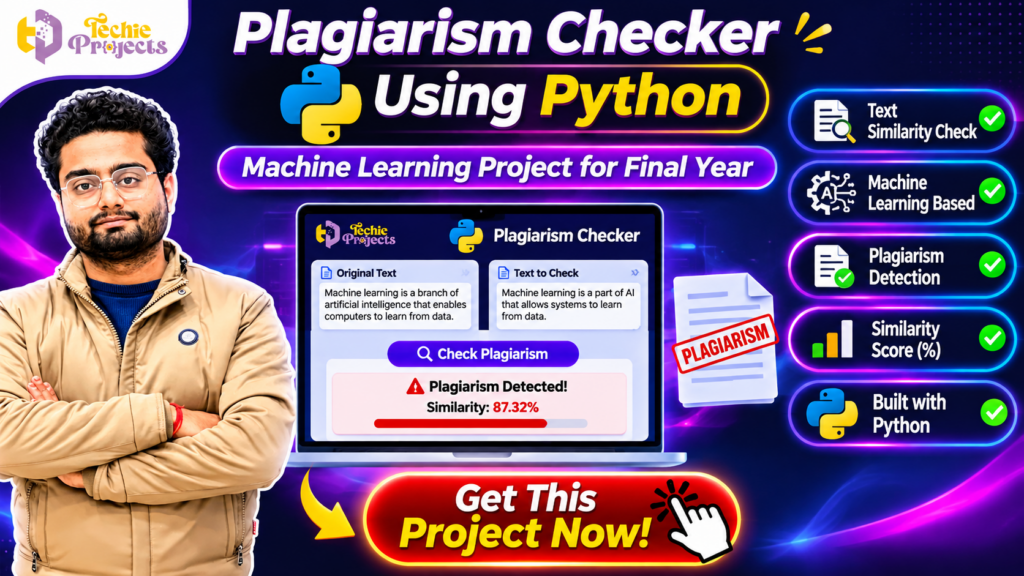
🎓 Looking for a ready-to-use Plagiarism Checker Using Python project for your final-year engineering submission? Get your project from Techie Projects and explore how Python, machine learning, and text-processing techniques can help identify similarities between documents. Whether you are a B.Tech, BCA, MCA, or computer science student, this project can help you understand practical applications of artificial intelligence and natural language processing.
Instead of spending weeks building a complete project from scratch, you can get project assistance, source code, and implementation guidance from Techie Projects. The Plagiarism Checker Using Python project is a useful academic option for students interested in machine learning, Python programming, document comparison, and text similarity detection.
If you are preparing a final-year project, mini-project, or academic demonstration, this project provides an opportunity to explore how two text documents can be processed and compared to identify matching or similar content.
📞 Contact Techie Projects for Project Enquiries
Want to purchase the Plagiarism Checker Using Python project? Contact our team for project details, source code availability, documentation, and implementation support.
- 📱 WhatsApp: https://wa.me/919460060699
- ☎️ Contact Number: +91 94600 60699
- 🌐 Website: https://techieprojects.com/
- 📸 Instagram: https://www.instagram.com/pythonprojects_/
Get your project details and enquire about the available package today!
🎬 Watch the Plagiarism Checker Using Python Project Demo
Explore the project demonstration to understand its interface, document comparison process, and plagiarism detection workflow.
The demo can help you understand how text is entered or provided for comparison, how the application processes the content, and how similarity results may be presented to the user.
Project functionality and the demonstration interface depend on the supplied implementation.
💻 What Is Plagiarism Checker Using Python?
A Plagiarism Checker Using Python is a software application designed to compare text content and identify similarities between documents. Plagiarism detection is useful in academic environments, content management, research, and document verification.
The project uses Python programming and text-processing techniques to examine textual information. Depending on the implementation, it may preprocess the text, extract meaningful words, calculate similarity scores, and display the comparison results.
For example, imagine that a student submits an assignment containing several paragraphs. The application can compare the submitted text with another reference document and identify sections that contain similar wording.
The purpose of this project is to demonstrate how computer programs can assist with text comparison. It also introduces students to practical concepts such as:
- Python programming.
- Natural Language Processing (NLP).
- Text preprocessing.
- Document comparison.
- Machine learning concepts.
- Similarity measurement.
- Result visualization.
This makes the project a suitable learning opportunity for students interested in artificial intelligence and software development.
🚀 Why Choose This Plagiarism Checker Project?
Students often need projects that demonstrate practical programming knowledge rather than only theoretical concepts. A plagiarism detection application offers an interesting combination of Python programming, text analysis, and machine learning concepts.
Here are some reasons to consider this project:
🎯 1. Practical Application of Python
Python is widely used in automation, data science, artificial intelligence, and natural language processing. Developing a plagiarism checker gives students an opportunity to understand how Python can solve a real-world text-processing problem.
🤖 2. Introduction to Machine Learning
Text similarity analysis can introduce students to machine learning and computational approaches for comparing textual content. Depending on the selected implementation, students can explore similarity algorithms and NLP techniques.
📚 3. Useful for Academic Demonstrations
The project can be demonstrated using sample documents and text inputs. Students can explain the comparison workflow, processing steps, and output during their project presentation.
🧠 4. Understand Natural Language Processing
Natural Language Processing helps computers process and analyze human language. This project introduces concepts such as tokenization, text cleaning, and document similarity.
💡 5. Expandable Project Scope
Students can explore additional features such as document upload, comparison history, report generation, and multiple-document comparison, depending on their technical requirements.
⚙️ Key Features of Plagiarism Checker Using Python
The following are common features that can be included in a Python-based plagiarism detection application. Actual functionality depends on the project version and included modules.
📄 1. Text Input and Document Comparison
The application can accept text from users or process supported document files. It compares the provided content with reference text to identify matching or similar sections.
🔍 2. Text Similarity Detection
Text similarity detection is an important part of a plagiarism checker. The application can calculate how closely two text documents match using an appropriate similarity technique.
📊 3. Similarity Score
A similarity score can help users understand the degree of textual similarity between documents. The score may be displayed as a percentage or another numerical result.
Remember that a similarity score does not automatically prove plagiarism. Common phrases, quotations, references, and technical terminology can also produce matching text.
🧹 4. Text Preprocessing
Text preprocessing prepares documents for comparison. Depending on the implementation, it may include:
- Removing unnecessary spaces.
- Converting text into lowercase.
- Removing selected punctuation.
- Tokenizing sentences or words.
- Removing common stop words.
- Normalizing textual content.
These operations can help make the comparison process more consistent.
📑 5. Result Display
The application can display the comparison output through a user interface. Results may include similarity percentages, matching content, or other comparison information supported by the implementation.
🖥️ 6. User-Friendly Interface
A simple interface can make the application easier to demonstrate. Users can provide text, start the comparison process, and review the results without directly interacting with Python code.
📂 7. Document Processing
Depending on the included libraries and implementation, the application may support selected document formats. Confirm the supported file types before purchasing or integrating additional document-processing functionality.
🧠 Technologies Used in Plagiarism Checker Using Python
This project introduces students to several technologies and programming concepts used in text analysis.
🐍 Python Programming
Python is the primary programming language for developing the application. Its simple syntax and extensive library ecosystem make it suitable for academic projects involving text processing and machine learning.
🤖 Machine Learning
Machine learning techniques can be used in some plagiarism detection implementations to analyze textual information and identify patterns. The exact algorithm depends on the project design.
📖 Natural Language Processing
Natural Language Processing is a field of artificial intelligence that focuses on enabling computers to work with human language.
NLP techniques can help process text, identify words, and prepare documents for similarity analysis.
📊 Text Similarity Algorithms
Similarity algorithms compare textual information to estimate how closely two documents match. Depending on the implementation, techniques may include:
- Cosine similarity.
- TF-IDF vectorization.
- Jaccard similarity.
- Token-based comparison.
- Other text similarity approaches.
Not every implementation uses all these techniques. The actual algorithm should be confirmed from the project source code.
🖥️ Development Environment
The project can be developed and executed in a suitable Python environment. Depending on the supplied implementation, students may use tools such as:
- Python.
- Visual Studio Code.
- Jupyter Notebook.
- Required Python packages.
- A supported operating system.
🔄 How Does a Python Plagiarism Checker Work?
A plagiarism detection application generally follows a sequence of operations to compare documents.
Step 1: Provide Text or Documents
The user provides the original document and the text or reference document that needs to be checked.
Step 2: Text Preprocessing
The application processes the supplied text. This may include cleaning unnecessary characters, converting text into a consistent format, and separating content into smaller units.
Step 3: Text Feature Extraction
The processed text is converted into a representation that can be compared computationally. Depending on the algorithm, this may involve word frequencies, tokens, or numerical vectors.
Step 4: Similarity Calculation
The application compares the processed representations using the selected similarity algorithm.
For example, cosine similarity can measure the similarity between two numerical text vectors. Other techniques may compare sets of words or matching sequences.
Step 5: Display the Results
The application displays the calculated similarity result and any additional comparison information supported by the implementation.
This workflow demonstrates how Python can be used to transform ordinary text into information that a computer can analyze.
🏗️ How to Develop Plagiarism Checker Using Python
Developing a plagiarism detection system is a useful way to learn Python application development. Students can divide the project into smaller modules to understand the complete workflow.
1. Define Project Requirements
First, decide what the application should do. Identify whether it will compare manually entered text, uploaded documents, or multiple reference documents.
2. Prepare the Python Environment
Install Python and configure the required development environment. Install the libraries needed by the selected implementation.
3. Implement Text Preprocessing
Create functions to clean and normalize textual information. This step prepares the input for further analysis.
4. Select a Similarity Technique
Choose a suitable algorithm for comparing documents. For an academic implementation, TF-IDF with cosine similarity is one possible approach.
5. Build the Application Interface
Develop an interface where users can provide documents or text and view the comparison output. The interface can be command-line based or graphical, depending on project requirements.
6. Test the Application
Test the system with different sample documents, including identical text, partially similar content, and unrelated documents. Review the output to understand how the selected algorithm behaves.
7. Prepare Project Documentation
Document the objective, methodology, system requirements, technologies, implementation, screenshots, and testing results.
Students can use this development process to understand the relationship between Python programming and practical text analysis.
🎓 Benefits for B.Tech, BCA, MCA and Final-Year Students
The Plagiarism Checker Using Python project can be useful for students who want to explore practical applications of Python and artificial intelligence.
Some academic benefits include:
- Practical Python experience: Understand how Python functions and libraries work together.
- Machine learning knowledge: Explore computational methods for analyzing text.
- NLP understanding: Learn how text can be cleaned, processed, and represented.
- Algorithm knowledge: Understand document similarity and comparison techniques.
- Project presentation: Demonstrate a working software application using sample documents.
- Resume development: Discuss the project as an academic programming experience.
This project can also provide a starting point for students who want to explore advanced topics such as semantic similarity, document classification, and intelligent content analysis.
🌍 Applications of Plagiarism Detection Systems
Plagiarism detection systems have applications in several areas where text originality and document similarity matter.
🏫 1. Educational Institutions
Educational institutions can use document comparison tools as part of academic integrity workflows. Such tools can help teachers and students review similarities in assignments and reports.
📝 2. Academic Research
Researchers may use text comparison tools to review documents and identify overlapping content during the writing process.
✍️ 3. Content Writing
Content creators and editors can use similarity-checking tools to review written material before publication.
📚 4. Document Verification
Organizations that handle large amounts of written information may use text comparison techniques to identify repeated or similar content.
💻 5. Learning and Research Projects
Students can use plagiarism detection applications to understand NLP, similarity algorithms, and Python-based software development.
Important: A basic academic plagiarism checker is not equivalent to a commercial plagiarism detection platform. Its results depend on the reference database, supported formats, preprocessing, and similarity algorithm used.
📈 Future Scope of Plagiarism Checker Using Python
Students can extend the project with additional capabilities as part of future development.
🔹 Multiple Document Comparison
The application could be extended to compare one document against several reference documents.
🔹 PDF and DOCX Support
Additional document-processing libraries could be integrated to support formats such as PDF and DOCX, subject to the implementation and testing requirements.
🔹 Similarity Highlighting
The interface could highlight matching sentences or text sections to make comparison results easier to understand.
🔹 Comparison History
A database could be added to store previous comparison results and allow users to review them later.
🔹 Report Generation
The application could generate downloadable reports containing document details and similarity results.
🔹 Advanced NLP Techniques
Students could explore semantic similarity methods to identify related meaning even when documents use different words.
These enhancements can help students understand how a basic text comparison application can be developed into a more advanced document analysis system.
💰 Why Purchase Your Python Project from Techie Projects?
Finding a suitable final-year project can be challenging, particularly when students need source code, documentation, and technical guidance within a limited academic schedule.
Techie Projects provides project-related solutions for students working in different domains, including Python, machine learning, artificial intelligence, computer vision, IoT, data science, and web development.
When you enquire about the Plagiarism Checker Using Python project, you can discuss the available project package and the support required for your academic work.
What Can You Enquire About?
- Python project source code availability.
- Project documentation.
- Installation and execution guidance.
- Project explanation and implementation details.
- Demonstration and output screenshots, where available.
- Technical support options.
- Customization requirements.
The exact deliverables depend on the selected project package. Contact our team to confirm the available files and services before placing your order.
🎯 Who Can Purchase This Project?
This project may be suitable for:
- B.Tech Computer Science students.
- BCA students.
- MCA students.
- IT engineering students.
- Python programming learners.
- Machine learning beginners.
- Students preparing mini-projects or final-year submissions.
If you want to understand how text similarity detection works using Python, this project can be a useful academic learning resource.
🔎 Importance of Plagiarism Checker Using Python in Academic Projects
A Plagiarism Checker Using Python can help students understand how document comparison systems work in academic environments. Students regularly prepare assignments, research papers, technical reports, and project documentation. Comparing written content can help identify similarities and encourage responsible writing practices.
With a Python-based plagiarism detection application, students can explore how text preprocessing and similarity algorithms work together. It also provides practical experience in developing software that analyzes written information.
Another important advantage of a Plagiarism Checker Using Python is its educational value. Students can understand how textual data is converted into numerical representations and compared using computational techniques.
📊 How Plagiarism Checker Using Python Analyzes Text Similarity
The main objective of a Plagiarism Checker Using Python is to evaluate similarities between two or more text inputs. The application can process documents, extract useful textual information, and calculate similarity using the selected algorithm.
For example, TF-IDF can represent documents using numerical features, while cosine similarity can measure the similarity between their resulting vectors. These techniques provide a useful introduction to document analysis and natural language processing.
A Plagiarism Checker Using Python can also be extended with sentence-level comparison, matching-content highlighting, and document report generation. These enhancements depend on the selected implementation and can provide additional learning opportunities for students.
💼 Get Your Plagiarism Checker Using Python Project from Techie Projects
Are you searching for a practical Python machine learning project for your college submission? Techie Projects can help you enquire about the Plagiarism Checker Using Python project, including source code availability, documentation, and technical support options.
This project is suitable for students interested in Python programming, NLP, machine learning, and document similarity detection. Contact our team to confirm the available project package and discuss your academic requirements.
📱 WhatsApp: https://wa.me/919460060699
🌐 Website: https://techieprojects.com/
❓ Frequently Asked Questions (FAQs)
1. What is Plagiarism Checker Using Python?
Plagiarism Checker Using Python is an application that compares text documents and identifies similarities using Python-based text-processing and similarity analysis techniques.
2. Is this project suitable for final-year engineering students?
Yes. It can be considered for B.Tech, BCA, MCA, and other computer science-related academic projects, depending on institutional requirements.
3. Which programming language is used in this project?
Python is the primary programming language. Additional libraries may be used for text processing, similarity calculation, machine learning, and interface development.
4. Does the project use machine learning?
The project can demonstrate machine learning and text analysis concepts. The exact algorithms and libraries depend on the supplied implementation.
5. Can the application compare two documents?
Document comparison is the central purpose of this type of application. The supported input methods and document formats depend on the project version.
6. Does a similarity percentage always mean plagiarism?
No. A similarity percentage indicates matching or similar content according to the selected algorithm. It does not independently establish plagiarism because quotations, common phrases, and references may also produce matches.
7. Can I customize the project?
Additional features may be possible depending on the source code and technical requirements. Discuss your customization needs with Techie Projects before purchasing.
8. Where can I purchase this project?
You can contact Techie Projects through WhatsApp at +91 94600 60699 or visit https://techieprojects.com/ to enquire about the project package.
🏆 Explore More Python and Machine Learning Projects
Looking for more engineering projects? Explore other project categories available at Techie Projects.
- 🐍 Python Projects
- 🤖 Artificial Intelligence Projects
- 🧠 Machine Learning Projects
- 📊 Data Science Projects
- 📷 Computer Vision Projects
- 💬 Natural Language Processing Projects
- 🌐 Web Development Projects
- 🎓 Final Year Engineering Projects
Visit https://techieprojects.com/ to explore more project ideas and find a suitable academic project.
🎓 Conclusion
The Plagiarism Checker Using Python project is a practical academic project for students interested in Python programming, machine learning, natural language processing, and document similarity detection.
By exploring text preprocessing, similarity algorithms, and document comparison, students can understand how software applications analyze written content. The project also provides opportunities for further development through document uploads, similarity highlighting, comparison history, and advanced NLP techniques.
If you are searching for a Python-based machine learning project for your academic submission, contact Techie Projects to enquire about the available source code, documentation, and technical support.
📞 Contact Techie Projects today and get started with your Plagiarism Checker Using Python project!
WhatsApp: https://wa.me/919460060699
Website: https://techieprojects.com/