
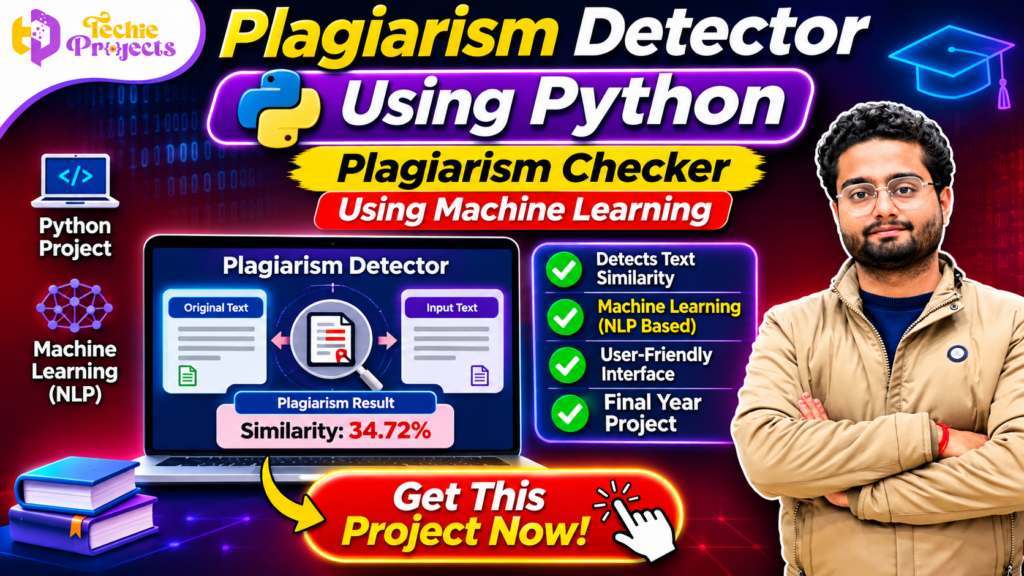
🎓 Looking for an impressive Python and Machine Learning project for your final-year submission? Get the Plagiarism Detector Using Python project from Techie Projects and explore how artificial intelligence and Natural Language Processing (NLP) can analyse text documents, identify similarities, and generate plagiarism-checking results.
This project is an excellent choice for B.Tech, BCA, MCA, M.Tech, and Computer Science Engineering students who want to demonstrate practical knowledge of Python programming, machine learning, text processing, and document similarity detection.
Instead of spending weeks developing every component independently, you can enquire about the available project package from Techie Projects. Get information about Python source code, project documentation, implementation guidance, and technical support to help you understand and demonstrate the application.
The Plagiarism Detector Using Python project demonstrates how two text documents can be processed and compared to identify matching or similar content. It is useful for exploring text similarity, NLP techniques, and machine learning concepts through a practical software application.
Whether you are preparing a final-year major project, a college demonstration, or a machine learning portfolio, this project offers an opportunity to learn how automated text analysis works.
📞 Contact Techie Projects for Project Enquiries
Want to purchase the Plagiarism Detector Using Python project? Contact Techie Projects to enquire about pricing, source code availability, documentation, and implementation support.
- 📲 WhatsApp: https://wa.me/919460060699
- ☎️ Contact Number: +91 94600 60699
- 🌐 Website: https://techieprojects.com/
- 📸 Instagram: https://www.instagram.com/pythonprojects_/
👉 Get This Project Now! Contact our team and discuss the available project package for your academic requirements.
🎬 Plagiarism Detector Using Python – Project Demo | Machine Learning Plagiarism Checker
The project demonstration explains the working of the Python-based plagiarism checker, including document input, text processing, similarity analysis, and the display of comparison results.
It provides an overview of how the application compares text content and identifies similarities between documents. Students can explore the interface, understand the project workflow, and learn how Python-based text analysis can be implemented.
🔍 What Is a Plagiarism Detector Using Python?
A plagiarism detector is a software application designed to compare text content and identify similarities between documents. It can help users examine whether two or more documents contain matching sentences, phrases, or passages.
The Plagiarism Detector Using Python project demonstrates this process using Python programming and text-processing techniques. The application accepts text or document inputs, processes the content, and compares the extracted text to calculate a similarity score.
For example, suppose a student has two documents containing paragraphs on the same topic. The application can analyse the text and identify overlapping content. The result helps users understand the degree of similarity between the documents.
Python provides several libraries that support text processing, Natural Language Processing, and similarity calculations. These tools make it possible to develop an application that compares documents through automated analysis.
The similarity score should not automatically be treated as proof of plagiarism. Common phrases, quotations, references, and legitimate shared terminology can also create matching content. Human review is necessary before drawing conclusions.
🎯 Objectives of the Plagiarism Detection Project
The primary objective is to develop a Python-based application that demonstrates automated document comparison and text similarity analysis.
The main objectives include:
- Develop a user-friendly plagiarism-checking application.
- Accept text or document inputs for comparison.
- Extract and preprocess text from the provided content.
- Identify matching words, phrases, and text patterns.
- Calculate similarity between documents.
- Display comparison results in an understandable format.
- Explore NLP and machine learning concepts.
- Help students understand practical Python application development.
This project gives students practical exposure to text analytics and automated content comparison.
⚙️ Key Features of Plagiarism Detector Using Python
The following features explain the important capabilities of this project.
1. 📄 Document and Text Input
The application allows users to provide content for plagiarism checking. Depending on the implementation, users can enter text directly or upload supported document formats.
2. 🔍 Text Similarity Detection
The system compares the provided text and identifies matching or similar content. This feature demonstrates how automated text comparison can help analyse document similarities.
3. 🤖 Machine Learning and NLP Techniques
Natural Language Processing techniques help convert text into a suitable representation for comparison. Machine learning and statistical approaches can also be explored to understand text similarity.
4. 📊 Similarity Percentage
The application can display a similarity score that represents the calculated similarity between compared documents.
The percentage depends on the selected algorithm and text representation. It should not be interpreted as a definitive plagiarism percentage or an independently verified measure of copied content.
5. 🖥️ User-Friendly Interface
A simple graphical or web-based interface helps users submit text, run comparisons, and understand the generated results without directly interacting with Python code.
6. ⚡ Automated Text Analysis
The application automates document comparison and reduces the need to manually inspect every sentence for matching content.
7. 📈 Comparison Results
The application presents the result of the text comparison in an understandable format. Depending on the implementation, it may display similarity scores and matching text information.
8. 🐍 Python-Based Development
Python provides the programming environment and libraries required for text extraction, preprocessing, similarity calculations, and application development.
🧠 Technologies Used in the Project
The Plagiarism Detector Using Python project combines programming, text processing, and similarity analysis.
🐍 Python
Python is the primary programming language used to develop the application. It provides a wide range of libraries for data processing, NLP, and machine learning.
📚 Natural Language Processing (NLP)
NLP techniques help computers process and analyse human language. Text cleaning, tokenisation, stop-word removal, and text representation can be used to prepare documents for comparison.
🔢 NumPy
NumPy supports numerical computations and array operations required by various data-processing tasks.
📊 Pandas
Pandas can be used to organise, manipulate, and analyse structured data where required by the implementation.
🤖 Scikit-learn
Scikit-learn provides tools for text feature extraction and similarity calculations. Techniques such as TF-IDF vectorisation and cosine similarity are commonly used in document comparison applications.
📝 NLTK
The Natural Language Toolkit can support text preprocessing operations such as tokenisation and stop-word handling.
🌐 Flask or Streamlit
A framework such as Flask or Streamlit can be used to create a user interface for document submission and result display, depending on the project implementation.
🔄 How Does the Plagiarism Detector Using Python Work?
The project follows a series of steps to process documents and calculate text similarity.
Step 1: Document Input
The user provides two or more text documents for comparison. The application accepts the supported input format.
Step 2: Text Extraction
If document files are provided, the application extracts their text content using suitable Python libraries. The extracted content is prepared for further analysis.
Step 3: Text Preprocessing
Text preprocessing removes unnecessary elements and standardises the content. Depending on the implementation, this may include:
- Converting text to lowercase.
- Removing unnecessary spaces.
- Removing selected punctuation.
- Tokenising sentences or words.
- Removing common stop words.
- Preparing text for feature extraction.
Preprocessing helps maintain consistency during comparison.
Step 4: Text Vectorisation
The processed text is converted into a numerical representation. One commonly used technique is Term Frequency-Inverse Document Frequency (TF-IDF).
TF-IDF represents the importance of terms within documents relative to the document collection.
Step 5: Similarity Calculation
After converting text into numerical vectors, the application can calculate similarity using cosine similarity.
Cosine similarity measures the angle between two vectors. It is commonly used to compare text documents represented through numerical features.
Step 6: Result Generation
The system calculates and displays a similarity score based on the selected comparison method.
Step 7: Result Interpretation
Users can review the comparison result and investigate matching content. A similarity score is an indicator for further examination, not a final academic or legal judgement of plagiarism.
📚 Understanding TF-IDF and Cosine Similarity
TF-IDF and cosine similarity are important concepts in many document comparison applications.
What Is TF-IDF?
TF-IDF stands for Term Frequency-Inverse Document Frequency. It measures how important a word is within a document compared with a collection of documents.
A term that appears frequently in one document but less frequently across other documents may receive a higher weight.
TF-IDF helps convert text into numerical vectors that can be used by similarity algorithms.
What Is Cosine Similarity?
Cosine similarity measures the similarity between two numerical vectors by calculating the cosine of the angle between them.
A higher cosine similarity generally indicates that two documents have more similar term distributions under the selected representation.
It is useful for identifying textual overlap, but it may not detect every form of plagiarism. For example, heavily paraphrased text can have low lexical similarity even when the underlying ideas are similar.
🚀 Why Choose a Plagiarism Detector Using Python for Your Academic Project?
Choosing a Plagiarism Detector Using Python project is a practical way to demonstrate your knowledge of Python programming, Natural Language Processing, and machine learning. It combines multiple computer science concepts in one application and provides an opportunity to understand how automated document comparison works.
A Plagiarism Detector Using Python can process text, extract important features, and calculate similarities between documents. Students can explore how TF-IDF and cosine similarity help identify overlapping content and understand the limitations of automated plagiarism checking.
For final-year engineering students, this project also provides valuable learning opportunities in software development, data preprocessing, algorithm implementation, and user interface design.
💡 How to Improve Your Plagiarism Detector Using Python Project
The basic application can be extended with additional features to make the Plagiarism Detector Using Python more useful as a learning project.
Some possible improvements include:
- Multiple Document Comparison: Compare several documents instead of only two files.
- Similarity Visualisation: Display comparison scores using charts or progress indicators.
- Highlighted Matching Text: Show matching sentences or passages to simplify result analysis.
- Document History: Maintain a record of previously analysed documents.
- Improved Text Processing: Explore advanced NLP techniques for better text representation.
- User-Friendly Dashboard: Organise document uploads and comparison results in an interactive interface.
These enhancements can help students understand the development possibilities of a Plagiarism Detector Using Python application and explore more advanced concepts in text analytics.
🎓 Get Your Plagiarism Detector Using Python Project from Techie Projects
Looking for a ready-to-explore academic project? Contact Techie Projects to enquire about the Plagiarism Detector Using Python package, including available source code, documentation, installation instructions, and technical support options.
Our team can help you understand the available deliverables and choose a suitable project package for your academic requirements.
🎓 Benefits of Plagiarism Detector Using Python for Final-Year Students
The Plagiarism Detector Using Python project provides students with an opportunity to explore several important areas of computer science.
1. Practical Python Programming
Students gain experience with Python programming, libraries, functions, and application development.
2. Understanding NLP Concepts
The project introduces text preprocessing, tokenisation, feature extraction, and similarity analysis.
3. Machine Learning Knowledge
Students can explore how numerical text representations and machine learning tools are used in automated text analysis.
4. Real-World Application Development
Document comparison is a practical problem that appears in education, content management, research, and information analysis.
5. Academic Project Demonstration
The application provides a practical topic for explaining software architecture, algorithms, input processing, and output generation.
6. Technical Presentation Skills
Students can explain the complete workflow, demonstrate the interface, and discuss the strengths and limitations of text similarity techniques.
7. Portfolio Development
A well-understood implementation can help students demonstrate Python and NLP knowledge in their academic or personal portfolios.
🏗️ Main Modules of the Project
The application can be organised into the following modules.
1. Input Module: Accepts text or supported document files.
2. Text Extraction Module: Extracts content from uploaded documents.
3. Preprocessing Module: Cleans and prepares text for comparison.
4. Feature Extraction Module: Converts text into numerical features using an appropriate technique.
5. Similarity Detection Module: Calculates similarity between document representations.
6. Result Module: Displays similarity scores and comparison information.
7. Interface Module: Provides an interactive environment for users.
The exact modules and technologies depend on the implementation included in the selected project package.
🌍 Applications of Plagiarism Detection Technology
Plagiarism detection and document similarity analysis have applications in several areas.
- Education: Helps students and educators examine similarities between academic documents.
- Research: Supports the review of overlapping text in research-related documents.
- Content Management: Helps content teams review similarities between written materials.
- Publishing: Supports editorial review workflows.
- Document Analysis: Demonstrates automated comparison of text-based documents.
- NLP Research: Provides an example of applying language-processing techniques to text analysis.
These applications require appropriate review procedures. A similarity score alone should not be used to accuse someone of plagiarism.
💻 Software and Hardware Requirements
The following are typical requirements for a Python-based document similarity project. Actual requirements may vary depending on the implementation.
Software Requirements
- Programming Language: Python
- Operating System: Windows 10 or Windows 11
- IDE: VS Code, PyCharm, or Jupyter Notebook
- Text Processing: NLTK or other suitable libraries
- Machine Learning: Scikit-learn
- Numerical Processing: NumPy
- Data Handling: Pandas, if required
- User Interface: Flask or Streamlit, if included
Hardware Requirements
- Processor: Intel or AMD processor
- RAM: 4 GB minimum; 8 GB recommended
- Hard Disk: Sufficient free storage for Python and project files
- Input Devices: Keyboard and mouse
- Display: Standard computer monitor
A dedicated GPU is generally not required for basic document similarity analysis.
🛒 Why Choose Techie Projects for Your Python Project?
Selecting the right project is an important step for final-year engineering and computer science students. A practical project should help students understand the implementation, explain the workflow, and demonstrate the concepts used.
Techie Projects provides academic project options in areas such as Python, Artificial Intelligence, Machine Learning, Deep Learning, Data Science, Computer Vision, IoT, and Web Development.
When you enquire about the Plagiarism Detector Using Python project, you can ask our team about the available package and its deliverables.
📦 What Can You Enquire About?
Depending on package availability, you can ask about:
- Python project source code.
- Required libraries and dependencies.
- Project documentation.
- Dataset or sample text files, where applicable.
- Installation and execution instructions.
- Implementation explanation.
- Technical support options.
- Project demonstration and workflow.
Please confirm the exact deliverables, compatibility, pricing, and support included before purchasing.
👨🎓 Who Can Purchase This Project?
This project may be suitable for:
- B.Tech Computer Science Engineering students.
- BCA students.
- MCA students.
- M.Tech students.
- Artificial Intelligence students.
- Machine Learning learners.
- Python programming learners.
- Students interested in NLP and text analytics.
Students should follow their institution’s academic policies and understand the project before presenting or submitting it.
🚀 Get This Project Now – Purchase from Techie Projects
Ready to explore the Plagiarism Detector Using Python project for your academic requirements?
Get in touch with Techie Projects and enquire about the available source code, documentation, pricing, and technical support.
👉 GET THIS PROJECT NOW!
📲 WhatsApp: https://wa.me/919460060699
☎️ Call: +91 94600 60699
🌐 Website: https://techieprojects.com/
📸 Instagram: https://www.instagram.com/pythonprojects_/
Contact Techie Projects today to discuss your requirements and find the right project package.
❓ Frequently Asked Questions (FAQs)
1. What is a Plagiarism Detector Using Python?
It is a Python-based application that compares text documents and identifies similarities using text-processing and similarity-detection techniques.
2. Which programming language is used in this project?
Python is used as the primary programming language. Libraries such as Scikit-learn, NumPy, and NLTK may support text processing and similarity analysis.
3. Which algorithms are used for plagiarism detection?
TF-IDF vectorisation and cosine similarity are common techniques for comparing text documents. Other NLP and machine learning methods can also be explored.
4. Is this project suitable for final-year students?
Yes. It can be a useful academic project for B.Tech, BCA, MCA, and other computer science students interested in Python, NLP, and machine learning.
5. Can this application detect copied text?
The application can identify textual similarities based on its implemented comparison methods. Its ability to detect copied or paraphrased content depends on the algorithm, document quality, and input data.
6. Does a high similarity score prove plagiarism?
No. A similarity score indicates overlapping text under a particular comparison method. Quotations, references, common phrases, and standard terminology can also create similarities. Human review is necessary.
7. Can I purchase the Python source code?
You can contact Techie Projects to enquire about source code availability, project documentation, and the deliverables included in the package.
8. How can I get this project?
Contact Techie Projects through WhatsApp at +91 94600 60699 or visit https://techieprojects.com/ to enquire about pricing and availability.
🔗 Explore Related Python Projects
Explore more academic project ideas and development resources from Techie Projects:
- Python Projects
- Artificial Intelligence Projects
- Machine Learning Projects
- Deep Learning Projects
- Natural Language Processing Projects
- Data Science Projects
- Web Development Projects
- Final Year Engineering Projects
Visit https://techieprojects.com/ to explore more projects.
🎯 Conclusion
The Plagiarism Detector Using Python project demonstrates how Python programming and text similarity techniques can be combined to analyse documents and identify overlapping content.
By exploring text preprocessing, TF-IDF, cosine similarity, NLP, and application development, students can gain practical knowledge of an important area of computer science.
If you are searching for a Python-based NLP or machine learning project for your final-year academic work, contact Techie Projects to enquire about the available project package, source code, documentation, pricing, and technical support.
🚀 Get your Plagiarism Detector Using Python project now!
📲 WhatsApp: +91-9460060699
🌐 Website: https://techieprojects.com/