
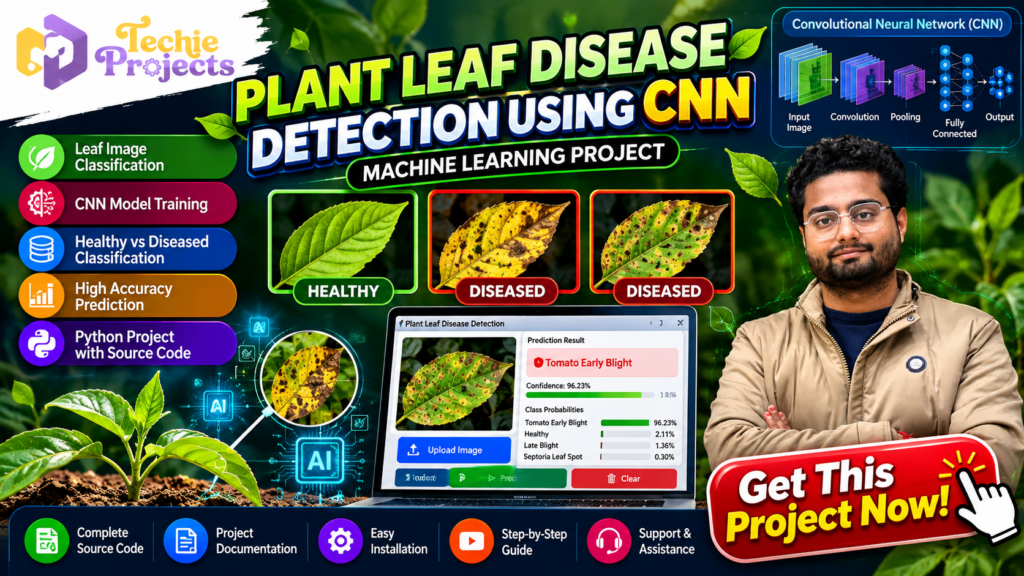
🌿 Looking for a complete Plant Leaf Disease Detection Using CNN project for your final-year submission? Get a practical machine learning project from Techie Projects with Python source code, project documentation, installation guidance, and technical assistance. This project demonstrates how Convolutional Neural Networks (CNN) can analyse plant leaf images and identify whether a leaf is healthy or affected by a disease.
Instead of starting from scratch, explore a ready-to-study project that helps you understand image processing, deep learning, model training, image classification, and prediction. Whether you are a B.Tech, BCA, MCA, M.Tech, or computer science student, this project can help you develop practical knowledge of artificial intelligence and machine learning.
Get the Plant Leaf Disease Detection Using CNN project from Techie Projects and take your college project development forward with source code and learning support.
📞 Contact Techie Projects for Project Enquiries
Interested in purchasing this project? Contact our team for project details, source code availability, documentation, and installation assistance.
- 📱 WhatsApp: Chat with Techie Projects
- ☎️ Contact Number: +91 94600 60699
- 🌐 Website: https://techieprojects.com/
- 📸 Instagram: https://www.instagram.com/pythonprojects_/
🎬 Plant Leaf Disease Detection Using CNN – Project Demo
🌱 What Is Plant Leaf Disease Detection Using CNN?
Plant Leaf Disease Detection Using CNN is a machine learning and image processing project that identifies plant diseases by analysing images of leaves. The system uses a Convolutional Neural Network to learn visual patterns from a collection of plant leaf images and classify them into different categories.
Plant leaves can show visible symptoms of diseases, including spots, discolouration, yellowing, lesions, and unusual textures. Manually identifying these symptoms can be challenging, especially when several diseases have similar visual characteristics.
This project explores how deep learning can assist with image-based plant disease classification. A user can provide a leaf image, and the trained model processes the image to predict its category.
The project can be developed using Python, TensorFlow or Keras, and image-processing libraries. It is particularly useful for students interested in artificial intelligence, computer vision, deep learning, and agricultural technology.
🎯 Main Objectives of the Project
The primary objective of Plant Leaf Disease Detection Using CNN is to demonstrate automated plant leaf image classification using deep learning.
The important objectives include:
- Develop a CNN-based image classification model.
- Identify visual differences between healthy and diseased leaves.
- Preprocess plant leaf images for model training.
- Train and evaluate a deep learning model.
- Predict the category of a newly uploaded leaf image.
- Display prediction results through a user interface.
- Understand how AI can support agricultural research.
- Explore practical applications of computer vision.
⭐ Key Features of Plant Leaf Disease Detection Using CNN
The project includes several features that demonstrate the practical use of deep learning and image processing.
1. 📷 Leaf Image Upload
Users can upload a plant leaf image through the application interface. The uploaded image is passed to the image-processing pipeline for preparation and classification.
2. 🧠 CNN-Based Image Classification
The Convolutional Neural Network learns important image characteristics such as edges, shapes, textures, and patterns. These features help the model distinguish between different leaf categories.
3. 🌿 Healthy and Diseased Leaf Classification
The system can classify images into the categories included in its training dataset. Depending on the dataset and model configuration, these may include healthy leaves and different disease classes.
4. ⚙️ Image Preprocessing
Before prediction, the uploaded image is prepared for the trained model. Common preprocessing operations include resizing, normalization, and converting images into the required numerical format.
5. 📊 Prediction Results
After processing the image, the application displays the predicted category. The interface may also display a confidence score or class probabilities when implemented in the model.
6. 💻 User-Friendly Interface
A graphical interface makes it easier to upload images and view prediction results without manually executing individual model functions.
7. 📁 Dataset-Based Training
The model learns from labelled plant leaf images. The dataset is divided into appropriate training, validation, and testing sets to support model development and evaluation.
🔬 How Does the Project Work?
Plant Leaf Disease Detection Using CNN follows a sequence of image-processing and machine-learning operations.
Step 1: Collect the Dataset
The first step is collecting plant leaf images. The dataset should contain images belonging to the different classes that the model needs to identify.
For example, it may include:
- Healthy leaves
- Early blight
- Late blight
- Leaf spot
- Other disease categories supported by the dataset
The quality, diversity, and labelling of the dataset directly influence model performance.
Step 2: Preprocess Images
Images may have different dimensions, resolutions, and lighting conditions. Therefore, preprocessing is performed to prepare them for model training.
Typical preprocessing operations include:
- Image resizing
- Pixel normalization
- Image format conversion
- Dataset labelling
- Data augmentation
Data augmentation techniques such as rotation, flipping, zooming, and shifting can help the model learn from varied image appearances.
Step 3: Build the CNN Architecture
A Convolutional Neural Network is designed to learn visual features from images.
A typical CNN architecture may contain:
- Convolutional layers: Extract visual features from input images.
- Activation functions: Introduce non-linearity into the network.
- Pooling layers: Reduce feature-map dimensions.
- Flatten layer: Convert feature maps into a vector.
- Dense layers: Learn relationships between extracted features.
- Output layer: Generate class predictions.
The architecture and number of layers depend on the dataset and implementation.
Step 4: Train the Model
During training, the CNN receives labelled images and learns to associate visual patterns with their corresponding classes.
The training process involves selecting an optimizer, loss function, batch size, and number of epochs. The model weights are updated to reduce classification errors.
Step 5: Evaluate Model Performance
After training, the model is evaluated using data that was not used for training.
Common evaluation measures include:
- Accuracy
- Precision
- Recall
- F1-score
- Confusion matrix
These measurements help assess the model’s classification performance. Actual results depend on the dataset, preprocessing, architecture, and training configuration.
Step 6: Predict New Images
Once the model is trained, a user can upload a new leaf image. The application preprocesses the image and passes it to the trained model.
The model returns a predicted class, which is displayed in the application interface.
🛠️ Technologies Used in the Project
The project can be developed using the following technologies:
| Technology | Purpose |
|---|---|
| Python | Main programming language |
| TensorFlow | Deep learning framework |
| Keras | CNN model development |
| NumPy | Numerical operations |
| OpenCV | Image processing |
| Matplotlib | Data visualisation |
| Scikit-learn | Model evaluation |
| Tkinter / Streamlit | User interface, depending on implementation |
The exact libraries and versions depend on the supplied project implementation.
💻 Software and Hardware Requirements
Software Requirements
- Operating System: Windows 10 or Windows 11
- Programming Language: Python
- Deep Learning Framework: TensorFlow / Keras
- Code Editor: Visual Studio Code or PyCharm
- Image Processing Library: OpenCV
- Required Python packages: As specified in the project requirements
Hardware Requirements
- Processor: Intel Core i3 or higher recommended
- RAM: 4 GB minimum; 8 GB or more recommended
- Storage: Sufficient space for the dataset, source code, and dependencies
- GPU: Optional; a compatible GPU can accelerate model training
Actual requirements depend on dataset size and model complexity.
📦 What Do You Get When You Purchase This Project?
At Techie Projects, the goal is to provide students with project resources that support development, understanding, and demonstration.
Depending on the selected package, the Plant Leaf Disease Detection Using CNN project can include:
1. Complete Python Source Code
Get the project source code to study the implementation, understand the workflow, and explore how the CNN model performs image classification.
2. Project Documentation
Documentation can help you understand the problem statement, objectives, methodology, system requirements, implementation, and results.
3. Installation Assistance
Get guidance for setting up the Python environment, installing required libraries, configuring dependencies, and running the application.
4. Code Explanation
Understand the major components of the project, including preprocessing, dataset handling, CNN architecture, model training, and prediction.
5. Technical Assistance
Get assistance with project-related technical questions and common installation or execution issues, according to the selected support package.
6. Project Demonstration
Use the project demonstration to understand the application’s workflow and prepare to explain its features during your academic presentation.
🎓 Why Choose This Project for Your Final Year?
Plant Leaf Disease Detection Using CNN is a useful project topic for students who want to explore practical applications of artificial intelligence.
For Computer Science Engineering Students: The project introduces CNN architecture, deep learning, image classification, and Python programming.
For Artificial Intelligence Students: It demonstrates how a neural network can learn image features and generate predictions.
For Data Science Students: It provides exposure to dataset preparation, data preprocessing, model evaluation, and performance analysis.
For Machine Learning Students: It offers practical experience with supervised learning and image classification.
For MCA and BCA Students: It provides an opportunity to understand how software applications can integrate machine learning models.
The project can also be extended with additional features, alternative CNN architectures, improved datasets, or a web-based interface.
🚀 Applications of Plant Leaf Disease Detection
Plant disease classification using computer vision has several potential applications.
1. Agricultural Research
Researchers can explore automated image classification methods to study plant health and disease patterns.
2. Smart Farming
Image-based disease detection can be integrated into experimental smart farming applications.
3. Educational Demonstrations
Students can use the project to demonstrate how artificial intelligence and computer vision can be applied to agriculture.
4. Plant Health Monitoring
A suitably developed application can help users organise and analyse plant leaf images over time.
5. AI-Based Agricultural Applications
The project provides a starting point for developing more advanced agricultural AI systems.
Important: This project is an educational image-classification application. Its predictions should not be treated as professional agricultural diagnosis or as a replacement for expert advice.
📈 Future Enhancements
Students can extend Plant Leaf Disease Detection Using CNN with additional functionality.
Possible improvements include:
- Support for more plant species.
- Addition of more disease categories.
- Mobile application integration.
- Web-based image classification.
- Real-time camera image input.
- Transfer learning using pretrained CNN models.
- Model performance comparison.
- Prediction history and result storage.
- Explainable AI visualisation.
- Integration with an agricultural advisory platform.
These enhancements can help students explore advanced concepts and make their project more comprehensive.
🛒 Get Plant Leaf Disease Detection Using CNN Project from Techie Projects
Are you ready to develop your final-year machine learning project?
Get the Plant Leaf Disease Detection Using CNN project from Techie Projects and explore a practical implementation of deep learning, Python programming, image processing, and plant disease classification.
Whether you need source code for learning, project documentation, installation guidance, or technical assistance, our team can help you understand the available project package.
🎯 Get This Project Now!
Techie Projects – Final Year Engineering Projects with Source Code
📲 Call/WhatsApp: +91-9460060699
🌎 Website: www.techieprojects.com
📺 Instagram: @pythonprojects_
Contact us to enquire about availability, package details, and project support.
❓ Frequently Asked Questions (FAQs)
1. What is Plant Leaf Disease Detection Using CNN?
Plant Leaf Disease Detection Using CNN is a machine learning project that uses a Convolutional Neural Network to classify plant leaf images into healthy or disease-related categories.
2. Which programming language is used in this project?
Python is commonly used because it provides libraries such as TensorFlow, Keras, NumPy, and OpenCV for deep learning and image processing.
3. Which deep learning model is used?
The project uses a Convolutional Neural Network (CNN) to learn image features and perform plant leaf classification.
4. Can I use this project for my final-year engineering project?
Yes. It is a suitable educational project topic for students in Computer Science, Artificial Intelligence, Data Science, and related branches. Students should understand, customise, and present their implementation according to their institution’s academic requirements.
5. Does the project include source code?
The available package can include Python source code. Contact Techie Projects to confirm the current package contents.
6. Can I run the project on Windows?
The project can be configured for a compatible Windows environment after installing the required Python version and dependencies.
7. Is a GPU required?
A GPU is not always necessary. A compatible CPU can run many inference tasks, although model training may take longer. GPU requirements depend on dataset size and architecture.
8. Can I add more plant diseases?
Yes. Additional disease categories can be supported by preparing appropriately labelled images, updating the dataset, and retraining or fine-tuning the model.
9. Is this project useful for learning machine learning?
Yes. It provides practical exposure to image preprocessing, CNN architecture, model training, classification, and evaluation.
10. How can I purchase the project?
You can contact Techie Projects through WhatsApp at +91 94600 60699 or visit techieprojects.com to enquire about the project package.
🔗 Explore Related Python and Machine Learning Projects
Explore more educational project ideas and implementations from Techie Projects:
- Machine Learning Projects
- Deep Learning Projects
- Computer Vision Projects
- Image Processing Projects
- Python Projects
- Artificial Intelligence Projects
- Data Science Projects
Visit Techie Projects to explore additional final-year engineering projects.
🏁 Conclusion
Plant Leaf Disease Detection Using CNN demonstrates how deep learning and computer vision can be applied to plant leaf image classification. By combining Python, image preprocessing, CNN architecture, and model evaluation, students can explore an interesting application of artificial intelligence in agriculture.
For students looking for a practical final-year project, this topic provides an opportunity to understand machine learning concepts through implementation. With source code, documentation, installation guidance, and technical assistance, Techie Projects can help you get started with your project development.
Get your Plant Leaf Disease Detection Using CNN project from Techie Projects today. Contact us to enquire about the source code and available project package.
📲 Call/WhatsApp: +91-9460060699
🌎 Website: www.techieprojects.com
📺 Instagram: @pythonprojects_